New to R. A. Torrey? Start with
Baptism with the Holy Spirit
All works · 25 hr 54 min read
Biography
- 1856 Born
- 1875 Converted
- 1889 Moody Institute
- 1928 Died
From that day on, every mouthful came directly from my Heavenly Father — not a meal on our tables, not a coat that went on my back, not a dress on my wife's back, nor the clothing on the backs of the four children, th…
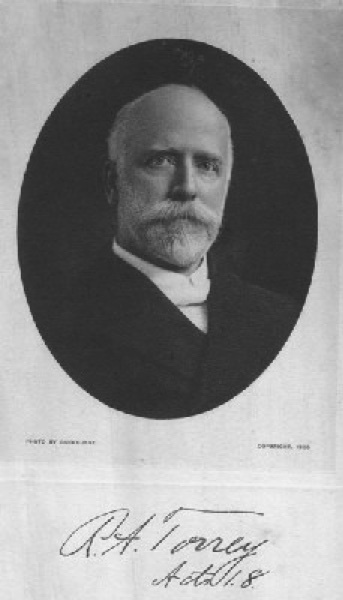
On a spring night in 1875, a Yale undergraduate sat alone in his room and decided to end his life. Reuben Archer Torrey was nineteen — born on 28 January 1856 into a wealthy Hoboken, New Jersey family — and by his own account thoroughly done with the faith he had been raised in. It was a faith with a face: his mother was a woman of deep and persistent prayer, who had asked God for years for her son's salvation and for his service, and who was not shy about reminding him what a life given to Christ might be. He had shrugged it off. He had come to New Haven at fifteen, and the years since had been given to the theatre, the racetrack, the card table, and a good deal of drink. He had also given them to argument: he was, he said later, "the leader of the new theology and destructive criticism wing of the seminary" — a young man who could dismantle a doctrine and enjoyed doing it.
What happened that night he told plainly, without embroidery. He had settled on suicide and had the means to hand. Instead he found himself praying — and in the dark of it remembering his mother, her faith, and the long years of her prayers for him. That memory became the turning point. In the praying he made a promise — that if God would deliver him, he would do whatever God asked. "I'll even preach!" he said, as though naming the last thing on earth he wanted to do. He rose from that prayer a different man, made his profession of faith publicly in the Yale chapel, and never went back on the bargain.
The apprenticeship of a doubter
Torrey took his degree and stayed on at the divinity school, finishing in 1878, and was ordained to the Congregational ministry the same year. He married Clara Smith in 1879 and went to a country pulpit in Garrettsville, Ohio. In 1882 he took his questions to their source, studying at Leipzig and Erlangen under Franz Delitzsch and Theodor Zahn — the very citadel of the higher criticism that had once been his stock-in-trade. He came home holding the opposite of what he had gone to confirm. Having examined the case against the Scriptures at first hand, he spent the rest of his life defending them, and he never lost the debater's habit of stating an argument fairly before answering it. Nor did he forget what honest doubt felt like from the inside. Having wrestled with unbelief to the edge of despair, he could speak to people caught in the same struggle without a trace of condescension — not as a man who had never doubted, but as one who had doubted and been answered.
Then came Minneapolis, and the making of the man. He pastored there and served as superintendent of the city's Congregational mission work, and in 1888 he did something that decided the shape of everything after: he gave up his salary in order to work among the poor, and threw his family's living entirely upon prayer. He had four children at the time.
From that day on, every mouthful came directly from my Heavenly Father — not a meal on our tables, not a coat that went on my back, not a dress on my wife's back, nor the clothing on the backs of the four children, that was not an answer to prayer.
— R. A. Torrey
Moody's man in Chicago
Years earlier, during an evangelistic campaign in New Haven, D. L. Moody had looked at the young Torrey and said, "Young man, you'd better get to work for God!" In 1889 Moody sent for him. Torrey was thirty-three when he became superintendent of the Chicago Evangelization Society — the school the world would come to know as the Moody Bible Institute — and he held the post until 1908. He built its curriculum around a simple conviction: that ordinary believers, grounded in Scripture and empowered by the Holy Spirit, could be trained for effective ministry. And, characteristically, he refused to let the school become an academy of talkers: students were sent out to street meetings, to hospitals, to jails, to the doors of the tenements. Book learning that produced no evangelists did not interest him. In 1894 he added the pastorate of the Chicago Avenue Church, now the Moody Church, and preached there for twelve years.
He was not an easy man to caricature. The scholar who had read Delitzsch in German ran a school for working people; the polished New Englander preached on Chicago street corners; the debater who could take an argument apart insisted that the church's real weakness was not intellectual at all.
Prayer is God's appointed way for obtaining things, and the great secret of all lack in our experience, in our life and in our work is neglect of prayer.
— R. A. Torrey, How to Pray
The Saturday-night room
In 1898 Torrey began a prayer meeting at the Institute on Saturday nights, from nine until ten. It was not a service and it was not advertised as an attraction; it was an hour of asking. As many as three hundred people came week after week, and what they asked for was a worldwide outpouring of the Spirit — not revival in Chicago merely, but revival in the earth.
Torrey prayed there for something else too, and more privately: that God would send him around the world preaching the gospel. He had no invitation, no committee, no money, and no reason to expect one. Within a week of laying that burden down in prayer, representatives of the churches of Australia — who knew nothing of it — wrote asking him to come.
Around the world
From 1902 to 1905, with the song leader Charles M. Alexander beside him, Torrey preached in Australia and New Zealand, in China and Japan and India, and through the British Isles. The scale is hard to take in at this distance. At Bingley Hall in Birmingham in January 1904, some seven thousand people professed conversion in thirty days. The London campaign of 1905 ran from February to June: two hundred and two meetings, an aggregate attendance of more than 1,114,000, and over seventeen thousand who professed faith. Across the whole tour the figure usually given is around one hundred and two thousand conversions.
Torrey distrusted the arithmetic even as he reported it. He had written before he left that revival is not manufactured, and he refused to let the meetings be described as his achievement. The Saturday-night room in Chicago, he maintained, had done the work; the platform merely collected it.
When we learn to come to God with an intensity of desire that wrings the soul, then shall we know a power in prayer that most of us do not know now.
— R. A. Torrey, How to Pray
Los Angeles, and the long finishing
He came home to America for good in December 1905 and spent the next six years in campaigns across the country. In 1908 he founded the Montrose Bible Conference in Pennsylvania, a place of summer teaching that outlived him. In 1912 he went west to become the first dean of the Bible Institute of Los Angeles, and from 1915 the first pastor of the Church of the Open Door — holding both until 1924, and shaping a generation of students, among them Charles E. Fuller.
The public years had their private griefs. He and Clara lost children, and the sorrow of it cut deep — those who knew the family said the losses left their mark on them both. But grief did not embitter him. It enlarged his compassion for the suffering, and it drove him harder upon the God he had trusted for the grocer's bill in Minneapolis. The man who stood before crowds of thousands kept the disciplines of a much smaller room: significant time every day in prayer and in the Bible, in the settled conviction that a preacher's effectiveness depended not on his platform but on his personal fellowship with God.
These were also the years of The Fundamentals, the twelve-volume series he helped edit, which gave a name to a movement he would have described more simply as believing what the Bible says. He wrote constantly — more than forty books, and for thirty years a Sunday-school commentary read across the country. How to Bring Men to Christ became a plain, practical handbook for ordinary believers who wanted to lead someone to faith, for he held that sharing the gospel was every Christian's work and not a specialist's. But the titles that lasted are the ones about prayer and about the Holy Spirit, because those were the subjects on which he was not merely instructing others.
The Spirit and the ordinary Christian
Of everything Torrey taught, the doctrine he pressed hardest was that the Holy Spirit is a Person to be known and not a force to be used. He wrote about it at length and returned to it in every campaign: that the Spirit convicts, regenerates, indwells, and — this was the emphasis his contemporaries argued about — that there is an enduement of power for service which the believer may and should definitely seek and definitely receive. He was careful about what he was not saying. It was not a second salvation, and it was not a badge of superior sanctity. It was equipment for work, offered to ordinary Christians, and in his view the reason so many of them laboured without visible fruit was simply that they had never asked for it — that they lived defeated because they leaned on their own strength instead of trusting the power of God.
He argued the point the way he argued everything, by piling up texts and daring the reader to check them. But the force of it came from somewhere else. A man who had renounced his salary and watched the meals arrive, who had asked to be sent around the world and been sent, was not speculating about the availability of God. He was reporting.
He resigned his Los Angeles posts in 1924 to return to evangelism, still travelling, still preaching, and lectured again at Moody in 1927. He died at his home in Asheville, North Carolina, on 26 October 1928, at seventy-two, and was buried on the grounds of the Montrose conference he had founded. Will Houghton, who knew him, put the epitaph better than any summary of the campaigns could: those who knew Dr. Torrey more intimately, he said, knew him as a man of regular and uninterrupted prayer.
It is worth remembering how the whole of it began — not in a pulpit or a lecture hall, but in a room at Yale where a young agnostic who had decided to die remembered his mother's prayers and found himself praying instead, and promised God he would go wherever he was sent. He was sent a very long way.
Books by R. A. Torrey (7)


Sermons by R. A. Torrey (14)
Books about R. A. Torrey (1)
Also appears in
Articles about R. A. Torrey (7)
Questions and Answers
What kind of home and schooling did R. A. Torrey come from?
Reuben Archer Torrey was born on 28 January 1856 into a wealthy family in Hoboken, New Jersey, and came to Yale at fifteen. He took his undergraduate degree there in 1875 and stayed on at the divinity school, so his early life joined real privilege to a first-rate education. Behind it all was his mother, a woman of persistent prayer who asked God for years for her son's salvation and his service.
Was Torrey ever a skeptic, and how did his conversion actually happen?
He was thoroughly a skeptic: he had given his Yale years to the theatre, the racetrack and a good deal of drink, and called himself the leader of the seminary's destructive-criticism wing, a young man who enjoyed taking a doctrine apart. His doubt ran to the edge of despair, and on a spring night in 1875 the nineteen-year-old sat alone in his room resolved to end his life, with the means to hand. Instead he found himself praying, remembering his mother's long years of prayer for him, and promised that if God delivered him he would do whatever he was asked — "I'll even preach!" He rose a changed man, professed his faith publicly in the Yale chapel, and never went back on the bargain.
Why did he go to study in Germany, and did he keep defending the Bible afterward?
In 1882 Torrey took his questions to their source, studying at Leipzig and Erlangen under scholars such as Franz Delitzsch and Theodor Zahn — the very citadel of the higher criticism that had once been his stock-in-trade. He came home holding the opposite of what he had gone to confirm, and spent the rest of his life defending the Scriptures he had examined at first hand. He was later among the editors of The Fundamentals, the twelve-volume series that gave a name to a movement he would have described more plainly as believing what the Bible says.
What was his connection with D. L. Moody?
During an earlier campaign in New Haven, Moody had told the young Torrey, "Young man, you'd better get to work for God!" In 1889 Moody sent for him, and at thirty-three Torrey became superintendent of the Chicago school the world would come to know as the Moody Bible Institute, a post he held until 1908. In 1894 he also took the pastorate of the Chicago Avenue Church — now the Moody Church — and preached there for twelve years.
What did his worldwide evangelistic tours look like?
From 1902 to 1905, with the song leader Charles M. Alexander beside him, Torrey preached in Australia and New Zealand, in China, Japan and India, and across the British Isles. At Bingley Hall in Birmingham some seven thousand people professed conversion in a single month, and the London campaign of 1905 ran from February to June with more than a million in aggregate attendance. He distrusted the arithmetic even as he reported it, and refused to let the meetings be described as his own achievement.
Why is prayer so central to how Torrey is remembered?
In Minneapolis in 1888 he gave up his salary to work among the poor and threw his family's living entirely upon prayer, later saying that not a meal or a coat came to them that was not an answer to prayer. From 1898 he led a Saturday-night prayer meeting at the Institute where as many as three hundred people asked, week after week, for a worldwide outpouring of the Spirit. He also prayed privately to be sent around the world preaching — and within a week, unsolicited, an invitation arrived from the churches of Australia.
What did Torrey teach about the Holy Spirit?
He pressed harder on this than on any other subject: that the Holy Spirit is a Person to be known, not a force to be used, and that there is an enduement of power for service which the believer may and should definitely seek and receive. He was careful to say it was not a second salvation nor a badge of superior holiness, only equipment for work offered to ordinary Christians. In his view many laboured without visible fruit simply because they had never asked for that power.
What did he do in Los Angeles?
In 1912 Torrey went west to become the first dean of the Bible Institute of Los Angeles, and from 1915 the first pastor of its Church of the Open Door, holding both posts until 1924. There he shaped a further generation of students, among them Charles E. Fuller. He had also founded the Montrose Bible Conference in Pennsylvania in 1908, a summer teaching work that outlived him.
Which of his many books are best known?
Torrey wrote more than forty books and, for thirty years, a widely read Sunday-school commentary. His practical handbooks endure — What the Bible Teaches, How to Study the Bible, and How to Bring Men to Christ — but the titles that lasted longest are those on prayer and the Spirit, such as How to Pray, The Power of Prayer and the Prayer of Power, and The Person and Work of the Holy Spirit. On those subjects, it was said, he was not merely instructing others but reporting what he had proved.
When and where did Torrey die, and how is he remembered?
He resigned his Los Angeles posts in 1924 to return to evangelism, still travelling and preaching, and lectured again at Moody in 1927. He died at his home in Asheville, North Carolina, on 26 October 1928, aged seventy-two, and was buried on the grounds of the Montrose conference he had founded. Those who knew him best remembered not the vast crowds but the man of regular, uninterrupted prayer behind them.