Book
The Life of Antony
The Life That Began Christian Monasticism
Other titles: Vita Antonii · Βίος Ἀντωνίου · The Life of Saint Antony · The Life of St. Anthony
Athanasius of Alexandria · 296–373
- 45 chapters
- 2 hr read
- Moderate Reading difficulty
Free to read·No account needed
Preface
Taking books where there’s no signal? See Ochorus for missionaries or chaplains
Grow with the story

Reader’s guide
About this book
Athanasius knew Antony personally and wrote his life shortly after the old hermit died. It follows a young Egyptian who hears the gospel read in church, sells everything, and walks into the desert to pray, and whose example emptied the towns into the wilderness behind him. Read across the empire within a generation, it carried the monastic ideal into the Latin West and was one of the books that turned Augustine around.
1. Antony you must know was by descent an Egyptian: his parents were of good family and possessed considerable wealth, and as they were Christians he also was reared in the same Faith. In infancy he was brought up with his parents, knowing nought else but them and his home.
Contents
- 1 Preface 2 min
- 2 Birth and beginnings of Antony 2 min
- 3 His early ascetic life 3 min
- 4 Early conflicts with the devil 4 min
- 5 Details of his life at this time (271-285?) 3 min
- 6 His life in the tombs, and combats with demons there 4 min
- 7 He goes to the desert and overcomes temptations on the way 1 min
- 8 How Antony took up his abode in a ruined fort across the Nile, and how he defeated the demons. His twenty years sojourn there 3 min
- 9 How he left the fort, and how monasticism began to flourish in Egypt. Antony its leader 2 min
- 10 His address to monks, rendered from Coptic, exhorting them to perseverance, and encouraging them against the wiles of Satan 36 min
- 11 The growth of the monastic life at this time (about A.D. 305) 1 min
- 12 How Antony renewed his ascetic endeavours at this time 2 min
- 13 How he sought martyrdom at Alexandria during the Persecution (311) 2 min
- 14 How he lived at this time 1 min
- 15 How he delivered a woman from an evil spirit 1 min
- 16 How at this time he betook himself to his inner mountain 3 min
- 17 How he there combated the demons 2 min
- 18 Of the miraculous spring, and how he edified the monks of the outer mountain, and of Antony's sister 2 min
- 19 How humanely he counselled those who resorted to him 4 min
- 20 Of the case of Fronto, healed by faith and prayer 1 min
- 21 Of a certain virgin, and of Paphnutius the confessor 1 min
- 22 Of the two brethren, and how one perished of thirst 1 min
- 23 Of the death of Amun, and Antony's vision thereof 2 min
- 24 Of Count Archelaus and the virgin Polycration 1 min
- 25 Strange tales of the casting out of demons 2 min
- 26 Of Antony's vision concerning the forgiveness of his sins 2 min
- 27 Of the passage of souls, and how some were hindered of Satan 2 min
- 28 How Antony reverenced all ordained persons 2 min
- 29 How he rejected the schism of Meletius and the heresies of Manes and Arius 1 min
- 30 How he confuted the Arians 1 min
- 31 How he visited Alexandria, and healed and converted many, and how Athanasius escorted him from the city 1 min
- 32 How he reasoned with divers Greeks and philosophers at the outer mountain 8 min
- 33 How he confuted the philosophers by healing certain vexed with demons 1 min
- 34 How the Emperors wrote to Antony, and of his answer 1 min
- 35 How he saw in a vision the present doings of the Arians 3 min
- 36 That his healings were done by Christ alone, through prayer 2 min
- 37 How wisely he answered a certain duke 1 min
- 38 Of the Duke Balacius, and how, warned by Antony, he met with a miserable end 1 min
- 39 How he bore the infirmities of the weak, and of his great benefits to all Egypt 1 min
- 40 Of his discernment, and how he was a counsellor to all 1 min
- 41 How, when now 105 years old, he counselled the monks, and gave advice concerning burial 3 min
- 42 Of his sickness and his last will 2 min
- 43 Of Antony's death 1 min
- 44 How Antony remained hale until his death, and how the fame of him filled all the world 2 min
- 45 The end 1 min
Questions and Answers
What is The Life of Antony about?
It is Athanasius's biography of Antony of Egypt, the young man who heard the gospel read in church, sold everything, and walked into the desert to pray — becoming the most famous of the early Christian hermits. It follows his long life of solitude, spiritual struggle, and holiness, and it became the founding classic of Christian monasticism and one of the most influential books of the early church.
Who was Antony of Egypt?
Antony was a wealthy young Egyptian of the third and fourth centuries who, hearing Christ's call to sell all and follow him, gave away his possessions and withdrew into the desert to a life of prayer and self-denial. He lived to a great age, drew many others to imitate him, and became known as the father of Christian monasticism.
Who wrote it, and did he know Antony?
Athanasius, the bishop of Alexandria and the great defender of Christ's deity, wrote it shortly after Antony's death. He knew Antony personally, and wrote as one who had seen the man and his influence firsthand, which gives the biography unusual authority and warmth — it is the portrait of a saint by one of the church's greatest theologians.
Why is this book so historically important?
Because it launched the whole tradition of Christian monasticism and shaped ideals of holiness for centuries. Widely read and translated, it drew countless people to the monastic life; famously, it was partly through hearing of Antony's example that Augustine was moved toward his own conversion. Few early Christian books have had so wide an influence.
What are the famous 'temptations' of Antony?
The book vividly describes Antony's spiritual battles in the desert against temptation and the forces of evil — struggles that later inspired much Christian art. Athanasius presents these not as mere legend but as the real warfare of a soul seeking God, and as evidence that Christ gives victory to those who resist evil through faith and prayer.
What does the book teach about the Christian life?
That the gospel call to leave all and follow Christ is to be taken seriously, and that a life of prayer, self-denial, and dependence on God brings real holiness and peace. Through Antony's example, Athanasius holds up wholehearted devotion, victory over temptation, and the reality of Christ's power in the believer's struggle.
Do you have to admire monasticism to appreciate it?
No — while it is the founding text of monasticism, its deeper appeal is to anyone drawn to wholehearted devotion and the reality of the spiritual life. Readers of every tradition have valued it as a portrait of a man who took Christ's call utterly seriously, and as a window onto the faith and struggles of the early church.
Where should a reader begin?
At the beginning, with Antony's call and withdrawal to the desert, and on through his life of struggle and holiness. It is a short, continuous biography meant to be read straight through, and read that way it conveys both the drama of Antony's spiritual battles and the steady devotion that made him a pattern for centuries.
Read in your language
About the author
Athanasius of Alexandria
The Life of Antony · 360
More like this
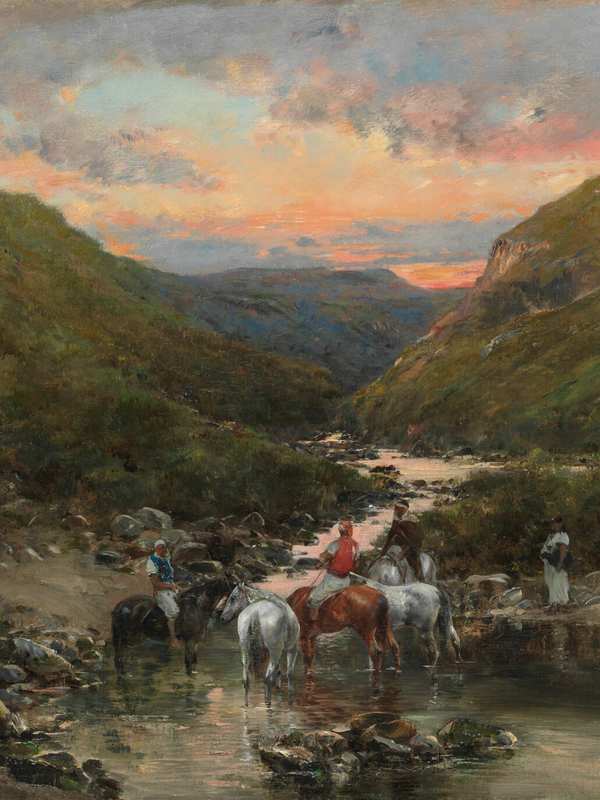
Victor Pierre Huguet, “Ravine Near Biskra” (c. 1895). The Art Institute of Chicago, CC0.
Cite this book
Copy a citation in the style you need.
- MLA
- Athanasius of Alexandria. The Life of Antony. 360. Ochorus, https://ochorus.com/books/life-of-antony/.
- Chicago
- Athanasius of Alexandria. The Life of Antony. 360. Reprint, Ochorus. https://ochorus.com/books/life-of-antony/.
- Chicago footnote
- Athanasius of Alexandria, The Life of Antony (360; repr., Ochorus), https://ochorus.com/books/life-of-antony/.
- BibTeX
- @book{athanasiusofalexandria360life, author = {Athanasius of Alexandria}, title = {{The Life of Antony}}, year = {360}, publisher = {Ochorus}, url = {https://ochorus.com/books/life-of-antony/} }