- 11 chapters
- 2 hr 52 min read
- Moderate Reading difficulty
Free to read·No account needed
The Handbook: Faith, Hope, and Love
Taking books where there’s no signal? See Ochorus for missionaries or chaplains
About this book
Augustine’s compact handbook of the Christian faith, written for a friend who asked for the essentials in brief. He answers by the three theological virtues — faith in the Creed, hope in the Lord’s Prayer, and the love that is the end of all the commandments — with his searching treatment of evil as the mere absence of good, of grace, and of the resurrection along the way.
I Cannot express, my beloved son Laurentius, the delight with which I witness your progress in knowledge, and the earnest desire I have that you should be a wise man: not one of those of whom it is said, “Where is the wise? where is the scribe? where is the disputer of this world?
Contents
- 1 The Handbook: Faith, Hope, and Love 10 min
- 2 Good, Evil, and Error 28 min
- 3 The Fall and the Grace of God 13 min
- 4 Christ the Mediator 15 min
- 5 Baptism and the Forgiveness of Sins 15 min
- 6 The Holy Spirit, the Church, and Pardon 15 min
- 7 Faith, Works, and Repentance 26 min
- 8 The Resurrection and the Judgment 13 min
- 9 The Will of God and the Two Kingdoms 27 min
- 10 Hope: The Lord’s Prayer 3 min
- 11 Love: The End of the Commandments 8 min
Questions and Answers
What is The Enchiridion by Augustine about?
It is Augustine's compact handbook of the Christian faith, written for a friend named Laurentius who had asked for the essentials in brief. Augustine answers by way of the three theological virtues — faith, hope, and love — expounding the faith through the Creed, hope through the Lord's Prayer, and love as the end to which both are directed. The result is a short summary of Christian belief from the church's greatest Latin teacher.
What does the word 'Enchiridion' mean?
It means a handbook or manual — literally something held in the hand. Augustine wrote it as a brief, portable statement of the faith for a reader who wanted the heart of Christian doctrine without a long treatise, and the title signals exactly that: a compact guide to be kept close and consulted.
How does Augustine structure the book?
Around faith, hope, and love. He treats what a Christian is to believe by expounding the Apostles' Creed, what a Christian is to hope for and pray by expounding the Lord's Prayer, and unites the whole under love, which he calls the greatest of the three and the goal of the commandment. It is a deliberately simple framework for the whole of the faith.
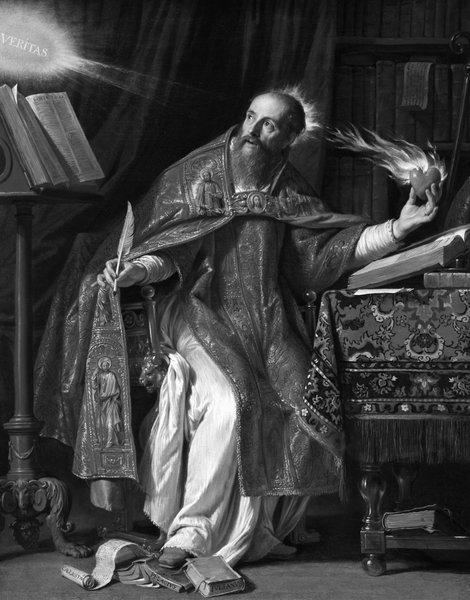
Who was Augustine of Hippo?
A bishop in North Africa in the late fourth and early fifth centuries, and the most influential theologian of the Western church — author of the Confessions and The City of God. Converted after a long and restless search, he became the great teacher of grace, and the Enchiridion distills his mature thought into a brief compass.
What does the Enchiridion teach about evil?
Augustine gives his well-known account that evil is not a substance or thing in its own right but a privation — a corruption or absence of the good. Whatever exists is good insofar as it exists; evil is the wounding or loss of that good. God brings good even out of evil, and Augustine uses this to uphold both God's goodness and his sovereignty over a fallen world.
What place does grace have in the book?
A central one. As always in Augustine, salvation is the work of God's grace and not of human merit — faith itself is God's gift, and the love that fulfils the law is poured into the heart by the Holy Spirit. The Enchiridion carries his lifelong conviction that we are saved by grace through faith, working by love, all of it God's doing.
Who is this book for?
For any Christian who wants the essentials of the faith set out briefly and authoritatively — much as Laurentius did when he first asked for it. It has served for centuries as a concise doctrinal summary, valued precisely because so great a mind chose to be so short, and it rewards both the beginner and the well-read.
Where should a reader begin?
At the beginning, following Augustine's own order: the faith of the Creed, the hope of the Lord's Prayer, and the love that crowns them. Because it is brief and deliberately ordered as a summary, it can be read straight through, giving the reader a compact map of the whole Christian faith from one of its greatest teachers.
Read in your language
More like this





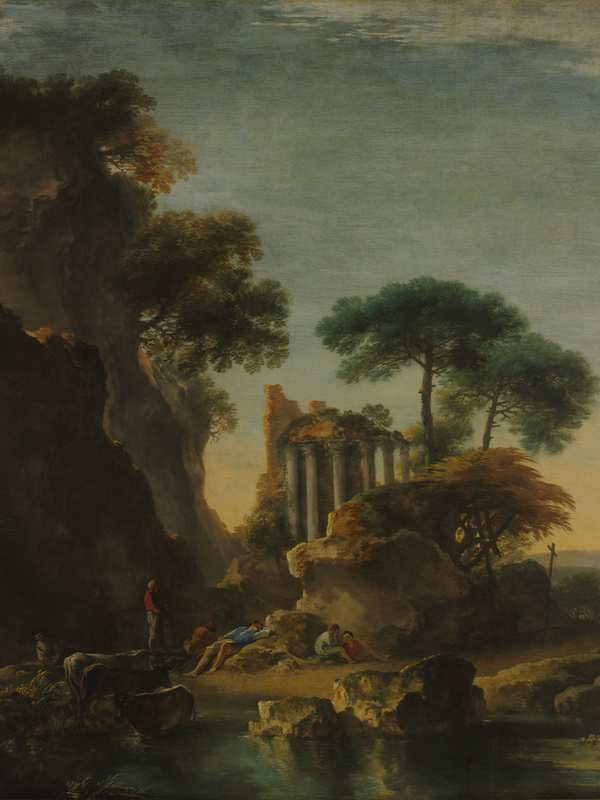
Salvator Rosa, “Ruins in a Rocky Landscape” (c. 1640). The Cleveland Museum of Art, CC0.
Cite this book
Copy a citation in the style you need.
- MLA
- Augustine of Hippo. The Enchiridion. 420. Ochorus, https://ochorus.com/books/enchiridion/.
- Chicago
- Augustine of Hippo. The Enchiridion. 420. Reprint, Ochorus. https://ochorus.com/books/enchiridion/.
- Chicago footnote
- Augustine of Hippo, The Enchiridion (420; repr., Ochorus), https://ochorus.com/books/enchiridion/.
- BibTeX
- @book{augustineofhippo420enchiridion, author = {Augustine of Hippo}, title = {{The Enchiridion}}, year = {420}, publisher = {Ochorus}, url = {https://ochorus.com/books/enchiridion/} }