Book
Portraits of Courage – Pandita Ramabai
A Scholar of the Scriptures, the Widows of India, and a Treasure That Never Failed
Book 6 of 11 in Portraits of Courage·Next in the series: Portraits of Courage – C. S. Lewis
- 29 chapters
- 3 hr 32 min read
- Moderate Reading difficulty
Free to read·No account needed
Preface
Taking books where there’s no signal? See Ochorus for missionaries or chaplains
Grow with the story


About this book
A Christian biography of Pandita Ramabai (1858–1922), the Sanskrit scholar orphaned by famine who became a widow at twenty-three, a pioneer of women's rights in India, a Christian, and the founder of Mukti, where thousands of famine girls, child-widows and outcast women found a home. Built on her own writings and checked against the early lives and modern scholarship, it tells the whole story — the reformer and the saint, the 1893 storm with the Hindu reformers, her anger at British injustice, the 1905 revival and her Marathi Bible. All Scripture from the public-domain ASV (1901).
“When my father and my mother forsake me, Then Jehovah will take me up.” — Psalm 27:10, ASV In January 1897 Ramabai sat down in Poona to thank the friends who had helped her and to describe her first journey into the famine districts of Central India. Before she described their sufferings, she described her
Contents
- 1 Preface 5 min
- 2 Introduction: The Pandita and Her Biographers 7 min
- 3 The Forest School 10 min
- 4 Pilgrims 7 min
- 5 The Famine 9 min
- 6 Four Thousand Miles 7 min
- 7 Pandita 8 min
- 8 Nineteen Months 8 min
- 9 “Open Thy Mouth for the Dumb” 8 min
- 10 As Abraham 8 min
- 11 The Religion Without Christ 8 min
- 12 The High-Caste Hindu Woman 7 min
- 13 Sharada Sadan 8 min
- 14 The Storm of 1893 9 min
- 15 “I Had Not Found Christ” 8 min
- 16 Remember the Days of Old 9 min
- 17 “My Great Sin” 7 min
- 18 Prove Me Now 7 min
- 19 The Sweeper 7 min
- 20 “Ramabai Is Dead” 8 min
- 21 Fire 8 min
- 22 A Famine of the Word 7 min
- 23 Manorama 6 min
- 24 Having Nothing 6 min
- 25 No Caste, No Sex 6 min
- 26 Appendix A: Lessons from the Life of Pandita Ramabai 5 min
- 27 Appendix B: Chapter-by-Chapter Study and Reflection Guide 7 min
- 28 Appendix C: Chronology of the Life and Times of Pandita Ramabai 5 min
- 29 Appendix D: Notes on Sources and Method 7 min
Questions and Answers
What is this biography of Pandita Ramabai about?
It is a Christian biography of Pandita Ramabai (1858–1922). It follows her from her birth in a forest in the Western Ghats and her childhood as a pilgrim, through the famine that killed her family, her honours as a Sanskrit scholar in Calcutta, her marriage and widowhood, England and America, her school for widows in Bombay and Poona, the famine rescues of 1896–1900, the founding of Mukti at Kedgaon, the 1905 revival, and her translation of the Bible into Marathi. It draws mainly on her own writings.
Who was Pandita Ramabai?
She was a Brahman woman, taught Sanskrit by her parents, who was acclaimed by the pandits of Calcutta in 1878 and became one of the first Indian women to campaign publicly for women's education and the rights of widows. She became a Christian in England in 1883, founded the Sharada Sadan school for widows in 1889 and the Mukti Mission at Kedgaon in 1897, rescued thousands of girls from famine, and translated the Bible into everyday Marathi.
Why does she say she found Christ eight years after her baptism?
In her 1907 Testimony she wrote that at her baptism in 1883 she had found 'the Christian religion' but 'had not found Christ, who is the Life of the religion.' About 1891, after reading the Bible itself rather than books about it, she came to an end of herself and surrendered to Christ, and found salvation as a free gift. The book takes that distinction seriously.
What happened in the Sharada Sadan crisis of 1893?
Her school for widows had been promised as religiously neutral. When girls began attending her private prayers and some declared faith in Christ, the Hindu reformers on its advisory board, including M. G. Ranade and R. G. Bhandarkar, resigned, and thirty-one pupils were withdrawn. The book gives both sides: the reformers' reasonable sense of a broken understanding, and Ramabai's refusal to shut the open door of her own room.
Was the Mukti revival of 1905 the start of Pentecostalism?
The revival at Mukti began in June 1905, before the Azusa Street meetings of 1906, and it influenced Pentecostal movements elsewhere, including in Chile. But speaking in tongues at Mukti came later, in December 1906, after news of Azusa Street arrived. Ramabai herself taught that love, not tongues, was the one necessary sign of the Holy Spirit.
Was she the first woman to translate the Bible?
No. Julia Smith had published a translation of the whole Bible into English in 1876, and Marathi Bibles existed before Ramabai's. Hers was the first translation of the Bible into colloquial Marathi, made for village women, and she was among the first women anywhere to translate the whole of Scripture from the original languages. The complete edition was published after her death.
How is Scripture used in the book?
Each chapter opens with a passage from the American Standard Version (1901) that carries its theme, from 'A father of the fatherless, and a judge of the widows' to 'there can be no male and female; for ye all are one man in Christ Jesus', and further passages are woven through the story, including verses Ramabai herself quoted. Every quotation was checked against the ASV text.
Where should a reader begin?
At the beginning. The preface and introduction explain the sources and the three ways Ramabai has been remembered — as reformer, saint, and missionary; the chapters then follow her life in order. Appendix A gathers lessons from her life, Appendix B is a study guide for groups, Appendix C a chronology, and Appendix D a note on sources and on popular claims the book corrects.
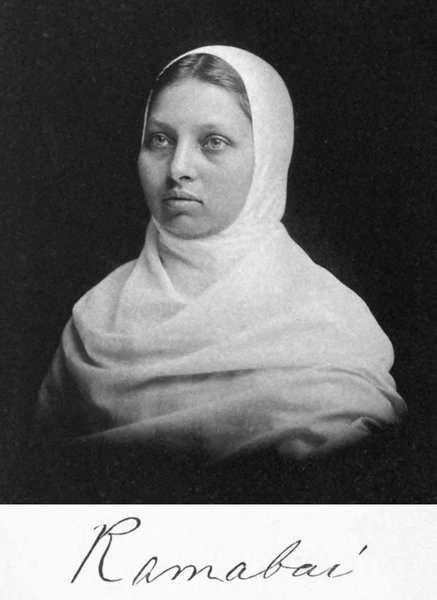
People in this book
More like this
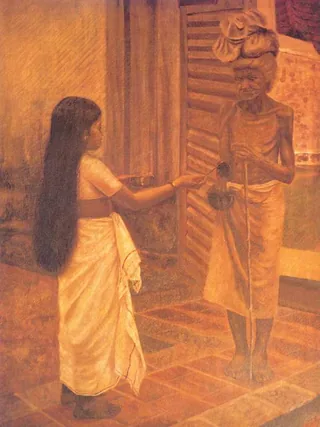
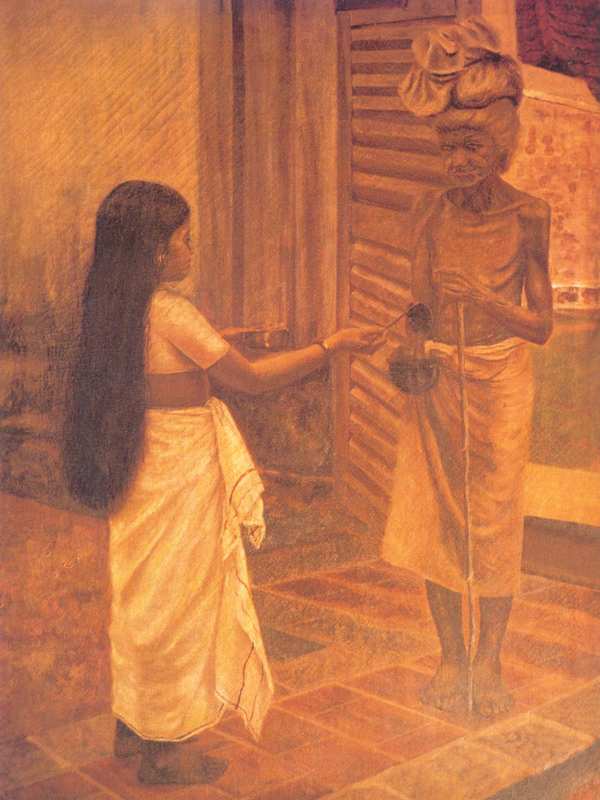
Raja Ravi Varma, “Charity” (). Wikimedia Commons, public domain.
Cite this book
Copy a citation in the style you need.
- MLA
- Ochorus Originals. Portraits of Courage – Pandita Ramabai. 2026. Ochorus, https://ochorus.com/books/pandita-ramabai-a-life/.
- Chicago
- Ochorus Originals. Portraits of Courage – Pandita Ramabai. 2026. Reprint, Ochorus. https://ochorus.com/books/pandita-ramabai-a-life/.
- Chicago footnote
- Ochorus Originals, Portraits of Courage – Pandita Ramabai (2026; repr., Ochorus), https://ochorus.com/books/pandita-ramabai-a-life/.
- BibTeX
- @book{ochorusoriginals2026portraits, author = {{Ochorus Originals}}, title = {{Portraits of Courage – Pandita Ramabai}}, year = {2026}, publisher = {Ochorus}, url = {https://ochorus.com/books/pandita-ramabai-a-life/} }