
Book
The Life and Diary of David Brainerd
Edited by Jonathan Edwards
Other titles: The Diary of David Brainerd · An Account of the Life of the Late Reverend Mr. David Brainerd
David Brainerd · 1718–1747
- 12 chapters
- 9 hr 8 min read
- Advanced Reading difficulty
Free to read·No account needed
From President Edwards’ Preface
Taking books where there’s no signal? See Ochorus for missionaries or chaplains
Grow with the story

Reader’s guide
About this book
The life and diary of David Brainerd, the young missionary to the American Indians in the 1740s, prepared for publication by Jonathan Edwards. Its pages trace his conversion, his labours and hardships in the wilderness, and above all his extraordinary life of prayer and longing after God. It has stirred generations of readers to deeper devotion and missionary sacrifice.
April 20, 1718-Feb. 1741. David Brainerd was born April 20, 1718, at Haddam, Connecticut. His father was Hezekiah Brainerd, Esq. and his mother, Dorothy Hobart, daughter of the Rev. Jeremiah Hobart. He was the third son of his parents, who had five sons and four daughters. The oldest son was a respectable citizen of Haddam; the second was
Contents
- 1 From President Edwards’ Preface 6 min
- 2 From his birth to the time when he began to study for the Ministry—containing his own narrative of his conversion, his connection with Yale-College, and the grounds of his expulsion 37 min
- 3 From about the time when he began the study of Theology, till he was licensed to preach 20 min
- 4 From his being licensed to preach, till he was commissioned as a Missionary 12 min
- 5 From his appointment as a Missionary, to his commencing his Mission among the Indians at Kaunaumeek, in New-York 13 min
- 6 His labors for nearly a year among the Indians at Kaunaumeek—temporal deprivations and sufferings—establishes a school—confession offered to the faculty of Yale College—days of fasting—methods of instructing the Indians—visit to New-Jersey and Connecticut—commencement of labor among the Indians at t 53 min
- 7 Labors for the Indians at and near the Forks of Delaware—idolatrous feast and dance—journey through the wilderness to Opeholhaupung or the Susquehanna—erects a cottage at Forks of the Delaware—some evidences of a work of the Spirit among the Indians—journey to New-England to obtain money to support 57 min
- 8 Being part 1st of his public journal of the Rise and Progress of a remarkable work of grace among the Indians in New-Jersey and Pennsylvania, kept by order of the Society in Scotland for propagating Christian knowledge.—Commencement of his labors at Crossweeksung.—Renewal of labor at the Forks of De 95 min
- 9 Being part 2d of his public journal of the Continuance and Progress of a remarkable work of grace among the Indians in New-Jersey and Pennsylvania kept by order of the Society in Scotland for propagating Christian knowledge.—Renewal of labor at Crossweeksung—outpouring of the spirit—remarkable case— 101 min
- 10 General Remarks on the Preceding Narrative 26 min
- 11 From the close of his Public Journal, June 19, 1746, to his death—continuance of labor at Crossweeksung and Cranberry—journey with six Christian Indians to the Susquehanna, and labors there—return to Crossweeksung—compelled by prostration of health to have the Indians—confinement by sickness at Eliz 104 min
- 12 Reflection I 24 min
Questions and Answers
What is The Life and Diary of David Brainerd about?
It is the journal and life of David Brainerd, the young missionary to the American Indians in the 1740s, prepared for publication by Jonathan Edwards. Its pages trace his conversion, his lonely labours and hardships in the wilderness, his deep struggles and consolations of soul, and his early death from tuberculosis — a searching record of a short life poured out for God.
Who was David Brainerd?
David Brainerd was a young New England missionary who gave a few intense years to preaching among the Native peoples of colonial America before dying of tuberculosis at twenty-nine. Expelled from Yale and often sick and alone, he laboured and prayed with extraordinary devotion, and his diary became one of the most influential missionary records ever published.
What is Jonathan Edwards's connection to the book?
Brainerd spent his final months in the home of Jonathan Edwards, who nursed him and, after his death, edited his diaries into this Life. Edwards saw in Brainerd a living example of true religion — the heart-affections he had defended in his own writings — and published the diary as a portrait of genuine, self-denying Christian devotion.
Why has this book been so influential on missions?
Because Brainerd's example of prayer, self-denial, and wholehearted devotion has stirred countless later missionaries — among them William Carey, Henry Martyn, and David Livingstone — to give themselves to the work. His short, sacrificial life, told in his own words, has functioned for generations as a summons and a pattern for missionary consecration.
What does the diary reveal about Brainerd's inner life?
A soul of deep earnestness and frequent struggle — seasons of darkness, self-examination, and longing for God alternating with times of sweet communion and joy in prayer. Brainerd is unsparing about his own discouragements and failings, which is part of the diary's power: it shows real, costly devotion in a man honest about his weakness.
Is the book discouraging, given his hardships and early death?
It is sober and often heavy, unflinching about suffering, loneliness, and death. Yet through it runs a thread of devotion and hope that has inspired rather than depressed its readers — the sense of a life, however short and hard, wholly spent for God and not wasted. Its melancholy is real, but so is its glory.
Who should read this book?
Anyone drawn to missions, or to the question of what wholehearted devotion to God costs and looks like. It has been a companion to missionaries and earnest Christians for over two centuries, valued both as a moving life story and as a searching example of prayer and self-denial that measures the reader's own devotion.
Where should a reader begin?
At the beginning, with Brainerd's early life and conversion, and on through the diary in order as his labours and struggles unfold. Edwards arranged it as a continuous life, and read that way it builds a cumulative portrait of a young man's devotion that has moved and challenged readers ever since.
Read in your language
More like this





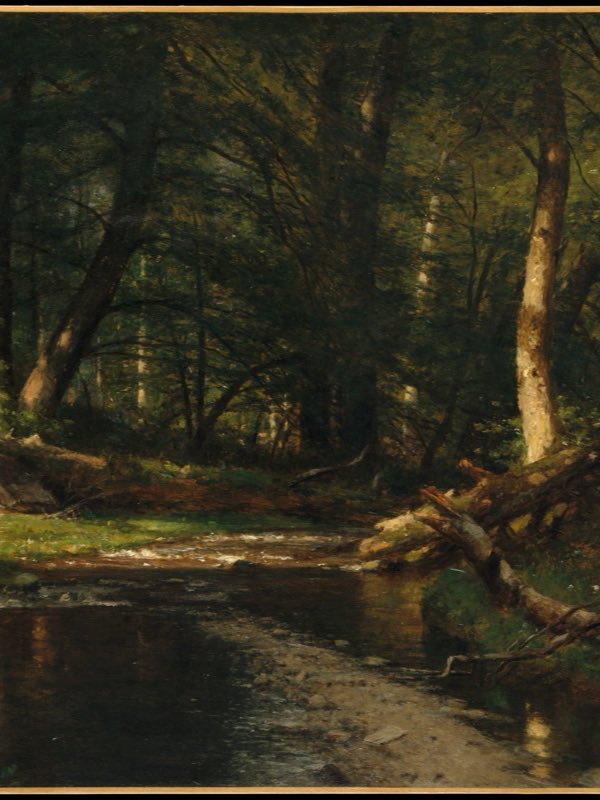
Worthington Whittredge, “The Brook in the Woods” (ca. 1885–86). The Metropolitan Museum of Art, Open Access.
Cite this book
Copy a citation in the style you need.
- MLA
- Brainerd, David. The Life and Diary of David Brainerd. 1749. Ochorus, https://ochorus.com/books/life-and-diary-of-david-brainerd/.
- Chicago
- Brainerd, David. The Life and Diary of David Brainerd. 1749. Reprint, Ochorus. https://ochorus.com/books/life-and-diary-of-david-brainerd/.
- Chicago footnote
- David Brainerd, The Life and Diary of David Brainerd (1749; repr., Ochorus), https://ochorus.com/books/life-and-diary-of-david-brainerd/.
- BibTeX
- @book{brainerd1749life, author = {Brainerd, David}, title = {{The Life and Diary of David Brainerd}}, year = {1749}, publisher = {Ochorus}, url = {https://ochorus.com/books/life-and-diary-of-david-brainerd/} }