New to George Whitefield? Start with
Selected Sermons of George Whitefield
All works · 31 hr 35 min read
Biography
- 1714 Born
- 1739 Field preaching
- 1770 Died
I put on my blue apron and my snuffers, washed mops, cleaned rooms, and, in one word, became professed and common drawer for nigh a year and a half.
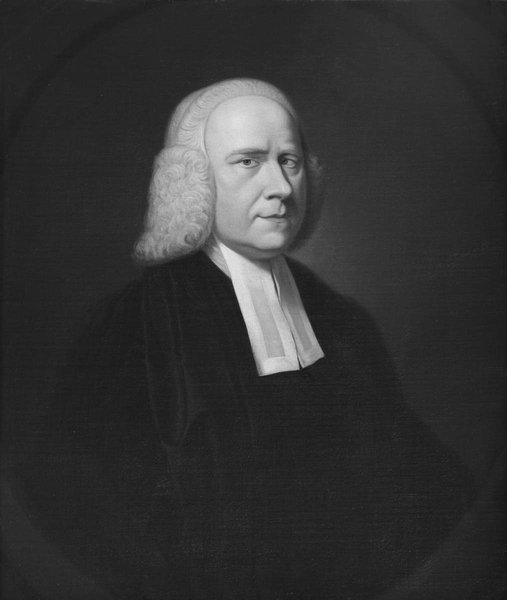
He was the loudest voice of his century, and he began it carrying tankards. Before George Whitefield stood on a mound outside Bristol and spoke to two hundred coal miners — before the fields of two continents filled with people who had never darkened a church door — he was a boy in a blue apron, washing mops in his mother’s inn. He never quite forgot it. Of all the things that might be said about the man who helped set the Great Awakening alight, the one he insisted on himself was that God had found him low and lifted him.
The Boy in the Blue Apron
Whitefield was born in December 1714 at the Bell Inn in Southgate Street, Gloucester, where his mother kept the house. His schooling ended early. His mother’s circumstances were declining, and the boy who had shown a gift for speaking and acting decided that more Latin would only spoil him for a tradesman. So he went to work in the family business, and he described the descent without flinching:
I put on my blue apron and my snuffers, washed mops, cleaned rooms, and, in one word, became professed and common drawer for nigh a year and a half.
— George Whitefield, A Short Account of God’s Dealings with the Reverend Mr. George Whitefield
Even here there were signs. He had “sometimes the care of the whole house” upon his hands, and still, in the odd hours, he composed two or three sermons and dedicated one of them to his elder brother. A tapster writing sermons in an inn is either a comic figure or a prophetic one, and it took years to discover which.
Oxford, and the Long Road to Grace
In November 1732 he matriculated at Pembroke College, Oxford, as a servitor — the lowest rank of undergraduate, a student who paid his way by waiting on wealthier men. He was a servant again, in a gown. But at Oxford he found the small, mocked company known as the Holy Club, and through Charles Wesley he found the book that undid him: Henry Scougal’s The Life of God in the Soul of Man, which told him that true religion was not doing but union — Christ formed within.
The discovery did not arrive as relief. It arrived as a demand, and Whitefield, being Whitefield, threw his whole body at it. He fasted Wednesdays and Fridays through Lent, thirty-six hours together. He prayed prostrate under the trees in Christ Church Meadow. He gave away his money, refused fruit, wore filthy gloves and patched shoes for the sake of humility, and drove himself so hard that by the spring of 1735 his health broke and he had to leave the university. He was trying, with real courage and total futility, to earn what could only be given.
When it came, it came quietly, and he never got over it.
But oh! with what joy — joy unspeakable, even joy that was full of and big with glory, was my soul filled, when the weight of sin went off, and an abiding sense of the pardoning love of God, and a full assurance of faith broke in upon my disconsolate soul! Surely it was the day of my espousals, a day to be had in everlasting remembrance.
— George Whitefield, A Short Account of God’s Dealings with the Reverend Mr. George Whitefield
Every sermon he preached for the next thirty-four years was, in some sense, an attempt to hand that morning to somebody else.
The Ice Is Broken
Bishop Martin Benson ordained him deacon at Gloucester on 20 June 1736. He was twenty-one. He preached his first sermon the following Sunday in St Mary de Crypt, the church where he had been baptized, before a congregation full of people who remembered him in his childish days. It went rather well. Word came back to him afterwards, and he passed it on with obvious delight: a complaint had been made to the bishop that he had driven fifteen people mad. The worthy prelate, he was told, wished that the madness might not be forgotten before the next Sunday.
Fame arrived almost at once, and with it the closing of doors. The churches that had thronged to hear the boy preacher began to bolt themselves against his doctrine of the new birth. And so, in the bleak February of 1739, denied pulpits and unwilling to be silent, he did the thing that changed everything. He rode out to Kingswood, where the colliers lived — men reputed to be little better than heathens, whom no one had troubled to evangelize — climbed a mount, and preached in the open air to about two hundred of them.
Blessed be God that I have now broken the ice! I believe I was never more acceptable to my Master than when I was standing to teach those hearers in the open fields. Some may censure me; but if I thus pleased men, I should not be the servant of Christ.
— George Whitefield, Journals, 17 February 1739
Within weeks the two hundred had become thousands, and at length, by a moderate computation, something near twenty thousand. These were people with no religious reputation to protect, no righteousness to defend, and Whitefield noticed that this made them quick to believe. His account of what he saw has outlived nearly everything else he wrote:
Having no righteousness of their own to renounce, they were glad to hear of a Jesus, who was a friend to publicans, and came not to call the righteous, but sinners, to repentance. The first discovery of their being affected, was, to see the white gutters made by their tears, which plentifully fell down their black cheeks, as they came out of their coal-pits.
— George Whitefield, quoted in John Gillies, Memoirs of the Life of the Reverend George Whitefield (1772)
It is worth pausing there. The image endures not because it is dramatic but because it is exact: grace is the thing that shows up as a clean line on a dirty face. He had taken the field, and he never left it.
The Atlantic and the Awakening
Whitefield crossed the ocean at an age when crossing it was an ordeal — seven visits to America, thirteen Atlantic passages in all, months at a time in a wooden ship. In 1739–40 he rode from Georgia to New England and back, preaching daily, and the scattered local stirrings of religion fused behind him into what we now call the Great Awakening. He preached in fields, from courthouse steps, in Philadelphia streets where Benjamin Franklin — unconverted, affectionate, and skeptical — measured the carrying power of his voice and printed his journals. He was, in effect, the first figure known personally to the whole seaboard, and he was known for one message: you must be born again.
Bethesda, and Its Shadow
The burden of his life was an orphanage. He began building Bethesda near Savannah on 25 March 1740, and for thirty years he begged for it, collected for it, defended its accounts, and poured his own money into it. Some of his most affecting preaching was fundraising, and he was scrupulous about it: sworn audits confirmed he had never converted a penny of it to his own use, and had charged the house with none of his travelling expenses.
And it is here that honesty requires the hardest paragraph. Bethesda was expensive, and Whitefield became convinced it could not survive on free labour. In 1747 he used £300 given him at Charleston to buy a South Carolina plantation and enslaved people to work it for the orphanage’s support, writing that it was “impossible for the inhabitants to subsist without the use of slaves.” Georgia’s founding charter had banned slavery; Whitefield lobbied the Trustees to overturn that ban, arguing to them that “had negroes been allowed, I should now have had a sufficiency to support a great many orphans,” and that Georgia “never can be a flourishing province, unless negroes are employed.” The prohibition fell in 1751. He campaigned for that outcome, he welcomed it, and he owned enslaved men and women until his death.
He cannot be excused on the grounds that no one knew better; he knew better himself. He wrote that the enslaved were “brought in a wrong way from their native country,” and that it was “a trade not to be approved of” — then reasoned that since it would continue regardless, he might as well profit by it and evangelize the people he bought. He had earlier rebuked Southern planters, in print, for their cruelty to those they held. That is precisely what makes it damning rather than merely tragic: the man who could see, across an entire ocean, that a coal miner had a soul, looked directly at slavery, named it wrong, and built his charity on it anyway. The gospel he preached would eventually arm the abolitionists. It did not reach his own accounts. Any honest love of Whitefield has to hold this without softening it.
Two Friends, One Gospel
His friendship with John Wesley was the great affection and the great wound of his public life. They had been brothers in the Holy Club; it was Whitefield who handed Wesley the open-air fields at Kingswood. But Wesley preached and printed Free Grace against predestination, and Whitefield — a convinced Calvinist — answered with a letter of remonstrance in December 1740. The rupture was public, painful, and exploited by lesser men on both sides. Whitefield came to regret the noise of it deeply, and refused to let the breach harden into enmity. They preached in each other’s pulpits again. They differed to the end and loved each other to the end.
The proof came posthumously. His friend Robert Keen had often asked him, half in jest, who should preach his funeral sermon if he died abroad — must it be his old friend Mr. John Wesley? Whitefield’s answer, given again and again, was four words: “He is the man.” And so when the news reached London, Wesley was engaged by the executors, and on Sunday 18 November 1770 he stood in Whitefield’s own chapel in Tottenham Court Road before an immense multitude gathered from every corner of the town, and preached his rival’s funeral. Wesley recorded that it was an awful season; all were still as night. Whichever of them was right about election, that scene is one of the more beautiful arguments for the faith they shared.
Weary in the Work, Not of It
The scale of his labour is hard to credit. His friend Henry Venn testified that for many years Whitefield preached from forty to sixty hours every week. The figure most often attached to his name — that he preached upwards of eighteen thousand sermons — deserves care rather than repetition. It is not a modern guess: Augustus Toplady, who knew him, reported that it came from a book in which Whitefield himself minuted the times and places of his ministerial labours, and the same number was later cut into his cenotaph. Even so, it is a claim resting on a record we can no longer inspect, and the honest form of it is that a contemporary, citing Whitefield’s own notebook, put the total above eighteen thousand. Call it an estimate on good authority rather than a counted fact. The truth it gestures at is not in dispute.
It cost him his body. Asthmatic and worn out at fifty-five, he was urged to slow down and would not. Told he should preach less often, he replied simply that he had rather wear out than rust out.
On Saturday 29 September 1770 he rode fifteen miles from Portsmouth to Exeter and preached in the fields to a great multitude. Before he went out, a friend named Clarkson, seeing him more uneasy than usual, told him he was fitter for bed than for the pulpit. “True, sir,” Whitefield said — and then turned aside, clasped his hands, looked up, and prayed:
He preached for two hours. Then he dined, rode on to Newburyport, ate a small supper, said he was tired, and went upstairs. He read his Bible with Dr. Watts’s psalms lying open beside him, knelt at the bedside, and closed the evening with prayer. Waking in the night unable to breathe, he prayed again — that God would bless the preaching he had done, and the preaching he meant to do that day, that more souls might be brought to Christ; and for a blessing on his Bethesda. He died at about six on the morning of 30 September 1770, in the parsonage of the Old South Presbyterian Church.
At his own desire he was buried where he lies still, in a vault beneath the pulpit at Newburyport — under a preaching place, which is exactly right. He had asked for one more sermon and then rest, and received both, and the man who had spent thirty-four years telling strangers in open fields that they must be born again went to find out whether he had told them the truth.
Read him for the fire, and for the joy that started it. Read him, too, with your eyes open. He was a servitor who became a voice for millions and never stopped being astonished by grace — and he was a man who held people as property while preaching that Christ had died for them. Both are true. He would be the first to tell you that whatever was good in him was borrowed, and the last to claim the loan had made him worthy of it.
Books by George Whitefield (1)
Sermons by George Whitefield (6)
Books about George Whitefield (1)

Articles about George Whitefield (1)
Questions and Answers
Is it true George Whitefield started out working in an inn?
Yes. He was born in December 1714 at the Bell Inn in Southgate Street, Gloucester, where his mother kept the house, and as a boy he put on a blue apron and snuffers, washed mops, cleaned rooms, and became the “common drawer” for close to a year and a half. Even then he was quietly composing sermons in the odd hours. He never forgot how low he had begun, and insisted all his life that God had found him there and lifted him.
How did a former tavern boy end up at Oxford?
In November 1732 he entered Pembroke College, Oxford, as a servitor — the lowest rank of undergraduate, paying his way by waiting on wealthier students. There he joined the small, mocked band known as the Holy Club, and through Charles Wesley he read Henry Scougal’s The Life of God in the Soul of Man, which convinced him that true religion was not doing but Christ formed within. He drove himself so hard with fasting and self-denial, trying to earn what could only be given, that his health broke — and only then did the assurance of God’s pardoning love break in upon him.
Why did Whitefield begin preaching in open fields instead of churches?
As his fame spread, many churches bolted their doors against his insistence on the new birth. In the bleak February of 1739, denied pulpits and unwilling to fall silent, he rode out to the colliers of Kingswood near Bristol and preached in the open air to about two hundred coal miners. “Blessed be God that I have now broken the ice!” he wrote — and within weeks the crowds had grown into the thousands.
Was his voice really as powerful as the legends say?
It was extraordinary. In Philadelphia the skeptical Benjamin Franklin, listening from the crowd and walking backward to gauge how far the voice carried, reckoned that Whitefield could be heard by something near thirty thousand people at once. Franklin never shared his faith, yet he became a genuine friend, printed his journals, and admired the man to the end.
What did Whitefield actually do in colonial America?
He crossed the Atlantic for seven visits, thirteen ocean passages in all, at a time when every crossing meant months in a wooden ship. In 1739 and 1740 he rode from Georgia to New England and back, preaching daily, and the scattered local stirrings of religion fused behind him into what we now call the Great Awakening. He became, in effect, the first public figure known personally up and down the whole American seaboard, and he was known for one message: you must be born again.
What was the Bethesda orphanage, and is it true he owned enslaved people?
Bethesda, begun near Savannah on 25 March 1740, was the great burden of his life; for thirty years he begged and collected for it and poured in his own money, and sworn audits confirmed he never took a penny of it for himself. But honesty requires the hard part. Convinced the house could not survive on free labour, he used money given at Charleston to buy a plantation and enslaved people to work it for the orphanage’s support, and he lobbied the Georgia Trustees to overturn the colony’s ban on slavery, which fell in 1751. He owned enslaved men and women until his death, and any honest love of him has to hold that without softening it.
Did he preach to enslaved people, and how do we square that with the slavery?
He did preach to the enslaved and insisted they had souls to be saved, and he had earlier rebuked Southern planters in print for their cruelty to those they held. Yet the same man wrote that the slave trade was “a trade not to be approved of,” named it wrong, and then built his charity on it anyway. The gospel he proclaimed would one day arm the abolitionists; it never reached his own accounts, and that contradiction is his, not a later invention.
Were Whitefield and John Wesley friends or rivals?
They were both. The two had been brothers in the Holy Club, and it was Whitefield who handed Wesley the open-air fields at Kingswood, but they split publicly in 1740 when Whitefield, a convinced Calvinist, answered Wesley’s sermon Free Grace against predestination. Whitefield came to regret the noise of the quarrel deeply and refused to let it harden into enmity; they preached in each other’s pulpits again and loved each other to the end. Asked who should preach his funeral, Whitefield said of Wesley, “He is the man” — and when the news came, Wesley did.
What are his best-known sermons?
His preaching survives in printed sermons such as The Method of Grace, The Lord Our Righteousness, Marks of a True Conversion, and Walking with God, all circling the single theme of the new birth and a righteousness received rather than earned. The sheer volume is hard to credit: his friend Henry Venn testified that for many years Whitefield preached from forty to sixty hours every week.
How did George Whitefield die?
Worn out and asthmatic at fifty-five, he said he would rather wear out than rust out. On 29 September 1770 he preached for two hours in the fields near Exeter after praying, “Lord Jesus, I am weary in thy work, but not of thy work,” then rode on to Newburyport, Massachusetts, and died early the next morning, 30 September 1770, in the parsonage of the Old South Presbyterian Church. At his own wish he was buried in a vault beneath the pulpit there — fittingly, under a preaching place.