New to Charles G. Finney? Start with
Lectures on Revivals of Religion
All works · 35 hr 39 min read
Biography
- 1792 Born
- 1821 Converted
- 1830 Revival
- 1851 Oberlin
- 1875 Died
The Holy Spirit descended upon me in a manner that seemed to go through me, body and soul… it seemed to come in waves and waves of liquid love.
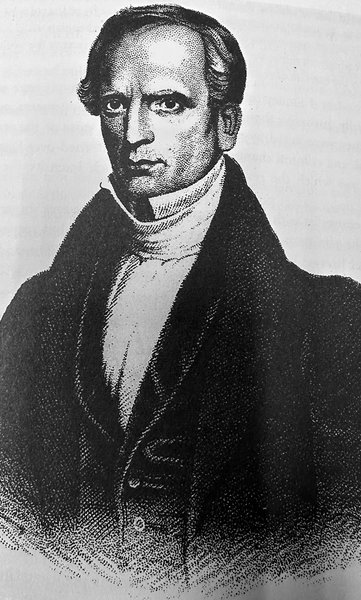
Charles Grandison Finney came to the gospel late, and by an unlikely road. Born in Warren, Connecticut, in 1792, the youngest of nine, he grew up on the raw frontier of upstate New York, far from settled churches. He never went to college. Tall, striking, and formidably self-assured, he trained instead as a lawyer, reading law in the town of Adams, and he expected to make his life in the courtroom. Religion he regarded coolly — a thing the prayer meetings around him seemed to ask for endlessly and never quite receive.
But the law kept sending him back to the Bible. Blackstone's commentaries cited Scripture; the more Finney read to understand the one, the more the other pressed on him. Through the autumn of 1821 the pressure grew unbearable, until one morning he turned aside into the woods north of the village, resolved not to leave until he had settled the matter with God. There, alone among the trees, his proud lawyer's heart broke, and he gave himself to Christ.
That evening, back in the empty law office, the settlement was sealed in a way he never forgot. As he sat by the fire the presence of God swept over him wave upon wave, until he could scarcely bear it.
The Holy Spirit descended upon me in a manner that seemed to go through me, body and soul… it seemed to come in waves and waves of liquid love.
— Charles Finney, Memoirs
"I said, 'I shall die if these waves continue to pass over me,'" he wrote; "and yet I had no fear of death." The next morning a deacon came to remind him of a court case. "I have a retainer from the Lord Jesus Christ to plead his cause," Finney answered, "and I cannot plead yours." The courtroom had lost him for good.
The lawyer turned evangelist
He studied theology under a local minister, was licensed to preach by the presbytery in 1823–24, and married Lydia Root Andrews the following year. Then he went out into the "burned-over district" — the belt of upstate New York so scorched by successive revivals that observers thought no fire could catch there again. Under Finney it caught as never before. At Evans' Mills, Antwerp, Utica, Troy, and finally in the great Rochester revival of 1830–31, towns were turned upside down. He preached without notes, argued like the advocate he had been, fixed men with his eyes, and pressed for a verdict then and there.
The Rochester revival of the winter of 1830–31 was the crown of it. For six months Finney preached almost daily to the leading citizens of a booming canal town — lawyers, merchants, and their families — and the character of the whole city changed. Grog shops closed, quarrels were made up, and the awakening rippled out along the Erie Canal into town after town. Contemporaries counted conversions in the hundreds locally and believed the ripple touched tens of thousands across the region. It made Finney the most famous revivalist in America and fixed the pattern others would imitate for a century.
His conviction was that revival is not a miracle to be waited on passively but the fruit of ordinary means used rightly — and that ordinary people, convicted of sin, must decide.
A revival is nothing else than a new beginning of obedience to God.
— Charles Finney, Lectures on Revivals of Religion
To bring people to that beginning he pioneered what critics called the "new measures": protracted nightly meetings, plain extemporaneous preaching, the naming of individuals aloud in prayer, women praying in mixed assemblies, and the "anxious seat" — a bench at the front where the awakened sat publicly, unable any longer to hide. These are commonplace now; in the 1820s they scandalized the settled clergy.
The men who prayed him through
Finney never believed the power lay in the measures, or even in his own preaching. Again and again he traced it to hidden intercession. Two men in particular went before him into the fire on their knees.
Finney called Nash one of those men who "had such a powerful Spirit of prevailing prayer," and reckoned that the revivals rose and fell with this unseen labor. It was no accident, he thought, that when Nash died on his knees at the end of 1831, Finney's own itinerant work in the fields soon drew to a close. The visible preacher had always been carried by the invisible pray-ers.
The mill that stopped for God
One scene, told in his own Memoirs, captures the whole pattern — intercessors laboring in secret, and a conviction that fell without a sermon. Walking one morning through Mr. Wolcott's cotton factory near Whitesboro, Finney passed a young woman at a machine who was watching him and whispering, half in mockery, to a companion.
Fire and opposition
Such power made enemies as well as converts. The emotional intensity of the new measures — and Finney's blunt, "denunciatory" preaching — alarmed the leaders of New England religion. The veteran revivalist Asahel Nettleton and the powerful Boston pastor Lyman Beecher set themselves against him, and in 1827 the two sides met face to face at the New Lebanon Convention to thrash it out. Beecher, by later report, warned him off:
I'll meet you at the state line, and call out all the artillerymen, and fight every inch of the way to Boston.
— Lyman Beecher, as remembered
The convention settled nothing, and the criticism only sharpened over the years. Old School theologians charged that Finney's stress on human ability and the sinner's will — worked out later in his Systematic Theology — had traded the sovereign grace of God for mere technique, making revival a thing men could manufacture. He lived under that accusation for the rest of his life. He was, by any reckoning, a controversial man; but tens of thousands dated their new obedience to God from the night they heard him.
Oberlin, and the long labor
From 1832 he pastored in New York City — first at Chatham Street Chapel, then at the Broadway Tabernacle built for him in 1836 — where he barred slaveholders from the Lord's Table, for his gospel had made him a fierce abolitionist. In 1835 he joined the new Oberlin Collegiate Institute in Ohio, an outpost of abolition and of coeducation, teaching theology and eventually serving as the college's president from 1851 to 1866. That same year, 1835, his Lectures on Revivals of Religion appeared and went round the world, shaping how the English-speaking church would think and pray about revival for generations.
The revivals did not end at the church door. Finney taught that a converted heart must show itself in a reformed life and a reformed society, and the awakenings he led poured energy into the great reform movements of the age — the crusade against slavery above all, but also temperance, education, and the opening of Oberlin to women and to Black students. Many of the era's most determined abolitionists dated their zeal to a Finney meeting. To him this was no distraction from the gospel; it was the gospel's fruit, obedience worked out where it cost something.
He preached and taught almost to the end, and died at Oberlin on August 16, 1875, at eighty-two. He left behind a divided verdict and an undivided passion: that no soul need wait, that God's work is done through praying people, and that revival begins the moment a heart turns, from the heart, to obey. "Religion," he insisted, "is something for man to do" — and having done it himself in a wood one autumn morning, he spent fifty years calling others to do the same.
Books by Charles G. Finney (2)
Sermons by Charles G. Finney (7)
Books about Charles G. Finney (1)

Also appears in
Articles about Charles G. Finney (3)
Questions and Answers
Who was Charles Finney?
Charles Grandison Finney (1792–1875) was a lawyer turned evangelist whose preaching helped drive the Second Great Awakening across upstate New York and beyond. Born on the raw frontier and never college-trained, he read law in Adams, New York, and expected a life in the courtroom. Convinced that revival was the right use of God-given means rather than a miracle to be awaited, he saw whole towns transformed and later became president of Oberlin College.
How was he converted?
The law kept sending him back to the Bible — Blackstone's commentaries cited Scripture, and the more he read the one the more the other pressed on him. Through the autumn of 1821 the pressure grew unbearable, until one morning he turned aside into the woods north of the village, resolved not to leave until he had settled the matter with God. There his proud lawyer's heart broke and he gave himself to Christ; that evening in the empty law office the presence of God swept over him "in waves and waves of liquid love."
What did he mean by "a retainer from the Lord"?
The morning after his conversion a deacon came to remind him of a court case he was to argue. Finney answered, "I have a retainer from the Lord Jesus Christ to plead his cause, and I cannot plead yours." The courtroom had lost him for good; he studied theology under a local minister, was licensed to preach in 1823–24, and went out into the mission field of upstate New York.
What was the "burned-over district"?
It was the belt of upstate New York so scorched by successive revivals that observers thought no fire could ever catch there again. Under Finney it caught as never before. At Evans' Mills, Antwerp, Utica, Troy and finally in the great Rochester revival of 1830–31, towns were turned upside down as he preached without notes, argued like the advocate he had been, and pressed his hearers for a verdict then and there.
What happened in the Rochester revival of 1830–31?
For six months Finney preached almost daily to the leading citizens of a booming canal town — lawyers, merchants and their families — and the character of the whole city changed. Grog shops closed, quarrels were made up, and the awakening rippled out along the Erie Canal into town after town. Contemporaries counted conversions in the hundreds locally and believed the ripple touched tens of thousands; it made Finney the most famous revivalist in America.
What were the "new measures"?
To bring people to a decision Finney pioneered what critics called the "new measures": protracted nightly meetings, plain extemporaneous preaching, the naming of individuals aloud in prayer, women praying in mixed assemblies, and the "anxious seat" — a bench at the front where the awakened sat publicly, unable any longer to hide. These are commonplace now; in the 1820s they scandalized the settled clergy.
How did he understand revival?
His conviction was that revival is not a miracle to be waited on passively but the fruit of ordinary means used rightly — and that ordinary people, convicted of sin, must decide. "A revival is nothing else than a new beginning of obedience to God," he wrote, and, more bluntly, "Religion is something for man to do." Having done it himself in a wood one autumn morning, he spent fifty years calling others to do the same.
Who prayed his revivals through?
Finney never believed the power lay in the measures or in his own preaching; again and again he traced it to hidden intercession. "Father" Daniel Nash would arrive in a town weeks ahead and give himself almost wholly to agonizing prayer while Finney preached; at Rochester, Abel Clary was so burdened for souls that he prayed on the floor, unable to rise. Finney reckoned the revivals rose and fell with this unseen labor, and when Nash died on his knees his own itinerant work soon drew to a close.
What happened at the Whitesboro cotton mill?
Walking one morning through Mr. Wolcott's factory, Finney passed a young woman at a machine who was whispering, half in mockery, to a companion. Her hands began to tremble so that she could not mend a broken thread; he came within a few feet, only looked at her, and she sank down and burst into tears. Conviction ran down the line, operatives wept at their machines, and the unconverted owner ordered, "Stop the mill, and let the people attend to religion." Within days nearly the whole mill was converted.
What opposition did he face, and what did he leave?
The intensity of the new measures and his blunt preaching alarmed New England's leaders; Asahel Nettleton and Lyman Beecher set themselves against him, meeting him at the New Lebanon Convention of 1827, and Old School theologians charged that his stress on human ability had traded sovereign grace for technique. He lived under that accusation for life. A fierce abolitionist who barred slaveholders from the Lord's Table, he served as president of Oberlin, and his "Lectures on Revivals of Religion" (1835) shaped how the church would pray about revival for generations.