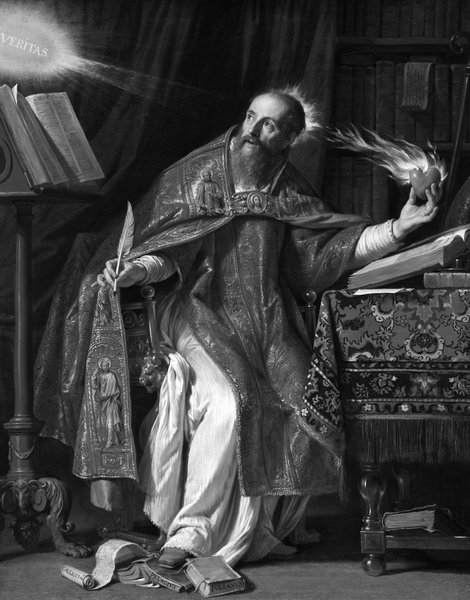
Augustine of Hippo — in their own words
50 quotations, each traced to the exact paragraph it comes from. Follow any of them into the full text — free, and without an account.
Confessions 33
Thou awakest us to delight in Thy praise; for Thou madest us for Thyself, and our heart is restless, until it repose in Thee.
Thou light of my heart, Thou bread of my inmost soul, Thou Power who givest vigour to my mind, who quickenest my thoughts, I loved Thee not.
I will now call to mind my past foulness, and the carnal corruptions of my soul; not because I love them, but that I may love Thee, O my God.
Luxury affects to be called plenty and abundance; but Thou art the fulness and never-failing plenteousness of incorruptible pleasures.
To Thy grace I ascribe it, and to Thy mercy, that Thou hast melted away my sins as it were ice.
I sought what I might love, in love with loving, and safety I hated, and a way without snares.
O Thou Good omnipotent, who so carest for every one of us, as if Thou caredst for him only; and so for all, as if they were but one!
Be not foolish, O my soul, nor become deaf in the ear of thine heart with the tumult of thy folly.
The Word itself calleth thee to return: and there is the place of rest imperturbable, where love is not forsaken, if itself forsaketh not.
He is within the very heart, yet hath the heart strayed from Him.
Man himself is a great deep, whose very hairs Thou numberest, O Lord, and they fall not to the ground without Thee.
Let the restless, the godless, depart and flee from Thee; yet Thou seest them, and dividest the darkness.
Let them then be turned, and seek Thee; because not as they have forsaken their Creator, hast Thou forsaken Thy creation.
Surely unhappy is he who knoweth all these, and knoweth not Thee: but happy whoso knoweth Thee, though he know not these.
Let my soul cleave unto Thee, now that Thou hast freed it from that fast-holding birdlime of death.
The Way, the Saviour Himself, well pleased me, but as yet I shrunk from going through its straitness.
Surely vain are all men who are ignorant of God, and could not out of the good things which are seen, find out Him who is good.
The mind commands the body, and it obeys instantly; the mind commands itself, and is resisted.
The mind commands the mind, its own self, to will, and yet it doth not.
Thou didst rescue my tongue, whence Thou hadst before rescued my heart.
Let me know Thee, O Lord, who knowest me: let me know Thee, as I am known.
Not with doubting, but with assured consciousness, do I love Thee, Lord.
What then do I love, when I love my God? who is He above the head of my soul?
All consult Thee on what they will, though they hear not always what they will.
Too late loved I Thee, O Thou Beauty of ancient days, yet ever new!
By continency verily are we bound up and brought back into One, whence we were dissipated into many.
Thou enjoinest continency: give me what Thou enjoinest, and enjoin what Thou wilt.
Let not these occupy my soul; let God rather occupy it, who made these things, very good indeed, yet is He my good, not they.
Nothing then of Thy Word doth give place or replace, because It is truly immortal and eternal.
O let the Light, the Truth, the Light of my heart, not mine own darkness, speak unto me.
Let me not be mine own life; from myself I lived ill, death was I to myself; and I revive in Thee.
I call upon Thee, O my God, my mercy, Who createdst me, and forgottest not me, forgetting Thee.
When out of their order, they are restless; restored to order, they are at rest.
The Enchiridion 17
In these two you have those three graces exemplified: faith believes, hope and love pray.
When, then, we believe that good is about to come, this is nothing else but to hope for it.
The fact that we do not see either what we believe or what we hope for, is all that is common to faith and hope.
From what is good, then, evils arose, and except in what is good they do not exist; nor was there any other source from which any evil nature could arise.
No one, of course, is to be condemned as a liar who says what is false, believing it to be true, because such an one does not consciously deceive, but rather is himself deceived.
To me, however, it seems certain that every lie is a sin, though it makes a great difference with what intention and on what subject one lies.
What goodness of will, what goodness of desire and intention, what good works, had gone before, which made this man worthy to become one person with God?
The man whom the thunder of this warning does not awaken is not asleep, but dead; and yet so powerful is that voice, that it can awaken even the dead.
Although, therefore, evil, in so far as it is evil, is not a good; yet the fact that evil as well as good exists, is a good.
As, then, the soul even now finds it impossible to desire unhappiness, so in future it shall be wholly impossible for it to desire sin.
After the fall, however, a more abundant exercise of God’s mercy was required, because the will itself had to be freed from the bondage in which it was held by sin and death.
Man, therefore, was thus made upright that, though unable to remain in his uprightness without divine help, he could of his own mere will depart from it.
No one, then, need hope that after he is dead he shall obtain merit with God which he has neglected to secure here.
For when there is a question as to whether a man is good, one does not ask what he believes, or what he hopes, but what he loves.
Of these four different stages the first is before the law, the second is under the law, the third is under grace, and the fourth is in full and perfect peace.
Now we love even our neighbor by faith; for we who are ourselves mortal know not the hearts of mortal men.
We love God now by faith, then we shall love Him through sight.