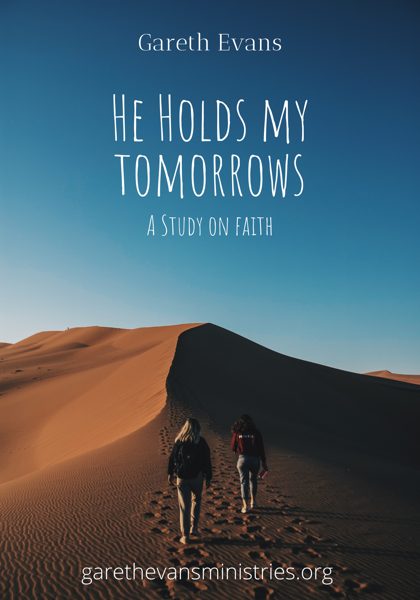
He Holds My Tomorrows is Gareth Evans’s plain-spoken study of what faith really is, and of how it works in the ordinary believer’s life. Starting from painful misunderstandings he met as a pastor, he defines faith as God’s own work in us, answered by our obedience, and then walks through Hebrews 11 one example at a time. Read it if you have ever been told you simply need “more faith,” or if you want to learn to walk with God one day at a time without knowing what lies ahead.
Why a book about faith begins with controversy
Evans opens with two stories that are hard to forget. Mary, a faithful believer worn down for months by a debilitating illness, receives a phone call from a church friend: the prayer group has decided to stop praying for her, because she obviously lacks faith or she would have been healed by now. Pastor John, meanwhile, watches his growing church borrow millions for a building that anyone who hesitated was told showed a lack of faith, only for interest rates to climb and a major employer to leave town. Both stories expose the same error. Faith has been treated as something we whip up by our own effort, a quantity that, once large enough, obliges God to act.
Evans believes in divine healing, but he insists there is no formula for it and that God remains sovereign. He then clears away four counterfeits. Belief is not faith, for even the devils believe. Presumption is not faith, and he shows it from the temptations of Jesus in Luke 4:1–13, where Jesus could have commanded the stone to become bread or thrown himself from the temple but would not act outside his Father’s will. Hope is not faith either; he suggests that much “name it, claim it” teaching is really about hope, and that Christian hope, unlike the world’s, is an eager expectation of what is certain. Finally, positive thinking and visualisation are not faith, however spiritual the language that surrounds them.
Hope is an attribute of the mind and is evidenced in confidence. Faith is an attribute of the heart and is evidenced in obedience.Gareth Evans
That distinction, which he repeats more than once, is the hinge of the whole book. Since Hebrews 11:6 says it is impossible to please God without faith, he wants readers to understand what faith actually is before they try to live by it.
Three kinds of faith, all from God
The longest teaching chapter sets out three kinds of faith Evans finds in Scripture. The first is saving faith, drawn from Ephesians 2:8–9: we are saved by grace through faith, and even that faith is the gift of God. He tells of a rabbi who grieved that his students believed in God only in their heads, and he fears many churchgoers are no different. Using 1 John 2:13–14, he describes the growth God intends, from little children to young men who have overcome the evil one, and on to fathers who know him who is from the beginning.
The second is the fruit of faith, one strand of the fruit of the Spirit in Galatians 5:22–23. Evans has fun with the image of fruit trees groaning and straining to produce apples; no tree does that, and neither should we. Like the tree of Psalm 1:3 planted by streams of water, the believer simply abides in the vine, and the life within produces fruit in its season. It takes time, pruning and trust, but not effort.
The third is the gift of faith named in 1 Corinthians 12:9, given for the good of the church. He pictures a board of elders, divided over hiring a youth worker they cannot afford, suddenly brought to one mind as God plants faith in each of them. He tells too of his friend Yorrie Richards, once a stammering thief, who insisted on preaching in his home town and found his voice steadied as he spoke. The conclusion is liberating: all three kinds of faith come from God, not from us. So, Evans says, please don’t tell a struggling believer to have more faith; what we need to develop is more trust.
God’s finger and our obedience
Evans next asks whom Scripture actually holds up as examples of faith. Not Caleb, Elisha or Daniel, but Abraham and Rahab, and, in the Gospels, six people Jesus commended: a Roman centurion (Matthew 8:8), a woman with a haemorrhage, a Canaanite mother, blind Bartimaeus, a woman in Simon’s house, and a Samaritan leper. Most were outsiders, several called themselves unworthy, and all were sinners. What they share is obedience to an inner witness, a word or prompting from God.
He then reads Hebrews 11:1 in the light of Paul. Faith as the substance of things hoped for is a gift, like a present a child has waited for; faith as the evidence of things not seen is a fruit, as a tree is known by its fruit (Matthew 12:33). From there he offers his own definition.
I define faith as God’s finger in the hearts of men and women, moving them to do His will.Gareth Evans
The moving finger is God’s; the response of obedience is ours. This is also why a chapter on hearing God’s voice belongs here. God spoke to Elijah not in wind, earthquake or fire but in a still, small voice (1 Kings 19:12), and Jesus said, “the sheep hear My voice” (John 10:27). To hear, Evans says, we need a hunger for God’s will, a heart set on obedience, time in the Word, a quiet place, and inner silence. He is gently wary of “The Lord told me…” and suggests the humbler “I believe the Lord would have me do this.” Yet he also tells, with evident wonder, of a drizzly November evening on Bear Hill when he heard a voice say he would pastor Victoria Alliance Church, and of waiting months, telling no one, until the invitation came.
Hebrews 11: examples, not heroes
Evans refuses to call Hebrews 11 a gallery of heroes. It is a list of ordinary people, including Moses the murderer, Sarah who laughed and Rahab the liar, placed after Hebrews 10 to show what living by faith looks like. The remaining chapters take them one by one, each closing with a short summary of principles.
- Cain and Abel (Genesis 4): God chose Abel’s lamb to teach that he is approached through shed blood, and he warned Cain that sin was crouching at the door. Evans spends time on how destructive offence can be when we let it become sin.
- Enoch and Noah: Enoch’s walk with God points to the hope of resurrection; Noah’s ark pictures the salvation prepared in Christ, where we are sealed and blessed with every spiritual blessing (Ephesians 1:3). Saving faith requires an obedient response.
- Abraham and Sarah: Abraham went out not knowing where he was going, holding possessions loosely. Sarah’s scheme produced Ishmael, while Isaac came by promise, and this becomes Evans’s call to do God’s work in God’s way, drawn from David’s failed attempt to carry the ark on a cart (1 Chronicles 15:13).
- Abraham tested: God tests to purify, not to tempt. Abraham said that God would provide himself the lamb (Genesis 22:8), and what we lay down we may take up again in power, as Moses did his staff.
- Isaac, Jacob and Joseph: the blessing of the younger son reveals what Evans calls the principle of the second-born, pointing to new birth in Christ, the second Adam (1 Corinthians 15:21–22). Joseph, dying in Egypt, looked ahead to a deliverer.
- Moses: every turn in his life, even forty “wasted” years with sheep, was God’s preparation. Evans reads the struck rock of Exodus 17:6 and the rock Moses should have spoken to in Numbers 20:8 as two pictures of Christ, the one struck once and the one we now approach in prayer.
- Rahab and the rest: a woman of Jericho confessed what her neighbours only feared, hung a crimson thread, and became an ancestor of Jesus. The chapter’s final verses show that faith sometimes conquers kingdoms and sometimes goes to the flames.
The threads that tie it together
Several convictions run through the whole book. The first is that faith is always seen in obedience. Noah did more than believe; he built. Abraham did not argue; he went. Joshua’s people marched around Jericho because God had spoken, and the walls fell. “Faith is not opposed to reason; it is above reason,” Evans writes, and the one who obeys, even crying “O Lord, I believe; help Thou, my unbelief!” (Mark 9:24), is walking by faith (2 Corinthians 5:7).
The second is the pilgrim heart. The people of Hebrews 11:13–16 confessed that they were strangers and exiles seeking a better country, and Evans presses the point: hold possessions lightly, stay free of debt, and take the place of the servant, the child and the younger, as Jesus taught in Luke 22:26.
The third is honesty about suffering. Not everyone in Hebrews 11 was delivered; some were sawn in two. Evans traces glory through suffering in John’s Gospel and tells of Stephen, the English martyrs and the five missionaries who died in Ecuador in 1956. God is glorified in his people whether he leads them over mountain tops or through valleys. Beneath it all runs grace, which reaches the lowest and lifts them up.
We are not called to stand in the world giving testimony to Christ; we are called to stand in Christ giving testimony to the world.Gareth Evans
How to read it
This is a warm, conversational book, full of stories from a Welsh schoolroom, Canadian pastorates and years aboard a Mercy Ship. The first four chapters carry the teaching about faith itself; read them slowly, perhaps with a notebook, because the rest of the book depends on them. The Hebrews 11 chapters are short and suit a chapter a day, with your Bible open at the Genesis or Exodus passage Evans names. His summaries at the end of each chapter make good prompts for prayer or a small group.
Some questions to carry with you:
- Have you ever been told, or told someone else, to have more faith? How does Evans’s call to develop more trust change that conversation?
- Where might you be confusing faith with presumption, positive thinking or hope?
- Which of the three kinds of faith do you most need to understand better right now, and why?
- What helps you hear the still, small voice, and what drowns it out?
- Is there something God may be asking you to lay down, so that you can take it up again in his power?
Evans closes with a picture of himself as a child holding his Father’s hand, not knowing whether the day leads to the sweetshop or the dentist, but trusting the one who knows the path. That is the heart of this book, and a fine place to begin.
I do not know what tomorrow holds, but I do know who holds tomorrow, and He is holding my hand!Gareth Evans