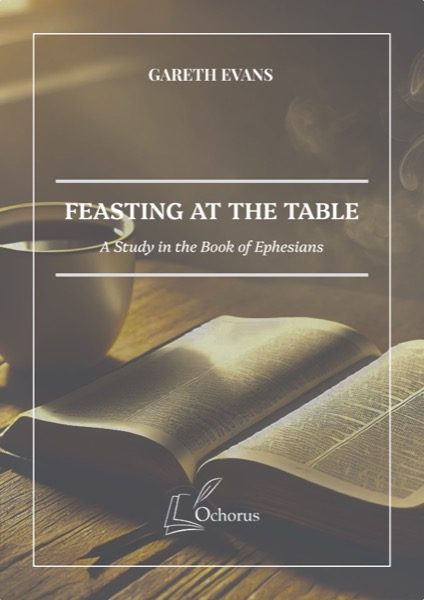
Feasting at the Table is Gareth Evans’s short, warm study of Paul’s letter to the Ephesians, written for ordinary believers who want to enjoy what God has already set before them in Christ. Read it if you have ever sensed that the riches Paul describes are true on paper but thin in your own experience; Evans wants to move you from knowing about these blessings to living in them.
What kind of book is this?
The book grew out of a series of lectures Evans gave at the Summer School at Capernwray, Australia, in 1995, later expanded from his notes so that a wider audience could share them. That origin shows. The nine chapters read like a teacher’s study notes brought to life: a verse from Ephesians, a word from the Greek, a question for the reader, a story from his own ministry, a hymn verse from A. B. Simpson or a line from A. W. Tozer, and then a prayer.
The title’s image is a well-laid table. Evans speaks of taking one item after another “off the table” of Ephesians and tasting it slowly. He is not writing a technical commentary. He is a host inviting his guests to sit down and eat, and he keeps asking, gently but persistently, whether we have actually tasted what is ours. He even draws the picture from his own home: a visitor may be seated in his house, but only the one who accepts his invitation to stay truly abides there and shares his table.
Sit, walk, stand: the shape of the book
Evans follows the flow of Ephesians itself, and the book falls naturally into three movements. First we learn to sit: God has “raised us up and seated us in heavenly places in Christ Jesus” (Ephesians 2:6), and the first three chapters dwell on the blessings that belong to us there. Then we learn to walk: the middle of the book follows Paul’s call to “walk in a manner worthy of your calling” (Ephesians 4:1) together with the rest of God’s people. Finally we learn to stand: the last chapter puts on the armour of Ephesians 6:10–18 and calls the believer to be an overcomer.
The order matters to Evans. Our walk, he says, is determined by the ground on which we stand, either this world’s system or the heavenly places. You cannot walk well until you have learned to rest, and you cannot stand firm in battle until your walk has been shaped by love. The book begins and ends with the same prayer, Paul’s prayer in Ephesians 1:15–19 and 3:14–19, so that the whole study is framed as something to pray, not merely to understand.
Seated at the table: riches in Christ
The opening chapter makes Paul’s prayer our own. Evans notes that the knowledge Paul asks for comes only by revelation: it is possible to know everything about God and not know him personally. He points to Moses, who had already seen so much and still cried, “O God, please show me Your Glory!” (Exodus 33:18). Paul prays that we would know the hope of God’s calling, the riches of the glory of his inheritance in the saints, and the surpassing greatness of his power toward us who believe. Along the way Evans offers his own working definitions: faith is an attribute of the heart, evidenced in obedience; hope is an attribute of the mind, evidenced in confidence.
The second chapter takes the phrase “in Him” off the table. Using Noah’s ark as a picture, Evans shows that there is no deliverance for anyone who stays outside, admiring the boat; we must enter Christ by faith. Then he walks through Ephesians 1 blessing by blessing: every spiritual blessing in heavenly places (Ephesians 1:3), chosen in him, adopted as sons, redeemed and forgiven, given an inheritance, sealed with the Holy Spirit of promise. His great concern is that these riches be appropriated.
These are theological truths, but, sadly, for many believers, they are not experiential truths. It is like having great riches in the bank but living like paupers because we do not draw on our wealth.Gareth Evans
Chapter three looks closely at two of these blessings: being sealed in him (Ephesians 1:13) and being seated in him (Ephesians 2:6). Evans understands the sealing as the promised outpouring of the Spirit that the disciples received at Pentecost, the power to be Christ’s witnesses (Acts 1:8), and he encourages readers to seek it with longing, prayer and worship, as the disciples tarried in Jerusalem. Being seated, by contrast, means rest: ceasing from our efforts to please God and entering his rest (Hebrews 4:10). Using Israel’s journey, he pictures Egypt as life without Christ, the wilderness as believing but not resting, and Canaan as the promises of God enjoyed now, not a picture of heaven after death. He links this to Isaiah 40:31, where waiting on the Lord carries the sense of being bound together with him.
A people together: body, covenant and calling
The middle chapters insist that none of these riches is meant to be enjoyed alone. To Paul, Evans writes, there is no such thing as an independent believer. The church is a body with Christ as its head, and a building of living stones with Christ as the chief cornerstone (Ephesians 2:20). Every member has a Spirit-given gift for the common good (1 Corinthians 12:7), and the unity Jesus prayed for in John 17:21 is meant to show the world who sent him. Evans, asked what part of the body he is, likes to answer with a grin that he is a big toe, often found in the dark places of the lives of those he counsels.
Chapter five turns to covenant. The Gentiles who were once strangers to the covenants of promise have been brought near (Ephesians 2:12–13). Evans traces God’s covenant from Abraham through Moses to the Last Supper, where Jesus made great promises and asked three things of his disciples: to serve one another, to love one another, and to obey his word. The laws of this new covenant are written on our hearts (Jeremiah 31:33), and the Lord’s Supper becomes our renewed yes to its terms.
Every time you and I take the bread and cup, we are declaring our agreement to the covenant.Gareth Evans
Chapter six, on the privilege of ministry, follows Paul in Ephesians 3 as a prisoner of Christ who revels in his calling rather than resenting his chains. Here Evans tells how, as a well-paid schoolteacher in 1979, he was invited to become a pastor and waited for the witness of the brethren before his wife Anne released him to obey. His point is that ministry is Christ’s gift to the church (Ephesians 4:11), not something earned with good marks, and that no one should step into a ministry God has not called and equipped them for.
Walking worthy and standing firm
Chapter seven gathers Paul’s five “walks”: worthy of our calling, no longer as the Gentiles, in love, as children of light, and as wise people. The qualities Paul names (humility, gentleness, patience, bearing with one another in love) are among the fruit of the Spirit (Galatians 5:22–23), and Evans insists that fruit grows by abiding, not by straining. He tells a deliberately absurd story of apple and cherry trees groaning until fruit burst from their branches, then admits he made it up, because believers who try to produce spiritual fruit by effort are just as foolish.
No amount of striving will produce joy or peace or gentleness, etc., in your life – only abiding in Him can produce such fruit.Gareth Evans
He finds three evidences of the Spirit-filled life in Ephesians 5:18–21: a praising spirit, a thankful spirit and a submitted spirit. Grumbling, politicking and pride, he says, call a claim to be Spirit-filled into question. Chapter eight applies this to marriage, family and work, beginning with the mutual submission of verse 21 and offering four principles for every relationship drawn from Ephesians 4:25–32: tell no lies, deal with conflict before the sun goes down, attack the problem rather than the person, and look for ways to turn enmity into unity.
The final chapter calls the believer to stand. Drawing on 1 John 2:12–14, Evans describes little children, young men and fathers, stages of spiritual growth that have nothing to do with age. The way to maturity runs through being a young man: strong because the word of God abides in you, and overcoming the evil one. He reads the promises “to him who overcomes” in Revelation 2 and 3, reminds us that Christ disarmed the powers at the cross (Colossians 2:15), and then walks through the armour of God, ending with faith, love and hope from 1 Thessalonians 5:8.
Note that there is no armour for the back! One cannot turn and run away!Gareth Evans
How to read it
Read Feasting at the Table with an open Bible beside it, ideally with Ephesians read through in one sitting first. Each chapter is short enough for a single evening or a small-group session, and Evans constantly stops to ask questions; it is worth pausing to answer them. Look up the cross-references he gives rather than skimming past them, because much of the feast is in the passages themselves. It suits personal devotions, a home group working through Ephesians, or a couple reading the chapter on relationships together.
These questions may help you linger at the table:
- Which of the blessings Paul lists in Ephesians 1 do you believe in theory but rarely draw on in practice?
- Evans distinguishes being seated in Christ from abiding there. What would it look like for you to rest rather than strive this week?
- If you took the bread and cup as a promise to serve, love and obey, which of the three would challenge you most?
- Are praise, thankfulness and a submitted spirit growing in you, or are grumbling and pride more visible?
- Where is the enemy firing lies at you right now, and which word of Scripture answers them?
Evans closes the book by praying Paul’s prayer over his readers once more, that we might be strengthened by the Spirit, rooted and grounded in love, and filled up to all the fullness of God. That is the spirit of the whole book: not a lecture about a distant feast, but an invitation to pull up a chair. Sit in Christ, walk in love and in the light, stand firm in his strength, and discover that the table is already spread.