Book · 28 chapters · 3 hr 5 min read
Portraits of Courage – Corrie ten Boom
A Hiding Place in Haarlem, a Sister in Ravensbrück, and the Long Work of Forgiveness
Book 3 of 5 in Portraits of Courage·Next in the series: Portraits of Courage – Mary Slessor
Free to read·No account needed
Preface
About this book
A Christian biography of Corrie ten Boom (1892–1983), the Haarlem watchmaker whose family hid Jews from the Nazis, whose father and sister died after their arrest, and who spent forty years preaching God’s forgiveness. It follows her from the Beje through Scheveningen, Vught, and Ravensbrück to Munich and sixty countries — comparing her earliest 1945 account with The Hiding Place and the independent record. Told in its own words, with gratitude but not hagiography; all Scripture from the public-domain ASV (1901).
“Pray for the peace of Jerusalem: They shall prosper that love thee.” — Psalm 122:6, ASV In the old centre of Haarlem, a few steps from the great market square and the towering Grote Kerk of St. Bavo, runs a short shopping street called the Barteljorisstraat.
Contents
- 1 Preface 5 min
- 2 Introduction: The Story She Told, and the Story the Records Tell 7 min
- 3 The Beje 8 min
- 4 A Father Among the Watches 8 min
- 5 The Youngest Daughter 7 min
- 6 The First Woman Watchmaker 6 min
- 7 Clubs, Children, and the Least of These 7 min
- 8 May 1940 7 min
- 9 The First Knock 6 min
- 10 Ration Cards and Lies 7 min
- 11 The Angels’ Crib 6 min
- 12 28 February 1944 8 min
- 13 “Father Was Released” 6 min
- 14 Vught 10 min
- 15 Barracks 28 8 min
- 16 The Bottle That Did Not Fail 5 min
- 17 Betsie 9 min
- 18 Entlassen 7 min
- 19 A Letter to the Informer 7 min
- 20 Homes for the Broken 6 min
- 21 The Hand in Munich 6 min
- 22 Sixty Countries 7 min
- 23 The Five Silent Years 5 min
- 24 The Legacy of Corrie ten Boom 6 min
- 25 Appendix A: Lessons from the Life of Corrie ten Boom 6 min
- 26 Appendix B: Chapter-by-Chapter Study and Reflection Guide 7 min
- 27 Appendix C: Chronology of the Life and Times of Corrie ten Boom 4 min
- 28 Appendix D: Notes on Sources and Method 6 min
Questions and Answers
What is this biography of Corrie ten Boom about?
It is a Christian biography of Corrie ten Boom (1892–1983), the Dutch watchmaker whose family hid Jewish refugees in a secret room in their Haarlem home. It follows her whole life — the family watch shop, the underground work, the raid of 28 February 1944, the prison at Scheveningen, the camps at Vught and Ravensbrück where her sister Betsie died, and the forty years of travel and preaching about forgiveness that followed.
Who was Corrie ten Boom?
Corrie ten Boom was a Dutch Christian and the first woman qualified as a watchmaker in the Netherlands. During the German occupation she and her family sheltered Jews and resistance workers in their home, the Beje, in Haarlem. After their arrest her father died in prison and her sister Betsie at Ravensbrück; Corrie survived and became an internationally known speaker. Yad Vashem recognised her as Righteous Among the Nations in 1967.
How does this book differ from The Hiding Place?
The Hiding Place (1971) is Corrie’s own story, written with John and Elizabeth Sherrill. This biography tells her life in its own words and compares it with her earliest account, the 1945 book A Prisoner and Yet, and with independent records. It notes which famous scenes appear already in 1945 — the vitamin bottle, the hiding-place drills — and which appear only later, such as the fleas in the barracks and the ‘clerical error’ release.
Did everyone in the hiding place survive?
No. Six people stood in the hiding place during the raid and were not found. But one of them, Mary van Itallie, was arrested again within days and murdered at Auschwitz in May 1944, according to the Jewish memorial register of the Netherlands. The cantor Meijer Mossel, called Eusie, survived the war. The book tells their story honestly rather than stopping at the raid.
Was Corrie’s release from Ravensbrück really a clerical error?
Corrie believed so, having been told this years later. But no document confirms it, her 1945 account shows the sisters expecting a fixed prison term, and Ravensbrück’s gas chamber began operating about a month after her release, not a week. The book concludes that she was discharged for reasons never fully explained, and that the danger she escaped was real.
What did Corrie ten Boom teach about forgiveness?
That forgiveness is an act of the will which God makes possible when we cannot. She wrote to the man believed to have betrayed her family in June 1945, forgiving him, and later told of shaking the hand of a former Ravensbrück guard in Munich only when God’s love flowed through her. She was honest that she had to learn forgiveness again and again.
How is Scripture used in the book?
Each chapter opens with a passage from the American Standard Version (1901) that carries its theme — beginning with ‘Thou art my hiding-place and my shield’ — and further passages are woven through the story, from Psalm 91, read by her brother on the night of the arrest, to Romans 5:5. Every quotation was checked against the ASV text.
Where should a reader begin?
At the beginning. The preface and introduction explain the sources; Part One tells of the family and fifty years of quiet faithfulness; Part Two the occupation and the hiding place; Part Three the prisons and Ravensbrück; Part Four the long work of forgiveness. Appendix B offers a chapter-by-chapter study guide for groups.
People in this book
More like this
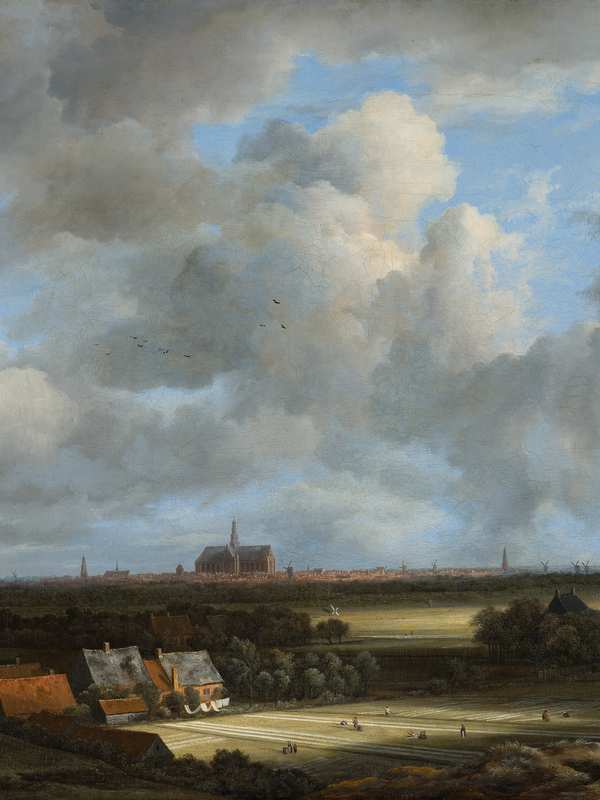
Jacob van Ruisdael, “View of bleaching fields and Haarlem” (1670). Wikimedia Commons, public domain.