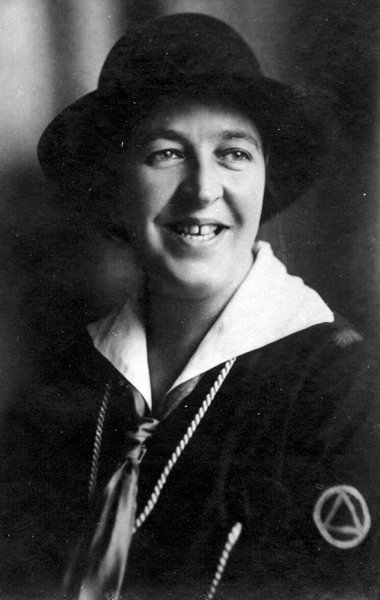
Biography
- 1892 Born
- 1922 Watchmaker
- 1944 Arrested
- 1983 Died
There is no pit so deep that He is not deeper still.
Above a watch shop in the old centre of Haarlem there was a false wall, and behind it a space barely large enough for a few people to stand. It was built into the top-floor bedroom of a woman in her fifties who had never married, who mended clocks for a living, and who had spent her whole life in the same narrow house. When the war reached her door, Corrie ten Boom turned that house into a refuge, lost most of her family for it, survived a place designed to kill her, and came out the other side to spend the rest of her life telling people about forgiveness. She is one of the few in this library who is remembered less for what she wrote than for one thing she did with her hand, years after the war, in a church basement in Munich.
The Beje
Cornelia ten Boom was born on 15 April 1892 in Amsterdam, and grew up in Haarlem, where the family kept a watch shop and a home together in one building. They called it the Beje, after the street it stood on, the Barteljorisstraat. Her father, Casper, was a watchmaker, devout and gentle, of the Dutch Reformed faith; her sister Betsie was her lifelong companion. It was an ordinary, believing, unremarkable household, the kind that produces no headlines for fifty years and then, tested, produces everything.
Corrie learned her father's trade and, in the 1920s (1924, by the museum's record), became the first licensed woman watchmaker in the Netherlands. For most of her life that is the whole story — a single woman, a family shop, church, and the slow work of small mechanisms. She was nearly fifty when the thing happened that the world now knows her for, which is worth remembering for anyone who suspects their real life has not yet started.
The hiding place
Germany occupied the Netherlands in May 1940. As the persecution of Dutch Jews tightened, the ten Booms were drawn into the underground, and their house — old, central, full of odd corners — became a link in a chain that moved Jews and resistance workers to safety. A secret room was built behind a false wall in Corrie's own bedroom on the top floor. The museum that keeps the house today reckons that the family and their network helped save an estimated eight hundred people, most of them sheltered not in the Beje itself but at safe addresses elsewhere. It is an estimate, from those who were there; the point is not the exact number but that each was a person, placed one at a time, at the risk of every life in the house.
On 28 February 1944 the family was betrayed by a Dutch informant. The house was raided and around thirty people were arrested that day, Corrie and Betsie and their elderly father among them. The soldiers never found the secret room. The six people hidden behind the wall, four Jews and two resistance workers, stayed there, silent, for two and a half days, until sympathetic policemen let them out. The hiding place held; the people who built it did not. Nor did all of those it sheltered survive the war: Mary van Itallie, one of the Jewish guests, was arrested again within days at a new address and died at Auschwitz on 1 May 1944, while Meijer Mossel, the cantor the household called Eusie, lived to see the liberation.
Casper ten Boom, who was in his eighties, died about ten days after the arrest. Corrie and Betsie were moved through prison at Scheveningen and the camp at Vught, and then east, into Germany, to the women's concentration camp at Ravensbrück.
Ravensbrück, and Betsie
What happened at Ravensbrück is the heart of Corrie's witness, and almost none of it is about her own courage. It is about her sister. Betsie ten Boom, frail and sick, met that place with a faith that unsettled everyone around her, including Corrie. She insisted that God was not absent from the barracks, that He could be thanked even there, and that they had been brought to this exact hell for a reason — to learn something they would one day have to tell.
Corrie recounts in The Hiding Place (1971) that their overcrowded barracks was infested with fleas, and that Betsie thanked God for them too. Only later did they understand why: the guards would not enter the flea-ridden block, and so the two sisters were left alone to read the Bible aloud to the other women, freely, in a place where such a thing should have been impossible.
Corrie also recounts a small bottle of liquid vitamins that she was somehow able to keep, from which she gave a drop each day to Betsie and then to more and more of the sick women around them — and which, she said, went on yielding drops far past the point it should have run dry, until a fresh supply reached them. Betsie compared it to the widow of Zarephath's jar of oil, in the days of Elijah, that did not fail. Corrie tells the story as her own memory, already in her first account of the camps, written in 1945; it belongs to her account of that place, and it is offered here as she offered it.
Betsie died at Ravensbrück on 16 December 1944. Before she died she had told Corrie, again and again, that they must go out afterward and tell people what they had learned there — that there is no darkness so deep that God is not deeper. It is the line most closely associated with the two sisters, and it was Betsie's:
There is no pit so deep that He is not deeper still.
— Betsie ten Boom, as recounted by Corrie in The Hiding Place
Days later, at the very end of December 1944, Corrie was released, for reasons never fully explained. Her first account, written in 1945, suggests the sisters had expected a fixed prison term to run out; years later she was told it had been a clerical error, and in The Hiding Place she recounts that the women of her age were sent to their deaths soon after she left. Whatever the cause, within weeks the camp began gassing the sick and the old. She never claimed to have earned her survival or to fully understand it. She had gone in with a sister and a family; she came out alone, carrying an instruction from a dead woman.
A tramp for the Lord
Corrie kept the instruction. For roughly the next thirty-three years, into her eighties, she travelled — more than sixty countries — as an itinerant speaker with almost no fixed home, calling herself a tramp for the Lord. Her message was not chiefly about the horror she had survived. It was about forgiveness, reconciliation, and the stubborn nearness of God's love in the worst places human beings can make. She had earned the right to say it in the only way such a right is earned.
Then, early in those travels, in 1947, in a church in Munich, the message was put to her directly, as she recounts it.
She had just spoken to a German congregation about God's forgiveness. Afterward a man came forward, beaming, his hand out — and she recognised him. He had been a guard at Ravensbrück, one of the men in the processing room where the sisters, Betsie among them, had been made to file past, naked, under his gaze. He did not recognise her. He told her he had since become a Christian, that he knew God had forgiven him for what he had done there, and he asked whether she, too, would forgive him. And he stood there with his hand held out.
She could not take it. She stood frozen, and the anger rose in her — the memory of Betsie, of that room, of all of it. She knew what her faith required, and she found she did not have it. So she prayed the only prayer she could manage.
Then, she recounts, she took his hand — woodenly, as an act of the will and not of feeling — and as she did, something moved through her arm and into their joined hands that she knew was not hers. A current of love, she called it, so strong it nearly overwhelmed her. She had willed the deed with a cold heart, and the warmth had been supplied from somewhere else. It is the truth she spent the rest of her life pressing on people, and she stated it plainly:
Forgiveness is an act of the will, and the will can function regardless of the temperature of the heart.
— Corrie ten Boom, Tramp for the Lord
What she leaves
In 1967 Yad Vashem recognised Corrie ten Boom as one of the Righteous Among the Nations, for the family's work in hiding Jews. In 1971 she told the whole story in The Hiding Place, written with John and Elizabeth Sherrill and carrying a preface by Billy Graham; a film followed in 1975. The book made a Dutch watchmaker and her dead sister known around the world.
She died in Placentia, California, on 15 April 1983 — her ninety-first birthday, the same date on which she had been born. In her tradition there was an old belief that only specially blessed people die on their birthday, and whether or not that means anything, the neatness of it is hard to ignore: the life closed on the day it opened, a full circle drawn around ninety-one years.
What she leaves is not a system or a book of doctrine. It is a single, tested claim, carried out of a place built to destroy it: that forgiveness is not a feeling you wait for but a thing you do, and that when you do it with a cold heart and empty hands, the love to fill them is given. Betsie promised, dying, that they would have something to tell because they had been there. Corrie spent thirty-three years telling it. The proof was her own hand, in Munich, taking the hand it could not bear to touch.
Sermons by Corrie ten Boom (6)
Books about Corrie ten Boom (4)



Also appears in

Questions and Answers
Who was Corrie ten Boom before the war, and what was the Beje?
For most of her life she was a watchmaker in Haarlem, an unmarried woman living above the family shop in a narrow house the ten Booms called the Beje, after the street it stood on, the Barteljorisstraat. Her father, Casper, was a watchmaker too, a devout and gentle man of the Dutch Reformed faith, and her sister Betsie was her lifelong companion. It was an ordinary, believing household of the kind that makes no headlines for fifty years, and Corrie was nearly fifty when the events happened that the world now remembers her for.
Is it true she was the first licensed woman watchmaker in the Netherlands?
So the museum that keeps her house records. She learned her father's trade in the family shop, and in the 1920s (1924, by the museum's record; other sources give 1921 or 1922) she became the first woman licensed as a watchmaker in the Netherlands. For most of her life that was the whole of her story: a single woman, a family shop, church, and the slow work of small mechanisms.
How did the ten Boom family come to hide Jews during the occupation?
Germany occupied the Netherlands in 1940, and as the persecution of Dutch Jews tightened, the ten Booms were drawn into the underground. Their old, central house, full of odd corners, became a link in a chain that moved Jews and resistance workers to safety. A secret room was built behind a false wall in Corrie's own top-floor bedroom, a space barely large enough for a few people to stand. The museum that keeps the house today reckons the family and their network helped save an estimated eight hundred people, most of them sheltered not in the house itself but at safe addresses elsewhere, placed one at a time, at the risk of every life in the house.
What happened when the family was betrayed?
On 28 February 1944 a Dutch informant betrayed them. The house was raided and around thirty people were arrested that day, Corrie and Betsie and their elderly father among them. The soldiers never found the secret room: the six people hidden behind the wall, four Jews and two resistance workers, stayed there, silent, for two and a half days, until sympathetic policemen let them out. The hiding place held; the people who had built it did not. Nor did all of those it sheltered survive the war: Mary van Itallie was arrested again within days at a new address and died at Auschwitz on 1 May 1944, while Meijer Mossel, the cantor the household called Eusie, lived to see the liberation.
What became of her father and her sister Betsie?
Her father, Casper, who was in his eighties, died about ten days after the arrest. Corrie and Betsie were moved through the prison at Scheveningen and the camp at Vught, and then east into Germany, to the women's concentration camp at Ravensbrück. Betsie, frail and sick, died there on 16 December 1944. Before she died she told Corrie again and again that they must go out afterward and tell people what they had learned, and the line most closely associated with the two sisters was hers: "There is no pit so deep that He is not deeper still."
What is the story about the fleas and giving thanks?
Corrie recounts in The Hiding Place (1971) that their overcrowded barracks was infested with fleas, and that Betsie insisted on thanking God even for them. Corrie could see no sense in it and gave thanks anyway. Only later did they understand: the guards would not enter the flea-ridden block, and so the two sisters were left alone to read the Bible aloud to the other women, freely, in a place where such a thing should have been impossible. In the one corner of that camp the guards avoided, two sisters read Scripture to the condemned.
How did Corrie survive when so many did not?
At the very end of December 1944, days after Betsie's death, Corrie was released, for reasons never fully explained. Her first account, written in 1945, suggests the sisters had expected a fixed prison term to run out; years later she was told it had been a clerical error, and in The Hiding Place she recounts that the women of her age were sent to their deaths soon after she left. Whatever the cause, within weeks the camp began gassing the sick and the old. She never claimed to have earned her survival or to fully understand it. She had gone in with a sister and a family and came out alone, carrying an instruction from a dead woman to go and tell what they had learned.
What is the encounter with the Ravensbrück guard, and why is it remembered?
For decades after the war Corrie travelled the world speaking about forgiveness and reconciliation. Then, by her own account, in 1947, in a church in Munich, a man came forward after she had spoken, beaming, his hand out, and she recognised him as a former guard at Ravensbrück. He said he had since become a Christian and asked whether she would forgive him. She stood frozen, unable to lift her hand, and prayed in silence, "Jesus, I cannot forgive him. Give me Your forgiveness." Then she took his hand as an act of the will, and, she recounts, a current of warmth she knew was not her own ran down her arm into their joined hands. She stated the lesson plainly: "Forgiveness is an act of the will, and the will can function regardless of the temperature of the heart."
What did she leave behind, and how did her life end?
In 1967 Yad Vashem recognised her as one of the Righteous Among the Nations for the family's work in hiding Jews. In 1971 she told the whole story in The Hiding Place, written with John and Elizabeth Sherrill, and a film followed in 1975; together they made a Dutch watchmaker and her dead sister known around the world. She died in Placentia, California, on 15 April 1983 — her ninety-first birthday, the same date on which she had been born. What she leaves is a single, tested claim carried out of a place built to destroy it: that forgiveness is not a feeling you wait for but a thing you do, and that when you do it with a cold heart and empty hands, the love to fill them is given.