

- 13 chapters
- 42 min read
- Accessible Reading difficulty
Free to read·No account needed
Restless
Taking books where there’s no signal? See Ochorus for missionaries or chaplains
Grow with the story
About this book
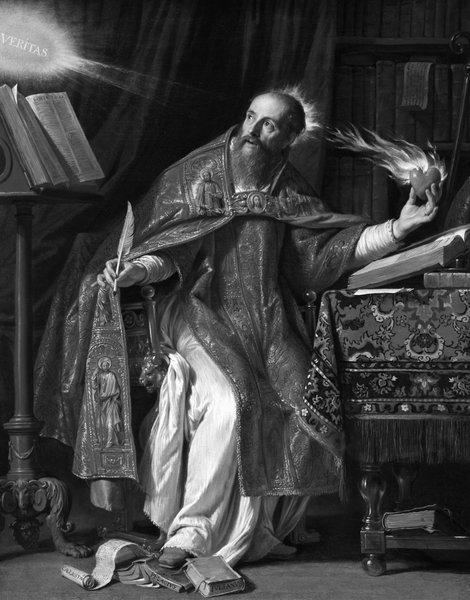
At sixteen, Augustine and his friends stole a tree's worth of pears they didn't even want and threw them to the pigs. Thirty years later, as a bishop, he wrote the whole story of his restless life as one long prayer to God: the lies, the ambition, the nine years in a strange religion, the woman he loved and sent away, the friend he lost, the mother who never stopped crying for him, and a child's voice in a garden in Milan. This teen edition retells the Confessions in plain English, quoting Augustine's own words throughout.
Most life stories begin with “I was born.” This one begins with a prayer. Augustine wrote the Confessions in his mid-forties, around the year 400, when he was already a bishop in North Africa. He did not write it to you. He wrote it to God, addressing him as “Thou” on almost every page, and you get to listen
Contents
- 1 Restless 3 min
- 2 Pears for the Pigs 3 min
- 3 A Cauldron of Unholy Loves 3 min
- 4 The Son of These Tears 3 min
- 5 Half of My Soul 3 min
- 6 A Lie at the Harbour 3 min
- 7 To Milan I Came 3 min
- 8 Absent While Present 3 min
- 9 Torn and Bleeding 3 min
- 10 Only Not Yet 3 min
- 11 Take Up and Read 3 min
- 12 At the Window in Ostia 4 min
- 13 Memory, Time and Rest 3 min
Questions and Answers
Who was Augustine?
Augustine of Hippo (354–430) was a North African, born in Thagaste in what is now Algeria. He was a brilliant teacher of public speaking who spent years chasing success, pleasure and answers. He became a Christian in Milan in 386, was baptised the next year, and later served for more than thirty years as bishop of Hippo, writing books that shaped Christian thinking for centuries.
Is this book honest about the hard parts?
Yes. It keeps the stolen pears, the lies, the years in a religious movement he later rejected, and his sexual history: he lived for about fifteen years with a woman he never married, had a son with her, sent her away to make a better marriage, and took someone else. It names that plainly, and says plainly that sending her away was a wrong done to her.
What does “our heart is restless, until it repose in Thee” mean?
It is from the first page of the Confessions. Augustine means that God made people for himself, so nothing smaller than God can satisfy them. Every chase in the book, after praise, pleasure, cleverness and love, is that restlessness at work until it finds rest in God.
Did Augustine really pray “Give me chastity and continency, only not yet”?
Yes, by his own account, as a teenager. He tells it in Book VIII against himself: he was afraid God would answer quickly and take away desires he still wanted to satisfy. It has become the classic picture of putting off doing what you know is right.
What happened in the garden in Milan?
In 386, torn between his old habits and God, Augustine wept under a fig tree and heard a child's voice chanting “Take up and read.” He opened Paul's letters at Romans 13:13–14, and his doubt vanished. His friend Alypius read the next verse and joined him.
How did Augustine treat the people closest to him?
Both well and badly, and he says so. He was a loyal, warm friend, and he grieved deeply. But he lied to his mother to escape her at a harbour, and he sent away the faithful mother of his son. He confesses all of it without excuses and gives God the credit for whatever good there was.
What is the Confessions, and why did Augustine write it?
A long prayer to God telling his life story, written around 397 to 400, when he was a bishop in his mid-forties. He wrote it to praise God's mercy, to tell honestly what he had been and what he still was, and to stir up his readers to turn to God. The quotations here are from E. B. Pusey's 1838 translation.
What can a teenager take from it?
That restlessness is a signal, not a flaw; that crowds and habits can pull you further than you mean to go; that “not yet” has no end date; that people praying for you are not wasting their time; and that God is closer than you think: “Thou wert with me, but I was not with Thee.”
Read in your language
More like this


Cite this book
Copy a citation in the style you need.
- MLA
- Augustine of Hippo. Confessions (For Teens). Ochorus, https://ochorus.com/books/confessions-teens/.
- Chicago
- Augustine of Hippo. Confessions (For Teens). Ochorus. https://ochorus.com/books/confessions-teens/.
- Chicago footnote
- Augustine of Hippo, Confessions (For Teens) (Ochorus), https://ochorus.com/books/confessions-teens/.
- BibTeX
- @book{augustineofhippoconfessions, author = {Augustine of Hippo}, title = {{Confessions (For Teens)}}, publisher = {Ochorus}, url = {https://ochorus.com/books/confessions-teens/} }