New to Richard Baxter? Start with
The Reformed Pastor
All works · 11 hr 36 min read
Biography
- 1615 Born
- 1641 Kidderminster
- 1656 Reformed Pastor
- 1691 Died
And thus (without any means but Books) was God pleased to resolve me for himself.
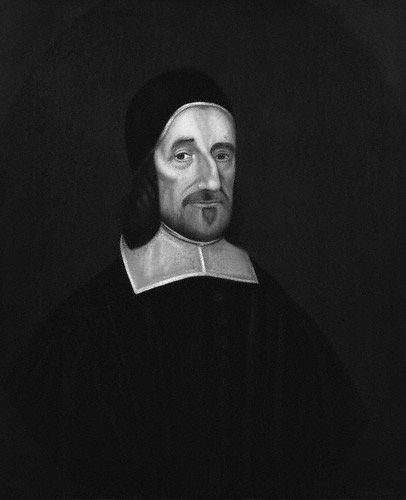
Richard Baxter preached as a man who expected to die — not as a turn of phrase, but as a plain reading of his own body. For some fifty years he carried an assortment of illnesses that his physicians could neither name nor mend, and he began nearly every work of his life on the assumption that he would not live to finish it. He was wrong about that for half a century. In the meantime he wrote something in the region of a hundred and sixty books, turned a careless weaving town into one of the most famous parishes in England, refused a bishopric, lost his pulpit, and was hauled before the cruellest judge of the age. He is one of the strangest and most human figures the English church has produced: a man of enormous tenderness who could not stop arguing, a peacemaker who quarrelled, a dying man who outlived nearly everyone who pitied him.
A Shropshire Boyhood, and a Book at the Door
He was born on 12 November 1615 at Rowton in Shropshire, in his maternal grandfather’s house, and baptised at High Ercall. His father was also called Richard Baxter; his mother was Beatrice, born Adney. In February 1626 the family moved to Eaton Constantine. The religious instruction available to him as a boy was, by his own reckoning, poor — a succession of local clergy of varying seriousness — and the awakening of his conscience came not through a preacher but through second-hand books that arrived almost by accident.
The first was lent to his father by a poor day-labourer of the town: an old, torn copy of what Baxter calls Bunny’s Resolution — a devotional book written by Parsons the Jesuit and corrected for Protestant use by Edmund Bunny. Reading it, Baxter felt his heart moved as no sermon had yet moved it. Then a pedlar came to the door with ballads and a few good books, and his father bought Richard Sibbes’s The Bruised Reed. That book, he wrote, “opened more the Love of God to me, and gave me a livelier apprehension of the Mystery of Redemption.” Later a household servant turned out to own a fragment of William Perkins’s works, and that confirmed him. Neither he nor his father, he admitted, then knew a single person with any real understanding of religion; he had never so much as heard anyone pray without a book.
And thus (without any means but Books) was God pleased to resolve me for himself.
— Richard Baxter, Reliquiae Baxterianae
It is worth pausing on that sentence, because it explains a great deal of what followed. Baxter was converted by print, in a house with no Christian conversation in it. For the rest of his life he behaved as though a book pressed into the right hands could do what he himself could not travel far enough or live long enough to do.
The Want of Academical Honours
Baxter never attended university. This was not a Puritan principle or a pose of humility; it was a disappointment, and he said so. He had gone to the free school at Wroxeter under a schoolmaster named John Owen, and had done well enough at Latin to be ready for Oxford. Then, as he put it, “When I was ready for the University, my Master drew me into another way which kept me thence, where were my vehement desires.” He was sent instead to Ludlow Castle to read with Richard Wickstead, chaplain to the Council there. The Oxford he wanted never happened, and he felt the lack of it for sixty years. He knew exactly what it would cost him: “I knew that the want of Academical Honours and Degrees was like to make me Contemptible with the most, and consequently hinder the Success of my Endeavours.”
So he taught himself, ferociously and unsystematically, and the self-teaching shows in everything he wrote — the enormous range, the impatience with schools of thought, the habit of settling every question personally from first principles as though no one had asked it before. In 1638 he became master of the free grammar school at Dudley and was ordained by John Thornborough, Bishop of Worcester. He moved on to Bridgnorth in Shropshire for nearly two years. He was, by then, a young man in a hurry, and already unwell.
Kidderminster
In the spring of 1641, at twenty-six, he was invited to Kidderminster in Worcestershire, a town of handloom weavers, and was legally appointed on 5 April. The parish held around eight hundred families. Its previous ministry had been negligible, and its reputation was for drink and ignorance.
What Baxter did there over the next two decades became the model that half the pastors of England would afterwards try to copy. He preached, of course. But he was equally convinced that preaching alone would not do it, and so he and his assistant set aside two days a week and took fourteen families every week, working through the parish family by family, sitting down with each household in turn, no strangers admitted — aiming to cover the whole parish in a year and then begin again. Out of this practice came The Reformed Pastor (1656), the book that made personal, house-by-house catechising a Puritan ideal rather than an eccentricity. He kept, by his own count, six hundred communicant members out of those eight hundred families, and he would not gather a select congregation of the willing out of the parish: “I think Parish Work the best.”
The results embarrassed him to describe. He described them anyway, because, as he said, he owed God the sacrifice of thanksgiving and would not withhold it for fear of being thought proud. The congregation outgrew the building and they had to put in five galleries. On Sundays, walking through Kidderminster, you could hear a hundred families singing psalms and going over the sermon in their houses.
when I came thither first, there was about one Family in a Street that worshipped God and called on his Name, and when I came away there were some Streets where there was not past one Family in the side of a Street that did not so
— Richard Baxter, Reliquiae Baxterianae
He never got over it. “O what am I, a worthless Worm,” he wrote, “not only wanting Academical Honours, but much of that Furniture which is needful to so high a Work, that God should thus abundantly encourage me, when the Reverend Instructors of my Youth, did labour Fifty years together in one place, and could scarcely say they had Converted one or two of their Parishes!”
It was at Kidderminster, too, that a young gentlewoman named Margaret Charlton arrived — proud, fashionable, fond of romances, openly disdainful of the poor weavers of the town — and was converted under his preaching on conversion. Soon afterwards she fell into what Baxter called “a Cough and seeming Consumption, in which we almost despaired of her life.” He and his praying neighbours could not bear that someone so newly changed should be taken away at once, and they resolved to fast and pray for her. She recovered.
The War, and the Chaplain
The Civil War broke out in August 1642 and Baxter, who wanted no part of it, was swept into it anyway. He tried neutrality, found the town unsafe, retired to Gloucester, then to Coventry with some thirty other fugitive ministers, where he served as chaplain to the garrison. After the Battle of Naseby he became chaplain to Colonel Edward Whalley’s regiment, on the advice of the Coventry ministers, and stayed until early 1647. He attended sieges but never fought. What he found in the New Model Army alarmed him permanently: a swarm of sectaries and enthusiasts arguing every doctrine of the faith into fragments, and he spent his chaplaincy trying, largely unsuccessfully, to argue them back.
In 1647 his body finally stopped him. A catastrophic nosebleed — one of many — ended his army service and left him languishing for months. Characteristically, he read providence into it, and reckoned afterwards that God had taken him out of the army before the army killed him.
Written in the Time of His Languishing
Baxter’s health is not a footnote to his life; it is the engine of it. He suffered from violent nosebleeds “in such excessive quantities, as often threatned my Life,” which he eventually concluded came from “Latent Stones in my Reins, occasioned by unsuitable Diet in my Youth” — kidney stones. To that were added a rheumatic head, a stomach that he said turned everything into wind, blood so sharp it excoriated his fingertips, and, after years of bleeding by physicians, a condition he named Praematura Senectus: premature old age, the infirmities of a man of eighty added to all the rest. He reckoned two great mercies in it. The first was that for all his bodily misery, he was never overwhelmed with real melancholy.
Convalescing at the house of Lady Rouse at Rous Lench in Worcestershire, far from home, with no book to consult but his Bible, and in continual expectation of death for months together, he wrote The Saints’ Everlasting Rest. He wrote it for himself, as a dying man’s meditation on the country he expected to enter within the year. Its title-page said as much: written by the author for his own use in the time of his languishing, when God took him off from his public employment. He then preached it at Kidderminster and published it in 1650, and it became one of the most loved devotional books in the English language. He lived another forty-one years.
Still thinking I had little time to live, My fervent heart to win mens Souls did strive.
I Preach’d, as never sure to Preach again, And as a dying man to dying men!
— Richard Baxter, Poetical Fragments (1681)
The Bishopric Refused
At the Restoration in 1660 Baxter came to London, was made a chaplain to the King, and for a short season stood near the centre of English religious life. He worked at the Savoy Conference of 1661 for a settlement broad enough to hold the moderate Puritans inside the Church of England, and drafted a Reformed Liturgy for the purpose. It was rejected.
Then came the offer. Colonel Birch approached him privately on behalf of the Lord Chancellor with the bishopric of Hereford — privately, Baxter noticed, so that a bishopric might not be publicly refused. Baxter would not give a flat denial while there was any hope of a broad settlement, but he was never in any doubt: “I told him that I was resolved never to be Bishop of Hereford, and that I did not think that I should ever see cause to take any Bishoprick.” He would live peaceably under whatever government the King set up, he said; he could not have a hand in executing it.
On 16 May 1662 he preached his farewell in the great church at Blackfriars. The Act of Uniformity required every minister to conform by St Bartholomew’s Day, 24 August 1662. Baxter did not conform. Nearly two thousand ministers went out with him in what became known as the Great Ejection — Black Bartholomew, the Dissenters called it — and English Nonconformity was born. Baxter was forty-six, and would never hold a parish again. He never returned to Kidderminster.
Three weeks later, on 10 September 1662, he married Margaret Charlton at Bennet-Fink Church. He was newly ejected, without a living, in poor health, and much older than she was; the marriage lasted nineteen years and was, by every surviving account including his own, exceptionally happy. Margaret managed their precarious life through the persecutions, and when she died on 14 June 1681 Baxter sat down within six weeks and wrote A Breviate of the Life of Margaret Baxter — a grieving husband’s memoir so candid about her gifts, her nerves, and her superiority to him in practical judgement that it remains one of the most moving documents of Puritan marriage.
The same year he published Poetical Fragments, verse written mostly for himself and for near friends in sickness. Among them was a hymn he called “The Covenant and Confidence of Faith,” to which he attached a single quiet footnote: This Covenant my Dear Wife in her former Sickness subscribed with a cheerful will.
Persecution, and the Trial
The years after 1662 were shabby and grinding. He retired to Acton to study. He was imprisoned for holding a conventicle and got out on habeas corpus. His licence to preach was withdrawn; a meeting house he opened in Oxendon Street was shut after a single use. In 1680 officers came to his house and carried off his books and goods. In 1684 he was hauled three times to the sessions house and bound over for £400.
In February 1685 he was arrested on a charge of libelling the Church of England in his Paraphrase on the New Testament. He came to trial at the Guildhall on 30 May 1685 before Sir George Jeffreys, the Lord Chief Justice, whose brutality is not a matter of legend but of record. Baxter was sixty-nine and physically wrecked. Jeffreys had no intention of trying the case; he abused the old man from the bench, and the defence Baxter had prepared was never allowed to be heard. He was convicted, fined 500 marks, and imprisoned until it should be paid. He stayed in prison about eighteen months, until the government remitted the fine and let him go in late 1686. He published no account of the trial in his lifetime.
I now see more Good and more Evil in all Men than heretofore I did: I see that Good men are not so good, as I once thought they were, but have more Imperfections… And I find that few are so bad, as either their malicious Enemies, or censorious separating Professors do imagine.
— Richard Baxter, Reliquiae Baxterianae
That is Baxter reviewing his own mind in old age, and it is the nearest thing he ever wrote to a self-portrait. He was an irenic man who spent his life in controversy and knew it. He longed for Christian unity and managed to fall out with almost every party that might have supplied it — bishops, Independents, the army sectaries, and a fair number of his own allies. He wrote too much, conceded too little in argument, and repented of the sharpness afterwards. He is not improved by being tidied up.
Almost Well
After the indulgence of 1687 his last years were quiet. He served, unpaid, as assistant to Matthew Sylvester, valuing the younger man’s meekness and sound principles, and supplying from the pulpit what Sylvester lacked in delivery. He kept writing to the end.
When a visitor near the close asked how he did, Baxter answered: “Almost well.” The day before he died, Dr William Bates came and offered some words of comfort, and Baxter replied: “I have pain: there is no arguing against sense; but I have peace: I have peace!” He died at about four o’clock on the morning of Tuesday, 8 December 1691, aged seventy-six. Churchmen and Dissenters came to the funeral together, which in that year in that city meant something. He was buried beside Margaret and her mother in Christ Church, Newgate, and Bates preached the sermon.
Five years later Sylvester published the mass of autobiographical papers Baxter had left him as Reliquiae Baxterianae — sprawling, indiscreet, unrevised, and one of the great memoirs in the language. In it a man with no degree, no health, no pulpit for the last twenty-nine years of his life, and no talent whatever for leaving an argument alone, gives God the credit for a street in Kidderminster where the psalms could be heard through the windows.
Books by Richard Baxter (2)
Books about Richard Baxter (1)
Also appears in
Articles about Richard Baxter (5)
Questions and Answers
Did Richard Baxter really never attend university?
He did not, and he felt the lack of it all his life. Ready for Oxford after his schooling, he was instead sent to read privately at Ludlow Castle, and the university he wanted never happened. He taught himself ferociously and unsystematically, knowing that the want of academical honours would make him "Contemptible with the most" — and his conversion had come the same way, through second-hand books at his father's door rather than any preacher, so that for the rest of his life he trusted print to reach where he himself could not.
Is it true he was sick for most of his life?
For some fifty years Baxter carried illnesses his physicians could neither name nor cure — violent nosebleeds he traced to kidney stones, a ruined stomach, and what he called premature old age. He began nearly every book expecting not to live to finish it, and he was wrong about that for half a century. It was during one such near-fatal spell, convalescing far from home with only his Bible, that he wrote The Saints' Everlasting Rest as a dying man's meditation on heaven.
What made his ministry at Kidderminster so famous?
Invited in 1641 to a careless weaving town of some eight hundred families known for drink and ignorance, Baxter spent two decades transforming it. By the time he left he reckoned six hundred communicants among those families, the congregation had outgrown its building, and on Sundays you could hear whole streets singing psalms and going over the sermon in their houses. Where he had found perhaps one worshipping family in a street, he left streets where scarcely one family did not.
How did he manage to pastor so many people personally?
Baxter was convinced preaching alone would not do it, so he and his assistant set aside two days a week to take fourteen families at a time, working through the whole parish household by household and then beginning again. Out of that practice came The Reformed Pastor (1656), which made patient, house-by-house catechising a Puritan ideal rather than an eccentricity. He refused to gather only the willing into a select congregation, saying plainly, "I think Parish Work the best."
What did he do during the English Civil War?
Baxter wanted no part of the war but was swept into it, serving as a chaplain to the Coventry garrison and then to Colonel Edward Whalley's regiment after Naseby. He attended sieges but never fought, and what he found in the army alarmed him: sectaries arguing every doctrine into fragments, whom he spent his chaplaincy trying to reason back. A catastrophic nosebleed ended his service in 1647, and he reckoned afterward that God had taken him out of the army before it killed him.
Why did he lose his pulpit in 1662?
At the Restoration Baxter worked for a church settlement broad enough to keep moderate Puritans inside the Church of England, and even quietly refused the offered bishopric of Hereford. When the Act of Uniformity required every minister to conform by St Bartholomew's Day 1662, he could not, and went out in the Great Ejection alongside nearly two thousand others. He was forty-six, and never held a parish again.
Is the story of his trial before Judge Jeffreys true?
It is, and it is not legend but record. In 1685, aged sixty-nine and physically wrecked, Baxter was tried for supposedly libelling the Church of England in his Paraphrase on the New Testament, before Sir George Jeffreys, the Lord Chief Justice. Jeffreys had no intention of trying the case fairly; he abused the old man from the bench and never let his prepared defence be heard. Baxter was convicted, fined, and imprisoned for about eighteen months until the fine was remitted.
What was his marriage to Margaret Charlton like?
Margaret was a proud, fashionable young gentlewoman converted under his preaching at Kidderminster; they married three weeks after his ejection, when he was without a living and much older than she. The marriage lasted nineteen years and was, by every account including his own, exceptionally happy, with Margaret steering their precarious life through the persecutions. When she died in 1681 he wrote A Breviate of the Life of Margaret Baxter within weeks — a grieving husband's memoir remarkably candid about her gifts and her better practical judgement.
What did he write, and what is he best known for?
Baxter produced something in the region of a hundred and sixty books, an astonishing output for so sick a man. Best loved are The Saints' Everlasting Rest, a meditation on heaven, and A Call to the Unconverted, a plain and urgent evangelistic appeal, while The Reformed Pastor shaped generations of ministers. He is also remembered for the couplet from his Poetical Fragments (1681): "I preach'd, as never sure to preach again, / And as a dying man to dying men!"
Did Baxter coin the saying about unity in necessary things?
He genuinely urged that principle — "unity in things necessary, liberty in things unnecessary, and charity in all" — as the heart of his lifelong plea for peace among Protestants, though the famous formula is older than Baxter and not original to him. He was an irenic man who spent his life in controversy and knew it, confessing in old age that good men were less good, and bad men less bad, than he had once supposed. Asked near the end how he did, he answered, "Almost well"; he died on 8 December 1691, aged seventy-six, and churchmen and Dissenters came to his funeral together.