New to John Chrysostom? Start with
On the Priesthood
All works · 6 hr 57 min read
Biography
- 347 Born
- 381 Deacon
- 387 The Statues
- 398 Archbishop
- 403 Deposed
- 407 Died
When I was driven from the city, I felt no anxiety, but said to myself: If the empress wishes to banish me, let her do so; the earth is the Lord's. If she wants to have me sawn asunder, I have Isaiah for an example. I…
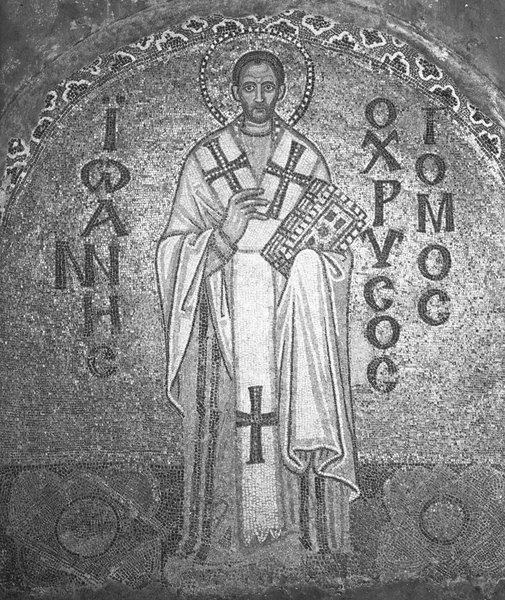
They did not call him Chrysostom while he lived. The name is Greek for golden-mouthed, and the church gave it to him afterwards, because for sixteen years in Antioch and six in Constantinople people packed the churches to hear a small, thin, ascetic man explain the Bible verse by verse, and could not get enough of it. He is the greatest preacher the ancient church produced. He is also the preacher it exiled, marched to death across Asia Minor, and then, thirty-one years too late, carried home in state.
He was born in Antioch around AD 347. His father Secundus, an officer in the Syrian army, died while he was an infant. His mother Anthusa was left a widow at twenty, refused every offer of remarriage, and raised her son and daughter alone. She did it so conspicuously well that the greatest pagan orator of the age, Libanius, on hearing about her, exclaimed: Bless me, what wonderful women there are among the Christians.
The lawyer who ran away
Anthusa gave her son the best education money could buy, which meant Libanius himself. John was his finest pupil. He went into the courts, where a gifted advocate could climb to prefect or consul, and by his own account he took to the life completely: he was, he says, a never-failing attendant at the courts of law, and passionately fond of the theatre.
It did not hold. What broke it was the ordinary corruption of the trade, taking a fee to make the worse case look the better, which struck him as accepting Satan's wages. He was baptised in his early twenties and wanted to leave at once for the monks in the mountains. His mother stopped him. She took him into the room where he had been born, sat him down by the bed, and asked him for one thing: not to make her a widow a second time.
He stayed. What he did instead was turn the house into a monastery, eating little and seldom and only the plainest food, sleeping on the bare floor, rising through the night to pray, and keeping almost unbroken silence in order to break himself of the habit of speaking ill of people. His old friends from the courts called him unsociable and morose. Only after Anthusa died did he go to the mountains, and there, in four years under an old Syrian monk and two more alone in a cave, he ruined his health for good. His stomach and kidneys never recovered. He came back down to Antioch an invalid, and remained one for the rest of his life.
Long afterwards Libanius, near death and asked whom he wished to succeed him, is said to have answered: John, if only the Christians had not stolen him from us.
Ordained deacon in 381 and presbyter in 386, he began to preach, and the city discovered what it had. He worked through whole books of the Bible in sequence, taking the plain sense, refusing allegory where the text did not invite it, and then turning without warning from exegesis to the people in front of him: their money, their servants, their theatre-going, their treatment of the poor. He is exceptionally hard on wealth and exceptionally warm to the actual poor, and after sixteen hundred years the discomfort has not worn off.
The year the city expected to die
In the spring of 387 a new tax provoked a riot in Antioch, and the mob did the one unforgivable thing: they pulled down the bronze statues of the emperor Theodosius and dragged them through the streets, including the statues of his late wife and his sons. When the city sobered up it understood that it might be destroyed. Cities had been.
Into that terror Chrysostom preached twenty-one sermons over Lent, the Homilies on the Statues, while the bishop Flavian made the journey to plead in person with the emperor. They are the sermons of a pastor holding a panicking congregation together day by day, alternating between comfort and unsparing moral demand.
From those Antioch years also comes his treatise on the priesthood, cast as a conversation with his friend Basil, and still the most searching book on pastoral ministry the early church produced. Its argument is that the work is so weighty, and the soul of the man who does it so exposed, that fleeing from it may be the sanest response, and it is written by someone who had fled from it himself.
Taken to the capital
In 397 the see of Constantinople fell vacant, and John was chosen without being consulted. He was got out of Antioch under military escort, to prevent the congregation rioting, and consecrated in February 398 by Theophilus of Alexandria, who wanted the appointment for his own candidate and never forgave him.
He was a disastrous choice from the court's point of view, which is to say the right one. He cut the episcopal household budget to nothing and sold the palace furnishings and the church silver to build hospitals. He disciplined clergy who lived comfortably. He preached at the capital exactly as he had preached at Antioch, on luxury, greed and the poor, in a city where the empress Eudoxia's household embodied all three. He was warned. He kept going, and at some point he preached a sermon on Jezebel that nobody at court mistook for a purely historical study.
In 403 Theophilus arrived with a bodyguard and a chest of presents, convened thirty-six mostly Egyptian bishops at a suburb across the Bosphorus, and had Chrysostom deposed in absentia on twenty-nine charges, including immorality, treason, eating alone, and calling the empress Jezebel. He refused to appear before a packed court, and when the sentence came he would not let the city fight for him: a word would have raised an insurrection, and he gave himself up to the officers instead.
Constantinople erupted anyway. The people besieged the palace; that night an earthquake shook the city and terrified Eudoxia into begging her husband to bring him back. Messengers went out with apologies, a fleet of small boats rowed out to meet him, the Bosphorus filled with torches and singing, and the people carried him bodily into the church and made him preach. It lasted a few months.
When I was driven from the city, I felt no anxiety, but said to myself: If the empress wishes to banish me, let her do so; the earth is the Lord's. If she wants to have me sawn asunder, I have Isaiah for an example. If she demands my head, let her do so; John the Baptist shines before me. Naked I came from my mother's womb, naked shall I leave this world.
— John Chrysostom, letter to Bishop Cyriacus
The road to Comana
The second exile, in 404, was final. He was sent to Cucusus in the Armenian mountains, and from there he kept writing: a stream of letters to his friends, and above all seventeen to Olympias, the wealthy young widow who had become a deaconess and given her fortune away, and who was now heartbroken and ill. For her he wrote the treatise arguing that no one is really injured except by himself.
Eudoxia, still not satisfied, forbade correspondence and ordered him moved to Pityus on the Caucasus, the most inhospitable posting in the empire. The guards took a sick sixty-year-old man on foot for three months. He never arrived. On 14 September 407, five or six miles short of Comana in Pontus, he was carried into the chapel of the martyr Basiliscus, put on white baptismal robes, received communion, and commended his soul to God. His last words were his old doxology: Glory be to God for all things. Amen.
They buried him beside Basiliscus. Thirty-one years later, in 438, his body was brought back to Constantinople and laid beneath the altar of the church of the Holy Apostles among the emperors and patriarchs. The young emperor Theodosius II and his sister Pulcheria, the children of Eudoxia and Arcadius, met the coffin at Chalcedon, knelt down before it, and asked heaven's forgiveness in their parents' names for what had been done to him.
What survives is enormous: more of Chrysostom's preaching has come down to us than of any other Greek father, because people wrote it down as he spoke. Read him for the exegesis if you like, but read him first for the tone. He assumes the person in front of him can change, and he will not let go of that assumption, whether he is arguing a friend back from a broken vow, or telling a terrified city that God has not abandoned it, or writing from a mountain village to a woman whose life has come apart, insisting that no one can really be harmed except by himself.
Books by John Chrysostom (1)
Sermons by John Chrysostom (5)
Also appears in
Questions and Answers
Who was John Chrysostom?
He was the greatest preacher the ancient church produced. "Chrysostom" is Greek for "golden-mouthed," a name the church gave him afterwards, because for sixteen years in Antioch and six in Constantinople people packed the churches to hear a small, thin, ascetic man explain the Bible verse by verse and could not get enough of it. He is also the preacher the church exiled, marched to death across Asia Minor, and then, thirty-one years too late, carried home in state.
Who was his mother, Anthusa?
His father, an officer in the Syrian army, died while John was an infant, and his mother Anthusa was left a widow at twenty. She refused every offer of remarriage and raised her son and daughter alone, so conspicuously well that the greatest pagan orator of the age, Libanius, on hearing about her, exclaimed, "Bless me, what wonderful women there are among the Christians."
Why did the lawyer abandon the courts?
Anthusa gave him the best education money could buy — Libanius himself, whose finest pupil he became — and he went into the courts, where a gifted advocate could rise to prefect or consul. What broke it was the ordinary corruption of the trade: taking a fee to make the worse case look the better struck him as accepting Satan's wages. Baptised in his early twenties, he wanted to leave at once for the monks in the mountains.
Why did he not become a monk immediately?
His mother stopped him. She took him into the room where he had been born, sat him down by the bed, and asked him for one thing: not to make her a widow a second time. He stayed, turning the house into a monastery — eating little, sleeping on the bare floor, rising through the night to pray. Only after Anthusa died did he go to the mountains, where four years under an old monk and two more alone in a cave ruined his health for good.
What were the Homilies on the Statues?
In the spring of 387 a new tax provoked a riot in Antioch, and the mob pulled down the bronze statues of the emperor and dragged them through the streets. When the city sobered up it understood it might be destroyed. Into that terror Chrysostom preached twenty-one sermons over Lent, holding a panicking congregation together day by day, while the bishop Flavian made the journey to plead with the emperor — who granted pardon, so that the calamity was turned into a blessing to the church.
What is his treatise on the priesthood?
Cast as a conversation with his friend Basil, it is still the most searching book on pastoral ministry the early church produced. Its argument is that the work is so weighty, and the soul of the man who does it so exposed, that fleeing from it may be the sanest response — and it is written by someone who had fled from it himself. It comes from his years at Antioch, before the weight he described fell on him in earnest.
Why did his ministry at Constantinople make enemies?
Chosen for the capital in 397 without being consulted and got out of Antioch under military escort, he preached there exactly as he had at Antioch — on luxury, greed and the neglected poor — in a city where the empress Eudoxia's household embodied all three. He cut the episcopal budget to nothing, sold the palace furnishings and church silver to build hospitals, and disciplined comfortable clergy. He was warned, and kept going.
What happened at the Synod of the Oak?
In 403 Theophilus of Alexandria arrived with a bodyguard, convened thirty-six mostly Egyptian bishops across the Bosphorus, and had Chrysostom deposed in absentia on twenty-nine charges — including treason, eating alone, and calling the empress Jezebel. He refused to appear before a packed court and would not let the city fight for him, giving himself up to the officers; Constantinople erupted anyway, and an earthquake that night so terrified Eudoxia that he was briefly brought back.
How did he die?
The second exile, in 404, was final. Sent to Cucusus in the Armenian mountains, he kept writing — seventeen letters to the deaconess Olympias among them, and a treatise arguing that no one is really injured except by himself. Ordered on to the most inhospitable posting in the empire, the guards took a sick sixty-year-old on foot for three months; he never arrived, dying on 14 September 407 near Comana with his lifelong motto on his lips: "Glory be to God for all things."
How was he vindicated, and what did he leave?
Thirty-one years after his death, in 438, his body was brought back to Constantinople and laid beneath the altar among the emperors and patriarchs; the young emperor Theodosius II and his sister Pulcheria, the children of Eudoxia, met the coffin and knelt before it, asking heaven's forgiveness in their parents' names. More of Chrysostom's preaching has come down to us than of any other Greek father, because people wrote it down as he spoke — read him first for the tone, which assumes the person in front of him can change.