Book · 26 chapters · 4 hr 34 min read
Portraits of Courage – Praying Hyde
The Life, Prayers, and Hidden Courage of a Missionary to the Punjab
Book 2 of 5 in Portraits of Courage·Next in the series: Portraits of Courage – Corrie ten Boom
Free to read·No account needed
Preface
About this book
A Christian biography of John “Praying” Hyde (1865–1912), the American Presbyterian missionary to the Punjab remembered above all as a man of prayer. It follows him from an Illinois parsonage through slow, misunderstood years in India to the Sialkot Conventions, the soul-a-day years, and his death — keeping what the records show apart from the legend, and weighing his example under Scripture. Written with gratitude but not hagiography; all Scripture from the public-domain ASV (1901).
“Pray ye therefore the Lord of the harvest, that he send forth laborers into his harvest.” — Matthew 9:38, ASV Long before anyone called John Hyde a man of prayer, he grew up listening to one. His father, the Rev. Smith Harris Hyde, was a Presbyterian minister in western Illinois.
Contents
- 1 Preface 5 min
- 2 Introduction: One Man, Two Little Books, and a Legend 8 min
- 3 A Minister’s Son from Carthage 11 min
- 4 “It Is Settled” 10 min
- 5 The Letter on the Ship 11 min
- 6 The Sin That Had Not Been Taken Away 11 min
- 7 Slow of Speech and Hearing 11 min
- 8 The Punjab He Entered 11 min
- 9 Preparing the Messenger 11 min
- 10 The Half-Hour Rule 11 min
- 11 Sialkot: “Is the Holy Spirit First?” 12 min
- 12 The Prayer Room 14 min
- 13 “Give Me Souls, or I Die” 12 min
- 14 A Soul a Day, and “What About That One?” 12 min
- 15 The Accuser of the Brethren 10 min
- 16 The Garment of Praise 11 min
- 17 Tears at a Train Window 15 min
- 18 The Cross He Could Not Stop Preaching 13 min
- 19 A Heart on the Wrong Side 11 min
- 20 Wales, Shrewsbury, and a Hymn That Sang Him Down 14 min
- 21 “Victory, Victory, Victory” 9 min
- 22 The Legacy of Praying Hyde 10 min
- 23 Appendix A: Twenty-Five Lessons from Hyde’s Prayer Life 7 min
- 24 Appendix B: Chapter-by-Chapter Study and Reflection Guide 9 min
- 25 Appendix C: Chronology of the Life and Times of John Hyde 6 min
- 26 Appendix D: Notes on Sources and Method 8 min
Questions and Answers
What is the biography Praying Hyde about?
It is a Christian biography of John Hyde (1865–1912), the American Presbyterian missionary to the Punjab known as “Praying Hyde.” It follows his life from a minister’s home in Illinois through twenty years in India — slow early years, the Punjab Prayer Union, the Sialkot Conventions, his long nights of intercession, and his death in 1912 — and draws out what his prayer life teaches under Scripture.
Who was John Hyde?
John Nelson Hyde was a missionary of the Presbyterian Church in the U.S.A. to the Punjab, in what is now Pakistan and north-west India, from 1892 until his death in 1912. Deaf, slow of speech, and shy, he became known for giving himself day and night to prayer, so that Punjabi villagers called him “the man who never sleeps,” and for his part in the revival that began at the Sialkot Convention in 1904–05.
How does this book treat the legends about Praying Hyde?
It keeps them apart from the record. Almost everything vivid about Hyde comes from two devotional memoirs of 1923, so the book says which friend each story comes from, checks it against mission reports, church magazines, and a colleague’s obituary, and corrects what the popular accounts got wrong — such as the place of his death (Northampton, Massachusetts, not Clifton Springs) and the unverified “soul a day” totals.
Did prayer really move Hyde’s heart?
That claim rests on a friend’s memory of one Calcutta doctor saying Hyde’s heart had shifted to the right side of his chest. The book tells the story as his friends told it, explains the ordinary medical causes of a right-sided heart, and leaves the miracle unclaimed — while being honest that his way of life did wear down his health.
What was the Punjab Prayer Union?
A small covenant of Christian workers in the Punjab, begun around April 1904, in which Hyde was one of the moving spirits. Members answered five questions — beginning with prayer for quickening in their own lives — and promised half an hour of prayer each day, as soon after noon as possible, “till the awakening comes.” Its members saw it as the hidden root of the revival that followed.
What can ordinary Christians learn from Hyde’s life?
Not his exact form of prayer, which his own friends warned against copying, but its spirit: preparing the messenger as well as the message, putting the Holy Spirit first, praying persistently for real people, giving thanks instead of accusing others even in prayer, putting on praise before feeling it, and loving the one still missing. Each chapter closes with reflection, and an appendix gathers twenty-five lessons.
How is Scripture used in the book?
Every chapter opens with a passage from the American Standard Version (1901) that carries its theme, and further passages are woven through the story — the promises Hyde prayed, such as “Open thy mouth wide, and I will fill it,” and the texts his life illustrates. All quotations were checked against the ASV text.
Where should a reader begin?
At the beginning, reading in order: the preface and introduction explain the sources, Part One shows how an ambitious young man became an intercessor, Part Two follows the school of prayer he entered in the Punjab, and Part Three his last illness and legacy. The study guide in Appendix B suits a small group reading one chapter a week.
People in this book
More like this

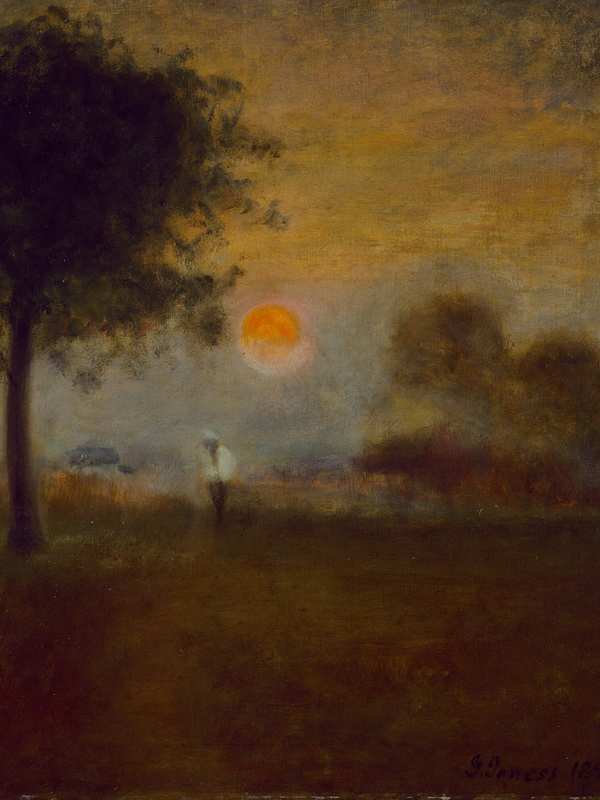
George Inness, “Moonrise” (1891). The Art Institute of Chicago, CC0.