Biography
- 1865 Born
- 1892 To India
- 1899 Prayer nights
- 1904 Prayer Union
- 1908 400 souls
- 1912 Died
Father, give me these souls, or I die!
There is a difficulty at the heart of any life of John Hyde, and it is better to name it at the start than to pretend it away. Almost everything vivid that we know about the man called “Praying Hyde” — the whole nights on the floor, the finger laid on his lips, the heart said to have shifted in his chest — comes to us through a single small devotional book: Francis McGaw’s Praying Hyde, published in 1923, more than a decade after Hyde was dead, and drawn in part from what other people remembered. The hard, checkable facts of his life are thinner and quieter than the legend. This account keeps the two apart on purpose. Where the record is solid, it says so plainly; where the story rests on McGaw and the memories he gathered, it says that too. Hyde does not need to be inflated. What is verifiable is remarkable enough.
A minister’s son from Illinois
John Nelson Hyde was born on 9 November 1865 in Illinois, one of six children of the Reverend Smith Harris Hyde, a Presbyterian minister. His father was a man who prayed, in particular, a specific prayer — that God would send out labourers into the harvest — and it is one of the few threads that runs unbroken from the well-attested record into the legend: the son became, in the end, an answer to the kind of prayer the father had prayed. The household knew the cost of that prayer, too. An elder brother, Edmund, had set out toward the mission field himself and died of fever while still a student.
Hyde graduated from Carthage College in Illinois with high honours in 1887, and went on to McCormick Theological Seminary in Chicago, finishing his training there in 1892. In October of that year he sailed from New York for India. He was twenty-six.
He carried a real disadvantage with him. Hyde was partly deaf — “slow of speech and hearing,” as the phrase went — and this made the early work of learning a new language slow and discouraging. It is worth holding onto, because the man who would later be remembered for fluent, tender preaching in two Indian languages did not begin as an obvious success. His station, throughout his years in India, was Ferozepore in the Punjab; from there he worked the villages of the Ludhiana district, and from about 1906 he had charge of the circle around Moga, where his later years were spent. The deafness never fully lifted, but he became genuinely fluent in Urdu and Punjabi.
The turn toward prayer
The early years were hard and the converts were few. It seems to have been out of that hardness, rather than out of any easy success, that Hyde’s praying life grew. From about 1899 he began to spend whole nights in prayer. This is the root of everything the later devotional writers made of him, and it grew from the least romantic soil there is: a discouraged missionary with little to show, who decided that the answer was not to work harder in front of people but to wait longer before God.
Father, give me these souls, or I die!
— John Hyde, as remembered in Francis McGaw’s Praying Hyde (1923)
That cry is McGaw’s, and its exact wording varies from telling to telling — some render it “O God, give me souls or I die.” It should be read as the shape of the man’s burden as those close to him remembered it, not as a transcript. But the burden itself is not in doubt.
Around April 1904, in the same year as the first of the great annual Sialkot Conventions, a few missionaries began the Punjab Prayer Union, and Hyde was remembered as one of its moving spirits. Its purpose was to pray for a “quickening” — a revival — across the Punjab and across India. Sialkot was not his own station — it was the centre of a sister mission, the United Presbyterians — but he went there for the convention each year, and a colleague who knew him wrote that Hyde was among its leading figures from its first year, 1904, and that from few others had he heard such heart-searching messages. The members of the Union bound themselves to a simple, checkable discipline: to set apart half an hour each day, as soon after noon as they could manage, to pray for the awakening — and to keep on, in the Union’s own words, until the awakening comes.
What the praying was said to do
Out of the Prayer Union and the Sialkot Convention came what mission accounts of the time describe as a genuine outpouring — conventions marked, from 1904 onward, by deep conviction, open confession and renewal. Those who were there credited Hyde’s long, hidden intercession with much of it. This is the most solid of the answers to his prayer: not a private marvel, but a public work that many witnesses saw and named.
The most famous single claim about his fruitfulness belongs partly to the record and partly to tradition, and the two should be kept distinct. The devotional accounts say that in 1908 Hyde prayed for one soul a day, and that something over four hundred were brought in that year; that he then raised his asking to two souls a day, and near the end to four; and that on any day the full number was not reached, there lay on him at night a weight so heavy that he could neither eat nor sleep. Those figures — the four hundred included — come from McGaw and the memories he gathered; no mission statistic of the time has been found to check them. Hyde’s own words, in a letter to his old classmates, are plainer: “over a thousand the past two years,” and “never a day if we were right with God without souls.” What the mission’s own records do show is the field he worked: at Moga, where he had been sowing, baptisms rose steadily for five years and numbered 685 in 1910 — the whole station’s harvest, not a count of one man’s converts, but the ground his praying covered.
The accuser of the brethren
Among the many scenes McGaw recorded, one stands out as both the most trustworthy and the most searching, and it turns not on triumph but on a rebuke Hyde believed he received from God himself. He was praying for revival in the life of an Indian pastor whose faith had gone cold, and he began, as we all begin, by telling God the man’s faults: “O Father, thou knowest how cold —” and got no further. He felt, he said, a finger laid on his lips, and heard the words, He that toucheth him, toucheth the apple of Mine eye. Hyde stopped. What came out of him next was not accusation but repentance.
Forgive me, Father, in that I have been an accuser of the brethren before Thee!
— John Hyde, in Praying Hyde (1923)
From that moment, the account runs, he could only praise the man he had come to criticise. It is among the most reliable of McGaw’s stories, and among the most useful, because it works against the grain of hero-worship. The great intercessor is caught in the oldest sin of the praying person — running down a brother in the presence of God — and is stopped, and turned. Whatever else the legend made of Hyde, this scene shows a man being corrected, not a man being admired.
A worn-out body
The nights and the burden took a toll on his health, and here the honest telling has to be most careful, because it is exactly here that devotion has most often outrun the evidence. The story that was handed down is this: a doctor who examined Hyde found his heart displaced from the left side of his chest to the right, and in the worst condition he had seen, and gave him only months to live unless he rested — the strain of prayer, the telling goes, had physically moved his heart.
It is a moving image, and it should be handled with care. A condition in which the heart sits on the right side of the body has a plain medical name — dextrocardia — and is very often something a person is simply born with. It is entirely possible that this is what the examining doctor found. The reading that prayer shifted a healthy heart is a devotional interpretation laid over the fact, not a medical finding. The right way to hold it is to tell the story as Hyde’s friends told it, and to leave the miracle unclaimed.
Hyde had already gone home to America once, on furlough, reaching New York in May 1901 and sailing back to India in September 1902. He left India for the last time in March 1911. For a season he travelled in Britain, sharing in the evangelistic work of J. Wilbur Chapman. Back in the United States the doctors found the real thing that was killing him — a malignant tumour of the brain.
Northampton, 1912
Here a smaller act of honesty is owed to the reader, because the popular devotional accounts often get the ending wrong. They will tell you Hyde died on the first of February at Clifton Springs. He did not. He died on 17 February 1912, at his sister Mrs. Mensel’s home in Northampton, Massachusetts, at the age of forty-six, and was buried at Carthage, Illinois, near the college where he had begun. The wrong date and place have been copied from book to book for a century; the corrected facts are worth restating simply because they are true.
The last words attributed to him were not in English but in the language of the people he had given his life to. A colleague’s obituary, written that spring, says only that his last words were uttered in Punjabi, and that shortly before, he told his sister, “It’s just victory, victory, victory.” The words themselves come down through W. B. Anderson, as McGaw recorded them: Bol, Yisu Masih, ki jai! — “Shout the victory of Jesus Christ!” The transliteration shifts from source to source; the sense of it is steady. A man who had spent his strength asking God for the souls of the Punjab died with a Punjabi shout of triumph on his lips.
Bol, Yisu Masih, ki jai! — Shout the victory of Jesus Christ!
— the last words remembered of John Hyde, as W. B. Anderson reported them to Francis McGaw
What he leaves
John Hyde wrote no great book; the book that carries his name was written about him, by another man, after he was gone. He left almost nothing in his own hand. What he left instead was a pattern — a discouraged, half-deaf missionary who, finding little fruit in front of people, went behind them and waited on God, and a small prayer union with a half-hour rule that anyone could keep. The father had prayed for labourers; the son became one, and prayed for the harvest itself.
The legend around him should be read for what it is: a devotional tradition, rooted in one 1923 book and in the memories it gathered, that has sometimes said more than can be proved. But strip the tradition back to what the record will bear, and a real man is still standing there — one who asked for a soul a day and saw the villages he prayed over come to baptism by the hundred, who was stopped mid-prayer from accusing a brother and turned to praise instead, and who died far from the Punjab still shouting its Saviour’s victory in its own tongue. That is enough. It was always enough.
Books about John Hyde (3)


Also appears in
Questions and Answers
Who was John Hyde?
John "Praying" Hyde (1865–1912) was an American Presbyterian missionary to the Punjab, remembered above all as a man of prayer — a leading figure of the Sialkot Convention from its first year and one of the moving spirits of the Punjab Prayer Union, remembered as a man who asked God for a soul a day. Much of his vivid reputation comes from Francis McGaw's 1923 devotional book "Praying Hyde," written after his death; the checkable facts are quieter, and remarkable enough on their own.
What was his background?
He was born on 9 November 1865 in Illinois, one of six children of the Reverend Smith Harris Hyde, a Presbyterian minister who prayed a specific prayer — that God would send out labourers into the harvest — so that the son became, in the end, an answer to the kind of prayer the father had prayed. Hyde graduated from Carthage College with high honours in 1887, trained at McCormick Theological Seminary, and sailed from New York for India in October 1892, aged twenty-six.
What disadvantage did he carry?
He was partly deaf — "slow of speech and hearing" — which made the early work of learning a new language slow and discouraging. It is worth holding onto, because the man later remembered for fluent, tender preaching in two Indian languages did not begin as an obvious success. His station throughout his years in India was Ferozepore, from which he worked the villages of the Ludhiana district, and from about 1906 the circle around Moga; the deafness never fully lifted, but he became genuinely fluent in Urdu and Punjabi.
How did his life of prayer grow?
The early years were hard and the converts few, and it was out of that hardness, rather than any easy success, that his praying life grew. From about 1899 he began to spend whole nights in prayer — the root of everything the later devotional writers made of him, grown from the least romantic soil there is: a discouraged missionary with little to show, who decided the answer was not to work harder in front of people but to wait longer before God.
What was the Punjab Prayer Union?
Around April 1904, the year of the first great annual Sialkot Convention, a few missionaries began the Punjab Prayer Union, with Hyde remembered as one of its moving spirits, to pray for a "quickening" — a revival — across the Punjab and across India. Its members bound themselves to a simple, checkable discipline: to set apart half an hour each day, as soon after noon as they could manage, to pray for the awakening, and to keep on, in the Union's own words, "until the awakening comes." It was ordinary, repeatable, and open to anyone.
What did the praying produce?
Out of the Prayer Union and the Sialkot Convention came what mission accounts describe as a genuine outpouring — conventions marked from 1904 by deep conviction, open confession and renewal — and those who were there credited Hyde's long, hidden intercession with much of it. This is the most solid of the answers to his prayer: not a private marvel but a public work that many witnesses saw and named.
What is the story of the soul a day?
The devotional accounts say that in 1908 Hyde prayed for one soul a day and saw something over four hundred brought in that year; that he then raised his asking to two souls a day, and near the end to four; and that on any day the full number was not reached a weight lay on him so heavy he could neither eat nor sleep. Those figures come from McGaw and the memories he gathered, and no mission statistic of the time has been found to check them. Hyde's own letter to his classmates speaks of "over a thousand the past two years." The mission's records show the field he worked: at Moga, baptisms rose for five years and numbered 685 in 1910 — the whole station's harvest, not one man's count.
What is the story of the accuser of the brethren?
It is among the most trustworthy and searching scenes recorded of him. Praying for revival in the life of an Indian pastor whose faith had gone cold, he began, as we all begin, by telling God the man's faults — "O Father, thou knowest how cold —" and got no further. He felt a finger laid on his lips and heard, "He that toucheth him, toucheth the apple of Mine eye." He stopped, and prayed instead, "Forgive me, Father, in that I have been an accuser of the brethren before Thee."
What is the truth about his displaced heart?
The story handed down is that a doctor found his heart displaced from the left side of his chest to the right and gave him months to live — the strain of prayer, the telling goes, had physically moved his heart. It should be handled with care: a heart on the right side of the body has a plain medical name, dextrocardia, and is very often something a person is simply born with. The reading that prayer shifted a healthy heart is a devotional interpretation laid over the fact, not a medical finding.
How did he die?
He left India for the last time in March 1911, travelled in Britain sharing in J. Wilbur Chapman's evangelistic work, and back in America the doctors found what was killing him — a malignant brain tumour. Contrary to the popular accounts, he died on 17 February 1912 at his sister Mrs. Mensel's home in Northampton, Massachusetts, aged forty-six, and was buried at Carthage, Illinois. A colleague's obituary says his last words were in Punjabi, the language of the people he had given his life to, and that he told his sister, "It's just victory, victory, victory." W. B. Anderson, as McGaw records, gave the words as "Bol, Yisu Masih, ki jai!" — "Shout the victory of Jesus Christ!"
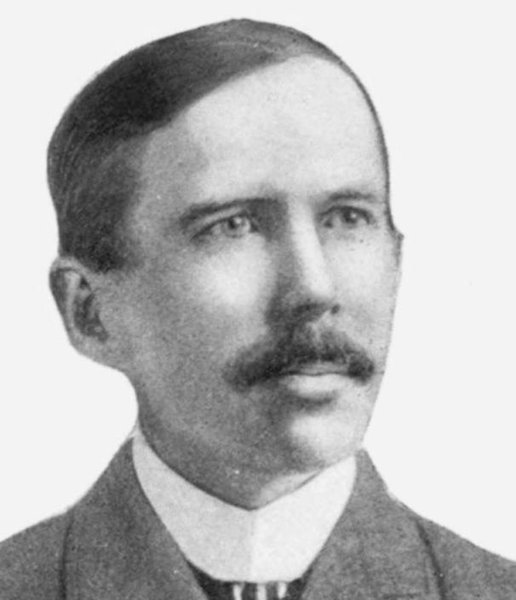
Portrait: Photograph c. 1900s, via Život víry