

Book
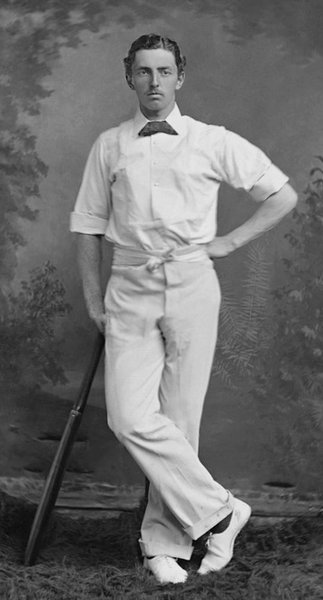
Portraits of Courage – C. T. Studd
A Cricketer for England, a Fortune Given Away, and the Road to the Heart of Africa
- 29 chapters
- 3 hr 56 min read
- Moderate Reading difficulty
Free to read·No account needed
Preface
Taking books where there’s no signal? See Ochorus for missionaries or chaplains
Grow with the story


About this book
A Christian biography of C. T. Studd (1860–1931), the Eton and Cambridge cricketer who played in the 1882 Oval Test that gave the world “the Ashes,” sailed for China with the Cambridge Seven, gave away his inheritance, and at fifty-two went to the north-eastern Belgian Congo, where he founded the mission that became WEC International and died at Ibambi. Built on the public record and checked against modern reference works, it tells the whole story honestly, from the courage and the joy to the quarrels, the morphine, the long separation from his wife and the split of 1931, and keeps the Chinese and Congolese Christians who built the churches in view. All Scripture from the public-domain ASV (1901).
“The lines are fallen unto me in pleasant places; Yea, I have a goodly heritage.” — Psalm 16:6, ASV The money that made the Studds came from a plant. Indigo, the blue dye that coloured the uniforms and workclothes of half the world, was grown and processed in the nineteenth century on great estates in the plains of Bihar, in north-eastern India, under the management…
Contents
- 1 Preface 7 min
- 2 Introduction: The Cricketer, the Crusader, and the Record 8 min
- 3 A Goodly Heritage 9 min
- 4 The Squire Who Sold His Horses 9 min
- 5 Fenner’s and the Oval 9 min
- 6 “This Sickness Is Not unto Death” 8 min
- 7 The Seven 8 min
- 8 In Chinese Dress 8 min
- 9 Treasure in a Field 8 min
- 10 Scilla 8 min
- 11 Lungan 8 min
- 12 Students and Soldiers 8 min
- 13 A Notice in Liverpool 8 min
- 14 The Heart of Africa 8 min
- 15 Niangara 8 min
- 16 The Chocolate Soldier 8 min
- 17 Nala and Ibambi 8 min
- 18 The Church in the Forest 8 min
- 19 The Crusade 8 min
- 20 A Sharp Contention 8 min
- 21 A Short Visit 8 min
- 22 The Thorn and the Needle 8 min
- 23 The Committee 8 min
- 24 Hallelujah 8 min
- 25 Only One Life 8 min
- 26 Appendix A: Lessons from the Life of C. T. Studd 6 min
- 27 Appendix B: Chapter-by-Chapter Study and Reflection Guide 8 min
- 28 Appendix C: Chronology of the Life and Times of C. T. Studd 7 min
- 29 Appendix D: Notes on Sources and Method 9 min
Questions and Answers
What is this biography of C. T. Studd about?
It is a Christian biography of Charles Thomas Studd (1860–1931). It follows him from a wealthy family home and the cricket fields of Eton, Cambridge and the Oval, through his conversion and restoration, the Cambridge Seven of 1885, the gift of his inheritance, nine years in Shanxi with his wife Priscilla, America and India, to the Heart of Africa Mission he founded in 1913 and his death at Ibambi, in the Belgian Congo, in July 1931.
Who was C. T. Studd?
He was an England Test cricketer who became a missionary with the China Inland Mission as one of the Cambridge Seven, gave away a fortune reported at £25,000 to £29,000, served as a pastor at Ootacamund in India, and at the age of fifty-two went to the north-eastern Congo. The mission he founded there became the Worldwide Evangelisation Crusade, now WEC International, and the Congolese church that grew from it, CECCA 16, counts its members and adherents in the hundreds of thousands.
What part did he play in the birth of the Ashes?
He played for England in the only Test of the 1882 Australian tour, at the Oval on 28–29 August. He was bowled by Spofforth for 0 in the first innings and was left not out, without facing a ball, when the last wicket fell and Australia won by seven runs. The mock obituary of English cricket that followed gave the series its name, and that winter he toured Australia with Ivo Bligh’s team, which went to win the Ashes back.
Did Studd write “Only one life, ’twill soon be past”?
Probably not. He loved the couplet and is recorded as quoting it to his grandchildren in a farewell letter in 1931, but the longer poem printed under his name says its author first heard the couplet from someone else, and no evidence has been found that he wrote them. The book also notes that the saying traditionally attributed to him, “If Jesus Christ be God and died for me, then no sacrifice can be too great,” and the “rescue shop” rhyme credited to him have not been traced to anything he published.
How does the book handle the hard parts of his later life?
Plainly and fairly. It tells of his conflicts with colleagues, his dismissal of his son-in-law Alfred Buxton, the offence caused by his 1928 D.C.D. booklet, his regular use of morphine for pain in his last years, the twelve years of separation from his wife Priscilla, and the crisis of 1931 in which the home committee tried to remove him and the mission split. It neither hides these things nor lets them erase the courage and fruit of his life.
How does the book treat the Chinese and Congolese people in the story?
As agents, not as scenery. It describes the Chinese Christians who led the churches of Shanxi, the colonial setting of the Congo after the Free State, the burdens of tax and forced labour, and the Congolese evangelists who carried the gospel through the Uele and Ituri forests in their own languages and at their own cost. Where the names of Congolese believers have not survived in the sources, the book says so rather than inventing them.
How is Scripture used in the book?
Each chapter opens with a passage from the American Standard Version (1901) that carries its theme, from “I count all things to be loss for the excellency of the knowledge of Christ Jesus my Lord” to “Except a grain of wheat fall into the earth and die, it abideth by itself alone.” Further passages are woven through the story, including Paul’s warning that giving everything without love profits nothing. Every quotation was checked against the ASV text.
Where should a reader begin?
At the beginning. The preface and introduction explain the sources and which famous stories and sayings can be trusted; the chapters then follow his life in order, from Tedworth and the Oval to China, India and the Congo. Appendix A gathers lessons from his life, Appendix B is a study guide for groups, Appendix C a chronology, and Appendix D a note on sources and method.
People in this book
More like this
Cite this book
Copy a citation in the style you need.
- MLA
- Ochorus Originals. Portraits of Courage – C. T. Studd. 2026. Ochorus, https://ochorus.com/books/c-t-studd-a-life/.
- Chicago
- Ochorus Originals. Portraits of Courage – C. T. Studd. 2026. Reprint, Ochorus. https://ochorus.com/books/c-t-studd-a-life/.
- Chicago footnote
- Ochorus Originals, Portraits of Courage – C. T. Studd (2026; repr., Ochorus), https://ochorus.com/books/c-t-studd-a-life/.
- BibTeX
- @book{ochorusoriginals2026portraits, author = {{Ochorus Originals}}, title = {{Portraits of Courage – C. T. Studd}}, year = {2026}, publisher = {Ochorus}, url = {https://ochorus.com/books/c-t-studd-a-life/} }