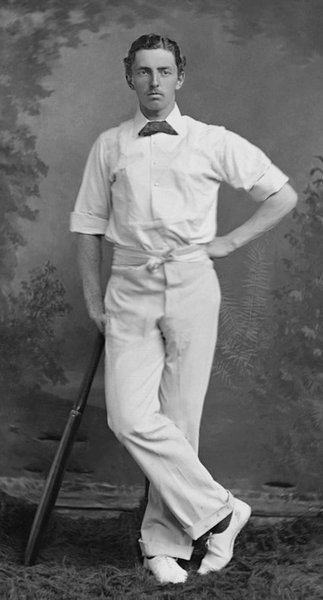
Biography
- 1860 Born
- 1878 Converted
- 1885 To China
- 1913 Congo mission
- 1931 Died
If Jesus Christ be God and died for me, then no sacrifice can be too great for me to make for Him.
In the summer of 1882, a young Englishman walked out to bat for his country at The Oval in the Test match that would give cricket its most famous name. When England lost, a mock obituary announced the death of English cricket and declared that the body would be cremated and the ashes taken to Australia — and so “the Ashes” were born. Charles Thomas Studd was among the best all-rounders England had. Within three years he had walked away from all of it: the fame, the game, and a family fortune, to sail for China as a missionary. He spent the rest of his life spending it, and he died in the heart of Africa at seventy, still refusing every half-measure — a man his own colleagues found as difficult as he was heroic.
A gentleman’s son
He was born on 2 December 1860 at Spratton, in Northamptonshire, into money. His father, Edward Studd, was a retired planter who had made a fortune in India and lived the life of an English country gentleman — horses, comfort, and no particular religion. Charles went to Eton, where he captained the cricket eleven at nineteen, and then to Trinity College, Cambridge, where he took his degree in 1883 and became a star of the university game. By every measure his world used, he had arrived before he was old enough to have earned it.
The turn came through his father. In about 1875 Edward Studd was converted during the great Moody and Sankey campaign that swept Britain, and the change in him was total. He began pressing the gospel on his sons with the same energy he had once given to sport. In 1878, at eighteen, Charles was converted too.
Then almost nothing happened. For roughly six years he was, by his own later account, a Christian in name and cold in fact — his faith a private matter that changed little and cost less. Cricket was still his life. It is an honest and useful stretch of the story: conversion had not yet become consecration, and he knew the difference only in hindsight.
The Cambridge Seven
What broke the coldness was, first, a death that did not come. In 1883 his brother George fell seriously ill, and standing at what might have been a deathbed Studd found the questions he had been avoiding: what was all his fame worth, if a man could be gone so quickly? Around the same time he heard D. L. Moody preach again, and the zeal of his conversion returned with force. This time it did not stay private. He offered himself as a missionary.
In 1885 he sailed for China with Hudson Taylor’s China Inland Mission, and he did not go alone. Six other privileged young Cambridge men went with him — athletes, an officer, men with prospects — and the group became famous across Britain as the Cambridge Seven. Their departure was deliberately publicized to stir the nation’s conscience about missions, and it worked: that seven men who could have had anything England offered would instead give it up for China was a sensation.
Studd gave up more than a career. Coming into his inheritance, he gave nearly all of it away — a sum variously reported at £25,000–29,000, an immense fortune for the time. He directed large gifts to Moody’s work in Chicago, to George Müller’s orphanages, to George Holland’s mission in Whitechapel, to the Salvation Army’s work in India, and to other causes. He kept back a modest sum for his future wife; the account most often repeated says that she told him to give that away too, so that they might begin married life with nothing but God to depend on. Whether the words fell exactly so, the pattern of the marriage bore it out.
If Jesus Christ be God and died for me, then no sacrifice can be too great for me to make for Him.
— C. T. Studd
That sentence is the key to everything he did and everything he got wrong. He believed it without qualification, and he never learned to let other people believe it at a different pace.
China, marriage, and India
He spent about ten years in China. There he married Priscilla Livingstone Stewart, a fellow missionary, in 1888; four daughters would survive. The Studds worked in the interior in the plain, hard conditions the China Inland Mission expected of its people, and by every sign they were happy in it. But his health, never robust under the strain he imposed on it, broke down, and in 1894 illness forced the family back to England.
He was not built for rest. After a period of deputation work he took a pastorate at Ootacamund, in the hills of southern India, serving there roughly from 1900 to 1906 among English-speaking residents and soldiers. It was quieter work than China, and it was not what his heart was set on. He had begun to think about the parts of the world where no missionary had gone at all.
The heart of Africa
What seized him was central Africa — vast regions he believed had never heard the gospel and had no one on the way to bring it. He was over fifty, his health was poor, and the doctors told him plainly that he must not go. He went anyway.
In 1913 he founded the Heart of Africa Mission and set out for the Belgian Congo. The work grew, and in time it became the Worldwide Evangelisation Crusade — WEC — one of the notable interdenominational missions of the century, which long outlived him. He spent roughly eighteen years in the Congo, latterly based at Ibambi, preaching, planting churches, and driving himself and everyone near him without mercy. The fruit was real and it endured. So did the cost, and honesty requires that the cost be named.
Some wish to live within the sound of church or chapel bell; I want to run a rescue shop within a yard of hell.
— C. T. Studd
Heroic and divisive
The same absolutism that made Studd give away everything made him very hard to work with. His Congo years were plagued with conflict — with fellow missionaries, with his family, and painfully with his own son-in-law, Alfred Buxton, who had once been his closest partner in the field. Missionaries left or were dismissed; those who could not match his ferocity were made to feel they had failed. He has been described soberly, and not by enemies, as an obstinate and unreasonable leader. His tract The Chocolate Soldier, a blast against soft, comfortable Christianity, captures the militant, no-half-measures spirit that both fuelled the mission and wounded the people inside it. In his last years the home committee moved to remove him from the leadership of the work he had founded.
There was a darker strand still. In his final years, worn by illness and pain, Studd kept an increasingly harsh personal asceticism, and he used morphine regularly for his suffering — a fact that was documented in his lifetime and caused controversy then. It should be neither hidden nor sensationalized. He was an old, sick man in a punishing climate, and the discipline that had once been a gift had hardened into something that hurt him and those around him. A saint is not a man without faults; he is a man whose faults God does not waste.
This is where the reverent thing to do is to tell the truth. Studd was heroic. He was also difficult, rigid, and, at the end, in some measure broken by his own severity. Both are true at once, and the second does not cancel the first. The gospel he preached does not require its heralds to be flawless — only to be forgiven, and to press on.
Only one life
He died at Ibambi on 16 July 1931, at seventy, of untreated gallstones, with no surgery to be had anywhere within reach of Ibambi. Those who told the story afterward remembered his final word as “Hallelujah,” and it may well have been; but it belongs to the tradition around him rather than to the certain record, and it is enough to say that he died as he had lived, in the field, at his post.
Among the words most loved by him and long associated with his name is a couplet he sent to his grandchildren in a farewell letter in that last year:
Only one life, ’twill soon be past; only what’s done for Christ will last.
— lines beloved by Studd (authorship debated)
The full poem’s authorship is genuinely uncertain, and it would be wrong to hand it to him without that caution. But he quoted those two lines to his own grandchildren as he neared the end, and no words could more exactly sum up the account of his years. They are his in the only sense that finally mattered to him: he had believed them all the way down.
What he leaves
C. T. Studd left no comfortable legacy and no tidy one. He left a worldwide mission, thousands who heard the gospel because he would not stay home, and a life so extreme that admirers and critics have never quite agreed on how to hold it. He gave away a fortune when he was young and his body when he was old, and he was, by turns, magnificent and impossible.
He would not have minded the mixed verdict. He had settled the only question that concerned him at eighteen, and again at twenty-four, and every day after: if Christ was God and had died for him, then nothing was too much to give back. He gave the cricket, the money, the health, and the years, and he counted none of it a sacrifice. Only one life — and he spent it all.
Books about C. T. Studd (4)




Also appears in
Questions and Answers
Who was C. T. Studd?
C. T. Studd (1860–1931) was an England cricketer who, after his conversion, gave away a fortune and joined the "Cambridge Seven" as a missionary — serving in China, India, and finally the Congo, where he founded what became WEC. A man of fierce, uncompromising, and at times difficult zeal, he lived by the conviction that no sacrifice could be too great for Christ. He was one of the best all-rounders England had, and within three years of playing in the Test that gave cricket "the Ashes" he had walked away from the game for China.
What was his background?
He was born on 2 December 1860 at Spratton, Northamptonshire, into money — his father a retired planter who had made a fortune in India. Charles went to Eton, where he captained the cricket eleven at nineteen, and to Trinity College, Cambridge, becoming a star of the university game. The turn came through his father, who was converted in 1877 during the Moody and Sankey campaign and pressed the gospel on his sons; in 1878, at eighteen, Charles was converted too.
Did his conversion change him at once?
No — and he was honest about the gap. For roughly six years he was, by his own later account, a Christian in name and cold in fact, his faith a private matter that changed little and cost less; cricket was still his life. It is a useful stretch of the story: conversion had not yet become consecration, and he knew the difference only in hindsight. What broke the coldness was his brother George's serious illness in 1884, which set him asking what all his fame was worth if a man could be gone so quickly, and hearing D. L. Moody preach again.
What was the Cambridge Seven?
In 1885 Studd sailed for China with Hudson Taylor's China Inland Mission, and he did not go alone: six other privileged young Cambridge men went with him — athletes, an officer, men with prospects — and the group became famous across Britain as the Cambridge Seven. Their departure was deliberately publicized to stir the nation's conscience about missions, and it worked: that seven men who could have had anything England offered would give it up for China was a sensation.
What did he do with his fortune?
Coming into his inheritance, he gave nearly all of it away — a sum variously reported at twenty-five to twenty-nine thousand pounds, an immense fortune for the time — directing large gifts to Moody's work in Chicago, George Müller's orphanages, a mission in Whitechapel, the Salvation Army in India, and other causes. He kept back a modest sum for his future wife; the account most often repeated says she told him to give that away too, so they might begin married life with nothing but God to depend on.
What was the conviction that drove him?
One sentence is the key to everything he did and everything he got wrong: "If Jesus Christ be God and died for me, then no sacrifice can be too great for me to make for Him." He believed it without qualification, and he never learned to let other people believe it at a different pace. He also wrote the line most associated with him: "Some wish to live within the sound of church or chapel bell; I want to run a rescue shop within a yard of hell."
What was his work in China and India?
He spent about ten years in China, marrying the missionary Priscilla Livingstone Stewart in 1888 and working in the interior in the plain, hard conditions the China Inland Mission expected. His health broke down under the strain he imposed on it, and in 1894 illness forced the family back to England. Not built for rest, he took a pastorate at Ootacamund in the hills of southern India from about 1900 to 1906, among English-speaking residents and soldiers — quieter work than China, and not what his heart was set on.
Why did he go to the Congo?
What seized him was central Africa — vast regions he believed had never heard the gospel. He was over fifty, his health was poor, and the doctors told him plainly he must not go. He went anyway, offering God the last thing he had left, the years of an old and sick man. In 1913 he founded the Heart of Africa Mission and set out for the Belgian Congo; the work grew into the Worldwide Evangelisation Crusade (WEC), and he spent roughly eighteen years there, based latterly at Ibambi, preaching and planting churches.
Was he easy to work with?
No — and honesty requires naming the cost. The same absolutism that made him give away everything made him very hard to work with. His Congo years were plagued with conflict — with fellow missionaries, with his family, and painfully with his own son-in-law Alfred Buxton; those who could not match his ferocity were made to feel they had failed, and in his last years the home committee moved to remove him from the work he had founded. Worn by illness, he kept a harsh asceticism and used morphine for his suffering. He was heroic, and also rigid and, at the end, in some measure broken by his own severity.
How did he die, and what does he leave?
He died at Ibambi on 16 July 1931, at seventy, of untreated gallstones, refusing to the last the care his body needed; tradition remembers his final word as "Hallelujah." Among the lines he loved and sent his grandchildren in a farewell letter was the couplet "Only one life, 'twill soon be past; only what's done for Christ will last." He left a worldwide mission still carrying the gospel nearly a century on, and a life so extreme that admirers and critics have never quite agreed how to hold it — magnificent and impossible by turns. He had settled the only question that concerned him at eighteen, and counted none of it a sacrifice.