
New to Phillis Wheatley? Start with
Poems on Various Subjects, Religious and Moral
All works · 1 hr 9 min read
Biography
Inexpressibly happy should we be could we have a due sense of the beauties and excellence of the crucified Saviour.
No one knows the name her mother gave her. She was born somewhere on the coast of West Africa around 1753, taken from her home as a small child, and carried across the Atlantic on a slave ship called the Phillis. In the summer of 1761 she was put up for sale in Boston, a thin, sick girl wrapped, as the family’s memoir later remembered it, in nothing but a scrap of dirty carpet. Susannah Wheatley, the wife of a prosperous Boston tailor and merchant, chose her over sturdier girls because of her “humble and modest demeanor,” and took her home in the family chaise. They guessed her age at about seven because she was shedding her front teeth. They named her after the ship.
Of Africa she kept only one memory, which she passed on to the family: that every morning her mother poured out water before the rising sun. It is worth holding that loss in mind, because the young woman who grew from that child would write with real gratitude of the faith she found in America — and would also write, in the same breath, of what it had cost her parents to lose her.
A child who learned to read the Scriptures
The Wheatleys soon saw that the girl was extraordinary. She was found trying to form letters on the wall with chalk or charcoal, and the Wheatleys’ eighteen-year-old daughter Mary began to teach her. John Wheatley later wrote that within sixteen months of her arrival, without any schooling, she had learned English — a language “to which she was an utter Stranger before” — well enough to read “the most difficult parts of the Sacred Writings, to the great Astonishment of all who heard her.” She went on to Latin, to Pope’s Homer and to Milton, to geography and ancient history; but the book that shaped her most was the Bible. By 1765, when she was perhaps twelve, she had written a letter to Samson Occom, the Mohegan preacher then raising money in England — the beginning of a friendship between two people of colour who both preached Christ to a world that doubted them.
She remained enslaved. The Wheatleys kept her close, spared her most heavy work, and gave her a light and writing things by her bed so she could set down lines that came to her in the night. Yet her place was always uncertain: invited into the houses of Boston’s great families, she would ask to eat at a side table rather than presume a seat among the guests.
In August 1771 she was received into the church that met at Boston’s Old South Meeting House, entered in its register simply as “Phillis, Servant to Mr. Wheatley.” Her letters from these years, written to her friend Obour Tanner, an enslaved African woman in Newport, show a heart that had taken the gospel deeply to itself. When Obour wrote of her own conversion, Phillis rejoiced with her over “the saving change,” and agreed that “there was nothing in us to recommend us to God.”
Inexpressibly happy should we be could we have a due sense of the beauties and excellence of the crucified Saviour.
— Phillis Wheatley, to Obour Tanner, 1772
She was glad, she told Obour, “to hear of so many of my nation, seeking with eagerness the way to true felicity,” and she prayed that they would all “meet at length in that happy mansion.”
The elegy for Whitefield
The poem that made her name was a funeral elegy. On 30 September 1770 George Whitefield, the great preacher of the awakening, died at Newburyport, north of Boston. Within weeks a broadside appeared, printed under the name of “Phillis, a servant girl, of 17 years of age,” who had “been but 9 years in this country from Africa.” It was reprinted across the colonies and in London. In it she remembered Whitefield’s “incessant cries” of prayer, and she put into his mouth an invitation that no one else in print was making:
“Take him, ye Africans, he longs for you, / Impartial Saviour is his title due.”
The Christ she knew was impartial — offered on the same terms to Africans as to anyone. That conviction runs through her best-known poem, “On being brought from Africa to America,” eight lines that have been read both as gratitude and as rebuke. It begins, “’Twas mercy brought me from my Pagan land,” and it ends by turning on the very Christians who looked down on her: “Remember, Christians, Negroes, black as Cain, / May be refin’d, and join th’ angelic train.” Modern readers sometimes wince at the opening line. But it is the testimony of a believer who counted her knowledge of the Saviour a mercy — and it was written by a woman who, as her later letters show, never mistook that mercy for a defence of slavery.
Poems on Various Subjects
Boston printers would not risk a book of verse by an enslaved African girl. Many simply did not believe she had written it. So in the autumn of 1772 the Wheatleys gathered an attestation signed by eighteen of the most prominent men in Massachusetts — the governor Thomas Hutchinson, the lieutenant-governor, John Hancock, John Wheatley himself, and ministers including Charles Chauncy, Mather Byles and Samuel Cooper — assuring the world that the poems had been “written by Phillis,” a young woman “under the Disadvantage of serving as a Slave.” Even with that, the book found its publisher in London, with the support of Selina, Countess of Huntingdon, Whitefield’s patron, to whom it was dedicated.
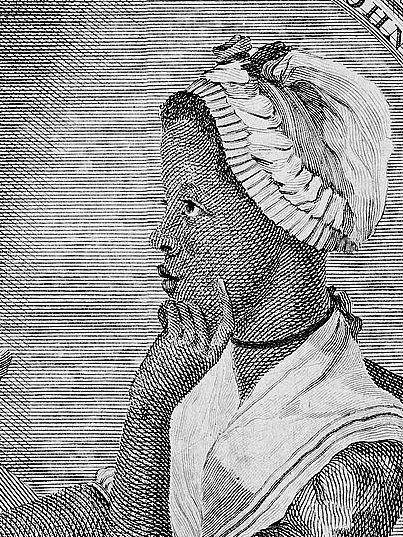
In May 1773, in poor health, Phillis sailed for England with the Wheatleys’ son Nathaniel. For a few crowded weeks she was received in London society: the abolitionist Granville Sharp took her to see the Tower, and she met, among others, the Earl of Dartmouth and Benjamin Franklin. To Dartmouth she had already addressed a poem that explained where her love of liberty came from. She had been, she wrote, “snatch’d from Afric’s fancy’d happy seat,” and she asked what “pangs excruciating” must have torn at her parents, and how “steel’d” the soul that “from a father seiz’d his babe belov’d.” Then word came that Susannah Wheatley was gravely ill, and Phillis sailed home before her book came off the press in September 1773, with an engraved portrait of her at her writing desk as its frontispiece. Poems on Various Subjects, Religious and Moral was the first book of poems published by an African American.
In the same letter she pressed on her friend the thing that mattered most:
Dear Obour, let us not sell our birthright for a thousand worlds, which indeed would be as dust upon the balance.
— Phillis Wheatley, 1773
Free, and speaking of freedom
That October she told a friend that “since my return to America my Master, has at the desire of my friends in England given me my freedom.” Freedom did not make her comfortable — she lived largely on the sale of her books, and asked Obour to find subscribers “as it is for my benefit” — but it let her speak more plainly than before.
In February 1774 she answered a letter from Samson Occom, who had written in defence of the natural rights of Black Americans. Her reply, printed in the Connecticut Gazette that March, is her clearest word on slavery, and it is a Christian argument from first to last. She believed, she wrote, that “the divine Light is chasing away the thick Darkness which broods over the Land of Africa,” and that civil and religious liberty were so bound together “that there is little or no Enjoyment of one Without the other.” The Israelites in Egypt had longed for freedom; so did her people.
In every human Breast, God has implanted a Principle, which we call Love of Freedom; it is impatient of Oppression, and pants for Deliverance.
— Phillis Wheatley, to Samson Occom, 1774
“By the Leave of our modern Egyptians,” she went on, “I will assert, that the same Principle lives in us.” She prayed, “God grant Deliverance in his own Way and Time,” and added that she wished this “not for their Hurt,” but to show the slaveholders “the strange Absurdity of their Conduct” — men who cried for liberty while exercising “oppressive Power over others.” It did not, she remarked drily, “require the Penetration of a Philosopher to determine” how badly the two agreed.
When war came, she wrote a poem to the new commander of the Continental Army and sent it with a letter in October 1775. George Washington answered from Cambridge in February 1776, praising “your great poetical Talents” and writing, “If you should ever come to Cambridge, or near Head Quarters, I shall be happy to see a person so favourd by the Muses.”
A seemingly frowning Providence
Then the losses began. Susannah Wheatley died in March 1774. “I was a poor little outcast & a stranger when she took me in,” Phillis wrote to Obour; “I was treated by her more like her child than her servant.” She had watched her mistress die in what she called “earnest longings, & impatient thirstings for the upper courts of the Lord.”
John Wheatley died in March 1778; Mary, her first teacher, died that September; Nathaniel, in England, died in 1783. In April 1778 Phillis married John Peters, a free Black man of Boston. The family memoir of 1834, drawn from relatives of the Wheatleys, paints him harshly as proud and improvident, and says he failed in business and once went to jail for debt; later historians think that portrait may be unfair, and the truth of the marriage is hard to recover. What is certain is that the war years were desperately poor ones, and that Phillis bore three children, of whom two died young.
She kept writing. In 1779, as Phillis Peters, she advertised proposals for a second volume of poems and letters, to be dedicated to Benjamin Franklin. Too few subscribers came forward in a ruined wartime economy, and the book never appeared; most of its manuscripts are lost. In 1784 she published a poem, Liberty and Peace, celebrating the end of the war. To Obour, in a short note of 1778, she had written that the upheavals of those years should “convince us of the uncertain duration of all things temporal,” and stir “an ardent desire of, & preparation for” a state “more suitable to the immortal mind.”
Remembered at the last
Phillis Peters died in Boston on Sunday, 5 December 1784, about thirty-one years old, and her last infant died with her. The Independent Chronicle noted that she was “known to the literary world by her celebrated miscellaneous poems.” She was buried, with her child, in an unmarked grave.
She had not been forgotten for long. Abolitionists reprinted her poems as proof of what they had always claimed, and every generation since has returned to her. But for a Christian reader she is more than a literary first. She is a young African woman who, stolen from her mother and sold as property, found Christ in the land of her captivity, called him the “Impartial Saviour,” and told the slaveholders of a revolutionary age, in the language of Exodus, that God had planted the love of freedom in every human heart. Her own counsel to Obour is a fair summary of how she tried to live: that “by the assistance of divine grace,” they would “live the life,” and so “die the death of the Righteous.”
Books by Phillis Wheatley (1)
Questions and Answers
Who was Phillis Wheatley?
Phillis Wheatley (c. 1753–1784) was an African-born Christian poet in Boston and the first African American to publish a book of poems, Poems on Various Subjects, Religious and Moral (London, 1773). Kidnapped as a child and enslaved by the Wheatley family, she became a church member, was freed in 1773, and wrote of Christ as the "Impartial Saviour" and of the love of freedom God implants in every heart.
What was her early life like?
She was born in West Africa around 1753 and carried to Boston on a slave ship called the Phillis, where she was sold in 1761 to Susannah Wheatley at about the age of seven. The only memory of Africa she kept was of her mother pouring out water before the rising sun each morning. The family named her after the ship.
How did she learn to read and write?
The Wheatleys' daughter Mary taught her, and John Wheatley wrote that within sixteen months she could read the most difficult parts of the Bible. She went on to Latin, classical literature and history, and by about 1765 she had written a letter to the Mohegan preacher Samson Occom.
What was her faith like?
In August 1771 she was received into the church at Boston's Old South Meeting House. Her letters to her friend Obour Tanner, an enslaved woman in Newport, speak of the saving change of conversion, of having nothing in herself to recommend her to God, and of longing for a due sense of the beauty of the crucified Saviour.
Why was her elegy on George Whitefield important?
When the evangelist George Whitefield died in September 1770, she published an elegy as a 17-year-old servant girl, and it was reprinted across the colonies and in London. In it she pictured Whitefield inviting Africans to Christ as their "Impartial Saviour," and the poem made her name known.
How was her book published?
Boston printers doubted that an enslaved girl could have written the poems, so in 1772 eighteen leading Bostonians, including the governor and John Hancock, signed an attestation that she was the author. The book was published in London in 1773 with the support of the Countess of Huntingdon, to whom it was dedicated, and carried an engraved portrait of her as its frontispiece.
What happened on her trip to England?
She sailed to London in May 1773 for her health and was received by figures such as Granville Sharp, the Earl of Dartmouth and Benjamin Franklin. She returned to Boston before the book appeared because her mistress was gravely ill, and she thanked God for bringing her home safely and largely restoring her health.
What did she write about slavery and freedom?
Soon after her return she was freed. In a 1774 letter to Samson Occom, printed in the Connecticut Gazette, she wrote that God had implanted in every human breast a love of freedom that is impatient of oppression, compared enslaved Africans to Israel in Egypt, and prayed that God would grant deliverance in his own way and time.
What trials did she face in her later years?
Susannah Wheatley died in 1774, and John and Mary Wheatley in 1778. That year she married John Peters, a free Black man, and the war years brought deep poverty; two of her three children died young, and her 1779 proposal for a second volume failed to find subscribers. In her letters she spoke of resigning herself to a seemingly frowning Providence and longing to delight in God alone.
How did her life end?
She died in Boston on 5 December 1784, about thirty-one years old, and her last infant died with her; they were buried in an unmarked grave. Abolitionists later reprinted her poems, and she is remembered as a believer who found Christ in the land of her captivity and spoke boldly for the freedom of her people.