New to G. K. Chesterton? Start with
Orthodoxy
All works · 23 hr 33 min read
Biography
The test of all happiness is gratitude; and I felt grateful, though I hardly knew to whom.
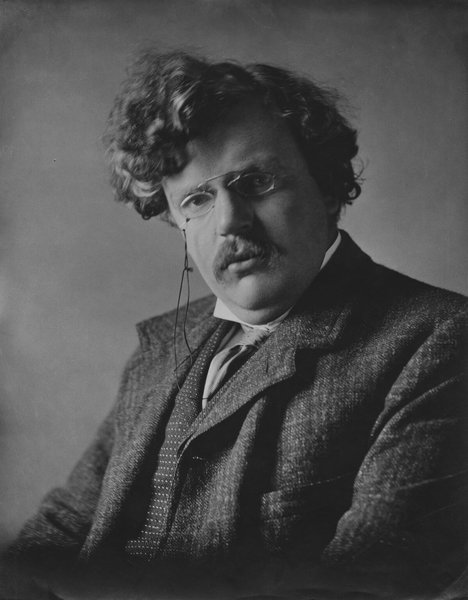
G. K. Chesterton was a huge man, more than six feet tall and broad in proportion, with a cloak, a wide-brimmed hat, a sword-stick and a pair of pince-nez that never sat straight. Behind the comic figure was one of the clearest Christian minds of the twentieth century. He wrote some eighty books, hundreds of poems, about two hundred short stories and thousands of essays, and in an age that was confident it had outgrown the faith, he argued for it so cheerfully that even his opponents loved him. More than anything else he was a man astonished by the world, and grateful for it.
A Kensington boyhood
Gilbert Keith Chesterton was born on 29 May 1874 in Kensington, London, the elder son of Edward Chesterton, whose family ran an estate agency, and Marie Louise Grosjean, whose family was of Swiss-French descent. His brother Cecil, five years younger, became his lifelong companion and sparring partner; the two boys argued, it was said, from the day Cecil could talk. Their father was a gentle, inventive man who built a toy theatre for the children, and Gilbert never forgot the little cardboard world with its painted scenes and tiny proscenium. The home was liberal, kindly and only loosely religious, and the boy grew up with a love of fairy tales, ballads and pictures more than of doctrine.
He went to St Paul's School, where he seemed to his teachers dreamy and slow, but where he and a circle of friends founded a debating club and a little magazine. In 1893 he enrolled at the Slade School of Art, part of University College London, to train as an illustrator. Those years became the darkest of his life.
Near despair, and a thread of thanks
The art world of the 1890s was full of a weary, clever pessimism, and the young Chesterton breathed it in. Alone with his imagination and his doubts, he fell into a period he afterwards described as a kind of madness. He filled notebooks with morbid drawings, until friends who found them wondered whether he was losing his mind, and he and Cecil experimented with the planchette and the Ouija board. He later said that whatever power moved the board, the one thing he could say with certainty about it was that it told lies; and he gave it up with what he called a bad smell in the mind. He came to feel that he had been playing with something dangerous.
What brought him back was not at first an argument but gratitude. Even at the lowest point, he said, he had held on to religion by a thin thread of thanks: the simple, overwhelming sense that it was good to exist at all, that a dandelion or a lamp-post was a gift that need not have been given. Out of that thread he began, slowly, to rebuild. Orthodoxy, written years later, tells the story of how the instincts of the nursery — wonder, gratitude and the sense that joy depends on keeping some small condition — turned out to fit the Christian creed like a key in a lock.
The test of all happiness is gratitude; and I felt grateful, though I hardly knew to whom.
— G. K. Chesterton, Orthodoxy
Frances
In 1896 Chesterton met Frances Blogg, the eldest daughter of a family in the artistic suburb of Bedford Park. Everyone around her talked endlessly about religions; what astonished him was that she actually practised one. She had been brought up in an Anglo-Catholic school, she went to church, she prayed, and she seemed entirely untouched by the fashionable moods of the people around her. He fell in love with her almost at once. They were married on 28 June 1901 at St Mary Abbots, Kensington, and through her faith and the clergy and Anglican friends she brought into his life, he found his way into the Church of England.
It was a deeply happy marriage, and also one marked by a quiet sorrow. They longed for children, and for many years hoped; at last Frances underwent an operation in the hope of being able to have them, but none came. Chesterton sat for two hours on the stairs of her nursing home, blocking the way, because he would not take her the sonnet he had written for her recovery until he had got its last line right. In later years their secretary, Dorothy Collins, became almost a daughter to them, and the children of their friends and neighbours filled the house at every Christmas party.
A journalist in the great debates
Chesterton had left the Slade without a degree and gone to work for a publisher, but he soon found his calling in journalism. He wrote reviews and essays for The Speaker and the Daily News, and from 1905 a weekly column for the Illustrated London News that he kept up for the rest of his life. He loved an argument, and he chose the biggest opponents he could find. In 1903 and 1904 he answered the atheist editor Robert Blatchford in the pages of The Clarion. For thirty years he debated George Bernard Shaw, in print and on public platforms, and the two remained affectionate friends throughout. He crossed swords with H. G. Wells over socialism, progress and the meaning of history. He held that ordinary people's instincts — for home, for property, for freedom, for faith — were wiser than the theories of the intellectuals who despised them.
In 1905 he published Heretics, a book of essays on the leading thinkers of the day, from Kipling to Shaw. Its critics, among them the writer G. S. Street, complained that he had attacked everybody else's philosophy without stating his own. Chesterton accepted the challenge. The answer, published in 1908, was Orthodoxy: not a textbook of theology but, as he said in its preface, an account of how he personally had come to believe. He tells it as the story of a man who set out to discover a new truth and found, to his embarrassment, that it had been discovered already.
I am the man who with the utmost daring discovered what had been discovered before.
— G. K. Chesterton, Orthodoxy
Orthodoxy was written when Chesterton was an Anglican, and it defends the faith of the Apostles' Creed rather than the claims of any one church. That is part of why Christians of every tradition have loved it ever since.
Father Brown and Beaconsfield
On a lecture tour in Yorkshire in 1904 he met a young Catholic priest, Father John O'Connor, who became one of his closest friends. Chesterton was astonished to find that this shy, kindly man knew more about the dark places of the human heart than any worldly-wise undergraduate. From that surprise came Father Brown, the small, round, unremarkable priest who solves crimes because he understands sin from the inside. The first collection, The Innocence of Father Brown, appeared in 1911, and the stories have been read and filmed ever since.
In 1909 Gilbert and Frances left London for Beaconsfield, a quiet market town in Buckinghamshire. They lived first in a small house called Overroads and later in Top Meadow, across the road, where the large studio became the scene of plays, parties and endless visitors.
Illness, and a brother lost
Late in 1914, worn out by work and the first months of the war, Chesterton collapsed. His heart was failing, and on Christmas Eve he fell into a coma from which, for weeks, he hardly woke. Frances nursed him through the winter, writing anxious letters to Father O'Connor and asking him to pray. Slowly, in the early months of 1915, he came back.
Sorrow came again at the war's end. Cecil Chesterton, who had enlisted as a private, fell ill in the last weeks of the fighting and died in a military hospital in France on 6 December 1918. Gilbert grieved for him deeply, and for years kept going the small political paper, The New Witness, whose editorship he had taken over when Cecil enlisted — out of loyalty to his brother, and at great cost to his own time and purse.
Into the Catholic Church
For many years Chesterton had been moving closer to the Roman Catholic Church. On 30 July 1922 he was received into it by Father O'Connor, in a makeshift chapel in a corrugated-iron hall belonging to the Railway Hotel in Beaconsfield, since the town had no Catholic church. Frances wept through the ceremony; she found the step hard, and followed him four years later, in 1926. Chesterton was entirely candid about where he had gone and why, and many Catholics count him among their great converts. Protestant readers, for their part, have never stopped finding in his books a warm and fearless defence of the faith they share — the Creed, the incarnation, the cross and the resurrection.
His greatest Christian books came in the years that followed. St Francis of Assisi appeared in 1923. In 1925 came The Everlasting Man, his answer to Wells's popular Outline of History: a retelling of the whole human story, from the paintings in the prehistoric cave to the child born in the cave at Bethlehem, to show that man is no mere animal and Christ no mere teacher. Among its readers was a young Oxford don named C. S. Lewis, then still an unbeliever. Lewis later wrote that in The Everlasting Man he first saw the whole Christian outline of history set out in a form that seemed to make sense, and he counted it one of the books that brought him to faith. St Thomas Aquinas followed in 1933, a short book that scholars of Aquinas have admired ever since.
Joy, which was the small publicity of the pagan, is the gigantic secret of the Christian.
— G. K. Chesterton, Orthodoxy
The last chapter
In the spring of 1936, after finishing his Autobiography, Chesterton's strength began to fail; the doctors found that his heart could no longer carry his enormous frame. Waking from a long reverie near the end, he said that the issue was now quite clear: it was between light and darkness, and everyone must choose his side. He died at Top Meadow on 14 June 1936, with Frances beside him, and was buried in the Catholic cemetery at Beaconsfield. Frances died two years later and was buried with him.
Chesterton never thought of himself as a saint, and he would have laughed at the idea of being a theologian. He was a journalist who wrote too much and too fast, and some of what he wrote has not aged well. But he gave the church something rare: a joyful, fighting faith that refused to be embarrassed, that found the creed not a cage but a playground with walls, and that saw the world, from the dandelion to the stars, as a gift that calls for thanks. Orthodoxy and The Everlasting Man are still finding readers who, like Lewis, discover in them that the old faith is far larger, stranger and gladder than they had been told.
Books by G. K. Chesterton (5)


Books about G. K. Chesterton (1)
Articles about G. K. Chesterton (1)
Questions and Answers
Who was G. K. Chesterton?
Gilbert Keith Chesterton (1874–1936) was an English journalist, poet, novelist and Christian writer. He wrote some eighty books, hundreds of poems, about two hundred short stories and thousands of essays, and in an age confident that it had outgrown the faith he defended it so cheerfully that even his opponents loved him. He is best remembered for Orthodoxy, The Everlasting Man and the Father Brown detective stories.
Where and when was Chesterton born?
He was born on 29 May 1874 in Kensington, London, the elder son of Edward Chesterton, whose family ran an estate agency, and Marie Louise Grosjean. His brother Cecil, five years younger, was his lifelong companion. He went to St Paul's School and in 1893 enrolled at the Slade School of Art to train as an illustrator.
What happened to Chesterton during his years at the Slade School of Art?
The Slade years were the darkest of his life. Breathing in the weary pessimism of the 1890s art world, he fell into what he later called a kind of madness, filled notebooks with morbid drawings, and with his brother experimented with the planchette and the Ouija board. He gave it up, concluding that whatever moved the board told lies. What brought him back was gratitude: he said he had held on to religion by a thin thread of thanks for the sheer goodness of existing.
How did Chesterton's wife Frances influence his faith?
He met Frances Blogg in 1896 and was astonished that, among people who talked endlessly about religions, she actually practised one; she had been brought up in an Anglo-Catholic school, prayed and went to church. They married on 28 June 1901 at St Mary Abbots, Kensington, and through her faith and the Anglican friends she brought into his life he found his way into the Church of England.
Did G. K. Chesterton have children?
No. Gilbert and Frances longed for children and hoped for many years; Frances even underwent an operation in the hope of being able to have them, but none came. Their secretary, Dorothy Collins, later became almost a daughter to them, and the children of friends and neighbours filled their house at Christmas parties.
Why did Chesterton write Orthodoxy?
In 1905 he published Heretics, essays on the leading thinkers of the day. Critics, among them the writer G. S. Street, complained that he had attacked everybody else's philosophy without stating his own. Orthodoxy (1908) was his answer: not a textbook of theology but an account of how he personally came to believe, told as the story of a man who set out to discover a new truth and found it had been discovered already. He wrote it as an Anglican, and Christians of every tradition read it.
Who did Chesterton debate?
He loved an argument and chose the biggest opponents he could find. In 1903 and 1904 he answered the atheist editor Robert Blatchford in The Clarion. For thirty years he debated George Bernard Shaw, in print and on public platforms, and the two remained affectionate friends. He also crossed swords with H. G. Wells over socialism, progress and the meaning of history.
Who inspired Father Brown?
On a lecture tour in Yorkshire in 1904 Chesterton met a Catholic priest, Father John O'Connor, who became one of his closest friends. He was astonished that this shy, kindly man knew more about the dark places of the human heart than any worldly-wise undergraduate. From that surprise came Father Brown, the unremarkable priest who solves crimes because he understands sin from the inside; the first collection, The Innocence of Father Brown, appeared in 1911.
When did Chesterton become a Catholic?
After many years of moving towards it — through a near-fatal illness in 1914–15, from which both he and Frances spoke of his recovery as a miracle, and the death of his brother Cecil in France in December 1918 — Chesterton was received into the Roman Catholic Church on 30 July 1922 by Father O'Connor, in a makeshift chapel belonging to the Railway Hotel in Beaconsfield. Frances followed him four years later, in 1926.
How did The Everlasting Man influence C. S. Lewis?
The Everlasting Man (1925) retells the whole human story, from the paintings in the prehistoric cave to the child born at Bethlehem, to show that man is no mere animal and Christ no mere teacher. C. S. Lewis, then a young Oxford don and still an unbeliever, read it and later wrote that in it he first saw the whole Christian outline of history set out in a form that seemed to make sense; he counted it among the books that brought him to faith. Chesterton died at Beaconsfield on 14 June 1936.