

Book
The Key Teachings of G. K. Chesterton
An Ochorus companion to his life and teaching
- 19 chapters
- 2 hr 2 min read
- Moderate Reading difficulty
Free to read·No account needed
Introduction
Taking books where there’s no signal? See Ochorus for missionaries or chaplains
About this book
This is a companion to G. K. Chesterton, not a book by him. Written by Ochorus, it sets out in fifteen short chapters the teaching for which Chesterton is chiefly remembered — the wonder and gratitude he learned in the nursery, the madman who has lost everything except his reason, the thought that stops thought, the cosmic loyalty that loves the world enough to change it, the furious opposites that Christianity holds together, orthodoxy as the great adventure, joy as the gigantic secret of the Christian, tradition as the democracy of the dead, humility in its right place, the dignity of ordinary life, the man in the cave and the God in the cave, the strangest story in the world, the five deaths of the faith, and the holy gaiety of St Francis. It adds a chapter on his life, a conclusion, and a guide to his books.
It is important to be clear about what this book is and is not. It is an independent work of exposition, summary and appreciation, not published by, affiliated with, or endorsed by any society or body devoted to Chesterton’s memory or his cause. Two of his greatest books, Orthodoxy (1908) and The Everlasting Man (1925), are in the public domain and in the Ochorus library, and short sentences from them are quoted sparingly here, each checked against the library’s own text and named by book and chapter. Nothing is quoted from his later works that are still in copyright; those are described in our own words. Scripture is quoted from the Authorised (King James) Version.
Chesterton wrote Orthodoxy as a member of the Church of England and was received into the Roman Catholic Church in 1922. This volume says plainly where evangelical readers will differ from his later convictions — on the authority of the Church, on Mary and the saints, on the sacraments — and where his politics and economics are opinion rather than doctrine. It also faces honestly the antisemitic passages in some of his writing, which a fair modern companion must name. He would have wanted the argument, and he would have wanted readers to go past him to Christ.
The best way to use this book is beside his own. Orthodoxy and The Everlasting Man are both in the Ochorus library; read them alongside these chapters.
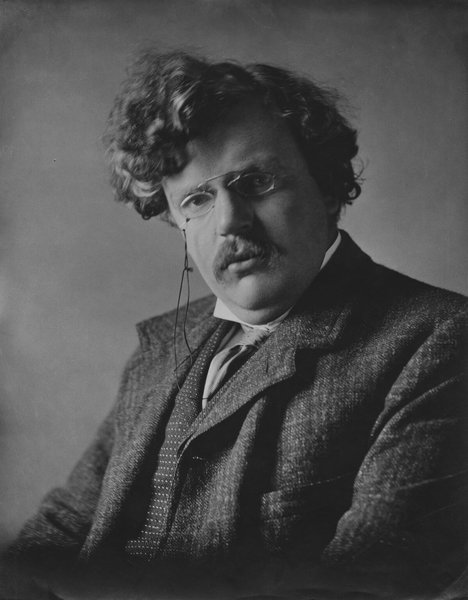
A toy theatre. Gilbert Keith Chesterton was born on the twenty-ninth of May, 1874, in Kensington, in west London, the elder son of Edward Chesterton, whose family ran a firm of estate agents, and Marie Louise Grosjean, whose family was of Swiss and French descent.
Contents
- 1 Introduction 11 min
- 2 From Kensington to Beaconsfield 11 min
- 3 The Ethics of Elfland 8 min
- 4 The Madman and His Reason 6 min
- 5 The Thought That Stops Thought 6 min
- 6 The Flag of the World 6 min
- 7 The Furious Opposites 7 min
- 8 The Wild Truth Reeling but Erect 6 min
- 9 The Gigantic Secret 5 min
- 10 The Democracy of the Dead 5 min
- 11 Humility in the Right Place 5 min
- 12 The Dignity of Ordinary Things 6 min
- 13 The Man in the Cave 6 min
- 14 The God in the Cave 5 min
- 15 The Strangest Story in the World 6 min
- 16 The Five Deaths of the Faith 5 min
- 17 The Holy Joy of St Francis 5 min
- 18 Conclusion 6 min
- 19 His Books, and Where to Start 6 min
People in this book
More like this





Cite this book
Copy a citation in the style you need.
- MLA
- Ochorus Originals. The Key Teachings of G. K. Chesterton. Ochorus, https://ochorus.com/books/key-teachings-of-g-k-chesterton/.
- Chicago
- Ochorus Originals. The Key Teachings of G. K. Chesterton. Ochorus. https://ochorus.com/books/key-teachings-of-g-k-chesterton/.
- Chicago footnote
- Ochorus Originals, The Key Teachings of G. K. Chesterton (Ochorus), https://ochorus.com/books/key-teachings-of-g-k-chesterton/.
- BibTeX
- @book{ochorusoriginalsteachings, author = {{Ochorus Originals}}, title = {{The Key Teachings of G. K. Chesterton}}, publisher = {Ochorus}, url = {https://ochorus.com/books/key-teachings-of-g-k-chesterton/} }