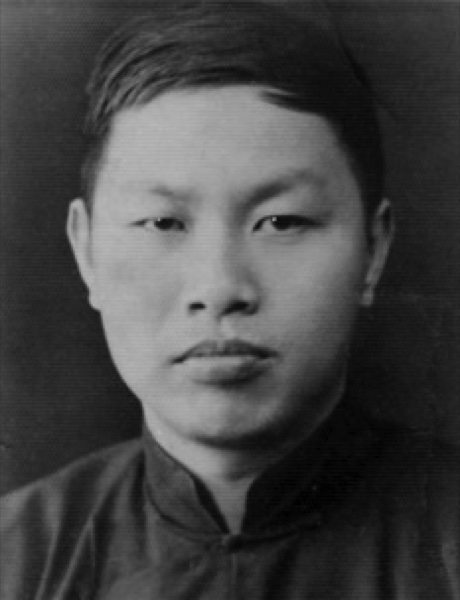
Biography
- 1903 Born
- 1920 Conversion
- 1925 Renamed
- 1972 Died
Lord, I leave my world behind. Your cross separates me from it forever, and I have entered into another. I stand where you have placed me in Christ!
Watchman Nee was born Ni Tuosheng in Shantou on 4 November 1903, into a family from Fuzhou already touched by the Christian faith. His grandfather had been among the first Chinese ministers ordained by the Congregational missions in Fujian province, and his mother, Lin Heping, was a woman of strong will and deep devotion. Nee was the first son among nine children, and his mother received his birth as the answer to her longing for a son — and dedicated the child to God in gratitude for it, a consecration made over him before he could speak a word. The Chinese name the family came to use for him, Tuosheng, evokes the sound of the night-watchman's wooden gong struck through the dark hours of a Chinese town — the watchman who stays awake while others sleep, calling out the passing of the night. It became, in English, simply Watchman: a name he would spend his life living up to, as one who watched and warned and kept vigil for the coming of the morning.
As a boy Nee was clever, ambitious, and by his own later admission proud. At thirteen he entered the Church Missionary Society's Vernacular Middle School in Fuzhou, beginning a Western-style education, and went on to excel at the Anglican-run Trinity College there, placing near the top of his class. A bright worldly future seemed assured, and for years he resisted the faith of his household, set on advancement. Grace reached him first through his mother. Under the preaching of the itinerant evangelist Dora Yu — herself a former medical student who had forfeited a lucrative career for the gospel — Lin Heping was so convicted that she came home and did something almost unheard of in that culture: she apologised to her own son for a wrong she had done him. The humbling of his mother pierced the pride of the boy, and he began to attend the meetings himself.
The night he could not rest
On the evening of 28 April 1920, at seventeen, Nee was alone in his room and could find no peace. His first inclination was not to believe, not to become a Christian — and yet that resolve left him more restless still. There was a real struggle within him. At last he knelt to pray. At first he had no words at all; then his sins rose up before him one by one, and he knew himself to be a sinner. As he made that first true prayer, joy and peace such as he had never known flooded in. He said simply to the Lord, "Oh, Lord, You have indeed been gracious to me." From that night he consecrated himself wholly to Christ and to the preaching of the gospel among his own people. The bright career for which his education had prepared him he laid down without looking back. At his baptism he declared what that surrender meant:
Lord, I leave my world behind. Your cross separates me from it forever, and I have entered into another. I stand where you have placed me in Christ!
— Watchman Nee, at his baptism
The new convert was eager for training, and he joined Dora Yu's Bible institute in Shanghai — only to be sent home, dismissed for undisciplined habits such as sleeping in late. The humiliation did its work. Determined that his character should be remade, he sought out the influence that would shape him most: Margaret E. Barber, an independent English missionary living near Fuzhou who had renounced her denominational ties for what she called a life of faith. Barber baptised Nee and his mother in 1921, treated him as a learner under strict, sometimes severe, discipline, and opened to him the deep well of her Holiness and Brethren library — introducing him to the writings of D. M. Panton, Robert Govett, G. H. Pember, Jessie Penn-Lewis, and T. Austin-Sparks, and to Brethren teachers such as John Nelson Darby, William Kelly, and C. H. Mackintosh. Nee devoured them, and his own library eventually grew to more than three thousand Christian volumes, reaching back to writers of the earliest centuries. When Barber died in 1930, she left everything she owned to him. From her he absorbed a conviction that would run through all his work: that the crucified and risen Christ must not merely be admired but must actually live His own life through the believer.
Ministry and the Little Flock
He did not wait for maturity to begin. With a band of like-minded students he organised independent meetings, dedicated Bible study, and street preaching through the town and its schools, and in those early years sixty-nine of his own college classmates were led to salvation. From 1922 Nee began holding church meetings in Fuzhou that grew into an indigenous Chinese movement, free of foreign denominational control, which outsiders called the Little Flock and its members called simply the church in each locality. In 1923 he launched a magazine, The Present Testimony, followed in 1925 by The Christian — the year he set aside his birth name Shu-tsu and took the name To-sheng, the watchman's gong. At twenty-one he helped establish a local church as far away as Sitiawan in Malaya, and soon afterwards the church in Shanghai that became the centre of his life's work. He lived what he preached: in those early days he is said to have kept only a third of his income for his own needs, giving a third to help others and spending the last third on spiritual books, and there were seasons in Shanghai when a little bread was all he had to eat in a day.
He held that there was only one true church in each city, and he laboured to see Chinese believers gathered on that ground rather than divided by imported labels. The work spread with remarkable speed. Beginning with a handful of members, in less than twenty years it grew to more than seven hundred assemblies and some seventy thousand believers across China, with daughter churches reaching into the Philippines, Singapore, Malaysia, and beyond — by 1949 the largest Protestant movement in the country.
All of this was carried on under the shadow of illness. From 1922 he was repeatedly struck down by tuberculosis; later came a chronic stomach disorder and a serious disease of the heart. In 1926, already weakened, Nee began his first major work, The Spiritual Man, writing much of it from a sickbed; it appeared in three volumes in 1928, the same year he convened his first Overcomer Conference in Shanghai. Recurring frailty dogged him for the rest of his life — he was healed of the heart disease, and said that his ministry was sustained not by physical strength but by resurrection life — and yet the stream of teaching never stopped. He was above all an expositor of the inner life: the crucifixion of the old self, the indwelling of Christ, the difference between the forgiveness of sins and deliverance from sin. His most enduring book, The Normal Christian Life, grew out of messages he delivered in English on a journey to Europe in 1938 and 1939 and distilled the whole of it into a single insistence: that the ordinary birthright of every Christian is not endless struggle but Christ Himself lived out from within.
God makes it quite clear in His Word that He only has one answer to every human need: His Son, Jesus Christ. In all His dealings with us He works by taking us out of the way and substituting Christ in our place. The Son of God died instead of us for our forgiveness: He lives instead of us for our deliverance.
— Watchman Nee, The Normal Christian Life
Nee taught that prayer was not a way of bending God to our wishes but of aligning ourselves with His will, and that this alignment was itself costly labour. He gathered much of this in the book Ochorus readers know as Let Us Pray, where he described prayer as the very track along which God chooses to run His work in the world.
Prayer is the rail for God's work. Indeed, prayer is to God's will as rails are to a train. Without any doubt, God is almighty and He works mightily, but He will not and cannot work if you and I do not labour together with Him in prayer.
— Watchman Nee, Let Us Pray
He was not a man who found prayer effortless or automatic. He called true prayer a real work, a self-denying work, the union of the believer's thoughts with the will of God.
True prayer is a real work. Praying according to God's will and praying only for His will is indeed a self-denying work.
— Watchman Nee, Let Us Pray
It was this understanding of prayer as costly partnership, rather than as a lever for personal comfort, that would carry him through the years no one could then foresee.
Marriage, arrest, and the long night
In 1934 Nee married Charity Chang, whose family had been friends of his for three generations; the decision had been the subject of much wrestling in prayer, for it drew public criticism at the time. The couple were never given children, and through Nee's frequent bouts of illness Charity cared for him with unwearying devotion. Together they gave themselves to the work through the turbulent 1930s and 1940s.
Those years held a humbling of another kind. In 1939, under family pressure and seeing in it a way to provide for co-workers suffering through the war, Nee took over his brother's struggling pharmaceutical firm, the China Biological and Chemical Laboratory, restructured it, and staffed it with members of the Shanghai church. But the elders were troubled that a minister of the gospel should be running a business, and in 1942 Nee laid down his public ministry; for a time the church in Shanghai ceased meeting altogether. He managed the factory quietly, even relocating to Chongqing in 1945, while continuing to give messages that would later be published as The Orthodoxy of the Church and his studies on the Song of Songs. In 1946 co-workers Peace Wang and Witness Lee began labouring to restore the church in Shanghai and Nee's ministry with it, and by April 1948 revival had swept the congregation and Nee stood before them again. He marked his restoration by giving the pharmaceutical factory itself to God for the work — an offering that moved many others to lay their own possessions on the altar. The Shanghai church swelled past a thousand members, and Nee acquired twelve bungalows at Kuliang, outside Fuzhou, as a training centre for his co-workers.
Then came the Communist victory of 1949 and, with it, a hardening hostility toward independent Christian movements that would not submit to state control. It was through the business that the authorities built their case. On 10 April 1952 he was arrested in Shanghai — accused of espionage and counter-revolutionary activity alongside charges of bribery, theft of state property, tax evasion, and moral irregularities. He was held for four years while an indictment running to 2,296 pages was assembled. The public trial of 1956 announced that he had been excommunicated by the Shanghai church and found him guilty on every count; he was sentenced to fifteen years of imprisonment with reform through labour. That same January a nationwide sweep took the co-workers and elders of the local churches: some died in labour camps, others served long sentences, congregations were shut, and the Shanghai assembly hall was in due course turned into a factory. When Nee's own sentence was complete in 1967 he was not released, for he was judged "unreformed." He would never again be free.
The suffering was not his alone. His wife Charity was arrested, released for failing health, then seized again during the Cultural Revolution, interrogated and beaten by Red Guards, paraded through the streets in a dunce's cap with a heavy board hung about her neck — and she refused to deny Christ. She was the only person permitted to visit him. Charity died in 1971, and Nee outlived her by barely a year.
"I maintain my joy"
Through twenty years of imprisonment, cut off from the movement he had raised up, in failing health from a diseased heart and a chronic stomach ailment, Nee's inner testimony did not break. In one of his last letters, written to his sister-in-law only thirty-eight days before his death, he set down four plain words: "I maintain my joy." He had written elsewhere that though his body was worn, the inward joy surpassed everything.
He died on 30 May 1972, at sixty-eight, and was cremated two days later. He never saw the earthly vindication of his labour, for the churches he founded had been suppressed, his books banned, and his name slandered. Yet the seed did not die. His writings — more than forty volumes of devotional, sermonic, and theological work, most of them drawn from notes of his spoken messages — were carried out of China and translated into languages East and West, from Japanese, Korean, Indonesian, and Tagalog to English, French, and Spanish, and went on to shape hundreds of thousands of believers who never met him. Today assemblies tracing their spiritual descent to his ministry number in the thousands worldwide, and The Normal Christian Life remains one of the most widely read devotional works to come out of the modern Chinese church.
Watchman Nee was a real man, not a plaster saint: proud in his youth, sharp in controversy, dogged by illness, and by no means beyond the criticism of his contemporaries. But the note under the pillow says what the whole life was reaching toward. He had spent himself calling the church awake through the long night, and when his own night came he kept the watch he was named for — believing, to the last breath, in the Son of God.
Books about Watchman Nee (3)


Also appears in
Articles about Watchman Nee (1)
Questions and Answers
How did Watchman Nee become a Christian?
On the evening of 28 April 1920, when he was seventeen, Nee knelt alone in his room after weeks of restlessness under the preaching of the itinerant evangelist Dora Yu, and for the first time prayed his way through his sins into peace. The ground had been prepared by his mother, Lin Heping, who was so convicted under Dora Yu’s ministry that she came home and humbly apologised to her proud son for a wrong she had done him. From that night he gave himself wholly to Christ and to preaching the gospel, laying down the bright worldly career his Western-style education had prepared him for.
Why was he called “Watchman”?
He was born Ni Shu-tsu, but in 1925 he set aside that birth name and took the name To-sheng, which evokes the sound of the wooden gong a night-watchman strikes through the dark hours of a Chinese town. The watchman stays awake while others sleep, calling out the passing of the night and warning of danger, and in English the name became simply Watchman. He spent his life living up to it, keeping vigil and calling the church awake for the coming of the morning.
What was the “Little Flock” movement he founded?
From the early 1920s Nee gathered Chinese believers into indigenous congregations free of foreign denominational control — a movement outsiders called the Little Flock, while its members called themselves simply the church in each locality. He held that there should be only one church in each city, and laboured to see believers united on that ground rather than divided by imported Western labels. Beginning with a handful, the work grew within about twenty years into some seven hundred assemblies and roughly seventy thousand believers, reaching beyond China into the Philippines, Singapore, and Malaysia, and by 1949 it was the largest Protestant movement in the country.
What are Watchman Nee’s best-known books?
His most enduring work is The Normal Christian Life, drawn from messages he gave in Europe in 1938 and 1939, which insists that the birthright of every believer is not endless struggle but Christ Himself lived out from within. He also wrote the three-volume The Spiritual Man, begun in 1926 from a sickbed; Sit Walk Stand, a study of Ephesians tracing the believer’s position, daily life, and spiritual warfare; and The Release of the Spirit, on the breaking of the outer self. Most of his more than forty volumes were compiled from notes of his spoken messages.
What did he teach about the cross and the inner life?
Nee was above all an expositor of the inner life, distinguishing the forgiveness of sins from deliverance from the power of sin, and teaching that the crucified and risen Christ must not merely be admired but must actually live His own life through the believer. He described human nature as spirit, soul, and body, and held that the outer soul-life must be broken so that the indwelling spirit can be released. From his mentor Margaret Barber he had absorbed the conviction that God’s one answer to every human need is His Son — given in exchange for the self that God takes out of the way.
Was Watchman Nee often ill?
Yes; from 1922 he was repeatedly struck down by tuberculosis, and later suffered a chronic stomach disorder and serious heart disease. He wrote much of The Spiritual Man from a sickbed, and recurring frailty dogged him for the rest of his life. He said his ministry was sustained not by physical strength but by resurrection life.
Who was Witness Lee, and how was he connected to Nee?
Witness Lee was one of Nee’s closest co-workers, who together with Peace Wang laboured from 1946 to restore the church in Shanghai and Nee’s public ministry after a period when it had ceased. When the Communist suppression came, Lee carried the local-church movement abroad, later spreading it through Taiwan and the West. Through him and others, Nee’s teaching reached hundreds of thousands of believers who never met him.
What happened to Watchman Nee under the Communist authorities?
On 10 April 1952 he was arrested in Shanghai, and after four years’ detention a 1956 trial convicted him and sentenced him to fifteen years of imprisonment with reform through labour. When that term expired in 1967 he was judged “unreformed” and never released, spending the last twenty years of his life in prison, cut off from the churches he had raised up. His wife, Charity, who alone was permitted to visit him, was herself arrested and beaten by Red Guards yet refused to deny Christ, and she died in 1971, barely a year before him.
How did he die, and what was found afterward?
Nee died in a labour camp in Anhui province in 1972, at sixty-eight, having outlived his wife by about a year. The authorities had put out word that he renounced his faith in prison, but when relatives came to gather his few belongings they found beneath his pillow a scrap of paper in his own hand: “Christ is the Son of God who died for the redemption of sinners and was resurrected after three days … I die because of my belief in Christ.” In one of his last letters, written thirty-eight days before his death, he had set down four plain words: “I maintain my joy.”