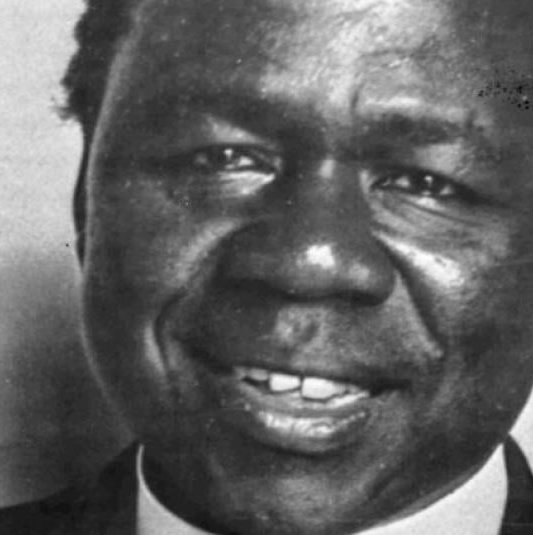
Biography
- 1922 Born
- 1948 Converted
- 1955 Ordained
- 1969 Bishop
- 1974 Archbishop
- 1977 Died
Tukutendereza Yesu — We praise you, Jesus; Jesus, Lamb of God, your blood cleanses me. I am satisfied in you.
The East African Revival gave the church a great many quiet people — health officers, teachers, catechists, men and women who confessed their sins in the open and sang the same short song for fifty years. It gave the church a few martyrs too. Janani Luwum was both. He began as a herdsboy in the far north of Uganda and ended as the Archbishop of the whole province, shot dead in a locked room for telling a tyrant the truth. Between the two ends lies a single unbroken line: a schoolteacher who was converted one January morning and never afterward stopped preaching, whatever it cost, and in the end it cost him everything.
A herdsboy from Mucwini
He was born about 1922 at Mucwini, in East Acholi, in the north of Uganda — a long way from the kingdoms and the cathedral cities where the church kept its power. No exact date survives; the year itself is only approximate, as it is for a great many people born in that place and time. His father was a Christian convert, one of the first in the district, which meant Janani was raised inside the faith rather than reaching it as a stranger. As a boy he herded the family’s cattle, goats and sheep, the ordinary apprenticeship of an Acholi childhood.
He was clever, and school carried him up out of the cattle paths. He went to Gulu High School and then to Boroboro Teacher Training College, and became a schoolteacher — a respectable position, a settled future. By his mid-twenties he had a trade, a wife named Mary, and a young daughter. By every ordinary measure he had arrived. What had not yet happened was the thing that would define everything else.
The morning of 6 January 1948
The Revival had been moving through East Africa for more than a decade — out of Rwanda and the mission station at Gahini, up through Uganda, carried by laymen who stood up in ordinary meetings and named their own sins aloud. Its people were called the balokole, the saved ones, and its song was a single Luganda chorus of thanksgiving for the blood of Christ, sung until it wore grooves in the memory of a whole generation.
Tukutendereza Yesu — We praise you, Jesus; Jesus, Lamb of God, your blood cleanses me. I am satisfied in you.
— “Tukutendereza Yesu,” the chorus of the East African Revival
On 6 January 1948 the fire reached Janani Luwum in his own village, while he was still a young schoolteacher. He was converted. It is the defining spiritual event of his life, and everything the rest of the biography records grows from it. There was nothing gradual about what followed. He became an evangelist at once, preaching against drink and tobacco, carrying the plain, uncomfortable, joyful message of the balokole into the villages around him. A man who had been going to be a teacher for the rest of his life had instead been arrested by God, and he never got over it.
Within a year the direction of his life had changed for good. He entered Buwalasi Theological College in January 1949, leaving his wife Mary and their young daughter at home when he first went. He was made a catechist in 1950, returned to train for ordination in 1953, and was ordained deacon on 21 December 1955 — St Thomas’s Day, the feast of the disciple who wanted to see the wounds before he would believe. He was ordained priest the following year.
From the north to the archbishop’s chair
What followed was two decades of steady ascent, though ascent was never the point. In 1966 he became Provincial Secretary of the Church of Uganda, Rwanda, Burundi and Boga-Zaire — administrative work, the unglamorous machinery of a large church. On 25 January 1969 he was consecrated Bishop of Northern Uganda. It is worth noting who came to that consecration: both Prime Minister Milton Obote and the army chief, Idi Amin, were present. The two men who would between them shape the horror of the next decade both watched the herdsboy from Mucwini become a bishop.
In 1974 the House of Bishops elected him Archbishop of the whole province, succeeding Erica Sabiti, the first African to have held the office. Luwum was the second. He was closely bound to his fellow Revival leader Bishop Festo Kivengere, and the two of them carried into the highest offices of the church the same brokenness and openness they had learned as young men in the meetings. He led as one of the balokole led — plainly, without pomp, and without the instinct to protect himself that high office usually breeds.
That instinct, or its absence, was about to be tested against Idi Amin.
Telling the truth to a tyrant
By the mid-1970s Amin’s Uganda had become a country of disappearances. People were taken in the night and did not return; bodies turned up in rivers and forests. Luwum did not stay silent, and he did not stop meeting the President — a decision that drew criticism from Christians who thought a churchman should keep his distance from a butcher. His answer to them is the fullest surviving statement of how he understood his own position:
I do not know for how long I shall be occupying this chair. I live as though there will be no tomorrow. I face daily being picked up by the soldiers. While the opportunity is there, I preach the gospel with all my might, and my conscience is clear before God that I have not sided with the present government, which is utterly self-seeking. I have been threatened many times. Whenever I have the opportunity I have told the President the things the churches disapprove of. God is my witness.
— Janani Luwum, answering those who questioned his willingness to keep meeting Amin
It reads like the same schoolteacher who could not keep the good news to himself in 1948 — only now the message was rebuke, and the audience was a man who killed the people who displeased him. In early February 1977 security forces raided the archbishop’s residence, claiming to search for weapons. Undeterred, Luwum and the House of Bishops — some eighteen of them — sent an open letter of protest to President Amin in the middle of that month, against the arbitrary killings and disappearances. It was as direct an act of defiance as any churchman in Africa had made.
The answer came quickly. On 16 February 1977 Amin convened a rally in Kampala. “Suspects” were paraded to read out confessions accusing Luwum of being an agent of the exiled Obote, plotting a coup, smuggling arms. Soldiers demanded his execution on the spot. The other bishops were dismissed; the archbishop was held back to see Amin privately. As he was led away, he spoke to Festo Kivengere, who never forgot it.
They are going to kill me. I am not afraid.
— Janani Luwum to Bishop Festo Kivengere, at the rally, 16 February 1977
He was arrested with two of Amin’s own cabinet ministers, Erinayo Oryema and Charles Oboth-Ofumbi. His last words to his fellow bishops, well remembered afterward, were not of fear but of a strange and settled sight:
I can see the hand of the Lord in this.
— Janani Luwum, his final words to his fellow bishops
By 17 February all three men were dead. Radio Uganda announced that they had been killed in a car crash while trying to overpower their driver and escape. It was a lie. When the body was released it was riddled with bullets; Amin’s own Minister of Health, Henry Kyemba, later wrote in A State of Blood that the archbishop “had been shot through the mouth and [had] at least three bullets in the chest.” He was buried near St Paul’s Church at Mucwini, in the ground he had come from.
The witness that outlived the tyrant
There was no rescue. For a martyr the honest answer to prayer is rarely a miracle of deliverance; it is the composure with which the death is met, and the way the witness refuses to die when the man does. Luwum had said he was not afraid, and he was not; he had said he could see the hand of the Lord, and he went to meet it. On 30 March 1977 a memorial service was held for him in Westminster Abbey — a herdsboy from Mucwini honoured under the vaults of England’s coronation church.
He had once said, simply, that he was prepared to die in the army of Jesus. The Uganda he left behind eventually found room even for reconciliation: in 2019, on the forty-second anniversary, his family and Idi Amin’s kin met in public to make peace — the Revival’s oldest instinct, sin named and forgiveness offered, working its slow way through a nation’s memory.
I am prepared to die in the army of Jesus.
— Janani Luwum
He was a soldier of that army from a January morning in 1948 until a February morning in 1977, and the line between the two never bent. A herdsboy who was told the truth and could not stop telling it; a bishop who kept meeting a murderer so that he could keep rebuking him; a man who saw the hand of the Lord in his own arrest and was not afraid. The chair he sat in he never expected to hold for long. The gospel he preached with all his might is holding still.
Also appears in

Questions and Answers
Who was Janani Luwum?
Janani Luwum (c.1922–1977) rose from a herdsboy in northern Uganda to Archbishop of the Church of Uganda, Rwanda, Burundi and Boga-Zaire. Converted in the East African Revival in 1948, he preached fearlessly and, after leading the bishops' protest against Idi Amin's killings, was murdered on 17 February 1977. He is honoured as one of the ten twentieth-century martyrs whose statues stand over the Great West Door of Westminster Abbey.
What was his early life?
He was born about 1922 at Mucwini, in East Acholi in the north of Uganda — a long way from the kingdoms and cathedral cities where the church kept its power. His father was one of the first Christian converts in the district, so Janani was raised inside the faith; as a boy he herded the family's cattle, goats and sheep. He was clever, and school carried him up out of the cattle paths, through Gulu High School and Boroboro Teacher Training College, to become a schoolteacher with a settled future.
How was he converted?
On 6 January 1948 the fire of the Revival reached him in his own village while he was still a young schoolteacher, and he was converted. It is the defining spiritual event of his life, and everything else grows from it. There was nothing gradual about what followed: he became an evangelist at once, preaching against drink and tobacco, carrying the plain, uncomfortable, joyful message of the balokole into the villages around him — a man arrested by God who never got over it.
How did he rise in the church?
Within a year the direction of his life had changed for good. He entered Buwalasi Theological College in 1949, was made a catechist in 1950, ordained deacon on St Thomas's Day 1955 and priest the following year. In 1966 he became Provincial Secretary; on 25 January 1969 he was consecrated Bishop of Northern Uganda — a consecration both Milton Obote and Idi Amin attended — and in 1974 the House of Bishops elected him Archbishop, succeeding Erica Sabiti as the second African to hold the office.
How did he understand his position under Amin?
By the mid-1970s Amin's Uganda was a country of disappearances, and Luwum did not stay silent, nor stop meeting the President. To Christians who thought a churchman should keep his distance, he answered: "I live as though there will be no tomorrow... While the opportunity is there, I preach the gospel with all my might, and my conscience is clear before God that I have not sided with the present government, which is utterly self-seeking... Whenever I have the opportunity I have told the President the things the churches disapprove of."
What was the bishops' protest?
In early February 1977 security forces raided the archbishop's residence claiming to search for weapons. Undeterred, Luwum and the House of Bishops — some eighteen of them — sent an open letter of protest to President Amin against the arbitrary killings and disappearances. It was as direct an act of defiance as any churchman in Africa had made, and the answer came quickly.
What happened at the rally on 16 February 1977?
Amin convened a rally in Kampala where "suspects" were paraded to read out confessions accusing Luwum of plotting a coup and smuggling arms; soldiers demanded his execution on the spot. The other bishops were dismissed and the archbishop held back to see Amin privately. As he was led away he spoke to Festo Kivengere, who never forgot it: "They are going to kill me. I am not afraid." His last words to his fellow bishops were, "I can see the hand of the Lord in this."
How did he die?
He was arrested with two of Amin's own cabinet ministers, and by 17 February all three were dead. Radio Uganda announced they had been killed in a car crash while trying to escape — a lie; when the body was released it was riddled with bullets, shot through the mouth and the chest. He was buried near St Paul's Church at Mucwini, in the ground he had come from. Tradition says that under interrogation he answered only by praying the Lord's Prayer, over and over, and died praying for his killers.
What became of his witness?
There was no rescue — for a martyr the honest answer to prayer is rarely deliverance but the composure with which the death is met. On 30 March 1977 a memorial service was held for him in Westminster Abbey, a herdsboy from Mucwini honoured under the vaults of England's coronation church. Amin fell two years after the man he murdered; Luwum did not. In 1998 his statue was raised over the Great West Door of Westminster Abbey, one of ten twentieth-century martyrs beside Martin Luther King Jr, Bonhoeffer and Romero.
How is he honoured, and what does his life say?
The Anglican Communion keeps his day on 17 February; Uganda keeps 16 February as a national holiday in his name; and in 2019 his family and Idi Amin's kin met in public to make peace — the Revival's oldest instinct, sin named and forgiveness offered, working its slow way through a nation's memory. His life is a single unbroken line: a herdsboy who was told the truth and could not stop telling it, a bishop who kept meeting a murderer so he could keep rebuking him, a man who saw the hand of the Lord in his own arrest and was not afraid.
Portrait: Anglican Focus