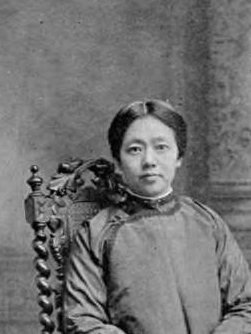
Biography
I often think that when I stand in my glorified body for the first moment in the presence of my Lord, my first exclamation will be—“Grace! Wonderful Grace!”
Dora Yu was born in 1873 in the compound of the American Presbyterian Mission in Hangzhou, where her father was studying to become a preacher. He had come a long way to that compound. Her father, the son of a wealthy Confucian family, had studied medicine and practised as a physician until the Taiping Rebellion, when the rebels took him prisoner. He won their favour by doctoring their soldiers, but never felt safe among them, and one night he escaped. Afterwards, in Hangzhou, he heard the gospel and became a Christian, and at forty he married. Dora and her sister, three years older, were the only children.
She grew up in parsonages, first in the tea country outside Hangzhou and then in the towns where her father served as pastor. She was a slow pupil beside her bright sister, and remembered herself as a child who believed everything she was told and could never quite see a joke. But her faith came early and stayed. She could not remember a time, she wrote, when she forgot to pray, and “Christ was a very real Person to me, and I loved Him.” Her sister was afraid of the dark; Dora used to ask herself, “If Jesus is here, why should I fear?”
I often think that when I stand in my glorified body for the first moment in the presence of my Lord, my first exclamation will be—“Grace! Wonderful Grace!”
— Dora Yu
A medical student alone in the world
In 1888, at fifteen, she left home for Suzhou (then spelled Soochow) to study Western medicine at the women’s hospital and medical school there. Three months later her father died. Within two years her mother, who for six winters had been unable to lie down because of heart disease, died too. Her parents had prayed to be spared until their girls were old enough to be left; that prayer, she said, was answered — but the loneliness was very great, and for years afterwards she could hardly bear to see a family gathered together. In the holidays, when every other student went home, she stayed behind.
She had made her own choice of a husband and was engaged, but as the wedding drew near (in 1892, according to her Chinese biographers) she found she could not go through with it. She feared, she wrote, that her love for God would be divided. Engagements were not easily broken in China, and for two weeks she wept and pleaded with God to set her free, promising to be His servant for the rest of her life — though she had first to be willing to say yes if He willed her to marry. The engagement was broken. Friends criticized her; she felt God telling her to take it quietly and show her sincerity by her life rather than her words. She never married.
“Lord, is this Thy love?”
She had read her Bible and prayed three times a day since childhood. Yet in 1895, a year before she was due to graduate, she woke one morning under a crushing sense of condemnation, convinced that she had committed a sin that could not be forgiven. For two weeks she could scarcely eat. She cried aloud for mercy day and night. A missionary friend begged her to believe in Christ for forgiveness, and she tried, but did not know how. Then a harder question was put to her: if it was God’s will that she spend the rest of her life as an invalid, would she accept it? She paused before the dark future that opened up, and then, deciding that no bodily suffering could be worse than the terror she was in, she cried out, “Yes, Lord, I am willing.”
In those weeks God brought her sins to mind, small and large, and taught her — she had not known it was in the Bible — that true repentance meant confession and restitution. Even a handful of corks once taken from the hospital dispensary without asking had to be paid for. Then one night, before the lamp was put out, the darkness broke. “All of a sudden God opened heaven to me, and filled me with His divine love,” she wrote. She cried out, “Lord, is this Thy love? I have never known it before.” She got out of bed to pray and could only say, three times over, “Lord, I thank Thee.” The next day even the sun seemed to shine more brightly.
She graduated in 1896 — she and a classmate were the school’s first women graduates — and stayed on at the hospital. She lived, she said, a year and a half in that heavenly joy, and then by her own account she drifted, grieving the Holy Spirit by ambition, until the world began to look attractive and real again.
Wanderings in Korea
In October 1897 her missionary friend, Josephine Campbell, invited her to Korea, where Campbell was opening the women’s work of the Southern Methodist mission in Seoul. Dora accepted at once — and later judged that she had gone “without permission from the King.” She titled this chapter of her life “Wanderings in the Wilderness.” She learned Korean, practised medicine and preached, did the work of a Bible-woman, and taught Chinese embroidery and lacework to the girls of the mission school. But her health collapsed. In 1899 she was sent home to China, where doctors told her she would likely be an invalid for life. She recovered enough to go back to Seoul in January 1900, then declined again for years — sleepless, living on drugs, weeping at the smallest trouble. Once, in the darkest stretch, the thought came to take a strong dose of a drug and be done with it; she answered, “No, I am going to wait God’s time.”
Just before her return to Korea, her sister fell gravely ill shortly after giving birth to her sixth child. Dora lay awake at night with a heavy heart, having asked God to carry the burden for her.
For two years she felt God telling her to go home to China, but she lingered, clinging, she said, to something He had told her to put aside. In the summer of 1903 she finally gave way.
Living by faith
Back in China she resolved to take no salary, though she could have supported herself by medicine. In January 1904 she rented a house near her sister’s home in order to preach the gospel to anyone she met. Before she moved in, the promised subscriptions collapsed, and her family feared her mind was not quite right. She went ahead, leaning on Jeremiah’s promise of “an expected end,” and gave up medicine for good. It became, she said, one of the most precious years of her life. Needs were met as they came. Late in 1904 her sister, her brother-in-law and their two eldest children were converted in revival meetings; he later became an evangelist himself.
At the second series of those meetings, the missionary women who were to lead the women’s sessions sent word they could hardly come, and the work fell to Dora — a woman who had lisped as a child and told stories badly.
From then on she was sent from mission to mission to preach. In the winter of 1907, sensing that she was working because she had become known as a worker rather than for love’s sake, she withdrew with a handful of pastors who felt the same need and confessed that she had left her “first love.” She found companions in the books of Andrew Murray, D. L. Moody and others. In 1908, with two friends, she prayed for a quiet place in Shanghai where Chinese Christians could “come apart and rest awhile,” and a gift from an American visitor rented the house she named the Bible Study and Prayer House. Bible readings began in Chinese, English and Korean, and the rooms were soon outgrown. A summer Bible school followed, drawing preachers’ wives, Bible-women and teachers from ten provinces through the August heat.
Revival in the south
Her first call to South China came in the spring of 1909. She could not speak a word of the southern dialects; she preached in English and missionaries translated. Before she left, she recalled one more old sin — glancing at notes during her final medical examination — and made it right. In the meetings that followed, she wrote, “God indeed visited us in mighty power”: pastors, preachers and church members pushed through the crowded church to take one another’s hands in tears, confessing their wrongs. Revival preaching took her across the country after that, and Chinese believers came to say that the north had Ding Limei and the south had Dora Yu.
In 1913–14 she travelled around the world for thirteen months. She came home grieved at what she had seen of “Higher Criticism” in the West and now in China, and she said plainly that it would be better for a missionary to stay home or go into business “than to be engaged in preaching a Christless Gospel.” She returned in December 1914 with a plan for a small house at Jiangwan (Chiangwan), outside Shanghai, where believers could be trained not only to search the Scriptures but to live them. Chinese Christians gave most of the money unasked, some selling their jewellery. The Bible school opened in 1916 with room for twelve. That year she published, in English, the little memoir God’s Dealings with Dora Yü: A Chinese Messenger of the Cross, later reissued in London.
It is only in proportion to my height in the heavenly places that I am able to come down low enough for God to use me.
— Dora Yu
The meetings at Fuzhou
In the spring of 1920 she held revival meetings at the Methodist Church of Heavenly Peace in Fuzhou. Among those who came was Lin Heping, a churchgoing mother who was converted there. Soon afterwards, in April 1920, Lin’s seventeen-year-old son, Ni Shuzu, also gave his life to Christ. He became known as Watchman Nee, and he later said simply that he had been saved through a woman believer, Dora Yu. For a time he studied at her Bible school in Shanghai, and she is also credited with introducing him to the English missionary Margaret Barber, who became his chief mentor. Through Nee and his mother, the fruit of those Fuzhou meetings ran on through Chinese Christianity for generations.
In 1927 Dora Yu went to England and spoke at the Keswick Convention — a rare honour for a Chinese Christian. Reports of her addresses say she pleaded with Western churches to stop sending missionaries who preached liberal theology to China. She returned to Shanghai by way of the United States in 1929.
Occupying till He came
Her health had been fragile all her life, and her last years were years of illness. She died in Shanghai in the spring of 1931, in her late fifties. She had prayed, near the end of her little book, that God would keep her “watching and waiting for His return,” and willing to fill any vacancy below until that coming.
She would not have wanted praise; God’s servants, she wrote, must “forward all the praises” to Him. Her own life was full of failures she refused to hide — the hasty journey to Korea, the bromide, the temper, the cooling of first love — and every one of them she told so that others passing through the same trials might take heart. Yet she had learned to live by faith with no salary, to preach without a script, and to wait for orders from what she called “the Almighty Captain.” Her book ends with a prayer and a plea that its readers would pray for her work, closing with the Bible’s own last prayer: “O Lord, come quickly. Amen.”
No books or sermons in the library yet for this writer.
Questions and Answers
Who was Dora Yu?
Dora Yu (Yu Cidu, 1873–1931) was a Chinese evangelist, revival preacher and Bible teacher. Trained in Western medicine, she gave up practice to preach by faith without a salary, founded the Bible Study and Prayer House and a Bible school in Shanghai, and led the 1920 meetings in Fuzhou through which Watchman Nee and his mother came to faith.
What was her early life like?
She was born in 1873 in the American Presbyterian Mission compound in Hangzhou, where her father, a former physician who had escaped captivity among the Taiping rebels, was training to be a preacher. She and her older sister were the only children. She wrote that she could not remember a time when she forgot to pray, and that Christ was a very real Person to her as a child.
Where did she study medicine?
In 1888, at fifteen, she left home to study Western medicine at the women's hospital and medical school in Suzhou (Soochow). Her father died three months after she arrived and her mother within two years, leaving her very much alone. She graduated in 1896 as one of the school's first two women graduates.
How did she come to a deep assurance of God's love?
In 1895 she was seized for two weeks by a terrible sense of condemnation, believing her sin could not be forgiven. She confessed and made restitution for wrongs God brought to mind and finally told the Lord she was willing even to be an invalid for life. One night, she wrote, God opened heaven to her and filled her with His love, and she could only say, Lord, I thank Thee.
What did she do in Korea?
In October 1897 she went to Seoul with the Southern Methodist missionary Josephine Campbell, where she practised medicine, preached, did the work of a Bible-woman and taught in the mission school. She later called those years her wanderings in the wilderness, because she felt she had gone without God's leading. Serious illness dogged her there, and she returned to China in 1903 after praying for, and receiving, the money for the journey.
How did her preaching ministry begin?
Back in China in January 1904 she rented a house to preach the gospel, refusing a salary and giving up medicine, though her family feared for her. When she was unexpectedly left to lead the women's revival meetings in her sister's city, she prayed for a message and went in trembling, and found blessing for ten days in succession. From then on she was invited from mission to mission to preach.
What was the Bible Study and Prayer House?
In 1908 she and two friends prayed for a quiet place in Shanghai where Chinese Christians could come apart to pray and study Scripture, and a gift from an American visitor rented the house. Bible readings, prayer meetings and a summer Bible school followed, drawing women workers from ten provinces. In 1916 she opened a small residential Bible school at Jiangwan outside Shanghai, built largely with gifts from Chinese Christians.
How was she connected with Watchman Nee?
In spring 1920 she led revival meetings at the Church of Heavenly Peace in Fuzhou, where Lin Heping was converted. Soon afterwards, in April 1920, Lin's seventeen-year-old son, Watchman Nee, also gave his life to Christ. He later studied for a time at her Bible school in Shanghai, and she is credited with introducing him to the missionary Margaret Barber.
Did she preach outside China?
Yes. Besides her years in Korea, she travelled around the world for thirteen months in 1913–14, and in 1927 she spoke at the Keswick Convention in England. There she urged Western churches to stop sending missionaries who preached liberal theology to China. She returned to Shanghai by way of the United States in 1929.
How did Dora Yu's life end?
Her health had been fragile all her life, and she died in Shanghai in the spring of 1931 after years of illness. She left a short memoir, God's Dealings with Dora Yu, in which she told her failures as honestly as her blessings so that others in the same trials might take heart. She is remembered as a pioneer of Chinese revival preaching who lived by faith.