New to Amy Carmichael? Start with
Things as They Are
All works · 7 hr 13 min read
Biography
- 1867 Born
- 1895 To India
- 1901 Dohnavur
- 1951 Died
Missionary life is simply a chance to die.
Amy Beatrice Carmichael was born on 16 December 1867 in the little seaside village of Millisle, County Down, in the north of Ireland, the eldest of seven children in a devout Presbyterian home. Her father, David, was a miller; the family knew both comfort and, after his early death when Amy was still in her teens, real financial hardship. She grew up praying childlike prayers with a child's boldness. The most famous of them is remembered still: as a small girl she asked God, night after night, to change her brown eyes to blue, and each morning ran to the mirror to see whether He had done it. He had not. Only decades later, dyeing her fair Irish skin with dark coffee to slip unnoticed into Hindu temples in South India, would she understand why brown eyes had been the better gift.
Her faith deepened in her teens and twenties into something far costlier than a child's wish. In the streets of Belfast, where the family had moved, she began gathering the poorest mill girls — the "shawlies," so called because they were too poor for hats and wore shawls over their heads — for Sunday classes. The work grew until it needed a hall of its own, and in 1887 the first "Welcome Hall" was built to house it. Those same Belfast years were shadowed by grief and pain — her father's death, and the first onslaughts of the chronic neuralgia that would dog her all her life — and it was amid that suffering, not apart from it, that she first sensed a stirring in her heart toward missionary service abroad. Through the Keswick Convention she came into the current of Victorian holiness teaching that would shape her whole life: a summons to entire surrender, to lay everything without reserve at the feet of Christ.
The Call East
The call to the mission field, when it came, was unmistakable and, to those around her, alarming. Stirred by the words of Hudson Taylor, founder of the China Inland Mission, Amy first offered herself to that very mission — but she was chronically unwell, the neuralgia could lay her low for weeks, and her health was judged unequal to it. She sailed instead for Japan in 1893, one of the first missionaries sent out under the Keswick banner, learning the language and wearing Japanese dress. Out of those months came her first book, From Sunrise Land (1895), but illness cut the venture short after some fifteen months. A brief spell in Ceylon — now Sri Lanka — followed. Then, in November 1895, she reached South India under the Church of England Zenana Missionary Society, committed from the outset to living among the people, learning their language and their ways — and there, apart from her arrival, she never left again. She would serve fifty-five years without a single furlough home.
India broke and remade her ministry. Itinerating through the Tamil villages around Tinnevelly — today's Tirunelveli — preaching from a bullock cart, she began to learn of a hidden evil: the devadasi tradition, in which young children, some of them infants, were "dedicated" by their families to the temples, the girls groomed for ritual prostitution under the mask of religious service. The turning point came on 7 March 1901, when a seven-year-old named Preena, who had escaped from a temple where she was being held, found her way to Amy. Amy wrote that the temple women had burned the child's hands for some childish fault. Preena climbed into Amy's lap, and Amy's course was set. She could not un-know what she now knew.
The Family at Dohnavur
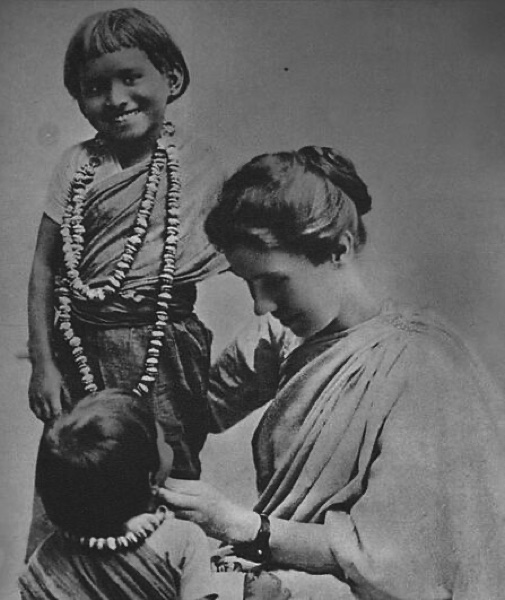
Out of that encounter grew the Dohnavur Fellowship, gathered around the village of Dohnavur near India's southern tip. Amy would not run it as an institution; she insisted it be a family, and that the children — rescued one by one, often through peril and at the edge of the law — call her not "madam" but Amma, mother. She dressed in a sari, adopted Indian food and custom, gave the children Indian names, and refused to make the work a showcase. She held to a hard financial discipline learned from Hudson Taylor and from George Müller's orphan houses before him: needs would be told to God in prayer, not solicited from donors; there were to be no appeals and no collections — simply pray, obey, and watch God provide. The children multiplied — seventeen girls by 1904, one hundred and thirty by 1913 — and in 1918 the Fellowship opened its doors to boys as well. Nurseries, schools, workshops, cottages, farmland, and eventually a hospital rose on the compound, until Dohnavur had grown into something like a model Christian village — all of it sustained, Amy maintained, by answered prayer.
Trials, and How Faith Met Them
Nothing about the work was easy or safe. Amy was accused of kidnapping, hauled into questions of law, opposed by those whose trade in children she was ending. She buried children she had fought to save. The year 1912 proved one of the most sorrowful of her life, bringing the deaths of close missionary colleagues and then of her own mother; she pressed on, finding solace in the grace of Christ and in the laughter and prayers of her growing Dohnavur family. And she wrote about all of it without varnish. Her 1903 book Things as They Are so unsettled its English readers with its unsentimental picture of the mission field that some accused her of exaggerating — she had refused the comforting fictions supporters expected, and the book's candour helped rouse real support for the work. She never pretended the cost was small.
Missionary life is simply a chance to die.
— attributed to Amy Carmichael
Her own deepest testing came late. In 1931 she prayed a dangerous prayer — that God would do anything in her that would fit her to serve Him — and soon after, while visiting a village to scout new ground for the ministry, she suffered a catastrophic fall, breaking her leg, dislocating an ankle, and injuring her spine. The injuries, joined to arthritis and the old neuralgia, left her largely bedridden for the last twenty years of her life. From that room, in constant pain, she wrote most of her books, poured out counsel to the Fellowship she could no longer walk among, and shaped the little devotional classic If, a series of searching lines that each measure the reader against the love shown at Calvary.
If I have not compassion on my fellow-servant even as my Lord had pity on me, then I know nothing of Calvary love.
— Amy Carmichael
Those lines were not written from a comfortable distance. They came from a woman who had spent thirty years pouring out compassion on the discarded, and who wrote them at last from a bed of pain, testing her own soul as fiercely as any reader's. The refrain returns again and again, each variation naming another quiet failure of love:
If I can easily discuss the shortcomings and the sins of any; if I can speak in a casual way even of a child's misdoings, then I know nothing of Calvary love.
— Amy Carmichael
Death and Legacy
Amy Carmichael never returned to Ireland after sailing east in 1893. She died at Dohnavur on 18 January 1951, at the age of eighty-three, having asked that no stone be set over her grave. The children buried her with a birdbath above the spot and one word for a memorial — Amma. She had lived to see the beginning of the end of the evil she fought: in 1947, four years before her death, the Madras Presidency outlawed the dedication of girls to temples — the devadasi system she had spent half a century opposing — a reform led by Indian campaigners such as Dr. Muthulakshmi Reddy, though many have traced in it the long influence of her witness too. The Fellowship she founded outlived her and continues its work in Tamil Nadu still, supporting children and families with education, healthcare, and Christian discipleship on the land she prayed into being.
She left behind a shelf of books that are less about India than about surrender: Gold Cord (1932), the story of the Fellowship, its title her image for the unbreakable bonds of love and shared purpose that bind a community to God and to one another; If; and many volumes of poems and letters that generations of readers have found convicting and clean. She taught that a Christian who asks to follow Christ closely should not be surprised to be marked by the following. Her instinct in every trial was to be still and to wait on God before acting.
So wait before the Lord. Wait in the stillness, and in that stillness assurance will come to you.
— Amy Carmichael
That was the pattern of her whole life: a bold child's prayer that God knew better than to answer as asked; a sickly young woman who would not stay home; a mother to thousands of children the world had thrown away; and, at the end, an invalid who from her bed still measured every impulse of the heart against the love of the Cross. She asked for no scar-free discipleship, and she was not given one. She would have said it was the truest mercy of her life.
Books by Amy Carmichael (1)
Books about Amy Carmichael (3)


Also appears in

Articles about Amy Carmichael (1)
Questions and Answers
Where did Amy Carmichael come from?
She was born on 16 December 1867 in the seaside village of Millisle, County Down, in the north of Ireland, the eldest of seven children in a devout Presbyterian home; her father David was a miller. Her most famous childhood prayer was to have her brown eyes changed to blue — a prayer God did not answer. Only decades later, dyeing her skin dark to slip unnoticed into Hindu temples in South India, would she understand why brown eyes had been the better gift.
How did her faith deepen before the mission field?
In Belfast she began gathering the poorest mill girls — the "shawlies," too poor for hats — for Sunday classes, until the work needed its own "Welcome Hall," built in 1887. Those years were shadowed by her father's death and the first onslaughts of the chronic neuralgia that would dog her all her life, and it was amid that suffering that she first sensed a call to missionary service, coming through Keswick into a summons to entire surrender.
How did she reach India?
Stirred by Hudson Taylor, she first offered herself to the China Inland Mission, but her health was judged unequal to it. She sailed instead for Japan in 1893 — out of which came her first book, "From Sunrise Land" — then briefly to Ceylon, and in November 1895 reached South India under the Church of England Zenana Missionary Society. Apart from her arrival she never left again, serving fifty-five years without a single furlough home.
What hidden evil did she confront in India?
Itinerating through the Tamil villages, she learned of the devadasi tradition, in which young children were "dedicated" by their families to the temples, the girls groomed for ritual prostitution under the mask of religious service. The turning point came on 7 March 1901, when a seven-year-old named Preena, escaped from a temple, found her way to Amy — the child's hands still bearing the marks where she had been branded for a first attempt at flight.
What was the Dohnavur Fellowship?
It grew from Amy's rescue of children, one by one, into a family gathered near India's southern tip. She would not run it as an institution: the children called her not "madam" but Amma, mother. She wore a sari, adopted Indian food and custom, and gave the children Indian names. Seventeen girls by 1904 and one hundred and thirty by 1913, with boys added from 1918, until nurseries, schools, workshops and a hospital made Dohnavur something like a model Christian village.
How was the work funded?
By prayer alone, a discipline learned from Hudson Taylor and from George Müller's orphan houses: needs would be told to God, not solicited from donors — no appeals and no collections. Through the lean years of the First World War, when the pound collapsed and prices soared, the Fellowship was somehow never left wanting; Amy's testimony was simple and unwavering — they had never lacked one good thing.
What opposition and sorrow did she face?
Nothing about the work was safe. She was accused of kidnapping, hauled into questions of law, and opposed by those whose trade in children she was ending, and she buried children she had fought to save. The year 1912 was among the most sorrowful of her life, bringing the deaths of close colleagues and of her own mother. Her book "Things as They Are" so unsettled English readers with its unsentimental candour that some accused her of exaggerating.
How did her active ministry end?
In 1931 she prayed that God would do anything in her that would fit her to serve Him, and soon after, scouting new ground, she suffered a catastrophic fall — breaking her leg, dislocating an ankle and injuring her spine. Joined to arthritis and the old neuralgia, the injuries left her largely bedridden for the last twenty years of her life. From that room, in constant pain, she wrote most of her books.
What is her little book "If"?
It is a series of searching lines that each measure the reader against the love shown at Calvary: "If I have not compassion on my fellow-servant even as my Lord had pity on me, then I know nothing of Calvary love." The lines were written not from a comfortable distance but from a bed of pain, by a woman who had spent thirty years pouring out compassion on the discarded, testing her own soul as fiercely as any reader's.
How did she die, and what is her legacy?
She died at Dohnavur on 18 January 1951, aged eighty-three, having asked that no stone be set over her grave; the children set a birdbath above the spot and one word for a memorial — Amma. In 1948 the dedication of girls to temples was outlawed in India, a reform many have traced to her long witness. The Fellowship she founded continues in Tamil Nadu still, and she left a shelf of books on surrender — "Missionary life," she wrote, "is simply a chance to die."