New to Zilpha Elaw? Start with
Memoirs of Mrs. Zilpha Elaw
All works · 4 hr 25 min read
Biography
This is my commission for the work of the ministry, which I received, not from mortal man, but from the voice of an invisible and heavenly personage sent from God.
Zilpha Elaw was born around 1790 in Pennsylvania, near Philadelphia, to Black parents she remembered simply as “religious parents.” In her father’s house the day began and ended with prayer: family devotion morning and evening, the praises of God sung aloud. It was the only such home she would know as a child. When she was about twelve her mother died after giving birth to her twenty-second child. Her father placed Zilpha with a Quaker family, Pierson and Rebecca Mitchel, to serve them until she was eighteen. Eighteen months later he too was dead, and the girl had no one on earth to look to but the household she had been sent to serve.
The Mitchels were kind, but their religion was kept “in the secret silence of the mind,” and no one spoke of God in her hearing. The change from her father’s praying house was hard. Left without guidance, she says, she ran into folly with the other young people of the house, though often she slipped away to weep before God where no one could see. Once, swearing to make her companions laugh, she looked up and seemed to see God frowning down on her, and her tongue stopped mid-word. That night she dreamed of the Day of Judgment, and woke so shaken that her mistress asked what had changed in her.
A vision in the cowshed
About this time the Methodists began holding meetings in that part of the country, and Zilpha was allowed to attend them every other Sunday afternoon. Under their preaching the darkness slowly lifted, but for months she had no assurance that her sins were forgiven, and she prayed for it every day. The answer came one evening in the most ordinary of places. She was milking the cow and singing a hymn — “Oh, when shall I see Jesus, and dwell with him above?” — when she turned her head and saw a tall figure in a long white robe coming towards her, who stood beside her with open arms and smiled. She felt that his very looks spoke, and said, “Thy prayer is accepted, I own thy name.”
She tells the story without embarrassment, and adds that even the cow saw it, bowing her knees and cowering to the ground. Readers may weigh such things as they will; Elaw herself declared that she wrote “as before God and Christ.” What is beyond doubt is what followed. “From that day to the present,” she wrote more than thirty years later, “I have never entertained a doubt of the manifestation of his love to my soul.” In 1808 she joined the Methodist Episcopal society. When the preacher asked whether anyone present wished to join, she rose and answered, “Yes, bless the Lord, here is one.” Looking her over, he remarked, “Well, this seems a bold champion indeed.”
The rest of the household did not share her joy. She was mocked by the young people, scolded by her mistress, and lived among them, she said, “as a speckled bird.” But the loneliness drove her to God. Her two-mile night walks to class meeting, past graveyards and through dark woods, became “seasons of sweet communion with my God.”
An unequal yoke
In 1810 she married Joseph Elaw, a fuller by trade, “a very respectable young man,” as she put it, “but he was not a Christian.” Within a year of the wedding Joseph had set out to make her give up her religion. He took her to a ball in Philadelphia, hoping the music would win her over; she stood in the ballroom and could only weep before God, and he never tried it again. The couple moved to Burlington, New Jersey, where, to her delight, the Methodist class met a few doors from her house. A daughter, Rebecca, was their only child.
At a camp meeting in the woods, Elaw came into the experience Methodists called entire sanctification. She sank to the ground under the preaching and lay there a long while, and heard a voice say, “Now thou art sanctified.” When she came to herself she felt “as pure as if I had never sinned in all my life.” This was Wesleyan holiness teaching, the conviction that God can cleanse the heart and fill it with love. For the rest of her life she counted it the heart of the gospel she preached. Soon after, she was praying aloud in the meetings, and for five years she carried what she called a “household ministry” through Burlington, visiting families rich and poor to speak with them about their souls.
The call she resisted
The call to preach came first through her sister Hannah. Dying in Philadelphia, Hannah told Zilpha she had seen Jesus, and that an angel had bidden her tell Zilpha “that she must preach the gospel.” Zilpha kept it to herself for years. Her husband’s opposition weighed on her, and so did her sense of being unfit.
A long illness brought her to the edge of death. Her doctor tried a last, brutal treatment, burning her side with caustic, and it nearly killed her. During her recovery she saw, one midnight, a figure by her bed bringing her word from God, and from that hour she began to mend. Fifteen months later a camp meeting was announced. She had no money and no suitable clothes. Then her old master Mitchel, hearing she had been ill, sent his son and daughter to find her in Burlington with a gift of money. It was the first such favour she had ever received from him, and to her it showed “the ever-mindful care of God.” At that meeting, on a Sunday at midday before thousands of people, she began, almost without meaning to, to exhort the crowd. When she sat down she heard the same voice again: “Now thou knowest the will of God concerning thee; thou must preach the gospel; and thou must travel far and wide.”
This is my commission for the work of the ministry, which I received, not from mortal man, but from the voice of an invisible and heavenly personage sent from God.
— Zilpha Elaw
The local ministers approved. Her own class did not. All but three of the Black class members who had loved her abandoned her: “Like Joseph, I was hated for my dreams.” Joseph Elaw heard the news from a neighbour who taunted him with it, and he begged her to stop. “Now child,” he told her, “we are undone.” Then his health failed. He died of consumption on 27 January 1823, still, as far as she could tell, a stranger to Christ, though he grew gentler near the end and admitted that her conduct had always been blameless. She turned down friends’ offers to pay for his funeral, wanting to do this last thing for him herself.
Teacher, debtor, preacher
Widowed and in debt, she put her daughter into service, went into service herself until her health broke, and then opened a school in Burlington for Black children, whom the white schools would not admit. Local Quakers gave her books and brought visitors to see “a female of colour teaching the coloured children.”
Oh! that men would outgrow their nursery prejudices and learn that “God hath made of one blood all the nations of men that dwell upon all the face of the earth.”
— Zilpha Elaw
But the commission would not leave her alone. She told herself it would be a sin to set out while she owed any man money, and she stayed two years in that state with no savings to show for it. She asked God for a sign within three months. None came, and she fell ill again, and then into a darkness so deep she could not pray. Her young daughter put it plainly: “I believe thou art going to be like some of the queer old women.” Elaw took the words as a rebuke from God.
On the soil of slavery
In 1828, leaving Rebecca with relatives, she went south into the slave states, into Maryland, Virginia and the District of Columbia. She knew exactly what she risked: a free Black woman with no protector could be seized and sold, and the law would allow it. In one small town the news that a Black woman was preaching to the enslaved drew a crowd, and as she watched them point at her through the door, terror took hold of her. She went off to a corner of the room and asked herself where the fear came from. Then her faith returned.
Get thee behind me Satan, for my Jesus hath made me free.
— Zilpha Elaw
She came out of her corner and went on with the meeting. White Methodists then opened the courthouse for her. She preached in Baltimore, Washington, Alexandria and Annapolis, to slaveholders in the body of a chapel and enslaved people in its gallery, all of them weeping together. Even so, she noted, “the production of the documents of my freedom was not once demanded during my sojourn on the soil of slavery.”
Over the next decade she travelled through New York, Connecticut, Massachusetts and Maine, preaching from chapel pulpits and from open wagons. In Hartford a leading Presbyterian minister vowed to have her stopped and ended up telling his own people that the work was of God. At an Oyster Bay camp meeting her own daughter cried out for mercy while she preached, and was converted before it ended. For some years she made her home on the island of Nantucket.
A stranger in a strange land
In 1828 she had heard a voice tell her she would see London. On 10 June 1840 she parted from Rebecca and two small grandsons. “Mother, we part now,” her daughter said, “but I think we shall yet meet again.” Elaw sailed from New York on 1 July and landed at the London Docks on 25 July. England was not easy. A Wesleyan committee in London examined her, she said, as “the proud do the needy.” In Liverpool a superintendent told her, “Do you not know that we do not allow women to preach?” She held, as she wrote, that the God who raised up Deborah had sent her, and that Paul’s rule for ordinary church order was never meant to limit the Holy Spirit’s extraordinary call. Primitive Methodists, Wesleyans and independent chapels opened their doors to her across Kent, Yorkshire, Lancashire and the north-east. She preached about two hundred times in nine months around Manchester, as well as to fishermen on Holy Island, and was nursed through a five-month illness by English friends.
In 1846, after five years in England, she published her Memoirs in London and dedicated them to “the Saints and faithful Brethren in Christ” who had heard her, meaning to cross “the pathless bosom of the foaming Atlantic” and go home. Her memoir ends there, and for more than a century it was not known what became of her. Historians searching English records have since found that a widow named Zilpha Elaw married Ralph Shum at Bow, in east London, in 1850, and was widowed again in 1854, and that a Zilpha Shum, aged 80, was buried in Tower Hamlets Cemetery in August 1873. If these records are hers, as scholars believe, she never sailed home, and she died in London. We do not know whether she preached in those last years, or whether she saw Rebecca again.
What she left is the testimony she wrote so that others might take heart: the story of a motherless servant girl who met Christ while milking a cow, and a widow who left her school with an empty purse. In slave country she told her fear, “my Jesus hath made me free.”
Books by Zilpha Elaw (1)
Questions and Answers
Who was Zilpha Elaw?
Zilpha Elaw (c. 1790–1873) was a Black Methodist preacher born near Philadelphia. Against fierce opposition she preached across the northern states and in the slave states of Maryland, Virginia and the District of Columbia, then spent years preaching in England. Her 1846 Memoirs are one of the earliest spiritual autobiographies by an African American woman.
What was her childhood like?
She grew up in a praying household, where family devotion was held morning and evening. When she was about twelve her mother died after giving birth to her twenty-second child, and her father placed her with a Quaker family, Pierson and Rebecca Mitchel, to serve until she was eighteen. Eighteen months later her father died too, leaving her with no one to look to but the household she served.
How was Zilpha Elaw converted?
Under Methodist preaching she prayed for months to know her sins were forgiven. One evening, while milking a cow and singing a hymn, she saw a figure in a white robe who stood by her with open arms, and she felt his looks say, "Thy prayer is accepted, I own thy name." She wrote that she never doubted Christ's love for her from that day on, and in 1808 she joined the Methodist Episcopal society.
What was her marriage like?
In 1810 she married Joseph Elaw, a fuller, whom she described as respectable but not a Christian. Within a year he was trying to make her give up her religion, once taking her to a ball in hopes of winning her over, where she could only weep before God. He later begged her to stop preaching, and he died of consumption on 27 January 1823.
What happened to her at the camp meeting?
At a Methodist camp meeting she came into the experience of entire sanctification. She lay on the ground a long time under the preaching, heard a voice say, "Now thou art sanctified," and felt as pure as if she had never sinned. This Wesleyan holiness teaching became the heart of her message, and for five years she carried a household ministry, visiting families in Burlington, New Jersey.
How was she called to preach?
Her dying sister Hannah told her that an angel had said Zilpha must preach the gospel, but for years she held back, pleading that she was a poor, coloured female. After a long and nearly fatal illness, she began to exhort the crowd at a camp meeting before thousands, and heard a voice say, "thou must preach the gospel; and thou must travel far and wide." She called this her commission, received not from mortal man but from God.
What did she do after her husband died?
Widowed and in debt, she went into service until her health failed, then opened a school in Burlington for Black children whom the white schools would not admit. For two years she would not set out to preach while she owed money. Then she pledged to go just as she was. In Philadelphia every congregation took up a collection for her, and she came home after seven months able to pay every debt.
Did she preach in the slave states?
Yes. From 1828 she preached in Maryland, Virginia and the District of Columbia, including Baltimore, Washington, Alexandria and Annapolis, at real risk of being seized and sold. When fear overtook her in one town she answered it, "Get thee behind me Satan, for my Jesus hath made me free," and went on. She noted that she was never once asked to produce the papers proving her freedom.
Why did she go to England?
She believed God had told her in 1828 that she would see London and declare his name there. In 1840 she left her daughter Rebecca and sailed from New York, landing at the London Docks on 25 July. Over the next five years she preached across Kent, Yorkshire, Lancashire and the north-east, including about two hundred sermons in nine months around Manchester, though some Wesleyan ministers refused to allow a woman to preach.
When did Zilpha Elaw die?
Her Memoirs, published in London in 1846, end with her hoping to return to America, and for a long time her fate was unknown. Historians have since found records of a Zilpha Elaw marrying Ralph Shum in east London in 1850, and of a Zilpha Shum, aged 80, buried in Tower Hamlets Cemetery in August 1873. If these are hers, as scholars believe, she died in London without returning home.
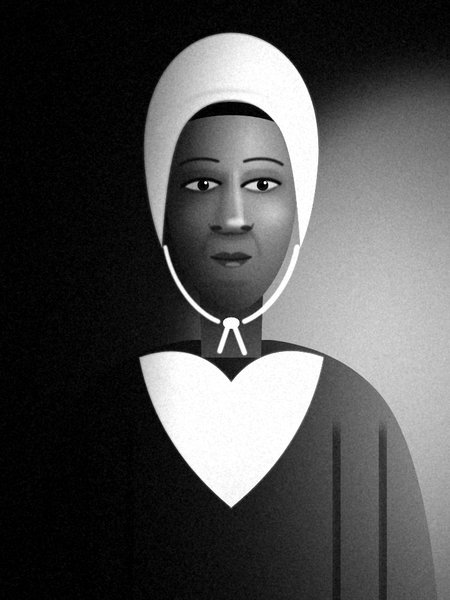
Portrait: Illustration by Ochorus (an imagined likeness)