New to William Law? Start with
A Serious Call to a Devout and Holy Life
All works · 10 hr 24 min read
Biography
- 1686 Born
- 1705 Cambridge
- 1714 Refused oath
- 1728 Serious Call
- 1761 Died
Devotion is neither private nor public prayer; but prayers, whether private or public, are particular parts or instances of devotion. Devotion signifies a life given, or devoted, to God.
In the churchyard of King's Cliffe, a stone village on the edge of the old forest of Rockingham, lies a man who never held a parish of his own, never rose an inch in the church he loved, and never once permitted anyone to paint his portrait. He founded no movement and gathered no following. Yet William Law wrote a book that John Wesley could not shake off, that George Whitefield said worked powerfully upon his soul, that made Samuel Johnson think in earnest about God for the first time in his life, and that Edward Gibbon — the great sceptic, no friend to religious enthusiasm — admitted would kindle any spark of piety in a reader into a flame.
He was born in 1686, the fourth of eight sons in a household of eleven children, to Thomas Law, a grocer of King's Cliffe, and his wife Margaret. A grocer's son with a good head was sent to Cambridge to make something of himself, and on 7 June 1705 William Law was admitted a sizar of Emmanuel College — a poor scholar, earning his keep. He read the classics, mathematics, and philosophy, and by 1711 he had done everything a young man was supposed to do: he took his degree, was elected a fellow of his college, and was ordained. He was twenty-five. The road ahead was straight, respectable, and entirely closed to him within three years.
The oath he would not swear
Queen Anne died in 1714 and the crown passed to George of Hanover. Every man holding office in church or university was required to swear allegiance to the new king and to abjure the exiled Stuart line. Law would not do it. He had already sworn to the House of Stuart, and he held that an oath, once given before God, is not a thing a man revises when the political weather changes. It was a scruple of conscience, and it cost him everything a young clergyman had. Deprived of his fellowship, he became a Non-Juror — one of that small, stubborn company of English clergy who paid for their consciences with their careers and lived on the margins of the establishment for the rest of their lives.
He was never restored. He served briefly as a curate at Fotheringay and in London, but preferment was impossible; when Dean Thomas Sherlock offered him advancement, the oath still stood in the way and Law declined. Instead of a bishopric he got obscurity, private teaching, and time to write. The Church of England's loss of a clergyman was the English-speaking world's gain of a devotional master.
His pen, at first, was a weapon. In 1717 he entered the Bangorian controversy with Three Letters to the Bishop of Bangor, still regarded as the most forcible writing the whole dispute produced. In 1723 he took apart Bernard Mandeville's cynical Fable of the Bees. But in 1726 something deeper surfaced: A Practical Treatise upon Christian Perfection. The controversialist was becoming a physician of souls.
The book that would not let go
By 1727 Law had joined the household of Edward Gibbon at Putney as tutor to the son of the house — the father of the historian who would one day write The Decline and Fall of the Roman Empire. He remained ten years and became, in the family's own reckoning, the honoured friend and spiritual director of them all. And there, at the end of 1728, he published the book that carries his name: A Serious Call to a Devout and Holy Life.
Its argument is disarmingly simple and almost impossible to escape. Everyone grants, Law observed, that prayer must be offered according to the will of God. Very well — then why should the other twenty-three hours be exempt?
Devotion is neither private nor public prayer; but prayers, whether private or public, are particular parts or instances of devotion. Devotion signifies a life given, or devoted, to God.
— William Law
From that seed the whole book grows. He drew portraits — Flavia, who spends on herself and gives the poor her leftovers; Miranda, who divides her fortune with the needy and keeps only her own share of it — so sharply observed that Gibbon thought them not unworthy of La Bruyère. But Law's satire was never cruelty. It was diagnosis. And in the second chapter he laid his finger on the nerve:
And if you will here stop, and ask yourselves, why you are not as pious as the primitive Christians were, your own heart will tell you, that it is neither through ignorance nor inability, but purely because you never thoroughly intended it.
— William Law
That sentence has undone a great many readers. It leaves no room for the comfortable excuse. You are not more holy because you have never seriously meant to be.
Wesley, Whitefield, and the Revival
The effect was extraordinary and almost immediate. Samuel Johnson picked it up at Oxford expecting a dull book he could laugh at, and later told Boswell he had found Law quite an overmatch for him — it was, he said, the first occasion of his thinking in earnest about religion. George Whitefield got hold of a small edition at Oxford and recorded that God worked powerfully upon his soul through it; he began to pray and sing psalms three times a day. Charles Wesley called reading it a turning point. John Wesley first came to see Law at Putney in 1732, and for years he carried the Serious Call and Christian Perfection with him and pressed them on his preachers. Henry Venn, Thomas Scott, James Hervey, John Newton — the men who lit the Evangelical Revival were reading William Law before they were reading each other. Half a century later, in 1784, the young William Wilberforce would be shaken by the same book.
An anonymous benefactor, it is said, pressed a thousand pounds into Law's hands, and Law appears to have turned it straight into a school at King's Cliffe for fourteen poor girls, founded in 1727, who were to be clothed and taught reading, knitting, and every useful kind of needlework. He was giving money away before he had published a word urging others to.
Fixed hours and a rule of life
A third of the Serious Call is about prayer — not prayer as mood, but prayer as appointment. Law urged a rule of life built on fixed hours: early in the morning, then nine o'clock for humility, noon for universal love and intercession, three o'clock for resignation to the will of God, and evening for self-examination and confession. He was blunt about the cost of the first of them: it is as much your duty to rise to pray, he wrote, as to pray once you have risen.
Prayer is the nearest approach to God, and the highest enjoyment of Him, that we are capable of in this life.
— William Law
Boehme, and the parting with Wesley
Around 1735 a physician friend, Dr George Cheyne, put into Law's hands a book that led him to the writings of Jacob Boehme, the German shoemaker-mystic. Law was captivated. He taught himself German in order to read Boehme in the original, and his last works — An Appeal to All that Doubt (1742), The Spirit of Prayer (1749–50), The Way to Divine Knowledge (1752), The Spirit of Love (1752–54) — are steeped in him. The moral rigour of the Serious Call gave way to something inward and luminous, all about the birth of Christ within the soul.
Not everyone followed him there, and it would be dishonest to pretend otherwise. This is where Law divided his admirers, and the division has never quite healed. In May 1738, fresh from his Aldersgate experience, John Wesley wrote to his old mentor with a reproach that still stings: how would Law answer it to their common Lord that he had never given Wesley this advice — never directed him first of all to a living faith in the blood of Christ? Law replied, with some dignity, that he had commended Thomas à Kempis and had constantly insisted on the same truth, and asked whether the quarrel was not partly a contest about words. But the friendship was over. In 1756 Wesley published an open letter saying he had scarce met with a greater friend to darkness, except the illuminated Jacob Behmen himself. Law never answered it publicly. He was, we are told, deeply hurt.
Something in that tension is worth sitting with. The man who had taught the Revival to be serious about holiness could not, in the end, walk with the Revival. And yet Wesley went on quoting him with admiration in his sermons for the rest of his life, and went on printing his books. Coleridge and Blake would later prize the Boehme volumes that Law's household paid to publish. Great teachers are rarely tidy.
King's Cliffe: a household of prayer and alms
When old Edward Gibbon died in 1737 the Putney years ended. Law lodged briefly in London and then, towards the close of 1740, went home for good to King's Cliffe. He was not alone for long. Archibald Hutcheson, a member of Parliament, had died that year wishing that his widow Elizabeth should live a retired and religious life under Law's direction; Hester Gibbon, sister of Law's old pupil, made the same choice. By 1744 the three of them were settled in Law's house at King's Cliffe, an ancient manor the village still called King John's Palace.
They set out, quite deliberately, to obey the Serious Call to the letter — to spend in charity everything not strictly necessary. Between them the two women had close to three thousand pounds a year, a very large income for the time. Almost all of it went out again. Law's school for fourteen girls was joined by a school for eighteen boys, raised to twenty in 1746; they built almshouses; Law kept a great theological library. Four cows were kept and their milk given away to poor neighbours. Every day Law tasted the soup made for the poor, and those who knew him said the one thing that could make him short-tempered was soup that had not been well enough made.
His own life was plain to the point of austerity — dinner at noon, tea at which he ate only raisins, a brisk walk in the fields, one pipe and a glass of water before bed. He loved music, insisting that anyone could be taught to sing well enough for devotion, and he was fond of animals and of children.
The charity was not universally admired. The rector complained that the household's giving was indiscriminate, and on 21 February 1753 the more considerable inhabitants of King's Cliffe formally petitioned the justices of the peace that Law and his family were the cause of the miserable poverty of the parish, drawing beggars from miles around. Law signed a reply. They would continue as they had begun; if the parish preferred, they would leave it altogether. They stayed. The beggars, as one historian dryly put it, proved too strong for the considerable inhabitants.
I give to all, because I pray to God to forgive all; and I cannot refuse an alms to those whom I pray God to bless.
— William Law
Almost in the act of singing
He caught a chill at the annual audit of his school, and after a fortnight's illness died on 9 April 1761, aged seventy-five. He had written a letter the day before without so much as mentioning that he was ill. He died, those with him said, almost in the act of singing the Angels' Hymn. He was buried at King's Cliffe, in the village where he was born, a few steps from the schools he had founded. Mrs Hutcheson lived on until 1781 and died at ninety-one; Hester Gibbon until 1790, dying at eighty-six — her nephew the historian noting, not unkindly, that she still lived in a hermitage at Cliffe, having long survived her spiritual guide and faithful companion Mr William Law.
He left no portrait, no monument, no denomination. He left a book. Two and a half centuries later the Church of England and the Episcopal Church still keep his memory on 10 April, and readers who have never heard of the Bangorian controversy or the Non-Jurors still find themselves stopped mid-page by a plain man asking a plain question: not whether they can be holy, but whether they have ever thoroughly intended it.
Books by William Law (1)
Articles about William Law (2)
Questions and Answers
Why did William Law lose his Cambridge fellowship and any hope of a church career?
Law had been elected a fellow of Emmanuel College and ordained by 1711, with a straight and respectable road ahead of him. But when Queen Anne died in 1714 and the crown passed to George I, every officeholder was required to swear allegiance to the new Hanoverian king and abjure the exiled Stuart line. Having already sworn to the House of Stuart, Law held that an oath given before God is not revised when the political weather changes, and he refused — a scruple of conscience that cost him his fellowship and any preferment for the rest of his life.
What was a "Non-juror," and what did that status mean for Law's life?
The Non-jurors were a small, stubborn company of English clergy who would not swear the oath of allegiance to the Hanoverian monarchs and so paid for their consciences with their careers. Law became one of them and was never restored to office. He served briefly as a curate and later declined advancement offered by Dean Thomas Sherlock, because the oath still stood in the way; barred from a parish of his own, he turned instead to private teaching and to writing.
Is it true he tutored the family of the historian Edward Gibbon?
Yes. Around 1727 Law joined the household of Edward Gibbon at Putney as tutor to the son of the house — the father of the historian who would write The Decline and Fall of the Roman Empire. He remained about ten years and became, in the family's own reckoning, the honoured friend and spiritual director of them all. It was during these years, at the end of 1728, that he published the book that carries his name.
What is William Law best known for?
He is remembered above all for A Serious Call to a Devout and Holy Life, published at the end of 1728, one of the most influential devotional books ever written in English. Its argument is disarmingly simple: everyone agrees prayer should be offered according to the will of God, so why should the other twenty-three hours of the day be exempt? For Law, devotion meant not a mood or an hour of prayer but a whole life given, or devoted, to God.
How did A Serious Call shape John Wesley, Whitefield, and Samuel Johnson?
The effect was extraordinary. Samuel Johnson picked it up at Oxford expecting a dull book to laugh at and later told Boswell he found Law "quite an overmatch for me," the first occasion of his thinking in earnest about religion. George Whitefield said God worked powerfully upon his soul through it, Charles Wesley called reading it a turning point, and John Wesley carried it and its companion volume for years and pressed them on his preachers — so that the men who lit the Evangelical Revival were reading William Law before they were reading each other.
What are the famous character sketches in the book?
Law drew portraits so sharply observed that Gibbon thought them not unworthy of the French satirist La Bruyère — Flavia, who lavishes money on herself and gives the poor only her leftovers, and Miranda, who divides her fortune with the needy and keeps just her own share. Yet the satire was never cruelty but diagnosis. He laid his finger on the nerve with a sentence that has undone many readers: you are not as holy as the early Christians "neither through ignorance nor inability, but purely because you never thoroughly intended it."
Why did his later turn to the mystic Jakob Böhme cool some of his admirers?
Around 1735 a physician friend put into Law's hands the writings of Jakob Böhme, the German shoemaker-mystic, and Law was captivated — he even taught himself German to read Böhme in the original. His later works grew inward and luminous, all about the birth of Christ within the soul, and not everyone would follow him there. The break with John Wesley was the sharpest: after Wesley reproached him for never pointing him to a living faith in the blood of Christ, the old friendship ended, and in 1756 Wesley published an open letter calling him a friend to darkness — a wound Law is said to have felt deeply, though Wesley went on quoting him with admiration for the rest of his life.
How did Law actually live out the holiness he wrote about?
Towards the end of 1740 he settled for good at King's Cliffe, the village where he was born, joined by two devout women, Elizabeth Hutcheson and Hester Gibbon, who set out deliberately to obey A Serious Call to the letter and spend in charity everything not strictly necessary. Between them the women had close to three thousand pounds a year, and almost all of it went out again: they ran a school for fourteen poor girls and another for eighteen boys, built almshouses, and gave away milk and soup daily. His own life was plain to the point of austerity — rising at five to pray, keeping fixed hours through the day — and he answered complaints about his indiscriminate giving simply: "I give to all, because I pray to God to forgive all; and I cannot refuse an alms to those whom I pray God to bless."
How did William Law die, and what did he leave behind?
He caught a chill at the annual audit of his school and, after a fortnight's illness, died on 9 April 1761 at the age of seventy-five, having written a letter the day before without so much as mentioning that he was ill. Those with him said he died almost in the act of singing a hymn. He was buried at King's Cliffe a few steps from the schools he had founded, leaving no movement and no monument, only a book that still stops readers mid-page with its plain question — not whether they can be holy, but whether they have ever thoroughly intended it.
Is there any portrait of William Law taken from life?
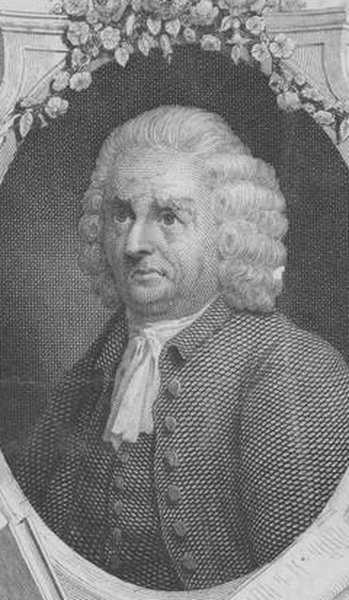
No genuine likeness of him is known to survive, because Law never once permitted anyone to paint his portrait — the later engravings that circulate are not drawn from life. It is of a piece with the man, who founded no denomination, sought no preferment, and gathered no following around himself. He left the world his books and his example rather than his face.