New to Thomas à Kempis? Start with
The Imitation of Christ
All works · 5 hr 13 min read
Biography
- 1380 Born
- 1392 Deventer
- 1399 Mount St Agnes
- 1413 Ordained
- 1471 Died
Better of a surety is a lowly peasant who serveth God, than a proud philosopher who watcheth the stars and neglecteth the knowledge of himself.
There is a strange arithmetic at the heart of this man's life. He wrote what is very likely the most widely read Christian book ever composed after the Bible itself — a little volume that has been translated into more languages than almost any other work of devotion, carried in the pockets of soldiers and scholars and dying men for six centuries. And he did it while going almost nowhere, meeting almost no one, and taking such care to leave no trace of himself that for three hundred years learned men argued about whether he had written it at all.
Thomas à Kempis spent roughly seventy years inside a single monastery on a low hill outside a provincial Dutch town. He held no great office. He preached to no crowds. He was never canonised. The record of his days is a record of copying, praying, teaching young men, and writing small books for their use. That is the whole of it — and that is precisely the point. The Imitation of Christ did not come out of a life of incident. It came out of a life of stability, and the two facts belong together.
Better of a surety is a lowly peasant who serveth God, than a proud philosopher who watcheth the stars and neglecteth the knowledge of himself.
— Thomas à Kempis
The hammer's son
He was born Thomas Hemerken — the name means something like "little hammer," and was later Latinised to Malleolus — in the town of Kempen in the Rhineland, in the diocese of Cologne. The year was 1379 or 1380; the sources cannot settle it, and neither should we. He is known to us by the place rather than the family: Thomas of Kempen, Thomas à Kempis.
His parents were John and Gertrude Hemerken, working people. Exactly what his father did is another small uncertainty: some accounts make him a smith, others simply a poor labouring man. His mother, by several accounts, kept a small school in the town. Nothing about the household suggested that one of its sons would be read for six hundred years.
There was an elder brother, John, some fourteen years ahead of him, and John went first — first to school, and later into the religious life. Thomas followed him both times. It is worth pausing on that, because it is a pattern in this life: Thomas rarely struck out. He followed, he stayed, he remained. In a century of restless reformers he was constitutionally a man who did not move.
Deventer, and the Modern Devotion
In 1392, at about twelve or thirteen, Thomas travelled to Deventer in the Netherlands to attend its famous school. He stayed some seven years, and those years made him.
Deventer was the heartland of what came to be called the devotio moderna, the Modern Devotion — a renewal movement begun by Geert Groote, who had died before Thomas was old enough to know him. Groote's followers, the Brethren of the Common Life, were not monks in the old sense. They lived together, worked with their hands, copied manuscripts for their bread, and pursued an interior, practical, unshowy Christianity: less speculation, more obedience. They were suspicious of learning that made a man proud and of devotion that made a man conspicuous.
At Deventer, Thomas came under the care of Florens Radewijns, Groote's successor and the movement's steadying hand. Radewijns took the boy in, paid his way, and shaped him. Decades later Thomas would write the lives of both men — one reason we know as much as we do about the Modern Devotion is that this quiet man in Zwolle wrote its history down. Everything characteristic of The Imitation — the distrust of clever talk, the insistence that Christ is followed rather than discussed, the tenderness toward beginners — is already in the air he breathed there as a schoolboy.
The hill of St Agnes
In 1399 Thomas went to Mount St Agnes, a new house of Canons Regular on a rise outside Zwolle, where his brother John was among the community and would serve as its prior. He arrived at about nineteen or twenty. He would die there, in the same house, at about ninety-one.
He was not, however, rushed into vows. The community was poor and unfinished — there were, in the early days, scarcely any buildings, no garden, no benefactors, no funds — and Thomas seems to have waited years on the threshold. He was clothed as a novice around 1406, when the cloister was at last completed, made his profession in 1407, and was ordained priest in 1413. From arrival to priesthood was fourteen years. Whatever else may be said of his vocation, it was not impulsive.
The poverty of those first years he recorded himself, in his Chronicle of the Canons Regular of Mount St Agnes — a plain, affectionate house-history that is our best window into the world he lived in. He describes evenings when supper ended with almost nothing left to divide the next day, and times when there were no cooking pots, or no suitable food at all. In one passage the cook, Gerard, anxious about the morning, came to Father John and asked sadly, "What shall I set before them to-morrow?" Thomas records the answer: John "consoled his sadness with kindly words, and exhorted him to have faith in the Lord, who doth not fail them that hope in Him."
The desk, and the whole Bible by hand
What did he actually do, for seventy years?
He copied. This was the Brethren's trade and their discipline, and Thomas was extraordinarily good at it. He copied a missal for the use of his community. He copied out the entire Bible by hand — a labour that survives in several great volumes, and which some accounts say he undertook more than once. Consider what that means as a spiritual exercise rather than a clerical one: years of moving through the whole of Scripture at the speed of a pen, one word at a time, with no possibility of skimming. It is hard to imagine a slower or more thorough way to let a book get inside a man.
Around that work he wrote his own: sermons and short treatises for novices, prayers, hymns, letters, the lives of Groote and Radewijns and of Lidwina of Schiedam, the Chronicle of his house. And, between roughly 1418 and 1427, four small booklets of counsel for young religious that would be gathered together and carried out of that cloister into the whole world.
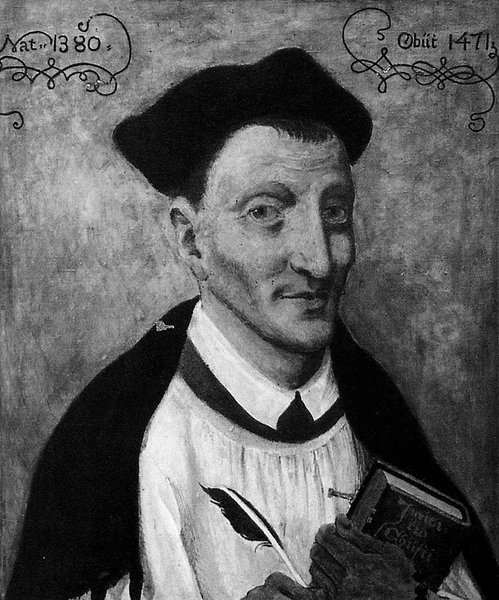
A Latin motto has long been attached to him — In omnibus requiem quaesivi, et nusquam inveni nisi in angulo cum libro: everywhere I have sought rest, and nowhere found it save in a corner with a book. It is worth being honest about this one, because it is quoted constantly as though it came from The Imitation, and it does not. It survives as a motto associated with his portrait and with early printed editions rather than as a line from his own published text. Whether or not the words are literally his, the description is exact.
Sub-prior, and master of novices
He was twice elected sub-prior of Mount St Agnes — the sources differ on the exact years, some giving 1425 and others 1429 — and once served as procurator, the house's business officer. That last appointment appears not to have gone well; later accounts describe him as simple in worldly matters and inclined to absent-mindedness, a man who withdrew from lively conversation and was relieved to be given back to his books.
But as sub-prior he was master of the novices, and this is the office that produced the book. Everything in The Imitation of Christ was written for particular young men whose faces he knew — anxious, ambitious, distractible beginners, learning to keep silence and to obey. That is why it does not read like theology. It reads like a wise old man talking quietly to someone who is struggling, which is exactly what it was.
I had rather feel contrition than be skilful in the definition thereof.
— Thomas à Kempis
The third and fourth books of The Imitation turn almost entirely into prayer — a dialogue between the soul and Christ, in which the writer stops instructing and starts asking. Anyone who wants to know how Thomas à Kempis prayed need only read them; his own hours, the daily round of the monastic office he kept for seven decades, are woven straight through the text.
Exile
The one great disruption came late. In 1429 a bitter dispute over who should hold the see of Utrecht brought an interdict down on the region, and the community was driven from the hill. "Alas! Holy God!" Thomas wrote in the Chronicle, "on the day before the Feast of St. Lambert we ceased from our singing by reason of the Interdict that was published against us!" The silencing of the sung office is the loss he names first.
The exile lasted until 1432. Thomas spent much of it at Bethany, near Arnhem, nursing his brother John, who was old and ill. John died there in November 1432. Thomas had followed him to school, followed him into religion, and now sat with him at the end; then he went home to the hill and stayed there for another thirty-nine years.
The quarrel over the book
The Imitation of Christ went out into the world anonymously, which was entirely in character — the Brethren's whole instinct was to efface the author. In 1441 Thomas completed and signed a codex in his own hand containing all four books together with nine other treatises; that manuscript survives in Brussels and is the single strongest piece of evidence for his authorship.
It did not settle the matter. For centuries rival claims were pressed with real heat: for Jean Gerson, the chancellor of Paris, whose name is close enough to invite confusion, and for a supposed Italian abbot called Giovanni Gersen. National pride, monastic pride, and genuine scholarly puzzlement all played their part. The honest summary is this: the case was seriously disputed for a very long time, and modern scholarship has come down decisively on the side of Thomas à Kempis — on the strength of the autograph manuscript, of contemporary witnesses who named him, and of the Dutch turns of phrase that show through the Latin. There is a fine irony in it: a man who took such pains to disappear behind his subject very nearly succeeded in losing his own book.
The end, and what came after
He died on 25 July 1471, in his ninety-first or ninety-second year, having outlived nearly everyone he had entered with. The Chronicle he had kept for so long was taken up by an anonymous successor, who recorded the death of the brother Thomas Hämerken, born at Kempen in the diocese of Cologne, and noted that he departed after Compline — after the last office of the day, the prayer said as the light goes. Some older reference works give a different date; the house's own chronicle is the better witness.
He was buried at Mount St Agnes. The monastery is long gone; his remains were eventually brought into Zwolle, and in 1897 a monument was raised over them in St Michael's Church bearing the words Honori, non memoriae Thomae Kempensis, cujus nomen perennius quam monumentum — to the honour, not the memory, of Thomas of Kempen, whose name is more lasting than any monument.
A story is often told that when his coffin was opened long after his death, scratches were found inside the lid and splinters under his fingernails, and that the Church therefore refused him canonisation on the grounds that a saint would not have fought so hard to live. It is a memorable tale and it should be labelled plainly: there is little evidence for any part of it. He was in fact never canonised, but the coffin story is legend, not history.
Vanity of vanities, all is vanity, save to love God, and Him only to serve.
— Thomas à Kempis
What remains is the arithmetic we began with. Seventy years in one house; a pen, a choir stall, a cell, a succession of nervous young novices; no travel, no controversy sought, no reputation built. And out of it, a book that has done more to shape ordinary Christian devotion than most councils and most kings — read by Ignatius of Loyola and John Wesley and Thomas More, by Samuel Johnson and by generations of people who never wrote anything down at all.
It is a rebuke to a great deal of what we assume about influence. Thomas à Kempis did not go out and find a hundred million readers. He stayed put, minded his own soul, copied the Scriptures until they were in his bones, and wrote plainly for the twenty young men in front of him. The hiddenness was not the price of the book. It was the soil it grew in.
Books by Thomas à Kempis (2)

Articles about Thomas à Kempis (5)
Questions and Answers
Where and when was Thomas à Kempis born, and what does his name actually mean?
He was born Thomas Hemerken in the town of Kempen in the Rhineland, in the diocese of Cologne, around 1379 or 1380; the sources cannot settle the exact year. The surname Hemerken means something like "little hammer" and was later Latinised to Malleolus, probably a nod to his father's trade. He is known to us not by his family but by his birthplace, as Thomas of Kempen, à Kempis. His parents, John and Gertrude, were working people, and he had an elder brother, John, some fourteen years ahead of him whom he tended to follow.
What kind of schooling did he have, and what shaped his outlook?
At about twelve or thirteen he went to Deventer in the Netherlands, staying roughly seven years at its famous school under the care of Florens Radewijns. Deventer was the heartland of the devotio moderna, the Modern Devotion begun by Geert Groote, whose followers, the Brethren of the Common Life, lived and worked together and copied manuscripts for their bread. Their Christianity was interior, practical, and unshowy: suspicious of learning that made a man proud and of piety that made him conspicuous. Thomas later wrote the lives of Groote and Radewijns, which is one reason we know as much as we do about the movement.
What was his life in the monastery like?
In 1399 he went to Mount St Agnes, a house of Augustinian Canons Regular on a rise outside Zwolle, where his brother John was among the community and would serve as prior. He was not rushed into vows: the house was poor and unfinished, and he waited years on the threshold, being clothed as a novice around 1406, making his profession in 1407, and being ordained priest in 1413. He remained there for roughly seventy years and died in the same house. The hardship of those early years he set down himself in his Chronicle of the Canons Regular of Mount St Agnes, our best window onto the world he lived in.
What did he actually do for seventy years in one place?
He copied. Copying manuscripts was the Brethren's trade and their discipline, and Thomas was extraordinarily good at it, producing a missal for his community and copying out the entire Bible by hand; he is generally said to have done so several times over, and one such copy survives in several volumes. Around that labour he wrote his own works: sermons and short treatises for novices, prayers, hymns, letters, saints' lives, and the chronicle of his house. He was twice elected sub-prior and served as master of the novices, and it was for those young men that his most famous book was written.
Did he really write The Imitation of Christ, or is that disputed?
For centuries it was seriously disputed, with rival claims pressed for Jean Gerson, the chancellor of Paris, and for a supposed Italian abbot called Giovanni Gersen; the work had gone out into the world anonymously, entirely in keeping with the Brethren's instinct to efface the author. Modern scholarship, however, has come down decisively on the side of Thomas à Kempis. The strongest single piece of evidence is a codex he completed and signed in his own hand in 1441, containing all four books, which survives in Brussels. Contemporary witnesses who named him and the Dutch turns of phrase showing through the Latin point the same way.
What is The Imitation of Christ about, and why has it been read for so long?
It gathers four small booklets of counsel, written between roughly 1418 and 1427 for particular young novices whose faces Thomas knew, on inward devotion, self-denial, and following Christ rather than merely discussing him. That is why it does not read like theology but like a wise old man talking quietly to someone who is struggling. Its temper is caught in a famous line from the first book: "I had rather feel contrition than be skilful in the definition thereof." The later books turn almost entirely into prayer, a dialogue between the soul and Christ.
Was Thomas à Kempis famous in his own lifetime?
No. He held no great office, preached to no crowds, sought no controversy, and was never canonised; his book carried his name so lightly that for a long time it was hard to prove he had written it at all. This obscurity was of a piece with the Modern Devotion's whole instinct toward self-effacement. A Latin motto is often attached to him, In omnibus requiem quaesivi, et nusquam inveni nisi in angulo cum libro, "everywhere I have sought rest, and nowhere found it save in a corner with a book"; it describes him exactly, though it survives as a motto linked to his portrait rather than as a line from his published text.
When and how did he die?
He died in 1471, in about his ninety-first or ninety-second year, at Mount St Agnes, having outlived nearly everyone he had entered with. The sources do not fully agree on the exact day: his house's own chronicle and much Catholic tradition give 25 July, while some reference works give a different date. The chronicler who took up the record after him noted that the brother, born at Kempen in the diocese of Cologne, departed after Compline, the last office of the day. He was buried at the monastery; long after, his remains were brought into Zwolle, and in 1897 a monument was raised over them in St Michael's Church.
Is the story about scratch marks in his coffin true?
It should be labelled plainly as legend. The tale runs that when his coffin was opened long after his death, scratches were found inside the lid and splinters under his fingernails, and that the Church therefore refused him canonisation on the grounds that a true saint would not have fought so hard to live. It is a memorable story with very little evidence behind any part of it. What is true is the plainer fact underneath it: Thomas à Kempis was in fact never canonised, but the coffin story is legend, not history.