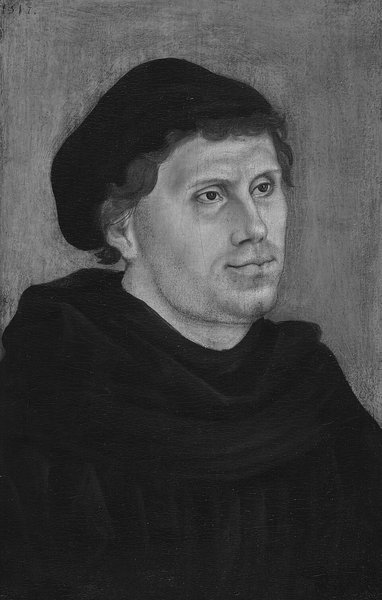

New to Martin Luther? Start with
The Bondage of the Will
All works · 13 hr 13 min read
Biography
- 1483 Born
- 1505 Vow
- 1517 95 Theses
- 1521 Worms
- 1525 Married
- 1546 Died
Help me, Saint Anne, and I will become a monk!
Martin Luther was born on 10 November 1483 in Eisleben, in the mining country of Saxony, and baptised the next morning on the feast of St Martin, whose name he bore. His father, Hans, had climbed by hard work from peasant stock into the copper trade and was determined that his clever son should rise higher still — into the law, and a secure and prosperous life. Martin was an obedient boy under a strict and sometimes brutal discipline, and he did as he was told, taking his master's degree at the University of Erfurt and beginning the study of law. He was twenty-one, dutiful, and outwardly on his way. And then, on a summer road, God knocked him flat.
A Vow in the Storm
On 2 July 1505, returning to Erfurt after visiting his parents, Luther was caught in the open by a violent thunderstorm near the village of Stotternheim. A bolt of lightning struck so close that it threw him to the ground, and in raw terror of death and judgement he cried out a vow to the patron saint of miners that his father had taught him to invoke.
Help me, Saint Anne, and I will become a monk!
— Martin Luther, in the thunderstorm at Stotternheim, 1505
He kept the vow. Two weeks later, over his furious father's protests, he sold his law books and entered the Augustinian monastery at Erfurt, and in 1507 he was ordained a priest. He threw himself into the monastic life with a desperate seriousness. He fasted, watched, prayed, and confessed his sins for hours at a stretch until his weary confessor told him to go away and come back when he had done something worth confessing. But peace would not come. Luther was crushed by an overwhelming sense of the righteousness of God — a God who demanded a perfection Luther knew he could never reach — and the harder he laboured to make himself acceptable, the more hopeless he grew. He would later say that if ever a monk got to heaven by his monkery, it would have been he, and it very nearly destroyed him.
The Gate of Paradise
His superiors, hoping study would settle him, pressed him toward a doctorate and a chair of biblical theology at the new University of Wittenberg. It was the best thing they could have done, for it set Luther to lecturing his way slowly through the Psalms and the letters of Paul. And there, wrestling above all with a single phrase in Romans — the righteous shall live by faith — the whole terrifying edifice of his fear gave way. He saw at last that the righteousness of God in the gospel is not a standard God demands of us and by which He damns us, but a gift God gives us, received by faith alone in Christ. The discovery broke over him like sunrise.
I felt that I had been altogether born again and had entered paradise itself through open gates. This passage of Paul became to me a gate to heaven.
— Martin Luther, recalling his discovery of justification by faith
Everything flowed from that. If a sinner is set right with God by faith in Christ and not by works or payments, then the whole machinery of merit — pilgrimages, penances, and above all the sale of indulgences, those certificates that claimed to buy the release of souls from purgatory — was a lie that robbed people of the free grace of God. On 31 October 1517, Luther posted ninety-five theses for academic debate on the door of the Castle Church in Wittenberg, protesting the traffic in indulgences. He meant to start a scholarly argument. He started the Reformation. Printed and carried across Germany within weeks, the theses lit a fire that no one could put out.
Here I Stand
Rome moved against him. Summoned, examined, and at last excommunicated by a papal bull he publicly burned, Luther was called in 1521 to answer before the Emperor Charles V and the assembled princes of the Holy Roman Empire at the Diet of Worms. His books were piled on a table and he was ordered to recant. He asked for a day to think, and returned the next evening to give an answer that has echoed for five centuries. He would not recant, he said, unless he were convinced by Scripture and plain reason, for he could not trust popes and councils who had so often contradicted one another and themselves.
My conscience is captive to the Word of God. To go against conscience is neither right nor safe. Here I stand; I can do no other. God help me. Amen.
— Martin Luther at the Diet of Worms, 1521
It was, in effect, a sentence of death; the Edict of Worms declared him an outlaw whom anyone might kill. But his prince, Frederick the Wise of Saxony, spirited him away in a staged ambush and hid him in the Wartburg Castle, where for the better part of a year Luther lived in disguise as a bearded knight, "Junker Jörg." He was often ill and battered by depression and by what he took to be the direct assaults of the devil. And he worked. In eleven weeks he translated the entire New Testament from Greek into a vigorous, singing German that ordinary people could read for themselves — a gift that shaped the German language itself and put the living Word into the hands of the plough-boy and the housewife, exactly as he intended.
A Home in the Black Cloister
Returning to Wittenberg, Luther gave the movement its shape: German services, congregational hymns, catechisms to teach the faith to children, and a recovered vision of ordinary life — marriage, work, parenthood — as the arena of holy obedience. He lived that vision himself. In 1525 he married Katharina von Bora, a runaway nun who two years earlier had escaped her convent hidden among the fish barrels of a merchant's wagon. It scandalised half of Europe and delighted Luther. Katharina, whom he called "my Katie" and teased as "the morning star of Wittenberg" for her early rising, took charge of the vast, chaotic household of the old Augustinian cloister — the children, the boarding students, the endless guests — and ran it, and him, with a firm hand he cheerfully acknowledged, joking that in domestic affairs he deferred to Katie and was otherwise led by the Holy Spirit.
Out of that home came some of the warmest devotional writing of the Reformation. When his barber, Peter Beskendorf, asked him plainly how to pray, Luther wrote him a little book, A Simple Way to Pray, counselling him to make the Lord's Prayer and the Commandments his daily school and never to let prayer grow cold or hurried. And out of the same years came the hymn that became the anthem of the whole movement — Ein feste Burg ist unser Gott, "A mighty fortress is our God, a bulwark never failing" — his defiant paraphrase of Psalm 46, sung in the teeth of every danger.
Prayed Back from the Grave
Prayer for Luther was not a discipline of calm but a wrestling, and he prayed as a man who believed God had bound Himself to His own promises and could be held to them. The most famous instance came in the summer of 1540, when his dearest friend and fellow-labourer Philip Melanchthon fell so gravely ill at Weimar that he seemed already dying, his eyes glazing and his speech failing. Luther rushed to his side, and turning to the window he prayed with an almost frightening boldness, reminding God of every promise in Scripture to hear prayer and refusing to let his friend go.
Luther's own health, worn by decades of overwork, illness, and strain, failed steadily in his last years. In the winter of 1546 he travelled, unwell, back to Eisleben — the town where he had been born — to make peace in a quarrel between two noble brothers. He completed the work of reconciliation, and then his heart gave out. In the early hours of 18 February 1546, as death came on, his friend Justus Jonas asked whether he was ready to die trusting Christ and the gospel he had preached. Luther answered, clearly, "Yes." He died within sight of the font where he had been baptised sixty-two years before.
On a scrap of paper beside him they found his last written words, a sentence that gathers his whole life and message into a breath. The man who had tried so hard to climb to God, and who had found instead that God comes down in free grace to the empty-handed, laid down his pen at the only place he had ever truly rested.
We are beggars. This is true.
— Martin Luther, his last written words, 1546
Books by Martin Luther (1)
Sermons by Martin Luther (6)
Books about Martin Luther (1)
Also appears in
Questions and Answers
Who was Martin Luther?
Martin Luther (1483–1546) was the German monk whose recovery of justification by faith alone sparked the Protestant Reformation. Driven into a monastery by terror in a thunderstorm and then into peace by a verse in Romans, he posted his Ninety-Five Theses in 1517, defied pope and emperor at the Diet of Worms, translated the New Testament into German at the Wartburg, and gave the church its hymns and catechisms. His last written words were, "We are beggars. This is true."
What was the vow in the storm?
On 2 July 1505, returning to Erfurt after visiting his parents, Luther — then a dutiful law student obeying a father who wanted him to rise into the law — was caught in a violent thunderstorm near Stotternheim. A lightning bolt struck so close it threw him to the ground, and in raw terror of death and judgement he cried out, "Help me, Saint Anne, and I will become a monk!" Two weeks later, over his furious father's protests, he sold his law books and entered the Augustinian monastery at Erfurt.
What was his terror in the monastery?
He threw himself into monastic life with desperate seriousness — fasting, watching, praying, and confessing his sins for hours until his weary confessor told him to come back when he had done something worth confessing. But peace would not come. He was crushed by an overwhelming sense of the righteousness of God, who demanded a perfection he knew he could never reach, and the harder he laboured the more hopeless he grew; if ever a monk got to heaven by his monkery, he said, it would have been he.
What was his discovery of "the gate of paradise"?
Set to lecture through the Psalms and the letters of Paul at Wittenberg, and wrestling above all with "the righteous shall live by faith," the whole edifice of his fear gave way. He saw that the righteousness of God in the gospel is not a standard God demands and damns us by, but a gift God gives, received by faith alone in Christ: "I felt that I had been altogether born again and had entered paradise itself through open gates. This passage of Paul became to me a gate to heaven."
What were the Ninety-Five Theses?
If a sinner is set right with God by faith and not by works or payments, then the whole machinery of merit — and above all the sale of indulgences, certificates claiming to buy souls out of purgatory — was a lie. On 31 October 1517 Luther posted ninety-five theses for academic debate on the door of the Castle Church in Wittenberg, protesting the traffic in indulgences. He meant to start a scholarly argument; printed and carried across Germany within weeks, he started the Reformation.
What happened at the Diet of Worms?
Excommunicated after burning the papal bull, Luther was called in 1521 to answer before the Emperor Charles V and the assembled princes at Worms, his books piled on a table, and ordered to recant. He refused unless convinced by Scripture and plain reason: "My conscience is captive to the Word of God. To go against conscience is neither right nor safe. Here I stand; I can do no other. God help me. Amen." The Edict of Worms declared him an outlaw whom anyone might kill.
What did he do at the Wartburg?
His prince, Frederick the Wise, spirited him away in a staged ambush and hid him in the Wartburg Castle, where for the better part of a year Luther lived in disguise as a bearded knight, "Junker Jörg," often ill and battered by depression. And he worked: in eleven weeks he translated the entire New Testament from Greek into a vigorous, singing German that ordinary people could read, a gift that shaped the German language itself and put the living Word into the hands of the plough-boy and the housewife.
What was his home life like?
In 1525 he married Katharina von Bora, a runaway nun who had escaped her convent hidden among the fish barrels of a merchant's wagon; it scandalised half of Europe and delighted him. "My Katie" took charge of the vast, chaotic household of the old cloister and ran it, and him, with a firm hand he cheerfully acknowledged. Out of that home came some of the warmest writing of the Reformation — "A Simple Way to Pray," written for his barber, and the hymn "A mighty fortress is our God."
How did he pray Melanchthon back from death?
In the summer of 1540 his dearest friend and fellow-labourer Philip Melanchthon fell so gravely ill at Weimar that he seemed already dying. Luther rushed to his side and, turning to the window, prayed with an almost frightening boldness, reminding God of every promise in Scripture to hear prayer and refusing to let his friend go. Melanchthon began to revive, took food, and recovered. "God gave me my brother Melanchthon back in direct answer to prayer," Luther said; Philip lived and laboured another twenty years.
How did he die?
Worn by decades of overwork, in the winter of 1546 he travelled, unwell, back to Eisleben — the town where he had been born — to make peace between two quarrelling noble brothers. He completed the reconciliation, and then his heart gave out. In the early hours of 18 February 1546 his friend Justus Jonas asked whether he was ready to die trusting Christ and the gospel he had preached, and he answered clearly, "Yes." Beside him they found his last written words: "We are beggars. This is true."