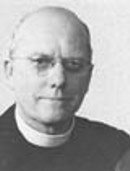
Biography
This year has ended up as one of the most blessed in the history of Kigezi. Largely as a result of the convention led by Dr J. Church and a band of men and women from Gahini.
Most of the East African Revival's famous names are African, and rightly so — it was an African awakening, carried by African men and women who confessed their sins to one another and sang in the open air. But a handful of Europeans stood inside it rather than above it, and the difference is worth noticing. They did not run the thing from a mission compound; they went into the villages with the teams, took the same road, and let the fire touch them too. Lawrence Barham was one of these. He was an English clergyman who came out to Africa meaning to go somewhere else entirely, spent the rest of his working life in the hills of Kigezi and Burundi, founded the school that still carries his name, and was passed over for a bishop's office for eighteen years precisely because he had thrown in his lot with a revival his superiors did not trust.
A door that closed toward China
He was born in the early twentieth century, an Englishman raised in the Anglican church, and his exact dates are not securely on record. What is clear is where his life turned. In 1926 he offered himself to the Church Missionary Society for China — the great missionary destination of that generation, the field every keen young volunteer dreamed of. China was closing to foreign missionaries just as he applied, and the door he had chosen shut in front of him.
He did not go home. He offered himself instead to the Ruanda Mission, a small and unfashionable CMS venture in the hills between the Belgian and British territories of central Africa, and in 1928 he sailed. That same year he married Julia, née Leakey, who went out with him and shared the work for the whole of it. Their son Kenneth was born in 1936 and would himself become a bishop in Rwanda decades later — the mission became a family calling.
It is worth pausing on the shape of that beginning. Barham did not get the field he wanted. He got the one that was left, and gave it everything. A great deal of the most durable missionary work of the century was done by people whose first plan fell through.
Kabale, and a school that would bear his name
He landed at Kabale, in Kigezi, the far south-west corner of Uganda, and was put straight to work. He was made headmaster of Kigezi High School and given charge of the church's work across the district. But the labour that outlasted everything else was quieter than a headmastership. Barham started a Bible school at Kabale to train African clergy and church-teachers — men who would carry the gospel into their own hills in their own language, which is the only way it ever truly travels.
That small Bible school grew. It became the Bishop Barham Theological College, and it is today the Bishop Barham University College at Kabale, a constituent college of Uganda Christian University. His name is on the gate of an institution that has trained clergy for the best part of a century. He did not set out to build a monument; he set out to train pastors, and the monument followed.
In 1938 Lawrence and Julia moved on to Buye, in Burundi, where he did the same thing again — founding the theological college first known as Canon Warner Theological College, to train clergy and teachers for the mission's churches across Burundi, Rwanda and Kigezi. Wherever the church needed roots, Barham's instinct was the same: raise up local men to lead it, and build them a place to be taught.
Standing inside the fire
By the time the Barhams reached Kabale, the East African Revival was beginning to stir out of the mission station at Gahini in Rwanda, where the doctor Joe Church and his African co-workers were praying and confessing together. From 1931, Barham was among the front rank of those who organised the teaching teams that carried it — named in the same breath as Joe Church, Simeon Nsibambi, Blasio Kigozi, Yosiya Kinuka and Kosiya Shalita, and working hand in hand with his Ugandan colleague Ezekieri Balaba. These men would gather a band of speakers and travel to a convention, and something would break open.
The seminal one in his own district came because he and Ezekieri asked for it. They sent an invitation to Gahini for a team to come to Kabale, and out of that came the Kabale Convention of September 1935 — one of the great outpourings of the revival, remembered ever after. Barham wrote about the year that followed in the mission's quarterly, Ruanda Notes, and his own words survive:
This year has ended up as one of the most blessed in the history of Kigezi. Largely as a result of the convention led by Dr J. Church and a band of men and women from Gahini.
— Lawrence Barham, in Ruanda Notes
What is striking about Barham in these accounts is that he never writes as a manager reporting results. He writes as a man watching something he did not control and would not have dared to invent. When a gardener came under conviction and returned money he had stolen, Barham reached for the only category that fit:
This is not emotionalism… it's stern conviction of the Holy Spirit and it fills us with awe.
— Lawrence Barham, in Ruanda Notes
The car-load of helpers
A revival is easy to celebrate and hard to shepherd. New converts — the keenites, as they were half-affectionately called — needed teaching, correction, and steadying, or their zeal would run into error and burn out. Barham's letters show him doing exactly this unglamorous follow-up work, Sunday after Sunday, with Ezekieri at his side:
Ezekieri and I with a car-load of helpers have therefore been going out for the last few Sundays to various centres of revival… In between services, we collected a little band of keenites, and after hearing their experiences, were able to point out to them from the Bible, dangers to avoid, as well as encouragements to their faith.
— Lawrence Barham, in Ruanda Notes
His steadiness showed most when others wanted to pull back. As the movement spread and grew disorderly, Ezekieri Balaba once told him that things were going rather strangely and they had better keep out of it. Barham would not:
No, we hadn't. We'd better go in it because if these things go wrong the government will clamp down and put these people in prison. We must go around and try to sort it out.
— Lawrence Barham, recalling Ezekieri Balaba
That is a missionary who has decided to be responsible for the people the revival produced, not merely to admire them from a safe distance. He would go in, precisely because it was risky, so that the risk would fall on him rather than on them.
The office that was withheld
His identification with the revival cost him. In 1946 Barham was nominated to be Bishop of Ruanda-Urundi. He was the obvious man — a founder of colleges, a leader of the movement, deep in the life of the church he served. The appointment was blocked by the Bishop of Uganda, because Barham was too closely bound up with the revival, which the Church of Uganda's leadership then regarded with real apprehension. The very thing that made him the right man made him, in their eyes, the wrong one.
He did not leave, and he did not sulk his way through the following years. He kept teaching, kept writing, and for a stretch from the late 1950s served the Ruanda Mission from Britain as its general secretary. The office he had been denied in 1946 came to him only eighteen years later. In 1964, when Jim Brazier retired, Barham was at last consecrated the second Bishop of Rwanda and Burundi — and given the specific, thankless task of preparing the diocese to be divided into two. He served just two years, to 1966, laying down the office almost as soon as he had received it.
Eighteen years is a long time to wait for a chair that half the church did not want you to have, and then to sit in it only long enough to plan its own partition. There is no record of Barham complaining. He had come out in 1928 for a field that was not his first choice, and he gave the rest of his working life to it whether or not it ever rewarded him. The bishopric, when it finally came, changed none of that. The work had already been the ministry.
What he leaves
Lawrence Barham wrote no famous book. What survives of his own voice is a scatter of letters and reports in a mission quarterly, and it is enough to show the man: awed rather than triumphant, patient rather than dramatic, willing to go into the difficult thing so that others would not carry it alone.
He leaves two things that outlasted him. One is a college at Kabale that still bears his name and still trains the pastors he cared most about raising up. The other is a pattern — of a European who did not stand over an African revival but stepped inside it, took the same road, honoured the men beside him, and let it convict and awe him like anyone else. He was passed over for high office for nearly two decades because he had loved that movement too openly, and he counted the movement worth more than the office. When the office finally came, he used it to hand the work on and stepped down.
Not every faithful life is crowned in its own lifetime. Barham's field was chosen for him by a door that closed, his best office was withheld from him by men who feared his friends, and his one verdict on the fruit of it all was that it filled him with awe. That is the honest measure of him — a man who wanted China, was given Kigezi, and gave Kigezi everything he had.
Also appears in

Questions and Answers
Who was Lawrence Barham?
Lawrence Barham was a British Anglican clergyman and CMS Ruanda Mission missionary who, turned away from China, sailed to central Africa in 1928 and gave his life to Kigezi and Burundi. A front-rank European figure of the East African Revival, he founded the Kabale Bible school that became Bishop Barham University College; his closeness to the Revival cost him a bishopric in 1946, which he finally received in 1964. He did not run the movement from a compound but went into the villages with the teams and let the fire touch him too.
How did he end up in Africa?
In 1926 he offered himself to the Church Missionary Society for China — the great missionary destination of that generation — but China was closing to foreign missionaries just as he applied, and the door shut in front of him. He did not go home. He offered himself instead to the Ruanda Mission, a small and unfashionable CMS venture in the hills of central Africa, and sailed in 1928 with his wife Julia, who shared the work for the whole of it. A great deal of durable missionary work has been done by people whose first plan fell through.
What did he build at Kabale?
He landed at Kabale, in Kigezi, and was made headmaster of Kigezi High School and given charge of the church's work across the district. But the labour that outlasted everything else was quieter: he started a Bible school at Kabale to train African clergy and church-teachers — men who would carry the gospel into their own hills in their own language. That school grew into the Bishop Barham Theological College, today the Bishop Barham University College at Kabale, a constituent college of Uganda Christian University.
Did he build elsewhere too?
Yes. In 1938 Lawrence and Julia moved on to Buye, in Burundi, where he did the same thing again, founding the theological college first known as Canon Warner Theological College to train clergy and teachers for the mission's churches across Burundi, Rwanda and Kigezi. Wherever the church needed roots, Barham's instinct was the same: raise up local men to lead it, and build them a place to be taught.
How did he stand within the Revival?
From 1931 he was among the front rank of those who organised the teaching teams that carried it — named in the same breath as Joe Church, Simeon Nsibambi, Blasio Kigozi and Yosiya Kinuka, and working hand in hand with his Ugandan colleague Ezekieri Balaba. He and Ezekieri sent an invitation to Gahini for a team to come to Kabale, and out of that came the Kabale Convention of September 1935, one of the great outpourings of the revival.
How did he write about what he saw?
Never as a manager reporting results, but as a man watching something he did not control. In the mission's quarterly, Ruanda Notes, he wrote that a year had ended "as one of the most blessed in the history of Kigezi," largely through the convention led by Joe Church's team. When a gardener came under conviction and returned money he had stolen, Barham reached for the only category that fit: "This is not emotionalism... it's stern conviction of the Holy Spirit and it fills us with awe."
What was his follow-up work?
A revival is easy to celebrate and hard to shepherd, and Barham did the unglamorous work of steadying the new converts — the "keenites," as they were half-affectionately called. Week after week he and Ezekieri went out with a car-load of helpers to the scattered centres where the fire had fallen; they listened first, hearing each young believer's own experience, and only then opened the Bible, to warn of the dangers and strengthen the faith. It is the labour that never makes the headline of a revival.
How did he show his steadiness?
It showed most when others wanted to pull back. As the movement spread and grew disorderly, Ezekieri Balaba once told him things were going strangely and they had better keep out of it. Barham would not: "No, we hadn't. We'd better go in it because if these things go wrong the government will clamp down and put these people in prison. We must go around and try to sort it out." He decided to be responsible for the people the revival produced, so that the risk would fall on him rather than on them.
What did his loyalty to the Revival cost him?
In 1946 Barham was nominated to be Bishop of Ruanda-Urundi — the obvious man, a founder of colleges and a leader of the movement. The appointment was blocked by the Bishop of Uganda because Barham was too closely bound up with the revival, which the Church of Uganda's leadership then regarded with real apprehension. The very thing that made him the right man made him, in their eyes, the wrong one. He did not leave or sulk, but kept teaching and writing.
When did the office finally come, and what does he leave?
The bishopric denied in 1946 came only in 1964, when he was consecrated the second Bishop of Rwanda and Burundi — and given the thankless task of preparing the diocese to be divided in two, serving just two years to 1966. Eighteen years is a long time to wait for a chair half the church did not want him to have, and then to sit in it only long enough to plan its partition. He leaves a college at Kabale that still bears his name, and a pattern: a European who stepped inside an African revival rather than standing over it, and counted the movement worth more than the office.
Portrait: Dictionary of African Christian Biography (photo from H. H. Osborn)