Where to start reading
Start with
Apologia Pro Vita Sua
Books by John Henry Newman (3)
Sermons by John Henry Newman (6)
Temporal Advantages
Newman argues from St Paul’s counsel of contentment that wealth, rank, power and even great abilities are not true goods for fallen people. Such things do not bring the happiness they promise, and they endanger the soul by crowding out devotion, breeding love of the world, unbelief and self-confidence, as Hezekiah, David and Solomon show. He ends that such gifts should be used for God’s glory but never sought, since every soul is a candidate for immortality.Religion Pleasant to the Religious
From "O taste and see how gracious the Lord is", Newman answers those who grant that religion is right but think it gloomy. He argues that God's service is the most pleasant thing in the world to those who love it, a secret known only by trying it, and hinted at by the pain of a bad conscience. He ends with the glory awaiting the saints and a call to press on toward heaven.Divine Calls
Starting from Samuel’s answer, Newman draws from St. Paul, the Apostles, Elisha and Abraham the pattern of Divine calls: they require instant obedience and lead we know not where. He insists that Christ calls us not once but all through life, through bereavement, trials, new truths, a fresh grasp of Scripture or new strength, and ends with a plea for an earnest spirit that simply says "Speak, Lord, for Thy servant heareth."Jeremiah, a Lesson for the Disappointed
Newman presents Jeremiah as the most fully recorded of the persecuted prophets and a type of Christ, whose ministry he sums up in three words: good hope, labour, disappointment. Tracing the prophet’s hopeful start under Josiah, his long sufferings and his passage through complaint into resignation, Newman argues that every life begins in hope and meets disappointment. He ends by urging his hearers to accept trial, persevere without seeing fruit, and mourn now that they may rejoice more perfectly.The Shepherd of Our Souls
Newman shows Christ taking the prophets’ title of Shepherd, gathering sheep scattered by faithless leaders and laying down His life to carry the lost on His shoulders. He traces the shepherd’s calling through Abel and especially Jacob, Moses and David, who endured, meditated and fought, and finds all three fulfilled in Christ as Priest, Prophet and King. He ends by urging his hearers to learn Christ’s voice, follow where He leads, and give Him their youth.Religious Joy
Preaching on Christmas Day, Newman draws two lessons from the angel’s message to the shepherds: lowliness and joy. God chose poor, obscure shepherds to be the first to hear of the Nativity, honouring humble life, and the angel’s "Fear not" turned their alarm into gladness. In the manger the Son of God empties Himself of His glory and so raises us toward a share in it. Newman ends by urging a cheerful heart and an ever-springing love.Biography
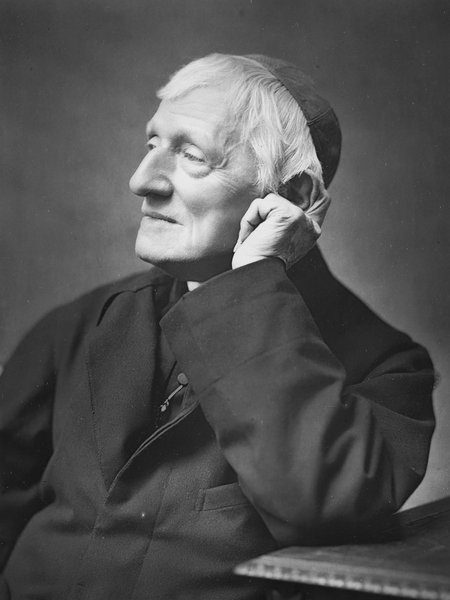
In the spring of 1864 a sixty-three-year-old priest in Birmingham sat down to answer a charge that he was a liar. The novelist Charles Kingsley had written that “Truth, for its own sake, had never been a virtue with the Roman clergy,” and had named John Henry Newman as his example. Newman’s reply was the story of his own soul, told week by week as he wrote it: how a London boy became an Evangelical, an Oxford clergyman, the leading voice of a movement that shook the Church of England, and at last, at forty-four, a Catholic. He called it Apologia Pro Vita Sua, a defence of his life, and its candour won over many readers who never shared his conclusions.
A boy who read the Bible
He was born in the City of London on 21 February 1801, the eldest of six children of a banker, John Newman, and Jemima Fourdrinier, who came of a family of French Huguenot refugees. At seven he went to school at Ealing, a bookish boy who skipped the games and read Walter Scott’s novels as they came out. He had been brought up “from a child to take great delight in reading the Bible,” he wrote, but had “no formed religious convictions till I was fifteen.”
Then, in the autumn of 1816, his last year at school, everything changed. A master named Walter Mayers, himself recently converted, talked with him and put books into his hands, all of the Calvinist school. Newman trusted what happened next for the rest of his life.
When I was fifteen (in the autumn of 1816) a great change of thought took place in me. I fell under the influences of a definite creed, and received into my intellect impressions of dogma, which, through God’s mercy, have never been effaced or obscured.
— John Henry Newman, Apologia Pro Vita Sua
Of that inward conversion he was still, he said, “more certain than that I have hands and feet.” The writer who marked him most was the Evangelical commentator Thomas Scott, to whom “(humanly speaking) I almost owe my soul,” and for years he used two of Scott’s sayings almost as proverbs: “Holiness before peace,” and “Growth is the only evidence of life.” That same autumn he became convinced that God was calling him to a single life, and he kept to it always.
Oxford, and two great blows
He went up to Trinity College, Oxford, in 1816. Anxiety ruined his final examinations, yet in April 1822 he was elected a fellow of Oriel, then the centre of Oxford’s intellectual life. Richard Whately, a senior don, took him in hand and taught him, Newman said, “to see with my own eyes and to walk with my own feet.” He was ordained in 1824 and 1825, served as curate of St Clement’s in Oxford, and in 1828 became vicar of St Mary’s, the university church.
He was honest about where his cleverness was taking him: “I was beginning to prefer intellectual excellence to moral; I was drifting in the direction of liberalism.” He was woken at the end of 1827 “by two great blows—illness and bereavement,” the bereavement being the death of his sister Mary in January 1828. Afterwards he began reading the early Church Fathers through in order, and found in them a Church visible, ancient and holy. Two friends shaped him now: John Keble, the quiet poet of The Christian Year, and Hurrell Froude, brilliant and fearless, who taught him to look with admiration on the Catholic past.
A work to do in England
In December 1832 he sailed with Froude and Froude’s father for the Mediterranean. He went back alone to Sicily and fell dangerously ill with fever at Leonforte. His servant thought he was dying, but Newman said, “I shall not die, for I have not sinned against light,” words he admitted he never understood. Recovering, he was overcome by the sense that God had kept him for a purpose.
Before starting from my inn in the morning of May 26th or 27th, I sat down on my bed, and began to sob bitterly. My servant, who had acted as my nurse, asked what ailed me. I could only answer, “I have a work to do in England.”
— John Henry Newman, Apologia Pro Vita Sua
Sailing home in an orange boat, he was becalmed for a week in the Straits of Bonifacio, and there wrote the lines “Lead, kindly light,” later a much-loved hymn. He reached England in July 1833. On 14 July Keble preached a sermon at Oxford called “National Apostasy,” and Newman wrote: “I have ever considered and kept the day, as the start of the religious movement of 1833.”
That movement, the Oxford or Tractarian Movement, set out to remind the Church of England that it was no department of the state but part of the one ancient Church, with bishops in succession from the apostles, real sacraments, and the faith of the Fathers. Newman began the Tracts for the Times that gave the movement its name, and for eight years his Sunday afternoon sermons at St Mary’s held a generation of undergraduates.
The death-bed of a conviction
Doubt came, as Newman tells it, through study. In 1839, reading the history of a fifth-century controversy, he met a sentence of St Augustine, “Securus judicat orbis terrarum,” roughly “the judgment of the whole world is sure.” “By those great words of the ancient Father,” he wrote, “the theory of the Via Media was absolutely pulverised.” The via media was the middle way between Rome and popular Protestantism that he had defended for years.
He tried to hold his ground. In February 1841 he published Tract 90, arguing that the Thirty-Nine Articles, the Church of England’s statement of doctrine, could be read in harmony with the ancient Catholic faith. The outcry was enormous. Senior tutors denounced it, the Bishop of Oxford asked that the Tracts stop, and for three years bishop after bishop condemned it.
From the end of 1841, I was on my death-bed, as regards my membership with the Anglican Church, though at the time I became aware of it only by degrees.
— John Henry Newman, Apologia Pro Vita Sua
In 1842 he withdrew to Littlemore, a village in his parish where he had built a church, and lived there with a few younger men in a quiet, semi-monastic way. It was hard, he said, to have to tell newspaper editors “that I went up there to say my prayers.” In February 1843 he publicly withdrew the hard things he had said against Rome, confessing they owed much “to an impetuous temper, a hope of approving myself to persons I respect, and a wish to repel the charge of Romanism.” In September he resigned St Mary’s and preached his last Anglican sermon, “The Parting of Friends.”
He never pretended the Church he was leaving was empty of God. Even then, he wrote, his “firm belief that grace was to be found in the Anglican Church remained too.” He set himself to write an Essay on the Development of Christian Doctrine, resolving that if his convictions had not weakened by its end he would act. On 8 October 1845 he told his friends he was expecting Father Dominic Barberi, an Italian Passionist, and meant to ask him for “admission into the one Fold of Christ.” He was received the next day at Littlemore.
Leaving Oxford
Friendships broke and families divided. Keble and Pusey stayed in the Church of England, as did most of the movement, which went on shaping Anglican life long after he had gone. Newman left Oxford on 23 February 1846, remembering the snapdragon on the wall opposite his first rooms at Trinity, which he had taken “as the emblem of my own perpetual residence even unto death in my University.” Writing in 1864, he added, “I have never seen Oxford since, excepting its spires, as they are seen from the railway.”
He was ordained a Catholic priest in Rome in 1847 and came home as a member of the Oratory, the community of priests founded by St Philip Neri. He settled at Edgbaston in Birmingham and lived there most of the next forty years among factory workers, Irish immigrants and tradespeople, who remembered him as a caring pastor. The Catholic years had their own trials. In 1852 a jury found him guilty of libel against an ex-friar, Giacinto Achilli, and he was fined £100. From 1854 he spent four years as first rector of the struggling Catholic University of Ireland, whose lectures became The Idea of a University. Pius IX mistrusted him, and he clashed with Henry Manning, another Oxford convert.
Peace, and a friend
In the Apologia he summed up his life since 1845 in a few lines. He had no more changes of opinion to report, and none of the anguish of the years before.
I was not conscious of firmer faith in the fundamental truths of revelation, or of more self-command; I had not more fervour; but it was like coming into port after a rough sea; and my happiness on that score remains to this day without interruption.
— John Henry Newman, Apologia Pro Vita Sua
He felt the difficulties of faith as keenly as anyone; but “Ten thousand difficulties do not make one doubt.” He dedicated the book to the priests of the Birmingham Oratory, and above all to Ambrose St John, who had joined him at Littlemore in 1843: “whom God gave me, when He took every one else away; who are the link between my old life and my new.”
The book changed how England saw him. The Dream of Gerontius, a poem of the soul’s passage through death, followed in 1865, and A Grammar of Assent in 1870. In 1879 Pope Leo XIII made him a cardinal; he asked to stay in Birmingham, and took as his motto Cor ad cor loquitur, “Heart speaks to heart.” Ambrose St John had died in 1875, a grief Newman compared to the loss of a husband or wife.
What he left
Newman died of pneumonia at the Birmingham Oratory on 11 August 1890, aged eighty-nine, and at his own wish was buried in Ambrose St John’s grave at Rednal. Their memorial stone reads Ex umbris et imaginibus in veritatem, “Out of shadows and phantasms into the truth.” He was beatified by Benedict XVI in Birmingham in 2010, canonised by Pope Francis on 13 October 2019, and in 2025 named a Doctor of the Church by Leo XIV. The Church of England, which he left, still remembers him on the day of his death.
Apologia Pro Vita Sua is the book we publish here. Its opening parts answer Kingsley directly; its heart is the long “History of My Religious Opinions” that follows, from the Bible-reading boy to the man received at Littlemore. It is not a book of easy devotion, and it does not ask the reader to agree with where Newman arrived. What it offers is rarer: a careful, humble, sometimes painful account of a Christian trying for thirty years to follow the truth as he saw it, whatever it cost him in friends and place.
The schoolboy who wished the Arabian Tales were true became a man convinced that the unseen world was more real than the seen. He followed the light he was given one step at a time, and told the truth about every step. That honesty, more than any argument, is what the Apologia still gives its readers.
Questions and Answers
Who was John Henry Newman?
John Henry Newman (1801–1890) was an English clergyman, theologian, poet and writer. As an Anglican at Oxford he led the Oxford Movement; in 1845 he was received into the Catholic Church, and in 1879 he was made a cardinal.
Where did John Henry Newman grow up?
He was born in the City of London on 21 February 1801, the eldest of six children of a banker, John Newman, and Jemima Fourdrinier, who came of a Huguenot family. He went to school at Ealing and was raised to love reading the Bible.
How did John Henry Newman become a committed Christian?
In the autumn of 1816, at fifteen, he went through an inward conversion under the influence of his schoolmaster Walter Mayers and the books he lent him. Newman said he was more certain of that conversion than that he had hands and feet, and he looked back on it all his life.
What did Newman do at Oxford?
He studied at Trinity College, was elected a fellow of Oriel in 1822, was ordained in the Church of England in 1824 and 1825, and in 1828 became vicar of St Mary’s, the university church, where his sermons drew a generation of students.
When did Newman write “Lead, Kindly Light”?
He wrote it in June 1833 while sailing home from Sicily, when his orange boat was becalmed for a week in the Straits of Bonifacio. He had just recovered from a dangerous fever, convinced that he had a work to do in England.
What was the Oxford Movement?
It was a movement within the Church of England, dated by Newman from John Keble’s sermon of 14 July 1833, which sought to recover the Church’s ancient and Catholic inheritance: the apostolic succession, the sacraments and the teaching of the Fathers. Newman began its Tracts for the Times.
What was Tract 90?
Tract 90, published in February 1841, argued that the Thirty-Nine Articles of the Church of England could be read in harmony with the ancient Catholic faith. It caused an uproar, the Tracts were brought to an end, and bishops condemned it over the following years.
When and why did Newman become a Catholic?
After years of study and doubt at Littlemore, he came to believe that the Catholic Church was the Church of the apostles, though he still held that grace was found in the Church of England. He resigned St Mary’s in 1843 and was received into the Catholic Church by Father Dominic Barberi on 9 October 1845.
What is Apologia Pro Vita Sua about?
It is Newman’s account of his religious opinions from childhood to 1845, written in weekly parts in 1864 to answer Charles Kingsley’s charge that he did not value truth. Its candour changed how many in England saw him, and it is read by people of many traditions.
How did Newman’s life end, and how is he remembered?
He lived his later years at the Birmingham Oratory, was made a cardinal in 1879, and died on 11 August 1890; at his wish he was buried in the grave of his friend Ambrose St John. He was canonised by Pope Francis on 13 October 2019 and named a Doctor of the Church in 2025, and the Church of England also remembers him on 11 August.