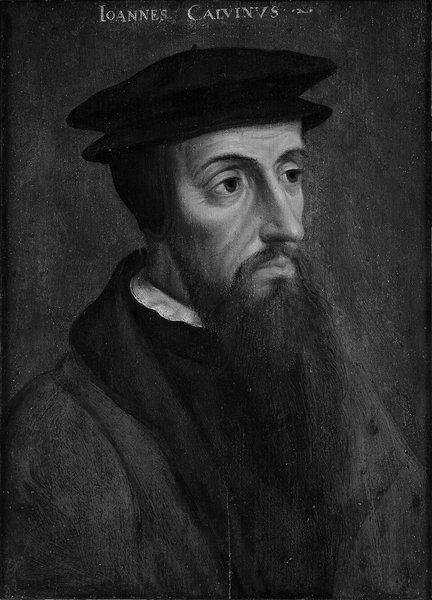

New to John Calvin? Start with
Institutes of the Christian Religion
All works · 56 hr 36 min read
Biography
- 1509 Born
- 1535 Institutes
- 1541 To Geneva
- 1564 Died
My heart I offer to you, O Lord, promptly and sincerely.
John Calvin was born on 10 July 1509 in Noyon, a cathedral town in the French province of Picardy. His father, Gérard Cauvin, was a legal officer in the service of the local bishop, an ambitious man who meant his gifted second son for the priesthood and later, as ambitions shifted, for the more lucrative career of the law. Neither plan reckoned with God, who would take this precise, reserved, bookish Frenchman and set him at the very centre of the Reformation — not as a firebrand but as its patient teacher, the man who, more than any other, gave the movement a mind. Everything Calvin became is gathered into the motto he took for his own and stamped on his seal: a hand holding out a flaming heart.
My heart I offer to you, O Lord, promptly and sincerely.
— John Calvin, his personal motto
A Scholar Redirected
Sent to Paris as a boy of around fourteen, Calvin passed through the Collège de la Marche and the austere Collège de Montaigu, taking his master's degree while still in his teens. He was, by every account, a formidable student — disciplined to the point of severity, quick, and already marked out by his teachers. When his father fell out with the cathedral chapter at Noyon, he abruptly redirected his son from theology to law, and Calvin went to study at Orléans and then Bourges under the finest jurists in France. There he also drank deeply of the new humanist learning, teaching himself Greek and Hebrew and reading the classics and the Church Fathers in their own tongues. His first book was not a work of religion at all but a scholarly commentary on the Roman philosopher Seneca. He looked set for the life of a quiet Renaissance man of letters.
But France in the early 1530s was a dangerous place to think freely about God. The evangelical ideas coming out of Germany were seeping across the border, and Calvin, moving in reform-minded circles in Paris, found the ground shifting beneath his feet. He never wrote at length about the crisis of his own soul — he was too self-effacing for that — but in the one place he let the curtain lift, the preface to his commentary on the Psalms, he described what happened in a single, unforgettable sentence.
God by a sudden conversion subdued and brought my mind to a teachable frame, which was more hardened in such matters than might have been expected from one at my early period of life.
— John Calvin, preface to the Commentary on the Psalms
He tells us almost nothing of the circumstances — no date, no place, no vision. He tells us only who did it. God subdued him. The proud, self-possessed scholar was mastered, and once mastered he could not go back. As persecution of the evangelicals sharpened in France, Calvin fled, moving under assumed names from city to city, and in 1535 settled for a time in Basel. There, still only in his mid-twenties, he wrote the first edition of the book that would occupy him for the rest of his life: the Institutes of the Christian Religion, a clear and ordered account of the evangelical faith, offered partly as a defence of his hunted fellow-believers before the king of France. It began as a slim handbook. Across the next twenty-three years he revised and enlarged it again and again until, in its definitive 1559 form, it stood as the most complete and influential statement of Reformed theology ever written.
Seized for Geneva
Calvin wanted a scholar's life — a desk, his books, and quiet. God wanted him in Geneva. In the summer of 1536, meaning only to spend a single night in the city while travelling to Strasbourg, he was recognised. The fiery reformer Guillaume Farel, who had wrenched Geneva loose from Rome but had not the gifts to build what must replace it, came to the inn and begged Calvin to stay and help. Calvin refused; he pleaded his studies, his temperament, his need for peace. And then Farel, in a moment Calvin never forgot, turned prophet and thundered that God would curse Calvin's studies and his quiet if he ran from the work to which he was plainly called. Calvin was undone by it. He took the terrible words as the voice of God Himself, and he stayed.
It went badly at first. Calvin and Farel pressed reforms and a discipline the city was not ready to bear, and in 1538 the magistrates threw them both out. For Calvin the exile felt less like a defeat than a deliverance — he could return to his books. He went to Strasbourg and spent what may have been the happiest three years of his life, pastoring a congregation of French refugees under the wing of the gentle reformer Martin Bucer, lecturing, and learning how a church was actually to be run. It was there, too, that he married. In August 1540 he wed Idelette de Bure, the widow of a converted Anabaptist, a woman of quiet strength who brought two children into the marriage and became, in Calvin's own word, the faithful helper of his ministry.
Then Geneva, in disarray without him, called him back. Everything in Calvin recoiled — he wrote that he would rather die a hundred deaths than take up that cross again. And yet, weighing the plain call of God against his own longing for peace, he surrendered. The heart in the open hand was not a slogan; it was the hardest act of his life.
The Pastor of Geneva
Calvin never held political office in Geneva and never became a citizen until near the end. He was, simply, a pastor and a teacher, and his authority was the authority of the pulpit and the Word. He preached constantly — often daily, working straight through books of the Bible verse by verse — and lectured, and wrote commentaries on nearly the whole of Scripture, and carried on an enormous correspondence that reached persecuted Protestants across Europe. He laboured to order the church after what he found in the New Testament: pastors to preach, teachers to instruct, elders to oversee, and deacons to care for the poor and the flood of refugees pouring into the city. In 1559 he crowned the work by founding the Academy of Geneva, a school and seminary that sent trained preachers back into France, Scotland, the Netherlands, and beyond, so that the little city became, in John Knox's phrase, the most perfect school of Christ since the apostles.
His years there were not serene. He fought bitter battles with powerful Genevan families who resented the church's discipline, and for a long stretch he seemed the losing party. And in 1553 came the episode that has shadowed his name ever since: the arrest, trial, and burning of Michael Servetus, who had denied the Trinity and taunted Calvin for years. Calvin sought his conviction and consented to his death — a judgement shared by nearly every authority of that harsh age, Catholic and Protestant alike, but a grievous thing to set beside the gospel of grace Calvin preached. It is no service to him to hide it. The same man who wrote so movingly of the tenderness of God could be hard, and knew it.
Prayer, the Chief Exercise of Faith
For all the weight of doctrine and government he carried, the beating heart of Calvin's religion was communion with God in prayer. In the longest chapter of the Institutes he taught that prayer is nothing less than the chief exercise of faith, the daily means by which believers dig up the treasures God has promised in the gospel. It was no theory to him. He closed each of his Old Testament lectures with a short, extemporary prayer that his hearers took down as he spoke — dozens of them survive, and they are the private devotion of the public man, laid bare.
Grant, Almighty God, that as thou art pleased daily to exhort us to repentance, and dost not suddenly execute thy judgment against us, so we may not abuse this thy forbearance.
— John Calvin, a closing prayer from his lectures on the Minor Prophets
His household knew grief. The one son Idelette bore him, Jacques, was born early in 1542 and lived only a few days; there were no other children who survived. And in March 1549 Idelette herself died, after a long decline. Calvin, who kept his feelings under such tight rein, let one line of his sorrow into a letter to a friend, and it is the more moving for its restraint.
Although the death of my wife has been exceedingly painful to me, yet I subdue my grief as well as I can.
— John Calvin, letter to Pierre Viret, 1549
How Long, O Lord
Calvin's body had never been strong, and the punishing regime of work broke it early. He was plagued for years by migraines, fevers, gout, kidney stones, and a lung ailment that finally burst a blood vessel as he strained to preach. He gave his last sermon in February 1564. In April he gathered the ministers of Geneva to his bedside and took his leave of them with a plainness that hid nothing — reminding them how little there had been when he first came, how bitter the struggle had been, and asking their pardon for any sharpness his affliction had drawn out of him.
He died on 27 May 1564, not yet fifty-five, worn to nothing in the service he had never wanted and never abandoned. At his own insistence he was buried in an unmarked grave, so that no shrine could ever gather at his bones; to this day no one knows the exact spot. He had spent himself in obscurity on purpose, wanting only that God be glorified and himself forgotten. The last words his companions recorded from him were not his own but the psalmist's ancient cry of longing — How long, O Lord — the prayer of a heart that had, at the very end, nothing left to offer but itself, promptly and sincerely, into the hands of God.
Books by John Calvin (1)
Sermons by John Calvin (4)
Books about John Calvin (1)
Questions and Answers
Where and when was John Calvin born, and what kind of upbringing shaped him?
Calvin was born on 10 July 1509 in Noyon, a cathedral town in the French province of Picardy. His father, Gérard Cauvin, was a legal officer in the service of the local bishop, an ambitious man who first meant his gifted second son for the priesthood and later, as his own fortunes shifted, for the more lucrative career of law. Calvin grew up a precise, reserved, bookish boy, and those traits would mark everything he later became.
What was Calvin trained to do before he became a reformer?
Sent to Paris as a boy of around fourteen, he passed through the Collège de la Marche and the austere Collège de Montaigu, taking his master's degree while still in his teens. When his father fell out with the cathedral chapter at Noyon, he redirected his son from theology to law, and Calvin studied at Orléans and Bourges under the finest jurists in France. He also drank deeply of the new humanist learning, teaching himself Greek and Hebrew; his first published book was not religious at all but a scholarly commentary on the Roman writer Seneca.
What did Calvin mean by his "sudden conversion"?
As evangelical ideas from Germany seeped across the border in the early 1530s, Calvin, moving in reform-minded circles in Paris, found the ground shifting beneath his feet. He said very little about the crisis of his own soul, but in the preface to his commentary on the Psalms he described it in a single sentence: that God, by a sudden conversion, subdued and brought his mind to a teachable frame, more hardened than might have been expected in one so young. He gives no date, no place, no vision — only that God mastered him, and that once mastered he could not go back.
Why did Calvin leave France, and how did he come to write the Institutes?
As persecution of the evangelicals sharpened in France, Calvin fled, moving under assumed names from city to city, and by 1535 had settled for a time in Basel. There, still only in his mid-twenties, he wrote the first edition of the Institutes of the Christian Religion, published in 1536 — a clear, ordered account of the evangelical faith, offered partly as a defence of his hunted fellow-believers before the king of France. It began as a slim handbook, but over the next twenty-three years he revised and enlarged it repeatedly until, in its definitive 1559 form, it stood as the fullest statement of Reformed theology ever written.
How did Calvin end up in Geneva, and what happened at first?
In the summer of 1536, meaning only to spend a single night in Geneva while travelling to Strasbourg, he was recognised. Guillaume Farel, the fiery reformer who had wrenched the city loose from Rome but lacked the gifts to build what must replace it, begged Calvin to stay; when Calvin pleaded his studies and his need for quiet, Farel thundered that God would curse those studies if he ran from the work to which he was plainly called, and Calvin, undone, stayed. It went badly at first: he and Farel pressed reforms the city was not ready to bear, and in 1538 the magistrates expelled them both.
What did Calvin do during his years in Strasbourg?
For Calvin the expulsion felt less like defeat than deliverance — he could return to his books. He went to Strasbourg and spent what may have been the happiest three years of his life, pastoring a congregation of French refugees under the gentle reformer Martin Bucer, lecturing, and learning how a church was actually to be run. It was there, in August 1540, that he married Idelette de Bure, the widow of a converted Anabaptist and a woman of quiet strength who became, in his own words, the faithful helper of his ministry; their infant son Jacques lived only a few days in 1542, and Idelette herself died in March 1549.
What was Calvin's ministry like after he was recalled to Geneva?
Geneva, in disarray without him, called him back in 1541, and though everything in him recoiled — he wrote that he would rather die a hundred deaths than take up that cross again — he surrendered and returned in September, staying without a break for the twenty-three years left to him. He never held political office and became a citizen only near the end; he was simply a pastor and teacher, preaching almost daily and working straight through books of the Bible verse by verse. He wrote commentaries on nearly the whole of Scripture, carried on an enormous correspondence with persecuted Protestants across Europe, and ordered the church around pastors, teachers, elders, and deacons for the poor.
What did Calvin teach about God's sovereignty and providence?
At the centre of Calvin's religion stood the conviction that God is truly and actively Lord of all things — that nothing falls out by chance, and that a believer's whole comfort lies in resting under the care of a Father who governs every circumstance. He held that God's providence is not a distant, general oversight but a near and particular ruling of the world, and he taught that prayer is the chief exercise of faith, the daily means by which believers lay hold of what God has promised. His own emblem — a hand holding out a flaming heart, offered to God promptly and sincerely — was the plainest picture of that surrender.
How should we understand the execution of Michael Servetus?
In 1553 the Spanish physician Michael Servetus, who had denied the Trinity and taunted Calvin for years, was arrested in Geneva, tried, and burned at the stake on 27 October. Calvin pressed for his conviction and consented to his death, and though he asked the magistrates for the mercy of beheading rather than the fire, they refused. The judgement was one shared by nearly every authority of that harsh age, Catholic and Protestant alike, but it remains a grievous thing to set beside the gospel of grace Calvin preached; it is no service to him to hide it, and the same man who wrote so movingly of God's tenderness could be hard, and knew it.
How did Calvin's life and work come to an end?
In 1559 he crowned his labours by founding the Academy of Geneva, a school and seminary that sent trained preachers back into France, Scotland, the Netherlands, and beyond. His body had never been strong, and years of relentless work broke it early with migraines, fevers, gout, kidney stones, and a lung ailment; he preached his last sermon in February 1564 and died on 27 May, not yet fifty-five. At his own insistence he was buried in an unmarked grave, so that no shrine could ever gather at his bones — to this day no one knows the exact spot — for he wanted only that God be glorified and himself forgotten.