Where to start reading
Sermons by Henry Drummond (5)
The Greatest Thing in the World
Taking 1 Corinthians 13 as his text, Drummond argues that the supreme good is not faith but love. He sets love against eloquence, faith, charity and martyrdom, breaks it into nine ordinary virtues from patience to sincerity, and insists it is learned by daily practice and caught by contemplating Christ, because "We love because He first loved us." He ends with the test of the Judgment: not how we have believed, but how we have loved.Pax Vobiscum
Drummond argues that the Christian experiences are not dropped into the soul by magic but follow the law of cause and effect. Taking Rest as his example, he reads Christ's "Learn of me" as a receipt: meekness and lowliness remove the pride and selfishness that cause unrest, and Christ's yoke makes the burden of life easy. Joy grows the same way, from abiding in the true Vine, and he ends: let us deal with causes.The Changed Life
Drummond sets aside the usual ways of becoming better men, from resolution and fighting single sins to copying virtues and keeping a diary of rules, and finds the true method in Paul's verse on reflecting the glory of the Lord. Glory is character, and since we become like those we habitually reflect, we are changed by keeping Christ our constant companion. The will's task is to hold the mirror in position, for "Christ can. Wherefore put on Christ."Dealing with Doubt
Speaking to workers among young men, Drummond calls honest doubters some of the best men he knows and traces doubt to its origins in human curiosity, a mysterious world and limited faculties. He contrasts the Church's habit of branding the heretic with Christ's patient teaching of Thomas, and urges Christians to concede what they can, set insoluble problems aside, and lead the doubter into obedience to Christ.Lessons from the Angelus
Taking Millet's painting "The Angelus" as an illuminated text, Drummond finds in its field, its two figures and its distant spire the three elements of a rounded Christian life. Work, done thoroughly and honestly, makes character; God, not a far-off detective but an ever-present Spirit who "worketh in you," is first in importance; and love, the divine element, completes the whole. He closes by urging those lacking any of the three to pray and work for it.Biography
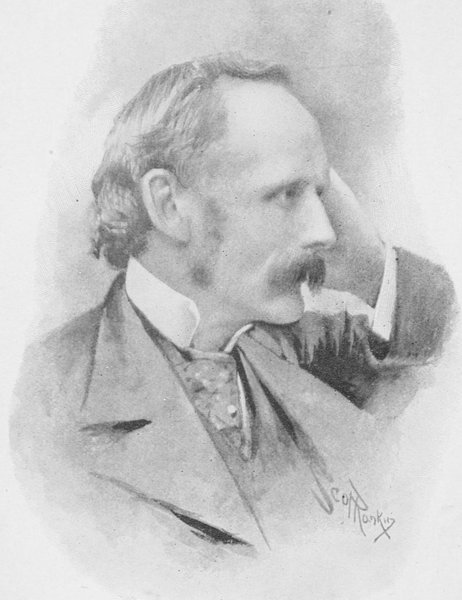
Henry Drummond is remembered today chiefly for one short address on the thirteenth chapter of First Corinthians, printed under the title The Greatest Thing in the World and read ever since by people who know little of its author. That is fitting, because the people who knew him best said the address was simply a description of the way he lived. He was a man of science teaching in a divinity college, an evangelist whom students crowded to hear, and a friend of boys who never lost the boy in himself. In a life of forty-five years he tried to show his generation that the God of the Bible and of the natural world is one God, and that the heart of following Christ is love.
A Stirling Boyhood
He was born on 17 August 1851 at Park Place in Stirling, in the shadow of the castle rock, the son of William Drummond, a seedsman, and his wife Jane. Henry went to the High School of Stirling and then to Morrison’s Academy at Crieff, and in 1866 he entered the University of Edinburgh, where natural science attracted him most. The home he came from was devout and Free Church, sincere rather than gloomy, and it gave him a tender conscience early. At twelve, he later recalled, he worked hard through Horatius Bonar’s God’s Way of Peace. While still a student he was deeply moved by some mission services at Cambusbarron near Stirling, and soon afterwards he told his father that he wished to enter the ministry.
He never claimed a sudden conversion. Asked once whether he had passed through one, he thought for a moment and said that he could not say he had, but added that he had seen too many ever to doubt that they were real. On his nineteenth birthday, his first away from home, while tutoring a family in Kincardineshire in the summer of 1870, he wrote in his diary:
Few lives have been as happy as mine. The rod of affliction may conquer many, but if I am subdued at all I have been “killed with kindness” — unmerited, unrequited, unsolicited, unexampled kindness.
— Henry Drummond
In the same entry, after confessing his sins, he named the chief desire of his heart: “to be reconciled unto God and to feel the light of His countenance always upon me.” That autumn he entered New College, Edinburgh, to study divinity for the Free Church of Scotland.
Into the Inquiry Room
In the late summer of 1873 two Americans landed at Liverpool, D. L. Moody, who preached, and Ira D. Sankey, who sang. Unknown in Britain, they found their first crowds at Newcastle and Sunderland, and on 23 November 1873 their mission opened in Edinburgh. Moody wanted students to talk with the anxious men who stayed behind after the meetings, and Drummond, twenty-two years old, went into the inquiry room. Friends remembered him walking home after meetings with his arm linked through that of some young man seeking Christ.
He was an unlikely partner for Moody. He was quiet, humorous and well read, and never much cared for large meetings. What drew him was the thing he had missed in ordinary church life: the patient, personal dealing of one soul with another before God. Moody, for his part, wanted a young man to lead his meetings for young men, and chose this one. Through 1874 and into the summer of 1875 Drummond followed the mission through Scotland, Ireland and England and worked beside the evangelists in London, speaking night after night. In those months he first spoke on love and on the changed life, themes that later made him famous.
Invitations to lead missions poured in, and he was unsure of his calling. At Bonskeid in Perthshire, in August 1875, Mrs. George Freeland Barbour, mother of his friend Robert Barbour, warned him how often a travelling evangelist’s life becomes a few years of blessing followed by carelessness, no study and no fruit. He listened, and went back to New College for his last year.
Science and the Spiritual World
In 1877 he was appointed lecturer in natural science at the Free Church College in Glasgow, the post he held for the rest of his working life. In 1878, after a summer supplying the Free Church station at Malta, he took charge of a small mission at Possilpark, a working-class suburb in the north of Glasgow, in the hard winter after the City of Glasgow Bank failed. From his Sunday addresses there grew the book that made his name.
Natural Law in the Spiritual World appeared in June 1883. Its argument was that the laws which science traces in the natural world, such as growth, degeneration and the dependence of life on its surroundings, run on unbroken into the spiritual world, so that the life of the soul can be studied with the same honesty as the life of a cell. He left Britain within a week of its publication and heard nothing of its fate until a bundle of letters reached his tent one night between Lake Nyasa and Lake Tanganyika. He was famous. Many readers found new hope in it for holding faith and science together. Others, theologians and scientists alike, thought its argument went further than the evidence allowed, and his later writing put the case in a different way. His conviction held: a Christian has nothing to fear from facts, and honest doubt deserves patience. “Doubt is honesty,” he once told Christian workers; “unbelief is obstinacy.”
The African journey of 1883 and 1884 was a scientific survey of the country around Lakes Nyasa and Tanganyika, made for the African Lakes Company, the Glasgow venture that supplied the Scottish missions there. He saw missionaries laying down their lives and the ruin left by the slave trade, and he suffered fever in a wet tent. His book Tropical Africa (1888) came out of the journey. So, his biographer believed, did a new gravity in him, a touch of sadness his friends had not seen before. He came home with grey in his hair, telling a friend, “I’ve been in an atmosphere of death all the time.” Soon after his return the Church raised his lectureship to a full chair, and on 4 November 1884 he was ordained and inducted as Professor of Natural Science, though to the amusement of his friends he insisted to the end that he had never been ordained.
The Greatest Thing
Early in 1885 the young cricketer C. T. Studd and the rower Stanley Smith, two of the Cambridge men bound for China with the China Inland Mission, stirred the students of Edinburgh University, and the leaders of that movement begged Drummond to carry it on. He agreed to give one address on a Sunday evening, for students only, in the Oddfellows’ Hall near the university. The hall, which held about nine hundred, was nearly full. That one evening became a work of ten years. Every winter, Sunday by Sunday, he spoke in the same quiet classroom voice and stayed late talking with men who had questions; in the busiest weeks his helpers met in their rooms at ten each night to pray. Hundreds who never went to church came to faith in Christ there. He counted it the real work of his life, and declined other calls, and even an invitation to stand for Parliament, to keep it.
On the evening of his thirty-third birthday, in August 1884, staying with Robert Barbour at Cults near Aberdeen, he spoke to the household on what Barbour called “Paul’s Hymn of Heavenly Love,” and his friend wrote that it was like being in heaven or in sight of it. He had given it in various forms since the Moody years. Printed as a slim book at the end of 1889, The Greatest Thing in the World sold in enormous numbers. Faith, it says, has been called the greatest thing in the religious world, but Paul says the greatest is love, and love is not a mood but a character made up of patience, kindness, generosity, humility, courtesy, unselfishness, good temper, guilelessness and sincerity, practised in ordinary days among ordinary people.
You will find as you look back upon your life that the moments that stand out, the moments when you have really lived, are the moments when you have done things in a spirit of love.
— Henry Drummond
Moody, who had known him since 1873, said that some men take an occasional journey into the thirteenth of First Corinthians, but that Henry Drummond lived there constantly.
His work for young people reached well beyond the university. The Boys’ Brigade, begun in Glasgow by William Smith in October 1883, won his heart from the start. He became an honorary vice-president, wrote little books for its boys, and pleaded its cause in Britain, the United States and Canada. He started the movement in Australia when he toured the colleges there in 1890, a journey that went on to the mission islands of the New Hebrides. In 1887 Moody brought him to Northfield, Massachusetts, and he went on from college to college across America; in 1893 he returned to give the Lowell Lectures in Boston. Published as The Ascent of Man in 1894, those lectures argued that alongside the “struggle for life” in nature there runs a “struggle for the life of others,” a long preparation for love. Some critics questioned his science, and some in his own Church distrusted his teaching, which he felt keenly. Yet the book’s deepest conviction was the one that ran through all his work: that love is woven into the purpose of the world because God is love.
“There’s Nothing to Beat That”
In the spring of 1894 the first signs of his last illness appeared. He went on teaching through the winter, stiff and bent and unable to sleep, until his doctors forbade any more lectures early in 1895. Only later was it found that a malignant disease of the bones was causing his agony. After a vain search for relief in the south of France, from September 1895 he lay at Tunbridge Wells in the care of his old friend Dr. Claude Wilson. In the end he could not bear even the grasp of a friend’s hand.
Those who sat with him said that his last two years were among his greatest services. He kept his humour and his love of chess and puzzles, and spoke kindly even of those who had attacked his teaching. Being cared for troubled him:
I have been giving all my life, and now it seems to me positively indecent to be only getting. Well, perhaps there’s a lesson in that too.
— Henry Drummond
On Sunday 7 March 1897 he lay weak and listless while his friend Dr. Hugh Barbour played hymn tunes to him. None roused him until Barbour played the old Scottish tune “Martyrdom.” Then Drummond beat time with his hand and joined in the words: “I’m not ashamed to own my Lord, or to defend His cause.” When it ended he said, “There’s nothing to beat that, Hugh.” Four days later, on the morning of Thursday 11 March 1897, he murmured a message for his mother and slipped away quietly.
They buried him at Stirling, beside his father, on the Castle Rock above the park where he had played as a boy, on a wild day of sleet and rain. Most of the mourners were young men, students from Edinburgh and Glasgow and from many lands, who owed their faith to him. His books on science have dated; his little address on love has not, because it was never really an argument. It was a portrait of Christ, drawn by a man who had spent his short life trying to resemble Him.
Questions and Answers
Who was Henry Drummond?
Henry Drummond (1851–1897) was a Scottish evangelist, writer and lecturer in natural science at the Free Church College in Glasgow. He worked alongside D. L. Moody in the 1873–75 missions in Britain, led a celebrated ten-year work among the students of Edinburgh University, and wrote “The Greatest Thing in the World,” his address on love from 1 Corinthians 13.
Where did Henry Drummond grow up, and how did he come to faith?
He was born on 17 August 1851 at Park Place in Stirling, the son of William Drummond, a seedsman, and was raised in a devout Free Church home, studying at Stirling High School, Morrison’s Academy in Crieff and the University of Edinburgh. He never claimed a sudden conversion, though he said he had seen too many ever to doubt their reality; instead a growing seriousness, deepened by mission services at Cambusbarron, led him to tell his father he wished to enter the ministry. On his nineteenth birthday in 1870 he wrote that the chief desire of his heart was “to be reconciled unto God.”
How did Henry Drummond come to work with D. L. Moody?
When Moody and Sankey opened their Edinburgh mission in November 1873, Drummond, a twenty-two-year-old divinity student at New College, began helping in the inquiry room, speaking personally with anxious men after the meetings. Moody soon put him in charge of meetings for young men, and through 1874 and into the summer of 1875 he followed the mission through Scotland, Ireland and England, speaking night after night.
Why did he not remain a travelling evangelist?
Invitations to lead missions poured in, and he was unsure of his calling. In August 1875, at Bonskeid in Perthshire, Mrs. George Freeland Barbour warned him how often an evangelist’s life became a few years of blessing followed by carelessness and no study, and he returned to New College to finish his training.
What did Henry Drummond teach in Glasgow?
In 1877 he became lecturer in natural science at the Free Church College in Glasgow, and in 1884 the post was raised to a full chair, to which he was ordained and inducted on 4 November 1884. Alongside his teaching he led a mission at Possilpark in the north of Glasgow from 1878.
What was “Natural Law in the Spiritual World” about?
Published in June 1883 and grown from his Sunday addresses at Possilpark, it argued that the laws science traces in nature, such as growth and degeneration, continue into the spiritual life. It became hugely popular and helped many readers hold faith and science together, though some theologians and scientists felt it pressed the comparison too far.
Why did Henry Drummond travel to Africa?
In 1883 and 1884 he made a scientific survey of the country around Lakes Nyasa and Tanganyika for the African Lakes Company, which served the Scottish missions there. He saw the sacrifices of the missionaries and the cruelty of the slave trade, suffered fever, and wrote of the journey in “Tropical Africa” (1888).
What was his work among the students of Edinburgh?
In 1885, after a stirring student mission by C. T. Studd and Stanley Smith, Drummond agreed to give one Sunday evening address for students in the Oddfellows’ Hall, and that work continued every winter for about ten years. Hundreds of students came to faith in Christ there, and he counted it the real work of his life.
What is “The Greatest Thing in the World”?
It is Drummond’s address on 1 Corinthians 13, which he had given in various forms since the Moody years and which was printed as a slim book at the end of 1889. It argues that the greatest thing is not faith but love, made up of patience, kindness, generosity, humility, courtesy, unselfishness, good temper, guilelessness and sincerity, and Moody said Drummond lived in that chapter constantly.
What else did he do in his later years, and how did he die?
He championed the Boys’ Brigade as an honorary vice-president, starting the movement in Australia in 1890, and gave the Lowell Lectures in Boston in 1893, published as “The Ascent of Man” in 1894. From 1894 a malignant bone disease slowly crippled him, and after long, patient suffering at Tunbridge Wells he died on 11 March 1897, a few days after joining in the hymn “I’m not ashamed to own my Lord” and saying, “There’s nothing to beat that.” He was buried beside his father in Stirling.