Biography
- 1909 Born
- 1929 Trained
- 1931 Gahini
- 1933 Revival
- 1936 Died
One word is carved on his grave in the grounds of Namirembe Cathedral, and it is the same word he carried on his last journey to Kampala: Zukuka — Awake. Blasio Kigozi was not yet thirty when he died, a fever burning through him before he could stand and say the thing he had come to say. He wrote no books. Only a handful of his own words survive, and one of them is that single word. Yet those who came after him counted him among the first and most important figures of the East African Revival, and some called him its John the Baptist — the voice that went ahead, cried out that the church was asleep, and was gone almost before the thing he announced arrived.
A younger brother, converted through his elder
He was born a Muganda, in Uganda, around 1909; the exact date, his birthplace, and his parents' names have not come down to us with any certainty. What is well attested is the household he belonged to. His elder brother was Simeoni Nsibambi, the Kampala layman whom the revival's own people regarded as one of its founders — the man who, on a Kampala street, pressed the visiting missionary Joe Church with the question of what was still missing in his Christian life, and would not let it go.
Kigozi was converted in his youth, and he was converted through Nsibambi. This is worth dwelling on, because it is the whole shape of his life in miniature. He did not come to his faith through a foreign preacher or a dramatic meeting. It came to him across a family table, from an older brother who had been gripped himself. The revival was, before it was anything else, this: one person who had been changed refusing to leave the next person unchanged. Kigozi received it that way, and he would spend the rest of his short life passing it on the same way.
The schoolmaster who wanted to be an evangelist
He trained as a schoolmaster. Around 1929 he completed his studies at the teacher-training and theological school at Mukono, and then he was sent south, across the border into eastern Rwanda, to take charge of the network of schools around the mission station at Gahini. He was a teacher by trade and by discipline — not, as one careless telling has it, a barely-literate convert, but a man properly trained to stand in front of a class.
But teaching was not the whole of what burned in him. He carried a fierce desire to follow in the steps of Apolo Kivebulaya, the pioneer Muganda evangelist who had carried the gospel far into the forests to the west. Kigozi wanted that life — the road, the villages, the preaching. And at Gahini he found the setting that would let the teacher become the evangelist.
Around 1931 he joined Dr Joe Church at Gahini Hospital, and the two became close friends. They shared a particular kind of piety — one that would not settle for respectable, half-asleep religion, that insisted on repentance, on moral transformation, on sin named out loud and left behind. Kigozi preached that way for the rest of his life. He was uncompromising to the point of discomfort, denouncing sin wherever he found it, and he gave himself to years of ceaseless itineration, going from village to village on foot, one settlement after another, refusing to let the country sleep.
Two men praying, and the answer that came
Before there was a movement, there were two men praying. Kigozi and Joe Church began to pray together at Gahini for a deeper transformation among the African workers at the station — not for numbers, not for buildings, but for their own colleagues to be genuinely changed. They kept at it for a couple of years, and nothing much seemed to happen.
Then in 1931 it happened. Yosiya Kinuka, a fellow worker at the station, underwent a dramatic conversion — a change so real and so public that it could not be explained away. Out of it grew the first small band of African evangelists who would carry the revival, the seed of the teams that soon spread it across the region.
It is a small enough episode to miss, but the shape of it matters. The revival did not begin with a strategy or a campaign. It began with two friends asking God, over and over, for one thing they could not manufacture — real change in the people right next to them — and then watching it arrive.
Ordained, and then the road again
In time Kigozi returned north to the theological college at Mukono. He was ordained deacon — the records disagree on the year, and there is no need to pretend to a precision they do not support — and then he went straight back to Gahini, this time to head the school for evangelists. It was exactly the work he was made for: not to sit in a study, but to form the men who would walk the roads he loved.
By 1933 the thing he and Church had prayed for was no longer a hope but a fire. At a convention at Gahini that year, Kigozi stood up to speak alongside his brother Nsibambi, and the accounts remember it as a turning point — the moment when, as the revival's own people put it, the fires began to blaze. The two brothers, the elder who had first been gripped and the younger he had gripped in turn, now stood together in front of a crowd, and the movement took hold.
Awake
By January 1936 Kigozi had one burden left, and it was for the church itself — not the villages this time, but the leadership. He had come to believe that the established Anglican church in Uganda was asleep: respectable, organised, and dead. And he resolved to say so to its face.
He travelled to Kampala to bring a message to the Synod of the church. Its substance can be given in the one word that became inseparable from his name: zukuka — awake. He meant to stand before the assembled leaders of the church and call them to shake off their apathy, to repent, to come alive. The full text of that message has not survived, and it would be a betrayal of the man to invent sentences for him; what is certain is the summons at its heart.
Zukuka! — Awake!
— Kigozi's rallying cry, and the single word later carved on his tombstone
He never delivered it. On his way to the synod he was struck down by tick fever — relapsing fever — and it moved fast. He was taken to the hospital at Mengo, and there, on 26 January 1936, he died. He was around twenty-seven years old. Those who told his story afterward remembered a cry of Awake, awake on his lips at the end; that belongs to tradition rather than to the record, and it is enough to say that the man who died with the word Awake attached to his name never got to shout it at the people he had come to wake.
The word on the grave
His sudden death, before the synod had even opened, did not silence the message. It sharpened it. A man who had crossed the country to tell the church to wake up had died at its door, and the leaders who might have shrugged off a living preacher could not shrug off a fresh grave. His call came to be regarded as prophetic. Within the next year or two, waves of revival swept through the Church of Uganda.
He was buried on Cathedral Hill, in the grounds of Namirembe Cathedral, before a great crowd, and his elder brother Nsibambi — the one who had first led him to Christ — officiated at the funeral. On the tombstone they cut a single word: Zukuka. Awake. It was the whole of his preaching, the whole of his last errand, and now the whole of his epitaph.
Zukuka
— the one word on Blasio Kigozi's grave at Namirembe
Those who weighed the revival afterward were not modest about him. One assessment named him the major founder and developer of the East African Revival in its first decade; others gave him the older, sharper title — the John the Baptist of the movement, the herald who prepares the way and then steps out of it. Both are the same judgement in different words: that a schoolmaster from Uganda who wanted only to walk the roads and preach spent himself so completely, and died so pointedly, that his one word outran his short life.
He is easy to overlook among the revival's louder names. He was not a bishop, not a martyr under a dictator, not the author of anything you can read. He was a younger brother who received his faith at home, a teacher who longed to be an evangelist, a friend who prayed for two unrewarded years before the answer came, and a preacher who died with his message still in his chest. What he leaves is that message, reduced to its irreducible core and set in stone: that the gravest danger to a church is not persecution but sleep, and that the only fitting response is to wake up.
Also appears in

Articles about Blasio Kigozi (1)
Questions and Answers
Who was Blasio Kigozi?
Blasio Kigozi (c.1909–1936) was a Ugandan schoolmaster and evangelist, younger brother of the revival co-founder Simeoni Nsibambi, who preached repentance across the villages around Gahini and died of tick fever in January 1936 while carrying his "Zukuka" ("Awake") call to the Church of Uganda synod. Remembered as the "John the Baptist of the East African Revival," he was buried at Namirembe beneath a tombstone bearing the single word "Zukuka."
How was he converted?
He was born a Muganda around 1909 and was converted in his youth through his elder brother Simeoni Nsibambi, the Kampala layman whom the revival's own people regarded as one of its founders. This is the whole shape of his life in miniature: he came to his faith not through a foreign preacher or a dramatic meeting but across a family table, from an older brother who had been gripped himself — the revival, before it was anything else, being one changed person refusing to leave the next unchanged.
What did he train and long to do?
He trained as a schoolmaster, completing his studies around 1929 at the teacher-training and theological school at Mukono, and was sent south into eastern Rwanda to take charge of the schools around the mission station at Gahini. But teaching was not the whole of what burned in him: he carried a fierce desire to follow in the steps of Apolo Kivebulaya, the pioneer Muganda evangelist, and at Gahini the teacher became the evangelist.
What was his preaching like?
Around 1931 he joined Dr Joe Church at Gahini, and the two became close friends, sharing a piety that would not settle for respectable, half-asleep religion but insisted on repentance, moral transformation, and sin named out loud and left behind. He was uncompromising to the point of discomfort, denouncing sin wherever he found it, and gave himself to years of ceaseless itineration on foot, village to village, refusing to let the country sleep.
What did his years of praying with Joe Church produce?
Before there was a movement there were two men praying. Kigozi and Joe Church began to pray together at Gahini for a deeper transformation among the African workers — not for numbers or buildings but for their own colleagues to be genuinely changed — and kept at it for a couple of years with nothing much seeming to happen. Then in 1931 Yosiya Kinuka underwent a dramatic conversion, the concrete answer that seeded the first African evangelistic team, and with it the movement itself.
What was his role by 1933?
In time he returned to the theological college at Mukono, was ordained deacon, and went straight back to Gahini to head the school for evangelists — exactly the work he was made for, forming the men who would walk the roads he loved. By 1933 the thing he and Church had prayed for was no longer a hope but a fire: at a convention at Gahini that year Kigozi stood up to speak alongside his brother Nsibambi, and the accounts remember it as a turning point.
What was the "Zukuka" message?
By January 1936 he had one burden left, and it was for the church itself. He had come to believe the established Anglican church in Uganda was asleep — respectable, organised, and dead — and resolved to say so to its face, travelling to Kampala to bring a message to the Synod. Its substance can be given in the one word inseparable from his name: "Zukuka" — Awake. He meant to call the assembled leaders to shake off their apathy, repent, and come alive.
Did he deliver his message to the synod?
He never delivered it. On his way to the synod he was struck down by tick fever — relapsing fever — and it moved fast; taken to the hospital at Mengo, he died there on 26 January 1936, around twenty-seven years old. His sudden death, before the synod had even opened, did not silence the message but sharpened it: a man who had crossed the country to tell the church to wake up had died at its door, and the leaders who might have shrugged off a living preacher could not shrug off a fresh grave.
What is the word on his grave?
He was buried on Cathedral Hill, in the grounds of Namirembe Cathedral, before a great crowd, and his elder brother Nsibambi — the one who had first led him to Christ — officiated at the funeral. On the tombstone they cut a single word: "Zukuka." Awake. It was the whole of his preaching, the whole of his last errand, and now the whole of his epitaph. Within the next year or two, waves of revival swept through the Church of Uganda.
How is he remembered?
Those who weighed the revival afterward named him the major founder and developer of its first decade, and gave him the older, sharper title — the John the Baptist of the movement, the herald who prepares the way and then steps out of it. Easy to overlook among the revival's louder names, he was a younger brother who received his faith at home, a teacher who longed to be an evangelist, and a preacher who died with his message still in his chest — leaving it reduced to its irreducible core and set in stone: that the gravest danger to a church is not persecution but sleep.
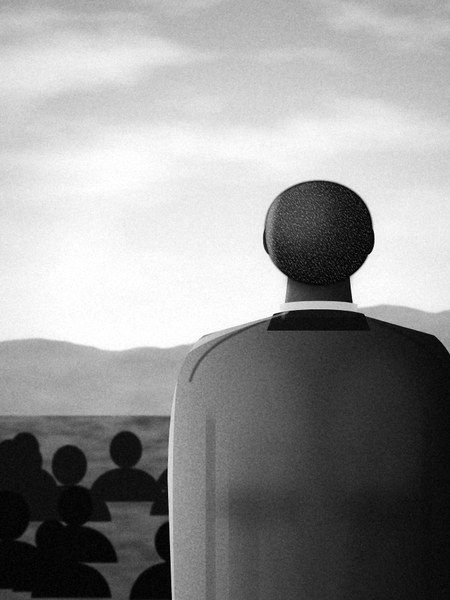
Portrait: Illustration by Ochorus (a scene, not a likeness)