Chapter 9 · 17 min read · 22 min listen
What Each One Wanted
The Crystal Theatre was so full that evening that people stood three deep at the back, and Mira could hear every one of them breathing.
She stood in the wings in her white dress, with the glowstone circlet on her head and the pendant at her throat, and waited for her name. Beyond the curtain the great bowl of the theatre rose in tier after tier of white seats, and all of it shone. It was the loudest room in Vaelport. On her first night it had made her eyes water; now she hardly noticed. You can grow used to a great many things, if people clap for you while you do it.
“Lovely,” said Oskar Venn, beside her. He had come round from his box to wish her luck, as he did every night. He bent and straightened her circlet with his ringed fingers. “Quite lovely, my dear. Oh — I have some happy news for you, before I forget. Your little friend Wren is to have a family. The Pellows, on Lantern Steps. The papers are to be signed tonight.” He smiled. “Isn’t that good? Everybody finding their place.”
“Tonight?” said Mira.
“Tonight.” He laid his hand on her shoulder. It was very cold, even through the white silk. “And now it’s your turn. Off you go.”
The curtain rose. The light came at her like a wave. And the cheering began.
She knew what to say; she had said it every night. She stood in the middle of the shining stage with Venn’s hand on her shoulder and told them about the dark, and Deepholm, and how she had come to Vaelport, and seen.
“And who is to say,” she said — it was the line the audience waited for, and she heard them lean forward to hear it — “that it was not this city’s light that opened my eyes? It might have been. How can anyone know that it was not?”
The theatre sighed, happily, like a cat by a stove. Then the clapping came, rolling down the white tiers towards her like warm water.
Only it was not warm. Mira had known that every night. But the pendant lay cool at her throat, and it was so very pleasant, after twelve years of being the blind girl who had to be led everywhere, to be somebody — that she had decided not to notice.
She bowed. And as she came up from the bow, she looked at the front row.
Faces were new to her, and she was greedy for them. The front row was where the children sat, because the Company gave children the best seats free.
They were not clapping.
They sat in a row with their glowstones on strings round their necks, and their hands in their laps, and their faces turned up to her, and they were not clapping and not smiling and not anything at all. They looked tired the way old stone steps are, that have been walked on too long.
And in the middle of the row sat a girl in a man’s coat, much too big for her, with the sleeves rolled up and up over her thin wrists. She was perhaps eleven. She was staring at the stage with her mouth a little open. And she was grey.
Not pale. Mira had learned the difference now. Pale was what everyone in Vaelport was. This girl was grey, the way the Hollow-touched Delvers had gone grey in Deepholm when the songs stopped.
Very softly, under the clapping, out of a habit older than her eyes, she clicked her tongue — tk — towards the grey girl, and listened for what came back.
Nothing came back.
Not nothing as in silence. Nothing the way the Silent Pit in Deepholm sends nothing back, however long you click into it. As if there were no one there at all.
Mira went down the steps at the front of the stage.
She felt Venn’s cold hand slide off her shoulder. She went and knelt down on the shining floor in front of the girl in the big coat and looked up into her face.
“What is your name?” she said.
The girl looked at her. Her lips moved. She frowned, very slightly, as if she were trying to remember where she had put something.
“I don’t—“ she said. And then nothing.
“That’s Pim,” said the small boy in the next seat. He said it flatly, without any interest. “She was our captain. Down the harbour. She went quiet this morning.”
Mira knelt there with her hands on the grey girl’s knees, and all round her the white theatre shone and shone.
I want to tell you what Mira did next quite exactly, because it was a brave thing, and brave things deserve to be told properly.
She stood up. She lifted the glowstone circlet off her head and laid it on the edge of the stage. She unhooked the pendant from her throat, and laid that beside it. Then she turned round and faced the whole of the Crystal Theatre — three thousand people, perhaps more, and every one of them looking at her — and she said, in her clear, precise Delver voice, so that it carried to the very back:
“It wasn’t your light. It was a man in a boat, and he didn’t ask for anything.”
There was a silence so deep that she could hear the glowstones not humming.
“I’m sorry,” said Mira. “I knew. I said it anyway, because you clapped.” She held out her hand to Pim. “Come along. Up you get.”
And Pim, who did not know her own name, took the hand, because somebody had held it out; and stood up; and let herself be led.
Oskar Venn had come to the front of the stage. He did not raise his voice. He never did. “The poor child is tired,” he said to the theatre gently, sorrowfully. “All this has been too much for her. We’ve asked too much.” He looked down at Mira, and his face was kind and puzzled and a little hurt. “My dear. Where are you going?”
“To find my friend,” said Mira. “I have something to say to her.”
She walked up the long white aisle with Pim’s grey hand in hers, and nobody stopped her. Behind her she heard Venn’s warm voice smoothing the murmur over, the way you smooth a sheet. Then the great doors swung shut, and she was out in the white night, eyes shut against the glare, clicking her way downhill towards the sea.
On Lantern Steps, Wren had a pen in her hand.
She had spent the whole day at the gaol behind the fish-market, trying to get in to see Ash. They had not let her, very politely. She had sat on the step beside Cinder all afternoon, and Cinder had leaned against her side, very lightly, and not even sneezed. At sundown Wren had come back up the crooked steps to the blue door, tired to her bones, and found the papers waiting on the kitchen table.
Mr Venn’s man had brought them, Mrs Pellow said, with a white ribbon round them. Wasn’t he a kind man?
Now the papers lay on the scrubbed table in front of Wren, thick and creamy, covered with long words she could only half read, with three empty lines at the bottom. Mr Pellow’s big slow name was to go on one, and Mrs Pellow’s small quick one on another. The top one was for her.
“Just there, pet,” said Mrs Pellow from the stove. She had been crying on and off for an hour, happily, and kept wiping her eyes on her apron and laughing at herself. “Just your name. You don’t have to put anything else.”
The kitchen was the only warm room in Vaelport. The fire burned in the grate, red and real, and the cat lay in front of it with its paws tucked under, and the kettle was beginning to sing. Mr Pellow sat in his chair by the hearth, mending a net, his big fingers knotting and pulling. He had not said much all evening. But now and then he looked up at Wren over the net, and his eyes were so full of hope that she had to look away.
Wren dipped the pen.
She held it over the line. She could feel the pendant at her throat, cool and smooth, and it made everything quiet and simple. Just your name. It was such a little thing to write. A name, on a line, and then there would be a blue door and a quilt and somebody calling up the stairs to her for ever.
She thought of Old Ash, behind the third window from the left.
She thought of the drawer upstairs, and the thin gold line across the floor; and found that she could not remember when she had last looked at it. Yesterday? The day before?
The pen hovered. A drop of ink gathered on the end of it.
Somebody knocked at the door.
It was Mira.
She was standing on the step in a white silk dress with no shoes on, breathing as if she had run all the way down from the third tier — which she had. Behind her, holding her hand, stood somebody small in a man’s coat with the sleeves rolled up.
Wren stared. The last thing Mira had said to her, days ago, was You just don’t like anyone else having anything, and Wren had carried it about ever since like a stone in her boot.
“Wren,” said Mira. She did not wait to be asked in. She did not wait for anything. “I was wrong. It was him in the boat. It was always him. I knew it was, and I said it wasn’t, because they clapped for me, and nobody had ever clapped for me before, and I liked it.” She drew a long breath. “I said you didn’t like anyone else having anything. That was a lie, and it was unkind, and I said it because you were right. I’m sorry. That’s all. I’m very sorry.”
If you have ever been given an apology like that — all at once, with nothing held back and no but at the end of it — you will know that there is only one thing to do with it.
“Course,” said Wren. Her voice had gone thick. “Course it’s all right. You great lump.” And she pulled Mira in over the step and hugged her, hard, the way she had never hugged anybody in her life except Nettle. Mira hugged her back.
Then Wren looked past her shoulder, at the one standing on the step.
“Pim?” she said.
Pim did not answer. She stood where Mira had left her, with her hands hanging and her grey face turned towards the warm light of the doorway, and she did not know that anybody had said her name.
Wren knew that face. She had seen it on Mrs Fenn, sitting on the bakery step with flour on her hands, unable to remember her children. She had seen it on Nettle, in the long dark of Soot Lane. She knelt down in front of Pim and took hold of her cold hands.
“Pim. It’s me. It’s the sweep. You tried to nick my purse, remember? You were rubbish at it.”
Nothing. Round Pim’s neck, on its string, her glowstone shone white and steady and perfectly content.
“She went quiet this morning,” said Mira softly. “The little ones said. All at once, like a lamp going out.”
Mrs Pellow had come to the door behind them, wiping her hands. “Oh,” she said. “Oh, the poor lamb. Bring her in, bring her in to the fire. She’s frozen.” She took Pim gently by the shoulders and led her to the hearth, and sat her down on the stool by Mr Pellow’s chair, and put a shawl round her. “There now. There. She’ll be right as rain in a bit, pet, you’ll see. They go quiet, sometimes, the young ones. It’s only growing up.”
It’s only growing up. Wren had heard that before, under the fish-market, from Pim herself.
She looked at Pim, grey and still beside the red fire. She looked at kind Mrs Pellow, with her stone shining at her throat; and at Mr Pellow, with his lying among the net; and at the cat, which had a little white stone on a ribbon round its neck, too, that she had never even noticed until now.
And she saw what the city did. Not with her head — she had known it with her head since the market square. She saw it the way you see a thing when it is sitting in front of your own fire.
She put both hands up to the back of her neck and unhooked her pendant, and laid it on the table beside the papers. It made a small cold click. And the moment it was off, she felt it: like coming up out of cold water; like a window thrown open in a room she had not known was stuffy. Everything came rushing back at once — Ash in his cell, and Varrick in the alley, and Pim, and Nettle, and the Beacon, and the road, and the Mountain. And under all of it, one single, plain, enormous thing.
She wanted the lamp.
She wanted it the way you want air. She wanted to hold it out to Pim and see the grey go out of her face.
“Hang on,” she said, to nobody. “Hang on, Pim. Two ticks.”
She went up the narrow stairs so fast she tripped on the top one, and dropped on her knees by the bedside table.
There was no gold line across the floorboards.
She pulled the drawer open.
The handkerchief was there, folded neatly in the bottom, just as she had left it. It was white. Not blue-and-white checks. White.
There was nothing on it at all.
She put her hand flat on the handkerchief, and it was cold. She felt into the corners of the drawer, as if a brass lamp could have hidden itself in a crack. She pulled the drawer right out and shook it, and the handkerchief fell onto the floor, and that was all.
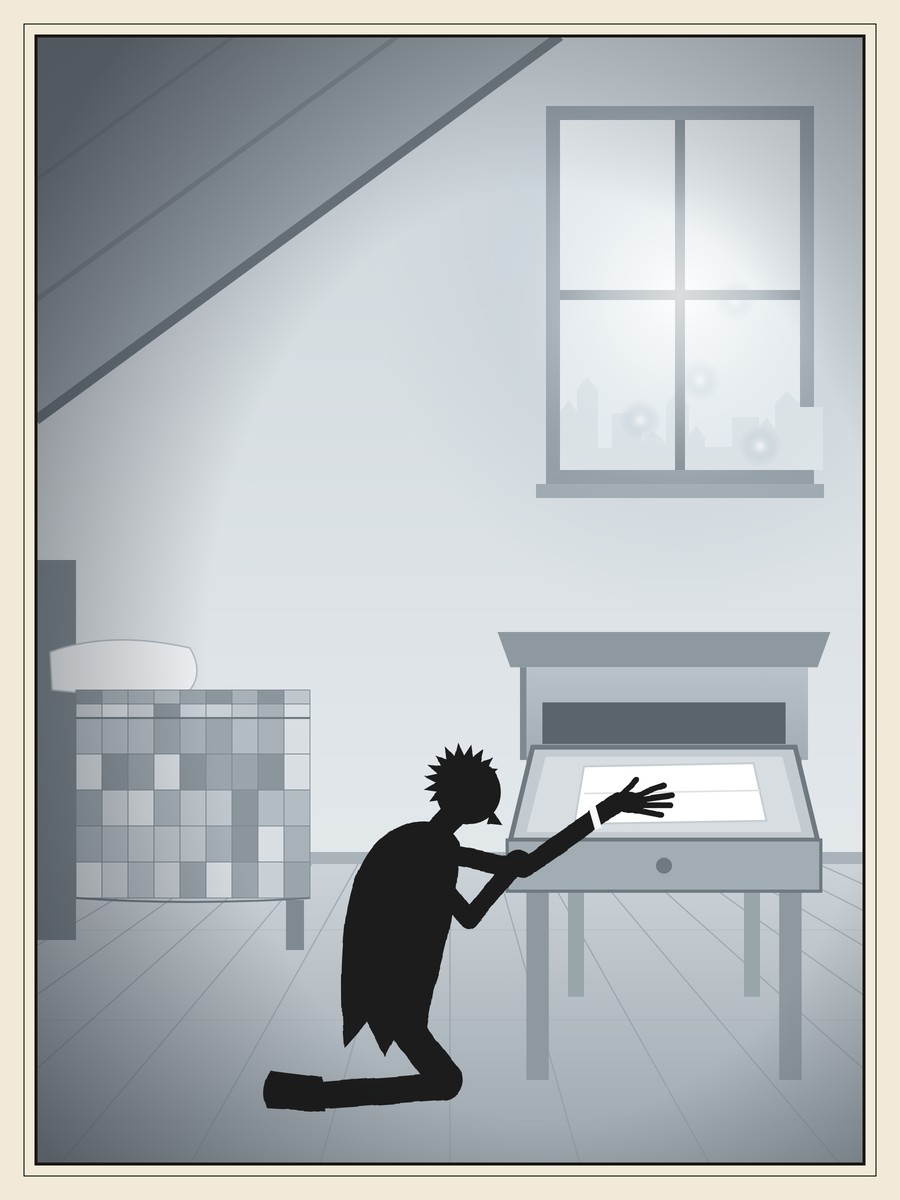
She looked on the windowsill, and under the bed, as if it might have come back to her by itself, the way it used to. Nothing.
It comes back, she thought. It always comes back. Only you’ve got to want it. And you stopped. You stopped wanting it, you stupid, stupid—
But she wanted it now. She wanted it with everything she had. And it did not come.
She went down the stairs slowly, holding on to the rail.
“Has anybody been up in my room?” she said. Her voice did not sound like hers.
Mrs Pellow turned from the fire, where she had been tucking the shawl round Pim. “Only your friend, pet,” she said. “The tall lad, with the spectacles. He came by this afternoon while you were out, to see how you were getting on. Said he’d left a little book up there, when he brought your bag, and might he go up and look for it while he waited, and I took him up a cup of tea.” She smiled. “He found it, though. Off he went in a dreadful hurry, without even his coat on, and never drank a drop of his tea.” Her face changed, looking at Wren’s. “Love? What is it? What’s the matter?”
Wren could not answer.
Not Tobin. That was all she could think. Not Tobin. Not him.
She found that she was crying. She did not know when it had started. It was quiet, and it would not stop.
“I can’t stay,” she said.
Mrs Pellow went quite still, with her hand on the shawl.
“I’m sorry,” said Wren. “I can’t. I’ve got to go. I can’t sign it. I want to — I want to more than anything, I want it more than I’ve ever wanted anything — but I can’t stay here. Not here. Not with—“ She looked at the stones. At Pim. “I’m sorry. I’m so sorry.”
“But pet,” said Mrs Pellow. Her voice wobbled. “But the papers. We were going to — your room’s all ready. You’ve only got to put your name.” She looked at the table, and then at her husband, as if he might be able to explain it to her. “Did we do something? Was it something we did?”
“No,” said Wren. “No. You never did anything. You’re the kindest people I ever met.”
Mr Pellow had put down his net. He looked at Wren for a long time with his slow, gentle eyes. He did not understand, and he was not going to ask her to make him.
“You go on, then, love,” he said at last, in his big quiet voice. “If you’ve got to. Door’s here.” He put his great hand on Pim’s grey head, very lightly. “We’ll sit with this one.”
And Wren, who had wanted all her life to be somebody’s, turned and ran out of the only warm house in Vaelport, with Mira at her heels, and did not look back, because she could not have borne to.
The landlady of the Salt Lantern had not seen the young gentleman since the afternoon.
“He came in,” she said, in her kind, flat voice, “and went upstairs, and came straight down again. In a hurry. He had his coat off and all bundled up in his arms, holding it against his chest like it was a baby. I said, ‘Aren’t you cold, sir?’ and he went past me as if he never heard.” She smoothed her apron. “That was hours ago. He hasn’t come back.”
Wren took the stairs two at a time. Mira came after her, clicking softly in the dim stairwell.
The room was just as Wren had last seen it. Ash’s bed was made, with his spare shirt folded on the end and his teacup on the sill. Tobin’s bed was made too — and it had not been slept in. Not last night; not at all. The blanket lay perfectly smooth. The pillow had not a dent in it.
Except for one small thing, lying in the very middle of the pillow.
It was a brass compass, worn smooth at the edges, with its lid shut.
Wren picked it up. It was cold. It had been the first thing she ever stole from him, in Soot Lane. He never let it out of his sight. He slept with it in his fist.
She opened the lid. There were the words inside it, small and worn: Home is where the light is. And the needle swung, and trembled, and settled, and pointed — steadily, patiently, the way it always had — north and a bit east, inland, away from the sea and the lighthouse and the whole white city, towards a mountain none of them could see.
“He left it,” said Mira, very low. “Wren. Why would he leave it?”
Wren did not answer. She was thinking of a boy on the harbour wall that morning, with a face like a boiled turnip, saying Have you got it with you? The lamp? — and of herself, saying It’s safe. It’s at the house.
She shut the lid of the compass, very gently, the way he always had.
And in her coat pocket, against her side, something began to hum.
It was very soft at first — so soft she thought it was her own heart. Then it grew. One long low note, trembling, cold, so quiet that she felt it more in her teeth than heard it: the note she had not heard once since they came through the crystal gates; the note that meant something cold had been let loose.
Mira’s head came up. Her eyes went wide.
In Wren’s pocket, the singing-stone had begun to sing.
Chapter 9 complete
What Each One Wanted