Chapter 8 · 17 min read · 22 min listen
The Offer
Tobin found the note when he hung up his coat.
He had come back to the Salt Lantern late, after walking the long way round by the town gaol, which was a square white building behind the fish-market with a row of small barred windows high up in its wall. He had not been allowed in. He had not really expected to be. But he had stood in the street for a long time anyway, looking up at the windows and wondering which one was Ash’s; and on the gaol step, right in the middle, sitting very upright with her tail wrapped round her paws, he had found Cinder.
She had not come to him when he called. She had looked at him once, and then gone back to staring at the third window from the left, and her tail-spark had been so small that in all that whiteness he could hardly see it at all. So in the end he had come away and left her there.
The room at the inn was very quiet without Ash in it. Ash’s bed was made, with his spare shirt folded on the end of it, and his teacup on the windowsill, and there was a dent in the pillow where his head had been. Tobin looked at it and found that he could not look at it for long. He took off his coat to hang it on the peg; and a fold of paper fell out of the pocket and lay on the floor between his feet.
It was not his. He knew every scrap of paper he owned, and he owned a good many. This was a small square of heavy white paper, folded twice. He picked it up and unfolded it.
The writing was black, and neat, and slanted a little backwards, in a hand he did not know.
The lighthouse. Midnight. Come alone, if you want to see your father again.
Tobin sat down on the edge of his bed rather suddenly.
He read it again, and turned it over, and read it a third time, as if the words might have changed while he was not looking.
He remembered, now, a man in the crowd in the market square, while Ash was speaking: a tall man in a long pale coat, who had bumped against him from behind and said I beg your pardon in a pleasant voice and moved on. Tobin had not even looked round. He had been watching Ash on the fountain. He had been watching the fish-head.
He felt in the other pocket. The compass was there; so was his father’s letter to the Queen, which he had not taken out since the night on the waystone, and had not been able to throw away either.
If you want to see your father again.
Now Tobin was a sensible boy, and he did what sensible boys do when they are frightened, which is to make a list. He took out his pencil and wrote it down the back of a drawing of a gate-hinge.
Reasons not to go.
1. It is obviously a trap.
2. It is obviously from Varrick. (Wren would say so. Ash would say so.)
3. Ash is in gaol and cannot be asked.
4. Wren lives on Lantern Steps now.
5. Mira is at the Palace and is not speaking to anyone.
6. It is midnight. It will be
He stopped there, because he had been going to write dark, and then remembered that in Vaelport it was never dark, and that this was the first night of his life on which he had not one single thing to be afraid of.
He looked at the list for a long time. It was a good list. It was a very sensible list. Then he folded it up with the note inside it and put them both in his pocket, and put his coat back on.
His hand went, on the way, to the pendant at his throat. The little stone was cool. And it is a strange thing, but as soon as he touched it, the fear went quiet — not away, exactly; only quiet, the way a dog goes quiet when you put a cloth over its cage. Tobin thought, There. I’m calmer now. I’m thinking clearly.
He was not. But I am afraid that is what it feels like.
The harbour wall of Vaelport ran out a long way into the sea, curving like an arm, with the fishing boats moored along its inside and the open water breaking against its outside. It was broad enough for two carts to pass, and it was lit, like everything, from end to end — a glowstone on a post every twenty paces, white and steady and silent. Tobin counted the posts as he walked, because counting things helped. There were eighty-four. At the end of the wall the stone rose up into a great rock, and on the rock stood the lighthouse.
It was tall and white and round, and at its top, behind glass, burned the largest glowstone in Vaelport. Its light did not turn, the way Tobin had read that lighthouse lights should. It simply shone out in every direction at once, so bright that the waves round the rock were lit to the bottom, white and cold and full of drifting weed.
The door at the foot of the tower stood open.
The stair inside went round and round the walls, up and up, white stone steps lit by small white stones, and Tobin climbed it with his hand on the cold rail. He counted the steps. He lost count somewhere after a hundred and ninety, because his heart was making too much noise. At the top was a round room under the great stone itself, with glass all round it and a narrow iron gallery outside the glass, and the sea below on every side.
It was very cold. Tobin’s breath went out of him in a white cloud. The great glowstone sat above him in an iron cradle, as big as a haycart, and its light poured down on everything and threw not a single shadow anywhere.
A man was standing at the glass with his back to the room, looking out at the city.
“You came,” said Captain Varrick, without turning round. “Good. I was afraid you would bring the girl. Or the fox. The fox doesn’t like me.”
His voice was exactly as Tobin remembered it: smooth and quiet and pleasant, like oiled iron. He turned round. He was tall and pale and grey-eyed, in his grey cloak, and he looked at Tobin the way a schoolmaster might look at a promising pupil who has come in late.
“Sit down, Master Harrowgate. You’ve had a long climb. Two hundred and twelve steps; I counted them myself, the first time.” There was a bench by the wall. “No? As you like.”
Tobin did not sit down. He stood in the middle of the floor with his hands in his coat pockets, so that Varrick would not see them shaking, and pushed his spectacles up his nose with his shoulder, which did not work.
“Actually,” he said, and his voice came out higher than he meant, “I only came to — to say that I know it’s a trap. Technically speaking, it’s an extremely obvious one. And I’m not going to—“
“Of course it’s not a trap,” said Varrick. “What would I trap you for? You haven’t got anything I want.” He smiled a little. “I asked you here to give you some news. You may do with it whatever you like. Here.”
He held out his right hand. It was bare — he had taken off his gauntlet, and Tobin could see the old shiny burn-scar running right across the palm — and on the palm lay a ring.
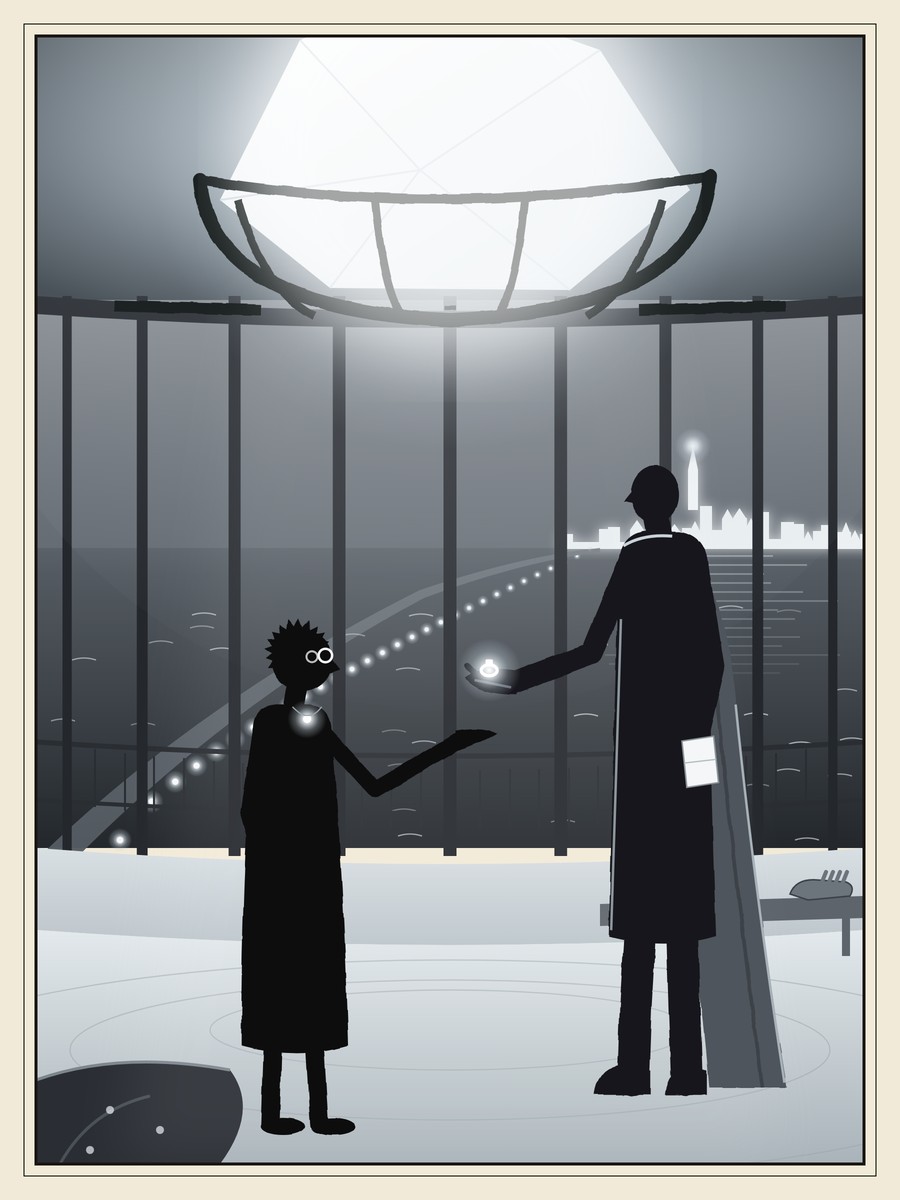
Tobin knew it before he touched it.
It was a heavy gold signet ring, a little worn on one side, with a tall tower carved on its face and a tiny flame at the top of the tower. He had seen it every day of his life: on the hand that turned the council papers; on the hand that had rested once — only once that he could remember — on the top of his head, the night after his mother died. He had seen its mark pressed into grey wax, on a letter to the Queen.
He took it. It was cold.
“Where did you get this?”
“From your father’s finger,” said Varrick. “With his permission, I should say. He wanted you to have it. He wanted you to have this, too.”
He held out a folded page.
Tobin unfolded it. The paper was coarse and grey, not the thick good paper his father always used, and the writing on it was his father’s tall, careful, slanting hand — but it was not careful. It wandered. The lines went downhill. In two places the pen had blotted, and in one it had gone right through the paper, as if the hand holding it had been shaking too much to hold it still.
Tobin, it said. If you can hear of this, I am sorry. I was wrong.
That was all. There was not even a name at the bottom.
Tobin read it four times. Then he looked up, and found that he could not see Varrick properly, because his spectacles had gone misty; and he took them off and rubbed them on his coat, which only made them worse.
“What have you done to him?” he said.
“I? Nothing.” Varrick leaned against the glass and folded his arms. “Your father made Her Majesty a promise. He promised her a lamp, in return for a throne, and he wrote to her to say so — you’ve read the letter; I know you have. And then he failed to deliver it, because his own son had walked off down the road with it. Her Majesty does not care for promises that are not kept. So she sent for him.” He shrugged, very slightly. “He’s in a cell, Master Harrowgate. A long way from here, in a place where the light doesn’t reach. He has been there some weeks. He wrote that the night they put him in. I’m told it took him most of the night.”
Tobin thought of his father in the dark.
His father, who had never raised his voice, who had wanted nothing but to keep the wall lit and the dark outside it — his father had always been afraid of the dark. It was why he had bargained in the first place. Tobin thought of him in a cold stone room with no lamp, sitting on the floor with his tall back against the wall, writing I was wrong by feel, while his hand shook.
He thought of his own night-lamp, his mother’s, with its little flame. He thought of how it had gone out on the strongroom stair in Emberwick, sixty-one steps down, and how he had stood there in the black with his heart trying to climb out of his mouth.
“Why are you telling me this?” he whispered.
“Because you can get him out,” said Varrick.
He said it quite simply, the way you might tell someone where they had dropped their gloves.
“Bring the lamp here,” he said. “To this room. Put it in my hand. And your father goes free that same night — out of his cell, back to his Hall, back to his wall and his city, and nobody will trouble him again. I give you my word on it. Better than that, I give you Hers.” He pushed himself off the glass. “She keeps her bargains, boy. It’s the only thing she does keep.”
“It isn’t mine,” said Tobin. His voice cracked in the middle. “The lamp. It isn’t mine to give. It’s Wren’s.”
“Is it?” Varrick’s grey eyes rested on him, mild and interested. “Where is it now, then? In her coat? Against her heart, the way the old man told her?” He waited. “No. It’s in a drawer, in a little room on Lantern Steps, lying on a folded handkerchief. She hasn’t touched it in days. She’s found something she wants more than she wants it — a mother, and a blue door, and a patchwork quilt. Can you blame her? I can’t.” He spread his scarred hand. “It’s lying in a drawer, Master Harrowgate, doing nobody any good at all. And your father is lying in the dark.”
Tobin opened his mouth, and shut it again. He had noticed. That was the worst of it. He had noticed, that very morning at the Salt Lantern, how flat Wren’s coat lay over her ribs; and how Cinder had sniffed the empty pocket twice; and how Ash had looked.
“It burns people,” he said desperately. “If you try to — if you sell it, it burns your hands. It burned the pawnbroker. Everybody knows that.”
“Then don’t sell it,” said Varrick. “I’m not offering to buy anything. I’m not paying you a penny. You won’t make a farthing out of it.” He smiled. “You’d only be fetching your father home.”
He picked up his grey gauntlet from the bench and drew it on, slowly, finger by finger, over the scarred palm.
“Keep the letter,” he said. “I’ve no use for it. The ring too, if you like; he’d want you to have it. I shan’t ask you for an answer tonight. I’m a patient man. I’ll be here — any hour, any day — when you’ve decided.” He turned back to the glass and the shining city below. “Mind the stairs going down. They’re steeper than they look.”
Tobin did not go back to the inn.
He sat on the harbour wall instead, halfway along it, between the fortieth glowstone and the forty-first, with his legs hanging over the dark water on the seaward side and the sea breathing in and out below him. He sat there all night. The light never changed. The stars, if there were any, could not be seen.
And he argued.
It is a terrible thing to argue with yourself all night, and I hope you never have to. It is worse when both sides of the argument are you, and both of them sound reasonable, and both of them love somebody.
It’s a trap, said one side.
Of course it’s a trap, said the other. But the ring is real. The letter is real. That’s his hand. You know it’s his hand. Varrick may be lying about everything else, but he isn’t lying about that.
That was the dreadful part. Everything Tobin could check was true.
He took out his pencil and the back of the gate-hinge drawing, and made two columns, because that was how he had always solved things. On one side he wrote Reasons to. On the other, Reasons not to.
Under Reasons not to he wrote: It’s Wren’s. He looked at that for a long time. Then he wrote: Ash would say no. He thought of Ash in his cell, behind the third window from the left, with his bad leg and no poles, and of Cinder on the step. Ash had been thrown into gaol for telling the truth about the light. Ash would not want — Ash would say —
He did not know what Ash would say. That was the trouble. He thought he did, and then he found he was not sure, and every time he tried to hear the old man’s voice in his head, the pendant at his throat seemed to turn it down, the way you turn down a lamp.
Under Reasons to, he wrote: Father.
He did not write anything else under it. He did not need to.
It isn’t selling, he told himself. Selling is when you get something for yourself. I don’t get anything. Technically speaking, it’s — it’s a ransom. A ransom is a different category of transaction altogether. Nobody would say a ransom was selling.
And she isn’t using it. She’s put it away. She doesn’t want it any more. She’s going to stay here with the Pellows and never go to the Mountain at all. It’s just lying there, in a drawer.
And it would be for him. Not for me. For him.
Somewhere far down inside him, a small voice said that it had heard all this before — from a man in a grey cloak at the top of the Beacon, offering Wren the world. But the pendant was cold against his throat, and the small voice was very small, and every time it began to say something, Tobin found it easier to think about something else.
Towards morning he took out his mother’s compass.
He did not mean to. His hand did it, the way your hand goes to an old bruise. He opened the lid. The words were there inside it, as they always were, in their small worn letters: Home is where the light is. And the needle, which Ash had tuned in Emberwick, swung round and settled and pointed — not at the white city, not at the lighthouse — but away, over his left shoulder, inland, north and a bit east, towards a mountain he could not see.
Away from where he was going.
Tobin shut the lid quickly, and put the compass back in his pocket, and did not take it out again.
The pale sun came up over the hills behind the city, as weak as ever. The fishing boats began to put out past him with their sails grey in the white light. And a little after that, Tobin heard quick feet on the harbour wall, and turned his head, and there was Wren.
She was out of breath. Her hair was sticking up in tufts, and her face was very white.
“There you are,” she said. “The landlady said you’d gone out. Where’ve you been?” She did not wait for an answer. She dropped down beside him on the wall, close, and spoke low and fast. “Listen. I saw him. Yesterday, in the square, when they took Ash. Varrick. Standing behind Venn in an alley, rubbing that hand of his, cool as you like. Venn doesn’t even know he’s there. It’s all hers, Tobin. The stones, the city, all of it. It’s her.”
Tobin looked at her.
He had the ring in one pocket and the grey page in the other, and the note, and the list with its two columns. He could have taken them out. He could have said, I know. He spoke to me. He’s got my father. He thought, afterwards, that if he had said it then — right then, on the wall, in the grey morning — everything might have been different.
“Did you?” he said.
“Did I what? Yes, I did. I’m telling you.” Wren frowned at him. “Are you all right? You look like a boiled turnip.”
“I’m fine,” said Tobin. “I didn’t sleep. It’s — the light. You know.”
Wren looked at him a moment longer. Then she looked out at the sea. “Yeah,” she said. “I know.”
He looked at her coat. It lay flat over her ribs. There was no warm shape there; no faint gold at the seams.
“Have you got it with you?” he said. “The lamp?”
Wren did not look at him. “It’s safe,” she said, after a moment. “It’s at the house. It’s fine.”
“Yes,” said Tobin. “Of course.”
She went off at last, up into the city, to see if they would let her into the gaol to visit Ash. Tobin watched her go. He sat on the wall until she was out of sight among the white houses; and then he sat there a long time after.
He told no one about the lighthouse. Not Wren, not Mira, not the landlady who asked him, kindly and flatly, whether he would like some breakfast. He told no one at all.
And the ring in his pocket grew no warmer, though he held it in his fist all day.
Chapter 8 complete
The Offer