Chapter 10 · 17 min read · 22 min listen
The Night of the Theft
We must go back a little way now, to the morning of that same day, and to Tobin; because the things that happened to Wren and Mira that evening had all been made ready hours before, by somebody who had not slept.
Tobin had sat on the harbour wall until the fishing boats went out. Then he had walked back to the Salt Lantern and lain down on his bed in his boots, and stared at the ceiling, and not slept there either. It was not dark, of course. It was never dark in Vaelport. The glowstone in the window-niche poured its white light over the little room exactly as it had at midnight, and the cloth he was meant to lay over his eyes lay folded on the chair.
If you have ever lain awake with a decision in your stomach, you will know that it does not feel like thinking. It feels like being very slowly turned on a spit. Bring the lamp, and your father goes free. Tobin turned one way, and saw his father’s hand writing I was wrong in shaky letters, in a cell somewhere. He turned the other way, and saw the lamp. Then he turned back again.
The pendant lay against his throat, small and cool and smooth. Whenever the turning got too bad, he found that he had put his fingers on it. It did not exactly help. It only made everything seem a little further off, the way the street seems further off through a window; and that was something.
Some time after noon he found he had stopped arguing. He had not decided. He had only stopped. Which, I am sorry to say, is how a great many bad things get done.
He got up, and went out.
The landlady of the Salt Lantern was sweeping her front step, slowly and evenly and without much interest, as if the broom were sweeping and she were only keeping it company.
“Afternoon,” she said, without looking up. “Your old grandad’s still locked up, then. The one with the sticks.”
Tobin stopped on the step.
“He isn’t my grandfather,” he said. “Actually. Technically we’re not related at all. I hardly know him, really. We only happened to be travelling the same way.”
“That so,” said the landlady, and went on sweeping.
Tobin walked down the white street with his ears burning. Ash was not his grandfather. You could not get into trouble for saying a true thing. But the words had come out in the wrong shape, and they stayed in his mouth like the taste of a bad tooth.
Lantern Steps was a crooked stair-street climbing up from the harbour, with a gutter down the middle and a glowstone in a little iron cage above every door. The Pellows’ door was halfway up. In Vaelport’s light it was white, like every other door; but Wren had told them that by the lamp it was blue, “a proper blue, like the inside of a mussel,” in a careful voice Tobin had never heard her use, as if the colour might break if she spoke too loud.
He knocked. The door opened, and the smell of bread came out round Mrs Pellow like a warm cloud.
“Why, it’s the young gentleman from the north!” She was floury to the elbows, and her face crinkled up with pleasure. “Come in, pet. She’s been out since first thing — up at that gaol again, I shouldn’t wonder, shouting at the gate. She’s a terror for shouting at gates. Amos is down at the nets.”
“Yes. Thank you. If it’s no trouble.” Tobin pushed his spectacles up his nose. “I only came to see how she was getting on. That’s all. Just to — see.”
The kitchen was small and low and warm. There was a real fire in the grate, red and yellow and leaning, and after so many days of white light the colour of it hit Tobin in the chest so hard that he had to look away. A grey cat lay in front of it like a dropped muff.
“She’s quiet,” said Mrs Pellow, going back to her kneading. “Quieter than she was. But Mr Venn’s clerk has brought the papers round, and she’s to sign them tonight when Amos is home, and I don’t think—“ Her hands stopped, deep in the dough. “I don’t think I’ve been so happy in years,” she said, and laughed at herself, and wiped her eyes on her arm, and left a stripe of flour across her cheek. “There now. Silly. Have a bun, pet.”
Tobin took a bun because it would have been rude not to. He found that he could not eat it.
“The thing is, Mrs Pellow,” he heard himself say, “I think I left something. In Wren’s room. When we brought her things up. A small book. With diagrams. I don’t suppose I could go up and look for it? And wait for her up there?”
“Go on up,” said Mrs Pellow, without a flicker. “First door. Mind the stair, the third one’s loose. I’ll bring you a cup of tea.”
That is the trouble with lying to kind people. It is so very easy.
The little bedroom was under the roof, with a sloping ceiling and a narrow bed with a patchwork quilt, every square of it white in the light from the window. Tobin, in the doorway, suddenly saw Wren lying there under it, curled up small, the way she curled up by the fire in Ash’s tower. He saw it so clearly that he nearly said her name.
There was nobody there.
Mrs Pellow came puffing up behind him with the tea, and set it on the windowsill, and patted his arm, and went down again. Tobin stood and looked at the cup until it stopped steaming.
Beside the bed stood a small table with a drawer. The drawer was shut. But round the crack at the top of it, so faint that you would only have seen it if you knew to look, there was a thread of gold.
Tobin knelt down in front of it, and said his reasons over to himself, quickly, the way you say a lesson you are afraid of forgetting. She put it away. She doesn’t even look at it. She’s going to stay here and be a Pellow and never go anywhere again. And technically it’s only a brass container with a flame in it, and my father is a person. He said he was sorry. He’s never said sorry to me in my whole life.
He pulled the drawer open.
The lamp lay on a folded handkerchief: small and battered and dented, with its hairline crack in the glass and its little hook on top. Its flame was lower than he had ever seen it, a quiet, patient bead of gold, like an eye half closed. Where its light touched the plain white wood, the wood went warm brown, the colour of a nut.
Tobin reached in and picked it up.
It was hot.
Not warm. Not the warmth he remembered from the Black Stair, when Wren had put it in his hands and it had sat there like a living thing, glad to be carried. This was the heat of a kettle-handle left on the stove. It went into his fingers and up through his palms in one hard, bright, astonishing sting.
He gasped and nearly dropped it.
He knew what it meant. He was not stupid, whatever else he was. He had heard Wren tell the story a dozen times, with relish: Silas Grubb reaching for it with his twenty silver crowns, and jumping back yelping. It burns the hand of anyone who tries to buy or sell it. Tobin had written that down in his notebook once, under a heading. He had found it very interesting at the time, as a principle.
He was not buying it. He was not selling it. He was — trading it. For a person. That was different.
The lamp did not think it was different.
Tobin knelt on Wren’s floor with tears of pain standing in his eyes, and the lamp burning in his hands. For one long moment he very nearly put it back. He wanted that remembered, afterwards: that he very nearly did.
Then he thought of his father’s hand, writing I was wrong.
He pulled off his coat and wrapped the lamp in it, round and round, as tight as he could, and pushed the drawer shut with his elbow, and went down the stairs.
“Find it, pet?” called Mrs Pellow.
“Yes,” said Tobin. “Thank you.”
“You’ll catch your death without your coat on!”
“It’s not cold,” said Tobin, which was a strange thing to say in Vaelport, where it was always cold; and he went out of the white door and down Lantern Steps without looking back. He was afraid that if he looked back, he would see the door blue.
He went back by the Salt Lantern first. He had not meant to; his feet took him there. The landlady looked up from her counter as he came in with the coat bundled against his chest, and said, “Aren’t you cold, sir?” and he went past her and up the four flights as if he had not heard.
In the empty room he took his mother’s compass out of his pocket and opened the lid. Home is where the light is. The needle swung, and shivered, and settled: north and a bit east. Away from the lighthouse, and the sea, and everything in Vaelport. Pointing, as steady as a finger, the other way.
“It’s not fair,” he whispered to it. “You don’t know. He’s in a cell.”
The needle did not move.
He could not carry it. That was the plain fact. He could not do what he meant to do with that thing in his pocket, pointing the other way the whole time. He shut the lid, gently, and laid the compass on his pillow. Then he went down the stairs again, quickly, before he could pick it up.
At the end of the long white harbour wall the lighthouse stood on its rock, and its great glowstone shone out over the water, where there were no ships for it to warn, and back over the city, where there was no dark for it to drive away.
Varrick had said any hour, any day. Tobin did not wait for a better one.
The heat came through every fold of the coat, however tightly he held it, as if he were carrying a loaf straight out of the oven. He shifted it from arm to arm. It made no difference. The lamp knew exactly where he was taking it.
Halfway along the wall a man sat on an upturned crate, mending a crab-pot. His flat tired eyes followed Tobin a little way.
“Here,” he said. “Aren’t you one of that old lamp-man’s lot? The mad one with the sticks, that they took up out of the square.”
Tobin did not stop walking.
“I don’t know him,” he said.
He said it quite loudly and quite clearly, and it was not even a little bit true. The man shrugged and went back to his crab-pot. And Tobin walked on with the lamp burning against his ribs, and found that he was crying, not loudly, just steadily, the tears running down under his spectacles into his collar. He told himself it was the pain in his hands. Some of it was.
It’s for Father, he said to himself, in time with his feet. It’s for Father. It’s for Father. It is a strange thing, but the more times you say a thing like that, the less it sounds like a reason, and the more it sounds like a noise.
He put his hand to his throat, and held the pendant, and went on.
The door at the foot of the lighthouse was open. The stair wound up and up round the inside of the white wall, two hundred and twelve steps; and at the top was the round glass room under the great glowstone, with the narrow iron gallery outside it. A door in the glass stood open. The wind came in off the sea and went round and round. Far below, the water broke white on the rock.
Captain Varrick was already there.
He stood out on the gallery at the rail with his back to the stair, looking out to sea, as if he had been standing there for hours and would happily stand for hours more. He did not turn round when Tobin came up the last step. He only said, pleasantly, “Today, then. I thought it might be.”
Then he turned, and looked at Tobin’s wet face and the bundled coat held out stiff in two shaking hands; and something in his own face settled, very slightly, the way a man sits back when a long game of cards comes out exactly as he expected.
“Well,” he said. “Let us see it.”
Tobin unwrapped the coat with fingers that would hardly obey him. In the great white glare from overhead, the lamp looked small and dull and yellow, like a brass button dropped in snow. But its little flame was still burning; and it was still, Tobin could feel, every bit as hot.
“My father,” he said. His voice cracked in the middle. “You said if I brought it, he’d go free. You said she keeps her bargains.”
“I did say that,” agreed Varrick.
He drew off his right glove — and Tobin saw, for a moment, the old pale scar across the palm, like a crease in paper — and then, as if he had thought better of it, drew it on again. Over the glove he wore a gauntlet of grey steel, jointed like the shell of a crab. He held it out, palm up.
“Give it to me, then,” he said. “It has to be given. You know that. I’m sure you’ve written it down somewhere.”
Tobin did not throw it. He did not drop it. He put it into Captain Varrick’s hand, carefully, the way you hand somebody a cup that is too full; and he let go.
The flame did not go out, not the way a candle goes out, with a twist of smoke. It simply shut, like an eye closing. One moment there was a small gold bead of light in the grey gauntlet; the next there was a battered brass lamp with a cracked chimney and nothing inside it at all. No glow. No warmth. It looked like something from the bottom of a box in Silas Grubb’s pawnshop, with a ticket on it saying one lamp, damaged, a penny.
All at once Tobin’s hands had stopped stinging. He had not known how much they hurt until they stopped. They felt cold now, and empty, and very far away.
“There,” said Varrick softly, turning the dark lamp over. “That’s all it ever was, you see. A bit of brass. Thank you, Tobin.”
“Now my father,” said Tobin.
Varrick laughed.
It was not a loud laugh. If it had been loud, it might have been easier. It was a small, quiet, almost friendly laugh, the kind a grown-up gives when a child says something funny without meaning to.
“Freed?” he said. “Your father? Boy, your father bargained with her and lost. People who bargain with her always lose.” He tucked the lamp into the crook of his arm. “You should know that. You just did.”
The words went into Tobin’s ears and lay there, like stones dropped into deep water, and for a moment nothing happened. Then they reached the bottom.
“But the ring,” he said. “The letter. It was his writing—“
“Oh, all quite true,” said Varrick. “He is in a cell; he did write to you; he is sorry. I never tell a lie when the truth will do the work, Tobin. It so seldom fails.” He drew his grey cloak about him. “He promised her this lamp, and could not deliver it, and she does not forgive people who fail her. She will find it very funny, I think, that his son did what he could not.”
Something in Tobin broke loose.
He was not a fighting sort of boy. He had been a disappointment to his father in the fencing-room every Thursday for six years. But he threw himself at Captain Varrick now, with his burned hands out, grabbing for the lamp.
It was like running into a wall. Varrick did not even seem to hurry. He moved one arm — that was all — and Tobin went flying sideways out through the open door and struck the iron rail of the gallery with his shoulder. His spectacles went skidding away, and for one sick, endless moment he saw the sea, very far down, white on the black rock, through the bars.
Varrick stood over him, a tall grey blur against the white.
“Don’t be tiresome,” he said. “You’ve done your part. I’m taking this down to the Great Forge, under the city. Old Venn’s people built it very finely; I don’t think he has ever been quite sure what it is for.” There was a smile in his voice. “This lamp is going to be laid on the anvil and pressed into the Queen’s greatest stone. A glowstone made from the last true Flame.” He paused, as if he could see it already. “Think how it will shine.”
His footsteps went away, unhurried, round and round and down the stair, until Tobin could not hear them any more.
He lay there a long time.
When at last he sat up, he found his spectacles by feel, with one lens cracked across, and put them on. The room swam back: the white floor, the iron rail, the great white stone blazing overhead. His coat lay crumpled where he had dropped it, empty. His palms were red and shiny and sore, and blisters were coming up on his fingers, where he had held the lamp all the long way down the harbour wall.
He had carried it all that way, burning, because he had wanted his father back so badly. And his father was not coming back. Ash was still in a cell. Wren was sitting, perhaps at this very moment, in a warm kitchen on Lantern Steps, not knowing that the drawer by her bed was empty.
The pendant lay against his throat, cool and smooth and kind. It doesn’t matter so very much, it seemed to say. Nothing does, if you don’t let it. It is easier not to feel.
Tobin took hold of it and pulled. The fine white chain bit into his neck, and gave way at the knot with a little snap. He got to his feet, holding the rail, and looked at the small cold stone in his hand. It shone up at him, white and perfect and quite indifferent.
He threw it as hard as he could out over the rail. It went turning down through the evening, a tiny white spark, smaller and smaller, and was gone into the sea without a sound.
And then it was as if the stone had been holding a door shut in him, all those days, and now there was nothing holding it.
Everything came through at once. His father, writing I was wrong. Wren on the waystone with her shoulder against his, cracking Nettle’s bread like a nut. The landlady on the step: I hardly know him, really. The man with the crab-pot, and his own voice saying, loud and clear, I don’t know him. Ash, who had stepped in front of him in the dry stream-bed and taken the hurt that was meant for him, and told him afterwards that fear was not the same as cowardice. Ash, whom he did not know.
Somewhere far out over the darkening water, a gull cried, once; and then again, thin and sharp and lonely.
Tobin sank down on the cold floor of the lighthouse, with his burned hands over his face, and wept bitterly.
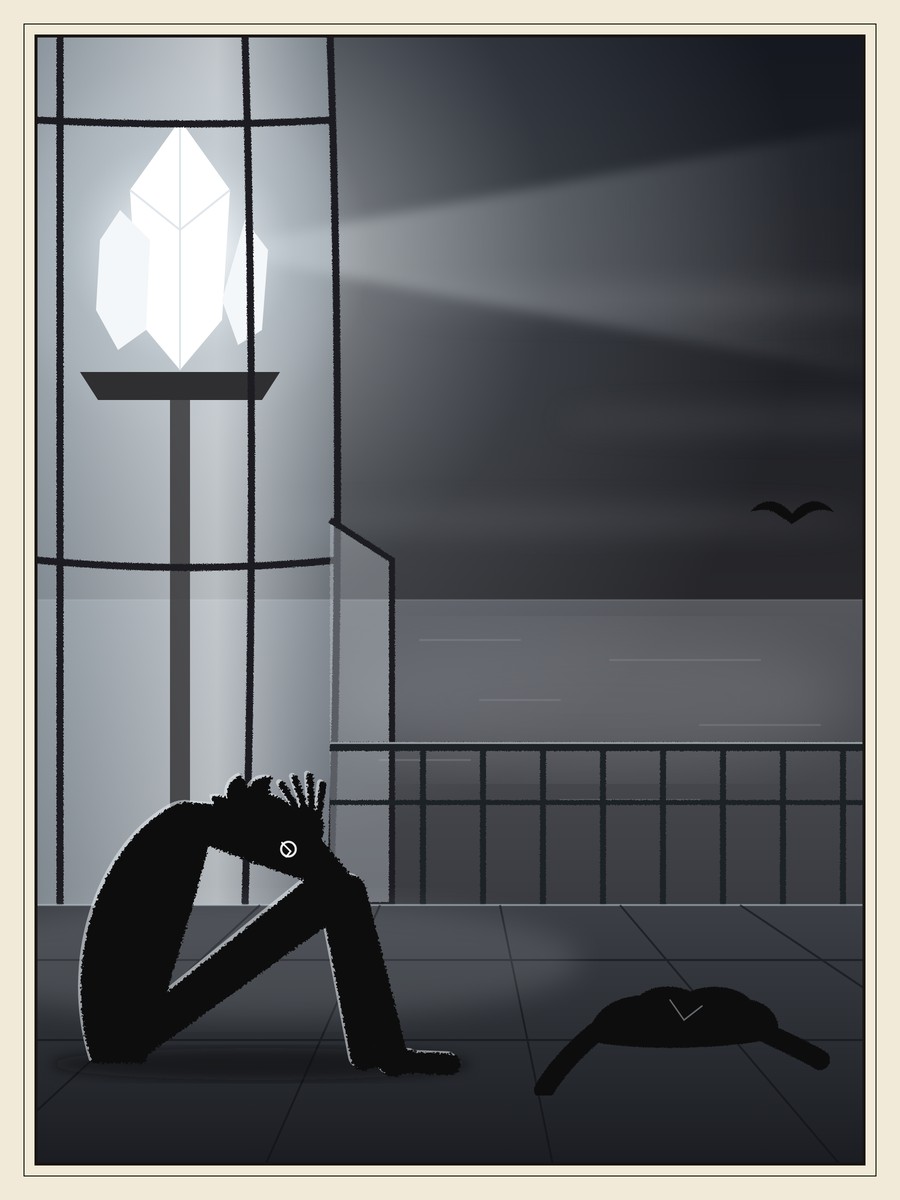
I will not tell you any more about that hour. Some things belong only to the person they happen to. But I will tell you this, because it matters for what comes after: it was the kind of weeping that is not the end of a person. It only feels like it.
Far below him, under the white city, in the place where the dark was pressed into stone, the great pale hammers were falling.
Chapter 10 complete
The Night of the Theft