Chapter 7 · 17 min read · 22 min listen
Ash’s Warning
“She drank it,” said Old Ash. “All of it. Every drop.”
He was sitting at the corner table of the Salt Lantern with his bad leg up on a stool and his two poles against the wall, staring at an empty teacup as if it had done something unforgivable.
“Who did?” said Wren. She had run most of the way down Lantern Steps. It had been days since she had sat at this table, and she had found, halfway down, that she missed it.
“The landlady,” said Tobin. He looked as if he had not slept. “Ash made her a pot. To say thank you for the beds.”
“With my own leaves,” said Ash darkly. “The ones that have been in my coat since the Gloam River, next to the fox’s biscuits. I steeped them the better part of an hour. And she drank it all, child, and set down the cup, and said, ‘Thank you, sir. That was very nice.’”
Wren stared at him.
“Nobody has ever finished my tea,” said Old Ash. “Not in sixty years. Not Cinder. Grown men have wept.” He pushed the cup away. “Hm. That is the worst sign I have seen in this whole bright city.”
Wren began to laugh, and stopped, because he was not joking. And because, now she thought of it, she had never once heard anybody laugh in the Salt Lantern.
Cinder came out from under the table, put her front paws on Wren’s knee and sniffed her all over, from her boots to her collar. She sniffed the inside pocket twice — the one next to Wren’s heart. Then she sat down and sneezed, a small worried sneeze with hardly a spark in it.
Wren knew why. That pocket was empty. She had felt how light it was the whole way down the steps, like a missing tooth your tongue keeps finding.
Old Ash looked at her coat. He did not say anything. He only looked at it, and then at her face; and Wren found that her hand had gone up to the pendant at her throat, and that the little white stone was cold.
“Tell her,” said Ash to Tobin. “About the mines.”
Tobin told her, with a great many long words and his spectacles pushed up his nose every other sentence. But there was something strange in the way he told it, and it took Wren a while to see what it was. He told it flat: the white tunnels, the grey miners, the black shaft with the cold pouring up it, and the great pale hammers pressing it small and hard and shining.
“Each glowstone is a Hollow,” he said. “Folded up. Pressed, technically, into a crystalline — into a stone. It doesn’t attack anybody. It just shines, and takes a little. Laughing first, we think. Then dreams. Then names. So slowly you’d think it was only getting old.” He pushed his spectacles up. “It’s a Hollow. The whole city. It’s a Hollow that’s been switched on.”
He said it the way you might read out the price of fish.
Wren had known, really, since the morning on the white stair when she held her stone beside the lamp and saw something move inside it. But knowing a thing alone in the dark is one kind of knowing; hearing it said across a table in the morning, by someone who has seen it, is another. It is the second kind, I am afraid, that makes your stomach turn over.
“Then why are you still wearing yours?” she said.
Tobin’s hand went to the pendant, as if he had forgotten it was there. “I did take it off. Down there. I tore it off.” He frowned. “And then I put it back. It seemed — rude, I suppose. Mr Venn gave it to me.” For a moment his eyes behind the spectacles were not flat at all, but lost. “Why are you?”
Wren did not answer. If she took the stone off, Mrs Pellow might notice, and ask, and look hurt. It seemed a lot of trouble over a stone.
Old Ash reached for his poles.
“I’ve sat and thought for two days,” he said. “That’s long enough for anybody. I’m going up to the market.”
“What for?” said Wren.
“To tell them.” He levered himself up, first onto one pole and then the other, his jaw set against his leg. “They’ve had their light a hundred years, and nobody has ever told them what it costs. It would be a poor sort of Lamplighter who walked through a city like this and kept his mouth shut.”
“They’ll think you’re mad,” said Tobin.
“Lad,” said Ash, “they thought I was mad in Emberwick for thirty years. I’ve had a good deal of practice. Fox. Come.”
Cinder came. And because there was nothing else to do, so did Wren and Tobin.
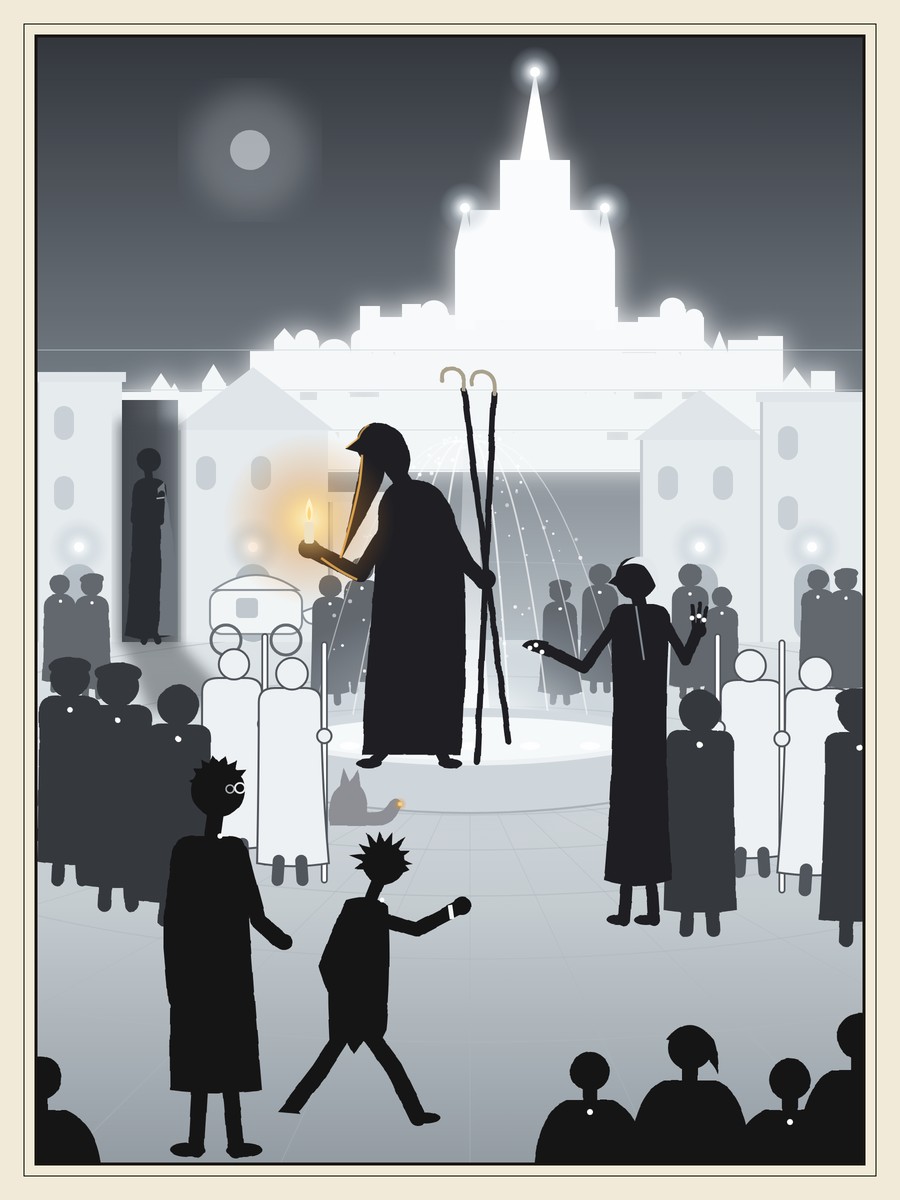
The great market square lay on the third tier of the city, halfway between the harbour and the Glass Palace, and it was the brightest place Wren had ever stood in. In the middle of it was a fountain — a stone basin wider than a cartwheel, with a column of water rising out of it and breaking and falling, lit from beneath by glowstones set in the bottom, so that every drop glittered. All round it the market went on: fish and cloth, white bread and white cheese and pale, careful vegetables, and people moving politely between the stalls, buying what they needed and going home.
Nobody called out their wares. Nobody haggled. A man dropped a basket of apples, and they rolled all over the square, and nobody laughed — not even the children, who only watched them roll and walked on.
A market where nobody shouts, Wren thought, is not a market at all. It is a waiting-room.
Old Ash walked out into the middle of it, tap and tap, and people moved politely out of his way. He reached the fountain. And then, to Wren’s horror, he set one pole inside the basin among the glowstones, hauled himself up, and stood on the wide stone rim with the water falling behind him.
“Get down,” hissed Wren. “You’ll break your other leg.”
“Hm,” said Ash. And he raised his voice.
He had a voice for it — big and slow and carrying, like a bell in a tower.
“People of Vaelport,” said Old Ash. “Will you hear an old man for a minute?”
They turned their pale, patient faces towards him, slowly, the way you might turn towards a bird that has got into the house.
“I’ve come from Emberwick, in the north, where the Rings are failing,” said Ash. “And I’ve seen your light. I never saw anything so bright. And I’ll tell you a thing about it that you know already, every one of you, if you’d stop and feel it.” He paused. “It shines. But it does not warm.”
Somebody coughed.
“Put your hand to it. The stone over your door. The one round your neck. It isn’t warm. It’s never been warm, not one day in a hundred years. Have you never asked why?”
He had a stump of candle in his fingers — out of his coat somewhere; Ash’s coat had everything in it. He struck a light from a little tinderbox, and a small yellow flame stood up in the middle of all that whiteness, leaning and flickering in the spray.
It looked very small. It looked almost silly — a little brown flicker, like a moth in a lamp-room. But Wren saw people look at it the way Mira had looked at the sea.
“Hold your stone up to a candle,” said Old Ash, “and look inside it. Look properly. Then tell me if you want it round your children’s necks.”
A few of them did. A stallholder with a fish-knife held his stone out, squinted, and shrugged. “Can’t see nothing. Just a stone.” A young woman glanced at hers and let it drop. They were not looking, Wren saw. They were doing what you do when somebody says there is a spider in your hair and you do not want there to be: a quick pat, a quick glance — no, nothing, see? — and back to your shopping.
Only one looked properly: an old woman with a basket of loaves on her arm. She held her stone close to the flame and looked into it for a long time, and Wren watched her face change — a slow, cold understanding coming into it, like water rising in a cellar. Then she closed her hand over the stone, tucked it inside her shawl, and walked out of the square very quickly without looking back.
Nobody noticed her go. Because somebody, at the back of the crowd, had started to laugh.
It was not a real laugh. It was a thin, polite, tired sound, the kind people make because they think they ought to; but others joined it, and it went round the square in a dry ripple, like wind in dead leaves.
“Poor old thing,” somebody said. “A candle. What would anyone want with a candle?”
Ash did not stop. He said that a city where the children do not run is not a safe city but a sick one. He said there was a flame in the world that warmed you when it lit you, and that it had been given away once, for nothing, by someone who loved them.
And a big lad in a fish-scaled apron reached into a bucket on the nearest stall, took out a fish-head, and threw it.
It hit Old Ash on the shoulder of his blue-grey coat, stuck there a moment, and fell into the fountain with a small wet plop.
Even the boy did not laugh. He only stared at his empty hand, puzzled.
Cinder went for him. She crossed the square in three bounds, sneezing sparks at every one, and the boy yelped and went backwards into a basket of crabs. Wren was halfway after her, fists balled, with a great many Soot Lane words ready on her tongue, when Ash spoke.
“Fox. Leave it.”
Cinder stopped, growled once, and came stiffly back to sit at the foot of the fountain with her back to the crowd.
Ash brushed the scales off his shoulder. “Hm. I’ve been thrown worse. Now. As I was saying—“
And at the top of the square, a carriage drew up.
It was white, with white horses, and the man who stepped down from it was dressed in white and pale grey, with his silver-white hair brushed back and rings on every finger.
The crowd parted for Oskar Venn like water before a boat, and a good many people touched their stones as he passed, as if for luck.
He came down to the fountain not hurrying, and he looked — Wren had to admit it — sorry. He looked up at Ash the way a doctor looks at a patient who has got out of bed against advice.
“Old friend,” he said gently. “There you are. We’ve been so worried.”
“Have you?” said Ash.
Venn turned a little, so the crowd could see his face. “This gentleman is my guest. He has come a very long way through very dark country, and he has seen things no man should see. He is tired, and confused, and he is frightening people.” He sighed. “It’s my fault. I ought to have taken better care of him.”
“Come down and rest, old friend.”
“I’m resting very well where I am, thank you,” said Ash. “I’d as soon finish what I was saying.”
“I know.” Venn’s voice was full of kindness. “That’s the trouble.” He lifted one hand — hardly a movement at all — and four men in white coats with white staves stepped out of the crowd, where Wren had not even seen them standing. “You’re disturbing the peace, you see. And peace is all we have here. We have to look after it.”
Wren pushed forward. “You can’t. He hasn’t done anything. He’s only talking—“
“My dear.” Venn looked down at her, and his eyes were so warm and so sad that for a moment she nearly believed him. “Nobody will hurt him. Nobody is ever hurt in Vaelport. He’ll have a quiet room and somebody to watch over him, and when he’s himself again, he can come out.”
He put out a hand as if to pat her shoulder. Wren’s feet stepped her back from it on their own. And as his fingers brushed her sleeve she felt, even through the cloth, how cold they were: cold as a step in winter; cold as the stone at her throat.
The white coats helped Ash down. They were not rough. They handed him his poles and took his elbow on the bad side and walked him across the square as politely as if they were taking him in to dinner. And Ash went. He did not struggle or shout. He held his back as straight as his leg would let him, and crossed that white square tap and tap, the way a king might walk to his crowning.
As he passed Wren, he stopped, and bent his head so that his singed beard nearly brushed her face.
“Keep it close, child,” said Old Ash, very low. “Whatever happens.”
Then he looked — once, only for a moment — at her coat. At the place over her ribs where there was nothing.
And he went on.
Cinder trotted at his heels. One of the white coats tried to shoo her with his stave; she sneezed on his sleeve, and after that he left her alone. Wren watched the little grey fox follow the old man down the steps towards the harbour, her tail-spark small and dim and steady, until they were gone.
I should like to tell you that Wren ran after them. Her feet were already turning. But it was then, with the crowd drifting back to its shopping and Venn shaking his head by the fountain, that she saw the shadow.
You will remember that there were no shadows in Vaelport. The light came from everywhere at once, and so nothing in the whole city cast one. Wren had stopped noticing it, the way you stop hearing a clock.
But beyond the carriage, in the mouth of a narrow alley between two white houses, where the light should have been as bright as anywhere, there was a shadow. A long, grey, upright shadow, standing quite still.
It was a man. He was tall and pale, in a grey cloak over grey armour, and he was not doing anything. He was only standing half in that strange shade, watching Oskar Venn — not the crowd, not the old man led away, only Venn — the way a farmer watches a good dog working his sheep, to see that it does the job properly.
And as he watched, he rubbed the palm of his right hand with the thumb of his left, round and round, as if it ached.
Wren went cold from her scalp to her boots.
Varrick.
She had last heard his voice across a swaying rope bridge in the black of the Deeps, and seen his face in a hundred bad dreams since.
He turned his head and looked straight at her, and inclined it a little, very politely, the way one grown-up greets another across a crowded room. Then he stepped back into the alley, and the shadow went with him, and there was nothing there but white light.
Venn had not looked round once. He was talking kindly to a stallholder about the price of fish, his cold hands folded in front of him, and he had no more idea that Varrick had stood behind him than a glove has of the hand inside it.
And Wren understood, all in one cold drop, the way the cold comes when a door blows open.
Venn did not know. He believed every word of his own speeches. He thought he was giving the whole world light for nothing and making everybody safe for ever. He was not lying to anyone. Somebody was lying to him.
The Queen had tried Hollows and Knights in Emberwick, and Wren had lit the Beacon in her face. So she had found another way. She had found a kind man with cold hands, and given him the most beautiful thing in the world to give away; and everyone who took it would go quiet, gently, one laugh at a time, and thank him for it, and never once be afraid.
Not war. Comfort. She meant to hollow the whole world by making it comfortable.
Wren’s hand went to her throat. The pendant was there, smooth and cold. She thought of the old woman with the loaves, closing her fist round her stone.
She did not take it off. She turned round, and ran.
She ran all the way up Lantern Steps, two at a time, until her chest burned. The door was blue only to her; in the white light it was as pale as the rest, but she had seen it once by the lamp. She let herself in with the key Mrs Pellow had given her on a loop of string, “so you can come and go, pet, like it’s your own.”
The house was empty. The kitchen fire was banked low and red under its ash, and the cat was asleep in front of it, and everything smelt of bread.
Wren went up to the little room at the top of the stairs and shut the door and stood with her back against it, breathing hard. There was the bed with the patchwork quilt, and the little bedside table with its one drawer.
She knelt down beside it.
Through the crack at the top of the drawer, where the wood had shrunk with age, a thin gold line of light lay across the floorboards. It was so faint that in that bright room you could only see it if you knelt close, the way she was kneeling now. But it was there. It had been there every time she looked; and lately, if she was honest, she had not been looking very often.
She pulled the drawer open.
The lamp lay on a folded handkerchief, small and battered, with its cracked chimney and the little hook on top. Its flame was low — never out, but low and quiet, like a candle in a room where somebody is sleeping. And in the drawer the colours had come back: the handkerchief was blue-and-white checks, the wood was warm and brown, and when she leaned closer, the ribbon on her wrist went red.
Its warmth touched her face.
Keep it close, child. Whatever happens.
She knew she ought to pick it up this minute, and put it in the pocket next to her heart, and go and find Tobin and make a plan.
And she thought of Mrs Pellow, who would be home soon, calling up the stairs, Is that you, pet? And of the papers that could be drawn up this week. And of how, if she put the lamp back in her coat, it would be a choice; and if she chose it, she would have to choose all the rest of it too — the road, the cold, the mountain, the dark, and no blue door, and nobody ever calling up the stairs to her again.
The pendant lay cold at her throat. It made everything seem far away and not very important, as if it were somebody else’s decision and could wait until tomorrow.
She did not pick the lamp up. She did not shut the drawer, either. She only knelt there with her hands in her lap and the gold light across her knees, and chose nothing at all. If you have ever stood on a riverbank meaning to jump in, and stood there so long that you never did, you will know what she was doing. It does not feel like deciding. That is the danger of it.
Downstairs, the front door opened.
“Is that you, pet?” called Mrs Pellow. “I’ve brought fish. You’ll never guess what I saw in the square.”
Wren’s hand moved — slowly, as if it were somebody else’s — and pushed the drawer shut. The gold line lay across the floor again, thin as a thread.
“Coming,” she called.
And she went down to supper, and left it there.
Chapter 7 complete
Ash’s Warning