Chapter 6 · 17 min read · 22 min listen
The Mines Beneath the Harbour
Tobin had hit the glowstone with a hammer, and the hammer had come off worst.
The stone itself had cost him nothing. There was a booth just inside the crystal gates with a sign over it — LIGHT FOR ALL, WITH THE COMPLIMENTS OF THE GLOWSTONE COMPANY — where a smiling woman in white handed them out to anyone who passed, like sweets at a fair. It was the size of a walnut, and it had been sitting on the end of Tobin’s bed for days, shining without stopping. It did not get warmer when he held it, or colder when he dropped it in the water jug. It weighed exactly the same as on the first day; he had checked four times on the landlady’s kitchen scales. And when he hit it with her hammer, the hammer bounced off and nearly broke his thumb.
“It’s impossible,” said Tobin, sucking his thumb. “Technically, scientifically impossible. Oil burns, and then it’s gone. A candle gets shorter. Even the Flame—“ He stopped. “Well, the Flame’s different. The Flame is given. But nobody’s giving this anything. It’s just sitting there being bright for nothing, and nothing is bright for nothing.” He glared at the stone. “Things don’t just shine. Something has to be paying for it.”
From the other bed, where he lay with his bad leg propped on a bolster, Old Ash opened one eye.
“Hm,” he said. “I’ve heard that before.”
“Wren said it. On the headland.” Tobin pushed his spectacles up his nose and did not look at the empty bed under the window.
It had been three days since Wren went to tea on Lantern Steps, and she had not come back to sleep. On the second day she had come down for her things, with her hair cut short and neat; and Tobin had carried her bag up the Steps for her, and she had talked very fast all the way about a cat called Biscuit, and had not quite looked at him. Tobin had noticed — he noticed the shapes of things; he could not help it — that her coat hung flat on the left side, where for as long as he had known her there had been a small warm bulge. He had said nothing.
And Mira was at the Palace. And the room was very quiet.
The strange thing was that Tobin did not mind as much as he ought to have done. He did not seem to mind anything very much these days. His father’s letter was still in his coat pocket, and he had not taken it out in days, and when he thought of it, it did not hurt the way it had hurt on the waystone. It felt far away, like a toothache in someone else’s mouth. He touched the pendant at his throat, cool on its fine white chain, and thought vaguely that this was probably a good thing.
“The landlady says they come from the Company’s works,” he said. “Past the fish market. From under it. There’s a mine. They change shifts at the evening bell.”
Ash sat up. It took him a while, and he made a face doing it.
“Then I suppose,” he said, “we had better go and see who’s paying.”
“You? With your leg?”
“My leg,” said Ash, reaching for his two poles, “has been complaining for three hundred miles. It may as well complain in a mine. Cinder. Out.”
Cinder came out from under the bed, sneezing, with the last of Tobin’s breakfast sausage in her mouth.
The works of the Glowstone Company stood at the far end of the harbour among the warehouses and cranes: square and white and windowless, with the Company’s sign carved over its high gate, a star with eight sharp points. The evening bell was ringing as they came along the quay, and out of the gate came the miners.
In Emberwick, men coming off a shift at the canal-locks shouted and pushed and sang. These did not. They came out in a long grey line, men and women both, with their heads down and their arms hanging, and they did not speak or look at one another. And past them, going the other way, another long grey line went silently in.
At the gate stood two overseers in long white coats, with round goggles of smoked glass pushed up on their foreheads, making marks in little books and talking to each other and not looking very hard.
“Keep your head down, lad,” murmured Ash, “and walk like you’re tired. It won’t be difficult.”
On a bench by the gate lay a pair of broken goggles among some rags. Tobin, passing, took them without quite deciding to — Wren would have been proud of him — and as they shuffled in at the tail of the line he worked one lens of smoked glass out of its frame with his thumbnail and tied it over the left lens of his spectacles with a bit of string. It made him look, Ash said afterwards, like a very anxious pirate. But it was the cleverest thing he did that night, and without it I do not think they would ever have come out again.
Nobody stopped them. Ash was too tall, and he limped, and he had a fox inside his coat; but the miners never looked at anything.
The way down was a cage: an iron cage on a chain, big enough for twenty, hanging in a square black shaft, with a great wheel above it and a heavy iron weight on the other side of the wheel. Tobin, Ash and Cinder filed in with the miners. The gate clanged, a bell rang, and the floor dropped away under their feet.
“It’s counterweighted,” whispered Tobin, because when he was frightened he explained things, and he was very frightened indeed. “The weight goes up as we go down, so the wheel hardly has to work at all, and the brake’s that lever by the gate, and if you were to pull it the other way—“
“Hm,” said Ash.
“Sorry.”
There was a young man next to Tobin, not much older than Dunstan the post-rider, with a grey face and his hands hanging loose. After a while Tobin said, very politely, because he could not think what else to say, “Excuse me. What’s your name?”
The young man turned his head, slowly. His eyes were pale and patient and perfectly empty, like windows in a house where no one lives any more. He opened his mouth. He seemed to be thinking. He thought for a long time.
Then he closed his mouth and turned back to the front; and Tobin understood, with a cold drop in his stomach, that it was not because he would not tell. It was because he could not remember.
At the bottom the cage-gate opened, the light came in, and Tobin cried out.
If you have ever come out of a dark room into a snowfield on a sunny day, you will know a very little of what it was like; but only a little. The tunnel was lined with glowstone — raw, in great rough lumps and slabs and spikes that covered the walls and floor and roof — and every inch of it shone, hard and white and cold. There was no darkness anywhere. There was no shadow anywhere. There were no edges to anything. The light came from every side equally, so that Tobin could not tell whether the wall beside him was a yard away or ten. He took one confident step forward and walked straight into it.
“Ow,” said Tobin.
“Hm,” said Ash. He had pulled his old hat down to his nose and screwed up his eyes till tears ran into his beard. “I can’t see a thing. This is worse than the Black Stair. At least the Black Stair had the decency to be dark.”
But Cinder had wriggled out of his coat. And Cinder, looking round at all that glowstone with her ears flat, did what she always did when she disliked something. She sneezed.
A spark flew out of her nose and hung in the air for a heartbeat before it died. And in all that blank white blaze, that one tiny golden spark was the only thing that had any edges. It had a place.
She sneezed again, further down the tunnel. And again.
“Follow the fox,” said Tobin. “I don’t think she can stop. She’s allergic to it.”
“Good girl,” said Ash, and put a hand on Tobin’s shoulder; and so they went down the white tunnel, an old man with his eyes shut and a boy with one eye shut, following a fox who sneezed gold.
Miners worked all along the tunnels, in silence. Some pushed little iron carts along rails, heaped with rough lumps of new white stone. Some sat at long benches cutting the lumps into pendants and windowsill stones and great round stones for lamp-posts. Nobody spoke. Only the tap of their tools went on and on, and the squeak of cart-wheels.
“They’re not digging,” said Tobin, after a while. “It’s not a mine at all. There isn’t a seam. The stone’s coming up, on the carts, from further down.” He looked at the rails, sloping away ahead of them. “Something’s making it.”
“Then let’s go and see what,” said Ash, very quietly.
Tobin knew why he spoke so quietly. He could feel it too. It was getting colder — not the clean cold of stone underground, but a cold that came up from below, like a draught from under a door, and went straight through his coat and skin into the middle of him. He knew that cold. He had felt it on the Greywaste, the night the Hollows came, and in the Deeps.
Cinder had stopped sneezing. She was walking with her belly almost on the floor and her tail-spark gone small, and a growl going on and on in her chest.
The tunnel ended. They came out onto an iron gallery, high up, with a rail along it; and below the rail there was nothing but air.
It was a cavern, round as the inside of a bell and nearly as big as Beacon Square. The gallery ran all round it near the roof. Far below, on the floor, stood the hammers.
There were a dozen of them, in a ring, each the size of a cart and pale as bone, rising and falling slowly one after another, driven by some great wheel Tobin could not see. Under each lay an anvil. And in the middle of the ring was the shaft.
It was black. In all that blazing white place it was the only black thing; and it was not dark the way a hole is dark. It was dark the way something is when it has never had any light in it at all. Out of it, slowly, the darkness was rising — like smoke, but thicker and slower than smoke, cold and grey-black, rolling over the lip and pouring down. Long iron funnels hung over it and drew it off in streams to the anvils. And as Tobin watched, the dark that rolled onto the nearest anvil began to take a shape.
It was the shape of a person. Not a real one; an outline, like smoke poured into the shape of a man, with no face. It stood up on the anvil slowly, the way a Hollow stands, and lifted its long grey arms—
And the pale hammer came down.
There was no sound. That was the worst of it. There ought to have been a great clang, and there was only a dull soft thud that he felt in the soles of his feet, with no echo after it. The hammer rose. The shape on the anvil was smaller, folded in on itself the way you fold a cloth. The hammer fell, and rose, and fell, and each time the shape was smaller and tighter and paler — until on the last blow it was not a shape at all, but a single smooth white stone the size of a fist.
And it began to shine.
A grey miner laid it in a cart. And on the anvil, already, the dark was rising into the shape of another man.
Beside Tobin, Old Ash had pushed his hat back. He was staring down at the shaft with his face gone grey under his singed beard, and his hands on the rail were shaking.
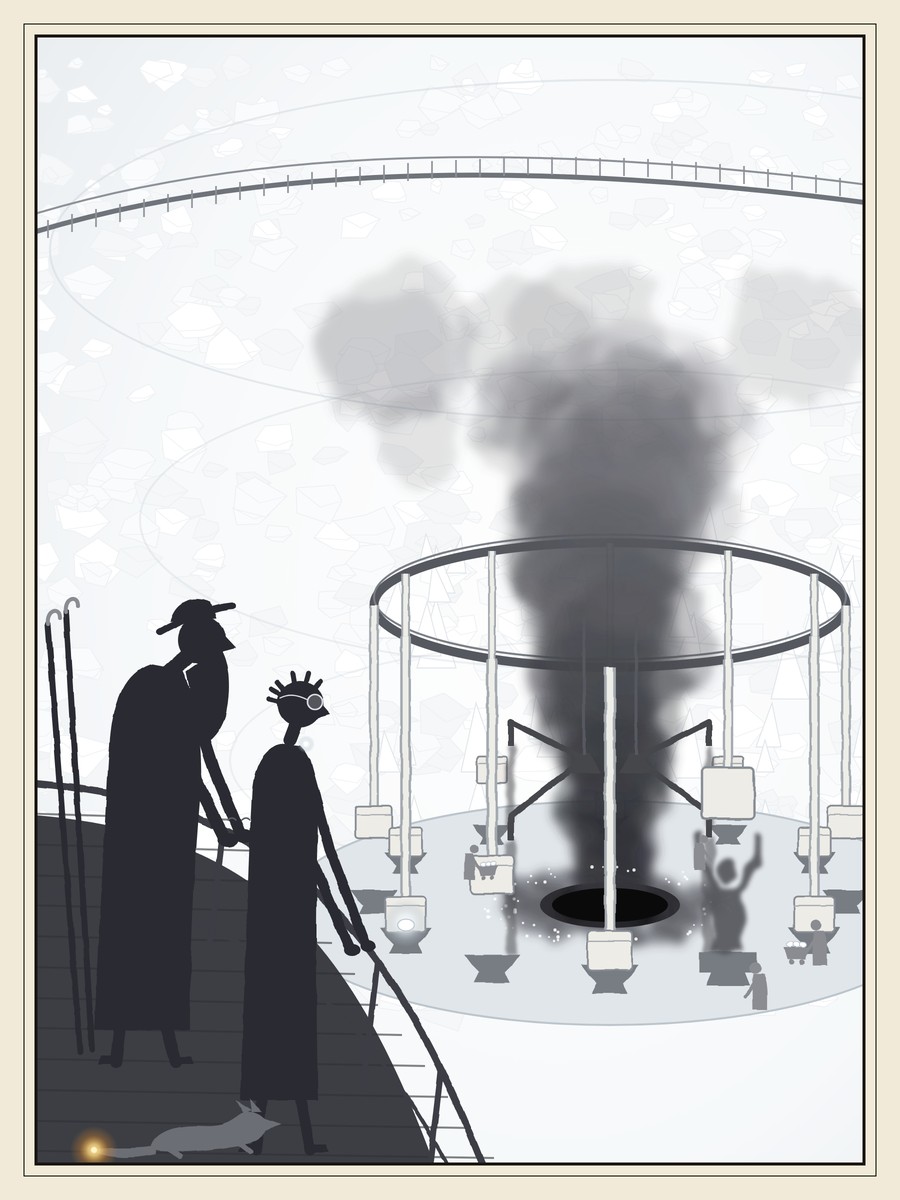
“That’s her,” he said, low and steady. “I’d know that cold anywhere. I’ve had it in my own leg, lad. That’s the Queen’s own dark.”
Tobin did not answer at first. He was thinking. It was what his mind did when it was most afraid, the way some people’s hands shake. The pieces were coming together in his head with little clicks, like the cogs of a clock, and he did not want them to, and they went on anyway.
“Oh,” he said. “Oh, no.”
“Lad?”
“It’s all of them.” His voice came out high and fast and stammering. “Every glowstone. Every lamp-post and every window and the gates and the theatre roof — they’re all this. Each one’s a Hollow, folded up small. That’s what’s paying for it. That’s why they never go out. They’re not burning anything; they’re just a Hollow, shut up, shining.” He swallowed. “And that’s why there are no Hollows in Vaelport. Of course there aren’t. They’re already in. They’re on every windowsill.”
“Go on,” said Ash quietly.
“A Hollow drains you. Your colour and your laughing and your name. Only a Hollow does it all at once, so you notice. These—“ He thought of the landlady, kind and flat. Of children who walked and did not run. Of the young man in the cage, thinking and thinking for a name that was not there. “These do it slowly. Kindly. Over years. People just get a bit tired, and a bit quiet, and then quieter, and they think it’s growing old. Going quiet, they call it. The whole city’s being drained, every night, while they sleep in the light with cloths over their eyes. And they thank him for it.”
He looked up through the roof of the cavern, as if he could see through the rock and the harbour and the shining tiers to the Glass Palace at the very top.
“It isn’t a city at all,” he said. “It’s a Hollow. The whole city. It’s a Hollow that’s been switched on.”
Ash did not say anything. He did not need to.
Tobin put his hand up to his throat.
The pendant was there, as it had been every day since the banquet. He had stopped noticing it. He noticed it now. It was cold — not stone-cold; Hollow-cold, the cold that came up out of the shaft below — and it had lain against his skin for more than a week.
He tore it off. The chain snapped. He held the little stone in his open palm, and it shone up at him, smooth and pretty and perfectly calm.
And the moment it was off, everything came back.
It came back the way feeling comes back into a foot that has gone to sleep, and it hurt like that too. The waystone. His father’s tall, careful, slanting writing. He is foolish, but he is mine. His father’s face at a window in Emberwick, not looking at him. The letter Tobin had crossed out for an hour at Ash’s table to get it right, read and folded and used like a map. It came into him in one great aching rush; and for a moment, on the iron gallery above the Great Forge, Tobin Harrowgate missed his father so badly that he could not breathe.
And in the middle of that ache, quite quietly, another thought arrived. It was not a thought he wanted. It was something about Oskar Venn: about a man who could build a place like this and light a whole city, and what such a man might be able to do, if he were asked. For a prisoner, say. Or a father.
Tobin looked at the pendant in his hand for a long moment.
Then, slowly, he put it back on. He knotted the broken chain with fingers that were not quite steady, and let it fall against his throat; and the cold settled into its old place, and the ache went small and far away again, like a toothache in someone else’s mouth.
Ash was still staring down at the shaft. He had not seen. Tobin did not tell him.
“YOU THERE!”
A man in a white coat stood at the mouth of another tunnel across the gallery, goggles down, a whistle halfway to his mouth, pointing straight at them.
“You’re not on the roster! Stop where you are!”
The whistle shrilled round and round the cavern. Below, the grey miners went on working without lifting their heads.
“Run,” said Ash. “You first, lad. Don’t argue.”
They ran — if you can call it running, when one of you is an old man on two poles and the other has one eye shut — back into the white tunnel, with Cinder streaking ahead and sneezing gold, past miners who did not turn. Behind them boots rang on iron, and another whistle answered from somewhere ahead. Ash was slowing. Tobin could hear the double click of his poles getting slower and slower.
“Go on,” said Ash.
“Not on your life,” said Tobin, and was astonished to hear himself say it, and got his shoulder under Ash’s arm.
They came round the last bend, and there was the cage, standing open and empty — and between them and it, the second overseer, coming down the tunnel with his arms spread wide.
Cinder did not even slow down. She went straight up the front of him like a squirrel up a tree, sat on his head, and sneezed into his goggles.
The overseer yelled and clawed at his face. Ash and Tobin went past him into the cage; Cinder leapt after them. Tobin slammed the gate, seized the brake lever — the one he had explained on the way down, while Ash said Hm — and pulled it the other way as hard as he could.
The great weight dropped. The cage shot upward so fast that Tobin’s knees buckled and Ash sat down on the floor, and the white tunnel and the yelling overseer and the cold from the black shaft fell away beneath them.
“Counterweighted,” said Tobin faintly, from the floor of the cage.
Ash looked at him. Then he began, of all things, to laugh — a short, creaky, breathless laugh, with his hat over one ear and the tears of the glare still in his beard.
“Hm,” he said. “Well done, lad. Very well done indeed.”
They came out through a side door into the white night of the harbour, and nobody followed. Perhaps — Tobin thought later, and did not like the thought — the overseers had gone to tell somebody.
They sat on the harbour wall to get their breath. Behind them the city climbed the hills, tier upon tier, blazing and shadowless: every window, every lamp-post, every mast, the great light of the lighthouse at the end of the wall, and high above it all the Glass Palace, where Mira was asleep. Somewhere up on Lantern Steps, Wren was asleep too. It was the most beautiful thing Tobin had ever seen. It was like looking at a field of frost and knowing that every glittering blade had once been something alive.
“Somebody has to tell them,” said Ash at last. He nodded at the city. “Whoever’ll listen. When I’ve thought how.” He put a heavy hand on Tobin’s shoulder and got himself up onto his poles. “Come on. Bed. You did well tonight, lad. Better than well.”
Tobin went with him. His hand had gone up, without his telling it to, to the knotted chain at his throat. He did not tell Ash about the thought that had come to him on the gallery.
It was the first thing he had ever kept from Old Ash. I am sorry to say it was not the last.
Chapter 6 complete
The Mines Beneath the Harbour