Chapter 5 · 17 min read · 21 min listen
A House for Wren
Wren went down to the fish market most mornings now.
Everywhere else in Vaelport smelt of clean white stone and cold air, like the inside of an empty cupboard. But under the long roof of the fish market there were tar and rope and wet wood, and gulls quarrelling on the beams, and slithering heaps of fish; and Wren, who had grown up between a tannery and a canal, found she could breathe there. There was nobody at the Salt Lantern to stay for. Tobin had taken to sitting on his bed with a glowstone he had bought, turning it over in his fingers and making notes; Ash slept late, because his leg was bad; and Mira was up at the Palace, and had not come down.
So Wren was alone, and eating a hot bun she had paid for (it is worth saying that she had paid for it), when a voice behind her said, “Wren, my dear! What a piece of luck.”
She turned round with her mouth full.
It was Oskar Venn, in his long pale coat, with the fishwives curtseying on every side, looking about as much at home as a swan in a coal-scuttle. Beside him, holding a basket on her arm, stood a small round woman in a brown shawl.
“There is somebody,” said Venn, “who has been asking after you.”
Her name was Mrs Rose Pellow. She was a good head shorter than Venn, and quick and plump as a wren herself, with a round red face and grey hair coming loose from its pins and flour on her sleeves; and the first thing she did was put down her basket and take Wren’s free hand in both of hers.
Her hands were warm.
That was what Wren remembered afterwards — not Venn’s charming explanation, of how Mrs Pellow had asked all along the harbour about the little sweep with the ribbon, and how he had happened to hear of it. In the whole of Vaelport — at the inn, at the banquet, at the theatre — she had not touched a hand that was warm. And this one was warm right through, like a loaf just out of the oven.
“I saw you give half your bun to a little one, Tuesday,” said Mrs Pellow. “By the net-sheds. A scrap of a thing, sitting staring at nothing, and you put it in her hand and closed her fingers round it. And I said to Amos, I said, that one’s been hungry herself.” She looked Wren up and down with bright, sharp, kind eyes. “And you still are, by the look of you. You’re all elbows. Will you come to tea, pet? We’re only up the Steps. I’ve a batch in.”
Wren looked at Venn. Venn smiled.
“I shall leave you two to get acquainted,” he said, and bowed — to Mrs Pellow, as gravely as if she were a duchess — and went away through the fish market with the crowd parting in front of him, and was gone.
Wren ought to have thought about that. In the old days in Soot Lane she would have thought about it at once — about why a man like that would bother to bring a sweep and a baker’s wife together, and what it was going to cost. And some small sharp part of her did think it, just for a moment.
But Mrs Pellow was still holding her hand. And it was so very warm.
Lantern Steps was a crooked stair-street that went up from the harbour between leaning houses, so narrow that the washing lines from one side reached the windows of the other. It was the nearest thing to Soot Lane that Wren had seen since she left; only it was clean, and white, and every window had its glowstone. The Pellows’ house was halfway up, small and square, with a step worn hollow in the middle and a door that was white like all the others.
As Wren went up the step her coat fell open, and the lamp’s light spilled out against the door for a moment — and the door was not white. It was blue. A deep, clear, cheerful blue, the colour of something Wren had no name for, with the paint worn pale round the latch where hands had opened it for years.
She pulled her coat shut quickly. But she had seen it.
Inside, there was a fire.
Wren stopped dead on the doormat. It was a real fire — a small, untidy, crackling fire of driftwood in a black iron range, with a kettle singing on top of it, and the heat of it came across the little kitchen and touched her face like a hand. She had not felt a fire since the camp on the headland. She had not known, until she felt it, how cold she had been.
“I know,” said Mrs Pellow, seeing her face. “Nobody needs a fire in Vaelport. That’s what they all say. Amos’s sister says it’s old-fashioned and dirty and I’ll have the house down.” She hung her shawl on a nail by the door. “I always kept a fire. My mother kept one. You can’t bake on a glowstone, whatever they tell you. And a house without a fire—“ She looked at the range and her face went soft. “Well. It’s not a house. It’s a cupboard with a roof on.”
There was a big man sitting by the fire with a fishing-net across his knees. He was the biggest man Wren had ever seen, bigger than Gristle Mott, with great slow gentle hands; and he was mending the net with a little wooden needle, so quickly and neatly that his fingers seemed hardly to move. He looked up, and his face was broad and brown and creased all over, and he smiled at Wren very slowly, the way the sun comes out from behind a cloud.
“This is Amos,” said Mrs Pellow. “He doesn’t say much. Amos, this is the sweep.”
“Afternoon, sweep,” said Mr Pellow, in a deep, slow voice like a barrel rolling. And he went back to his net.
There was a cat, too, asleep in a basket by the range: a fat, grey, untidy cat who opened one eye at Wren and shut it again. When Wren knelt to stroke it, her coat fell open once more and the lamp’s light touched it; and for a moment the cat was not grey at all but a bright, astonishing, marmalade orange, like a lit coal with fur on.
“Oh!” said Wren aloud, before she could stop herself.
“That’s Biscuit,” said Mrs Pellow, cutting bread. “He’s a terror. Sit down, pet. Sit.”
I wish I could tell you about that tea properly. It was nothing like Venn’s banquet of white food that tasted of very little. It was a brown loaf, hot from the oven, with butter that melted into it; and a pot of fish soup; and a jam tart; and tea that was strong and brown and hot and tasted — Wren said afterwards, when she could bear to talk about it — exactly the way Ash’s tea did not.
Mrs Pellow kept putting things on her plate. Wren kept eating them. Mr Pellow mended his net and said nothing, and every so often he looked up at Wren, eating, and his big creased face looked quietly pleased, as if somebody had told him good news.
They asked her about herself. And because nobody had ever asked her in quite that way before — as if they wanted to know the answer, not as if they were working out what she would fetch — Wren told them. Not about the lamp. But about Soot Lane, and Gristle Mott and the board money, and the cold garret, and Nettle. It simply came out of her, the way the warmth of the fire came into her, without asking.
“And your mum and dad?” said Mrs Pellow.
“Don’t know,” said Wren. “I was about four.” She looked at her plate. “I’ve got this.” She turned her wrist to show the ribbon — white, of course, in the light from the window. “And a bit of a song.”
Mrs Pellow did not say anything. She got up and went to the range and stood with her back to the room for a moment, doing something with the kettle that did not need doing.
When she had finished her tea, Wren looked up at the chimney-breast, and saw the soot round the edge of the range-door, and heard the way the fire was drawing — a little sluggish, a little smoky, with a catch in it like a cough — and her professional pride rose up in her.
“Your flue wants sweeping,” she said.
“I dare say it does,” said Mrs Pellow. “There’s no sweeps left in Vaelport, pet. Nobody’s had a fire to sweep for twenty years.”
“Got any brushes?”
It turned out that Mr Pellow had a long-handled broom, and a bundle of net-floats, and a length of old rope, and a great deal of patience; and between the three of them and a ladder, with Biscuit watching in disgust from the top of the dresser, Wren swept the Pellows’ chimney. She did it to pay for her tea. She told herself so, very firmly, all the way up the flue. Everything costs. You eat a person’s bread, you pay them back, and then you don’t owe anybody anything.
She came down black from head to foot, and a great cloud of soot came down with her and settled on everything; and Mrs Pellow, standing in the middle of her kitchen with soot on her nose, looked at her — and laughed.
It was a real laugh. It went up and up and ended in a sort of hiccup, and she had to sit down. Wren had not heard anybody in Vaelport laugh like that. Not once. Then Mrs Pellow got up, and fetched a basin of hot water from the kettle and a flannel, and took Wren by the chin and scrubbed her face. She did it briskly and not at all gently, the way you scrub a face you have scrubbed a thousand times before, talking all the while — “Hold still, you wriggler — look at your ears, there’s half the chimney in them — what you’ve been doing with this hair, I’d like to know—“
“Cut it,” said Wren, through the flannel. “With a knife.”
“With a knife.” Mrs Pellow put down the flannel and looked at her. “Sit on that stool.”
And so Wren sat on a stool by the fire in a warm kitchen on Lantern Steps, with a towel round her shoulders, while a woman she had known for three hours trimmed her hair with a proper pair of scissors, humming. The scissors went snip by her ear. Mrs Pellow’s fingers were warm on the back of her neck. Mr Pellow’s net-needle went in and out, in and out; the fire drew clean and bright up the swept chimney; and nobody wanted anything from her.
Wren sat very still. There was something happening in her throat, and she did not know what to do about it. She stared hard at the cat.
I think that you may know what she was feeling, even if you have had a mother all your life and never once thought about it; and if you do not, I hope you never will. It was the feeling of being looked after. Not paid, not owed, not put up with. Just looked after, as if it were the most ordinary thing in the world.
“There,” said Mrs Pellow at last, and turned Wren round by the shoulders to look at her, and nodded. “Now you look like somebody’s.”
It was dark — or what passed for dark in Vaelport, which was only a different sort of white — when Mrs Pellow said she couldn’t possibly let a child go down the Steps at this hour, and Wren must stop the night, and Amos would walk down to the inn and tell her friends where she was.
“Tell Ash,” said Wren. “The old one. With the poles.”
Mr Pellow nodded slowly, and put on his coat, and went.
When he had gone, Mrs Pellow lit a candle — a real one, a stub of yellow tallow in a tin holder, which she had to hunt for in three drawers — and took Wren up a narrow stair to a little room under the roof.
It was a small room. The ceiling sloped, like the ceiling of the garret in Soot Lane, only this one had been whitewashed, and there was a little square window with a curtain over the glowstone so that it was almost, nearly, dim. There was a narrow bed, and a bedside table, and a peg on the back of the door at just the right height for somebody not very tall. A pair of small boots stood under the window, very neatly, as if someone had taken them off a minute ago and would be back for them.
And on the bed was a quilt. It was a patchwork quilt, made of a hundred little squares of cloth stitched together, and in the candlelight Wren saw that some of the squares had once been different colours — very faintly, under the grey, the way a word shows through from the other side of a page.
“She made it with me,” said Mrs Pellow. She was standing in the doorway, holding the candle. “Our girl. Out of her old frocks, when she grew out of them. We were going to do another one when she was bigger.” She smoothed the quilt with one hand, though it was already quite smooth. “She’d be about your size. It was a fever. Nine winters back.” She was quiet for a moment. “This house has been very quiet, pet. Very quiet indeed.”
Wren did not know what to say. So she said nothing, which was the right thing.
Mrs Pellow sat down on the end of the bed. And then she said the thing she had been waiting all afternoon to say; Wren could see it in her face. She said it shyly, and all in a rush, like a much younger woman.
“Amos and me were talking. Before ever we met you. When Mr Venn first come round — he’s been ever so good, he came round himself to tell us about you, and said there was a little girl in want of a home, if we’d a mind. And we had. We have.” She took a breath. “We’d like you to stop, Wren. Not for tonight. For good. For ours. If you’d have us.”
The candle flickered. Wren held on to the bedpost.
“Mr Venn says the adoption papers can be drawn up this week, pet. He’ll see to it all his own self, so it’s done proper.” Mrs Pellow smiled, and the smile was so hopeful that it hurt to look at. “Only you’d have to stop here, in Vaelport. He was very particular about that, and I dare say he’s right. No more wandering off to mountains. Not if you’re ours.” She reached out and touched Wren’s freshly cut hair, very lightly. “You’ve done enough wandering for one little girl. Haven’t you?”
Wren did not say yes. And she did not say no.
She could not. She stood in the little room and the two words fought in her like cats in a sack. Yes — a door, a blue door, her own; a peg at the right height; a fire that somebody kept lit; a woman who would scrub her ears and call her pet and laugh until she hiccupped; a big quiet man who looked pleased when she ate. Never cold again. Never hungry again. Never nobody’s again. She had wanted it all her life without ever once letting herself know that she wanted it, the way you do not let yourself look too long at a cake in a shop window when you have no money.
And no. Ash, and his dreadful tea. Tobin, and his spectacles. Mira — though Mira had gone to the Palace and did not care. The Mountain, a long way off, that none of them could see. The road.
The lamp.
“I’ll — can I think on it?” she said at last. Her voice came out very small.
“Course you can, pet,” said Mrs Pellow at once. “Course you can. You take all the time you want.” She got up. She hesitated, and then bent and kissed the top of Wren’s head, quickly, as if she were afraid she would be told off for it. “Night, love. Sleep sound.”
She went out and left the candle.
A little later Wren heard the front door, and Mr Pellow’s slow tread in the kitchen, and the two of them talking low. Then Mr Pellow’s deep voice came up the stair, carefully, as if he were not much used to calling up stairs to anybody.
“Your old gentleman says goodnight, sweep. He says—“ A pause, while Mr Pellow got it right. “He says he’s glad you’ve a fire tonight.”
Wren sat on the bed and put her hands over her face.
She took off her coat at last, and her boots, and set the boots beside the other boots under the window. Then she took the lamp out of her coat.
It was burning, as it always burned: small and gold and steady, and the little room went warm and full of colour round it. The quilt woke up. Squares of rose and yellow and sea-green and a deep soft red came up out of the grey all over the bed, and one square near the pillow was the same blue as the door.
But the pendant at her throat was cold, as it was always cold now; and with the pendant on, she felt, holding the lamp, the way she had been feeling for days, as if she had mislaid something and could not think what. And the lamp was heavy. It was only a small, battered, dented brass thing that weighed no more than a cup, and it lay in her two hands that night heavier than it had ever been.
It was the lamp, she thought, that would take her away from here. Mrs Pellow had not said so. But that was what she had meant. If she had no lamp, nobody would need her to carry it to any mountain. She could just — stop.
She did not throw it away. I want to be quite clear about that. She did not throw it, or curse it, or say anything hard to it. She only opened the drawer of the little bedside table, and laid the lamp inside it, carefully, on a folded handkerchief that was lying there, the way you put away something good that you do not want to look at just now. And she shut the drawer.
It did not go out. A thin line of gold light came through the crack at the top of the drawer and lay across the quilt, warm, like a finger laid on a page to keep the place.
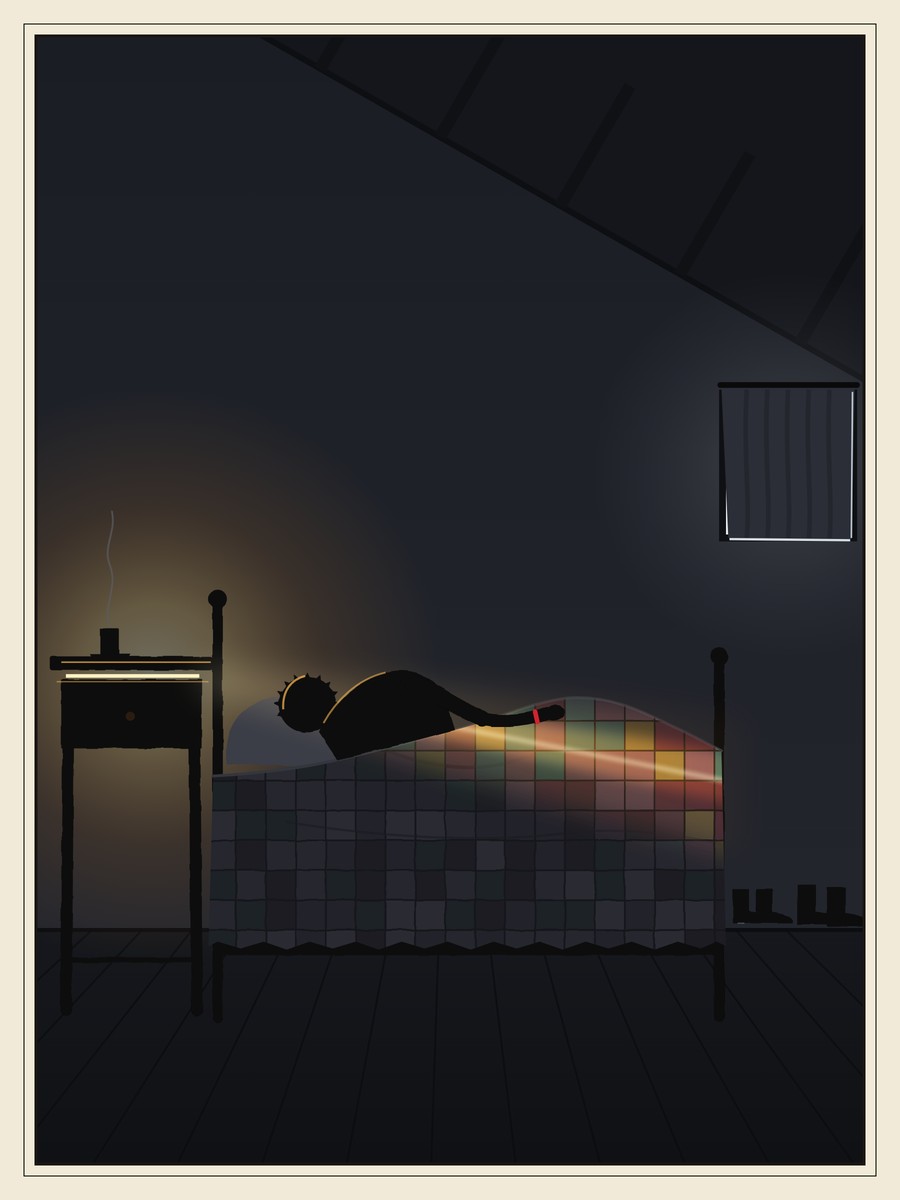
Wren blew out the candle. She lay down under the quilt that a girl she would never meet had made out of her old frocks, and she turned over onto her other side, towards the wall, so that she could not see the light.
And after a long while, warm all the way through for the first time since she had come to Vaelport, she slept.
Chapter 5 complete
A House for Wren