Chapter 4 · 17 min read · 22 min listen
The Girl Who Sees
By their fourth day in Vaelport, half the harbour knew that Mira had been blind.
This was because Mira had told them. She told the landlady of the Salt Lantern, and the boy who carried up the hot water, and a man selling white sugar-mice off a tray, and two old women on a bench who had not asked. She told it the way some people hum: because it was so full in her that it had to come out somewhere.
“I was born in the Deeps, under the Greywaste, where there is no light at all,” she would say, “and I had never seen anything, not once, not even my own hands. And then a ferryman on the Gloam River put his thumbs on my eyes, and I opened them, and the first thing I saw was a lamp.” And then, because she could not help it: “What colour is your hat? Is that brown? I have only just learned brown.”
The people of Vaelport listened politely. They nodded, and said, “Fancy,” in their soft, tired voices, and went on with what they had been doing, as if a girl who had been blind for twelve years and now could see were about as interesting as the weather.
All except one. That morning, a white carriage drew up outside the Salt Lantern for the second time that week, and the same footman got down from it, with the same small glowstone pinned to his collar like a star.
“Master Venn’s compliments,” he said, “to the young lady who sees.”
“A theatre?” said Wren.
They were at the window table of the Salt Lantern’s common room, Old Ash with his bad leg on a stool, and Cinder underneath, eating the crust off Tobin’s toast while he was not looking. The white light lay on the table without a single shadow, so that the cups and plates looked cut out of paper and stuck down.
“The Crystal Theatre,” said Mira. She had the card in both hands, and was reading it again, slowly, moving her lips. Reading was still new to her too. “Master Oskar Venn would count it the greatest honour if Miss Mira of the Deeps would consent to stand upon the stage of the Crystal Theatre tomorrow evening, and tell the people of Vaelport, in her own words, the story of the Girl Who Sees.” She looked up. Her eyes were very bright. “That is me. I am the girl who sees. He has given me a name.”
“You’ve already got a name,” said Wren.
“Not like this one.” Mira turned the card over, as if there might be more on the back. “It says tell the people. All of them, Wren. Not just the sugar-mouse man.”
“The Crystal Theatre,” said Tobin, “holds three thousand people. I asked the landlady. She says you can whisper on the stage and they’ll hear you in the back row, which is acoustically extremely interesting, actually, because a dome ought to throw the sound about, and if they’ve—“ He saw Wren’s face and stopped. “Sorry. It’s just — three thousand, Mira. That’s more than the whole of Deepholm.”
“I know,” said Mira, and laughed, and hugged the card to her chest.
Wren looked at Old Ash. Ash was looking at his tea, which was pale and weak and lukewarm, and which he had said three times was the worst he had ever been given. Wren thought this was a bit rich, coming from him.
“Well?” said Wren. “Aren’t you going to say anything?”
“Hm,” said Ash. He turned his cup round in his long fingers. “It’s Mira’s story, child. It’s hers to tell.” He looked up, and his eyes under their shaggy brows rested on Mira for a long moment, kindly and very carefully, the way you might look at someone walking along the top of a high wall. “Tell it true, that’s all. It’s a good story, told true.”
“Of course I will tell it true,” said Mira. “How else would I tell it?”
Under the table, Cinder finished Tobin’s toast and sneezed.
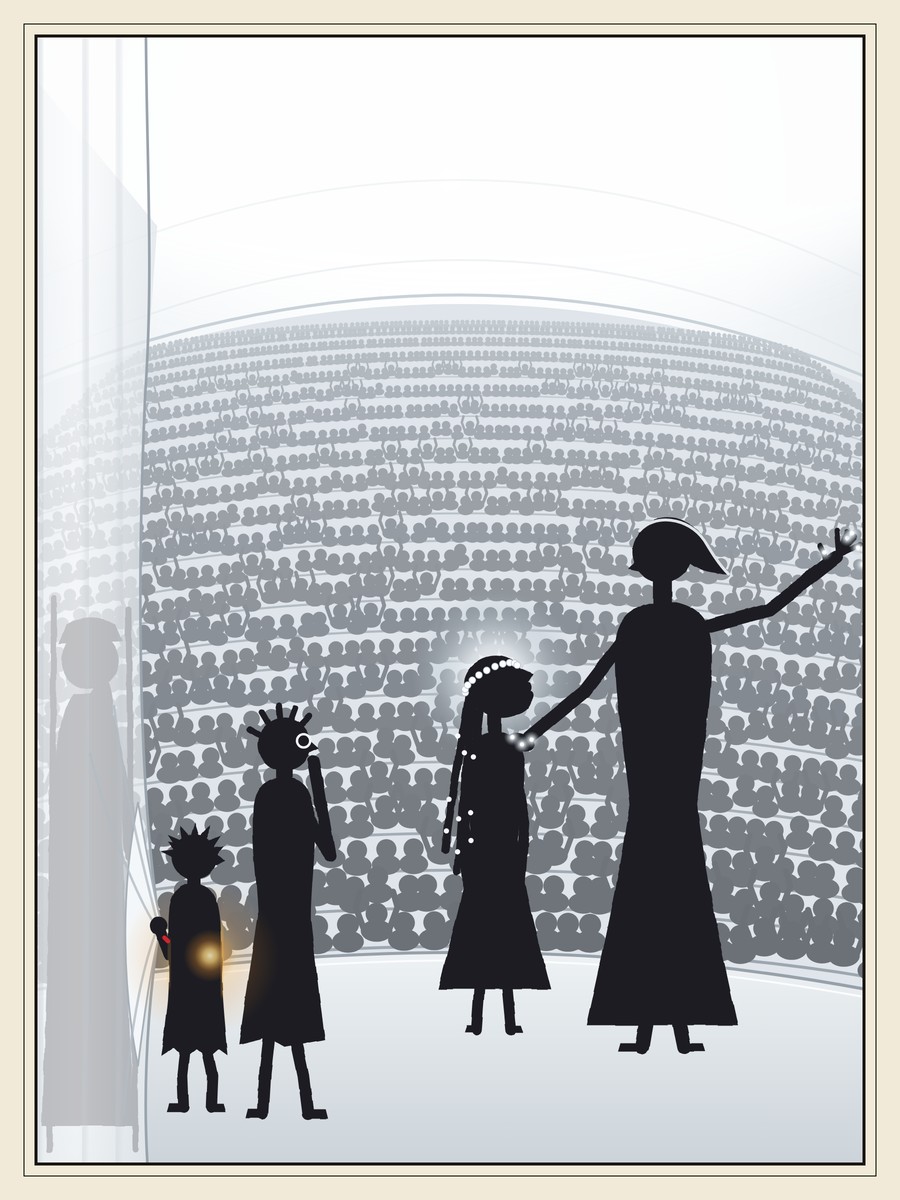
If you have ever stood at the edge of a very large crowd, you will know that it has a sound of its own, like the sea, even when nobody is talking. The Crystal Theatre held three thousand people that night, and every seat was full.
The seats went up and up in curving white rows, steeper and steeper, until the people at the top looked like sugar-mice on a tray. Over it all was the dome, and it was made of glowstone: one vast, smooth, curving sheet of it, so that the whole roof shone. The light came down out of it onto everything at once, white and steady and cold, and nobody in all those three thousand seats cast a shadow.
Wren, Tobin and Ash stood in the wings behind a curtain of white silk. Cinder was under Ash’s coat, because the footman had said that animals were not generally permitted, and Ash had said, “Neither are footmen, generally, in my experience. Hm,” and walked past him.
Mira stood alone in the middle of the stage.
She had on a new white dress, which had come in a box that afternoon with Master Venn’s compliments, and the light from the dome fell on her and made her look as if she were made of it. She was standing very straight. Wren could see that her hands were shaking.
Oskar Venn came out from the other side of the stage, and the theatre went quiet at once.
He was as fine as he had been at the banquet: silver-white hair, a long coat of the palest grey, a tiny cold stone on every finger. He walked to Mira’s side and smiled down at her, and turned to the crowd and spread his hands; and when he spoke he did not raise his voice at all. Tobin was right about the roof. Every word came to them in the wings as if he were standing at Wren’s elbow.
“My dear friends,” said Venn. “Many of you came here from towns whose Rings were failing, and whose Guilds charged you a day’s bread for a cupful of oil. You walked a long way in the dark, and came over the last hill and saw our light, and came in. And you have not been afraid of the dark since. Not one night.” He paused. “Tonight I want you to meet someone who has come from a place where there was no light at all. Not dim light. Not failing light. None.” He laid his hand, very gently, on Mira’s shoulder. “And now she sees. My friends: the Girl Who Sees.”
The theatre began to clap.
It went up the white rows like a wave going up a beach, and it was not polite, tired clapping, either. It rolled round and round under the shining dome. Somebody near the top whistled. Somebody stood up, and then a whole row, and then half the theatre.
Wren watched Mira’s face, and she would never quite forget it.
Mira had flinched at first — she always flinched at loud things, and this was the loudest thing in the world. Then she had stopped flinching. She stood quite still in the middle of all that noise, with her mouth a little open, and something came into her face that Wren had never seen there before, not even at the river when she opened her eyes. It was not joy, exactly. It was more as if she had been carrying something very heavy for a very long time, without knowing it, and somebody had just lifted it off her.
Then she told her story.
She told it the way she told everything — precisely, with all the sounds and smells in it: the echo-halls, the Story-Wall, the thousand steps of the Black Stair, the mist on the Gloam River, the creak of the ferryman’s oar. She told how the ferryman had dipped his thumbs in the grey water and laid them on her closed eyes, and how the first thing she ever saw was a lamp. She did not say whose lamp, or where it was now. Wren felt it warm against her ribs, and was glad, and a little uneasy.
When she had finished, the theatre clapped again, louder than before, and people came down the aisles to lay things on the stage: flowers (white ones; Vaelport did not seem to have any other kind), little boxes of sweets, a white silk scarf. A child of about six was lifted up by her father to lay a sugar-mouse at Mira’s feet, and the child did not smile while she did it; she only stared at Mira, gravely, as if she were trying to remember something.
And last of all a man in the Glowstone Company’s white livery came up the steps with a cushion, and on the cushion was a circlet: a thin band of white gold, set all round with tiny glowstones, so that it shone like a ring of frost. Venn lifted it himself and set it on Mira’s head.
“For the Girl Who Sees,” he said. “With the thanks of all Vaelport.”
Mira put up her hand and touched it. And the clapping went on and on.
“It’s so warm,” she said afterwards.
They were in a little white room behind the stage, all mirrors and presents. Cinder had found the sweets and was working through a box of them with her eyes half shut. Tobin was standing on a chair, peering at the ceiling and saying “Hm” to himself in a bad imitation of Ash. Ash sat in the corner with his poles across his knees and his eyes closed.
“What is?” said Wren.
“When they clap.” Mira was sitting at a mirror in her circlet, leaning close now and then to check that the other girl was really doing the same things she was. She was still not used to mirrors. “Everything here is so cold, Wren. Have you noticed? Even in the inn. Even in bed. I never knew I was cold until I came here, and now I am cold all the time. But when they clapped—“ She put her hand flat on her chest, where her pendant lay at her throat on its fine white chain. “It was like standing next to the lamp. It was the only warm thing in the whole city.”
Wren opened her mouth, and shut it again.
She thought of holding her own pendant up beside the lamp, walking back from the harbour, and seeing it go grey and dull, and something move inside it — something like smoke, folded small. She had told Ash and nobody else. She did not know if she was right; and looking at Mira’s shining face in the mirror, she was not at all sure this was the moment to try.
“The lamp’s warmer,” she said instead. It came out gruffer than she meant.
“Oh, I know that,” said Mira, and laughed. “I only meant — oh, Wren. Nobody has ever clapped me before. Do you know what I was, in Deepholm? I was the girl who believed the fairy story. The one who went and sat in the dark by the Story-Wall, when everybody else was at the Long Table. They were kind about it. They were always kind. Poor Mira, with her head full of the Warm Man.” She touched the circlet again. “And up here I have been the girl who walks into doorposts. The one who must be led through every gate by the sleeve. You have all been so patient with me, and I hate it. I hate being patient-with.” She turned round on the stool. “And tonight three thousand people stood up. For me. Not because they were being patient. Because they wanted to. Is that so very wicked, to like it?”
“No,” said Wren, and meant it. “No, it’s not wicked.” She tried to think how to say the next thing. “Only—“
The door opened, and Oskar Venn came in.
He stayed only a minute. He called Wren and Tobin “my dears”, and told Mira she had been a marvel, and asked if she would be so very kind as to come again tomorrow. And afterwards Wren found she could not remember what she had been going to say.
She went again the next night, and stood in the wings with her arms folded, and watched.
On the second night, it went wrong.
Mira told her story as she had before, and the theatre listened as it had before, and clapped. But this time, when she came to the ferryman — to the boat, and the mist, and the grey water — Venn was standing beside her with his hand on her shoulder; and Wren, in the wings, saw his hand move. Not much. A little squeeze, the kind you give someone to say, go on, you’re doing beautifully.
And Mira said, “Of course, I have often wondered since.”
The theatre leaned forward.
“I have wondered,” said Mira slowly, “whether it was really the ferryman at all. He was only an old man in a boat. He did not say anything. He did not make any light. And then a little while after, we came here — to the brightest place in all the world — and I have seen so much more clearly since I came.” She lifted her face to the shining dome. “Perhaps it was only beginning, on the river. Perhaps it was the light of Vaelport that was calling me all along, and finished it. It might have been. Who can say it wasn’t?”
The theatre roared. Venn smiled, and bowed his silver head a little, as if somebody had thanked him for something he had not liked to mention.
Wren did not clap. She was holding the white silk curtain so hard that her fingers hurt. Tobin had gone pink, and was pushing up spectacles that had not slipped. Old Ash stood leaning on his poles, very still, and said nothing at all.
She caught Mira in the corridor afterwards, outside the mirror-room, before the footmen came.
“What was that?”
Mira was carrying a great armful of white flowers. She looked at Wren over the top of them, and her face went careful. “What was what?”
“You know what. All that about wondering. Perhaps it was the light of Vaelport.” Wren’s voice came out in a hiss. “It wasn’t Vaelport, Mira. You know it wasn’t. You were in the boat. I was there. I was sitting next to you. He put his thumbs on your eyes.”
“I know he did. I told them he did.”
“And then you told them it wasn’t him!”
“I said I wondered.” Mira’s chin came up. “I am allowed to wonder. How do you know it wasn’t? You can’t see inside my eyes, Wren. I’m the one who was blind. I’m the one who knows what it was like, before and after. And since we came here, everything has been so much — clearer—“
“Because everything’s white! There’s nothing to see! You can’t even tell what colour anything is!”
“It might have been,” said Mira stubbornly. “That’s all I said. It might.”
“He didn’t ask you for anything,” said Wren. “That ferryman. He took us across and he gave you your eyes and he didn’t ask for a single thing, and then he went. And now Venn’s put his hand on your shoulder and given you a crown, and you’re giving it to him.” She was shaking. She only knew that the lamp was hot against her ribs, and that she wanted to cry, and would rather have died than do it in that horrible white corridor. “That’s what it is. He gave you a present and you’ve gone and sold it.”
Mira’s face went white — whiter than the flowers.
“That is not fair,” she said, quite quietly. “And I know why you are saying it.”
“Oh, go on, then. Why?”
“Because you just don’t like anyone else having anything.” Mira’s voice shook, but she did not stop. “You have the lamp. You’ve always had the lamp. Everyone looks at you, because you’re the one who carries it — Varrick follows you, and Ash teaches you, and you get to be brave and give it away and have it come back. And now for once somebody is looking at me instead, and you can’t bear it.”
Wren stared at her. It was the kind of thing you cannot answer, because there is just enough truth in it to stick, like a burr.
Tobin arrived at that moment, breathless, and saw their faces, and did the worst thing he possibly could have done, which was to try to help.
“Actually,” he said, “I think you’re both partly right. Logically. Wren’s right that the ferryman did it — I was there, the effect was immediate — but technically we don’t know how any of it works, so you can’t absolutely prove—“ He looked from one to the other. “I’m only saying, if you put both your positions side by side—“
“Oh, be quiet, Tobin,” said Wren and Mira at once.
It was the only thing they agreed on that night.
Ash had come up behind them on his two poles, slowly, with Cinder at his heels. He did not say anything. He looked at Mira, and at the circlet of white stones on her head, and at Wren; and Wren thought, for the first time since she had known him, that he looked old. Not stooped and gruff, the way he always looked. Old. As if he had a long way still to go, and had just felt how long.
“Hm,” he said at last, very softly. That was all.
Then a footman came, and bowed, and said that Master Venn hoped Miss Mira would take a little supper with him in the Palace.
Mira went. She did not look back.
The carriage came the next morning.
Wren was sitting on the step of the Salt Lantern when it drew up, with a cart behind it. Two footmen carried out Mira’s new white dresses in boxes, and her flowers, and her sweets, and laid them in the cart.
“Master Venn says it’s ever so far to come up every night,” Mira said. She was standing on the step above Wren with her circlet in her hands, not quite looking at her. “He says there is a whole wing of the Palace that nobody uses, and I may have a room there, for the performances. Just for the performances.” She turned the circlet round. “It is very kind of him.”
“Very,” said Wren.
“There is a window,” said Mira, “that looks right out over the sea.”
Wren said nothing.
Mira stood there a moment longer. She opened her mouth as if she were going to say something else — and then the footman held the carriage door open for her, and bowed, and said, “Miss,” and she shut it again. She put on the circlet. She got into the carriage.
Ash had come out onto the step behind Wren. He did not try to stop her. He only said, “Goodbye, child. Keep warm,” in his ordinary dry voice, and Mira said, “Goodbye, Ash,” from inside the carriage, very small.
Cinder ran after the carriage halfway down the street, and then stopped in the middle of the white road and sat down and watched it go, with her ears flat and her tail-spark gone dim.
I am sorry to say that Wren did not wave. Afterwards she wished very much that she had. But she sat on the step with her chin on her knees and watched the white carriage wind up the shining tiers towards the Glass Palace, until it was only a speck, and then not even that.
“She’ll come back,” said Tobin, behind her. “Won’t she? It’s only for the performances.”
Nobody answered him.
Inside Wren’s coat the lamp lay against her ribs, warm and steady. But it seemed to her, just then, sitting on that cold white step, that it was very heavy for such a small thing; and she did not take it out.
Chapter 4 complete
The Girl Who Sees