Chapter 3 · 17 min read · 22 min listen
The Children Who Don’t Laugh
The harbour was the only part of Vaelport that smelt of anything.
Wren found it the next morning, while the others were still asleep under their strips of linen. She had only meant to get out of that white room, where the light stared in at the window; and she went down the four flights of stairs in her stockings with her boots in her hand, and out of the door of the Salt Lantern, and down the last of the white steps — and there it was, and she stood still and breathed.
Tar. Salt. Wet rope and fish-guts and seaweed and the cold green smell of the sea. Gulls screaming over the masts. Men shouting — actually shouting — as they swung crates of fish up out of the boats on creaking pulleys. It was the first loud, dirty, honest place she had found in the whole city, and something in her chest that had been clenched since the gates let go a little. The glowstones were here too, on every mast-head and bollard. But the harbour was too busy to look at them, and the mud along the waterline was the colour of mud, which is a fine colour when you have been without it.
A sweep feels at home, you see, in any place where the work is dirty and nobody is looking at you. Wren pulled on her boots, put her hands in her pockets, and went to have a look round.
Over the water’s edge, standing on great tarry legs above the shingle, was the fish-market: a long low timber roof on posts, with the stalls and the slabs and the fishwives on top, and the tide sloshing in and out underneath. Wren was walking along under the edge of it, watching a man gut herrings faster than she could count, when she felt it.
It was a very good pick. Two fingers, light as a moth, sliding into her left coat pocket from behind, feeling for whatever was there. But Wren Ashby had been picking pockets in Crookback Market since she was six years old, and you cannot pick the pocket of a pickpocket, any more than you can sneak up on a cat.
She did not turn round. She dropped her own left hand and closed it, gently, round a thin wrist.
“That’s my singing-stone,” she said, without looking. “It’s no good to you. It only hums when there’s trouble.” She turned round. “And I’ll have that back, while you’re at it.”
The pickpocket was a girl. She was smaller than Wren, and younger — eleven, perhaps — with a sharp face and quick dark eyes and hair scraped back under a knitted cap; and she was wearing a man’s coat, so long that it came down nearly to her ankles, with the sleeves rolled back on themselves so many times that they made great fat rings round her wrists. Wren counted them later. There were eight. Round her neck on a dirty string hung a little glowstone, the way everybody’s did.
Or rather, it had hung there a moment ago. Now it was dangling from Wren’s other hand.
The girl looked at her own neck. She looked at the string swinging from Wren’s fingers. Something happened in her face — not much; it was not a face that did much — but Wren knew the look. It was the look of somebody who has just found out that they are not the cleverest thief on the beach.
“How’d you do that?” said the girl.
“Practice,” said Wren. “You lean in too far. You want to come in from the side, like you’re looking past.”
The girl considered this. Then she held out her hand, palm up, flat and steady. “Stone.”
“Stone,” agreed Wren, “for my pocket back how you found it. And the stone that’s in my pocket stays there.”
“Deal.” The girl took her glowstone, hung it round her neck again, and put her hands back in her enormous sleeves. She looked Wren up and down — the cropped hair, the patched coat, the soot that never quite came out of the creases of her knuckles — and her eyes narrowed. “You’re not a nob.”
“Do I look like a nob?”
“You came in a white carriage. Last night. Up the hill to the Palace.” The girl’s voice was quick and flat, like a coin being counted out on a counter. “Everybody on the harbour saw. People who come down from the Palace in a white carriage are nobs.”
“People who go up to it in one get fed,” said Wren. “That’s all. I went for the dinner. It wasn’t any good.”
For the first time, something in the girl’s face very nearly moved. It did not quite get as far as a smile.
“I’m Pim,” she said. “Come on, then. If you’re not a nob.”
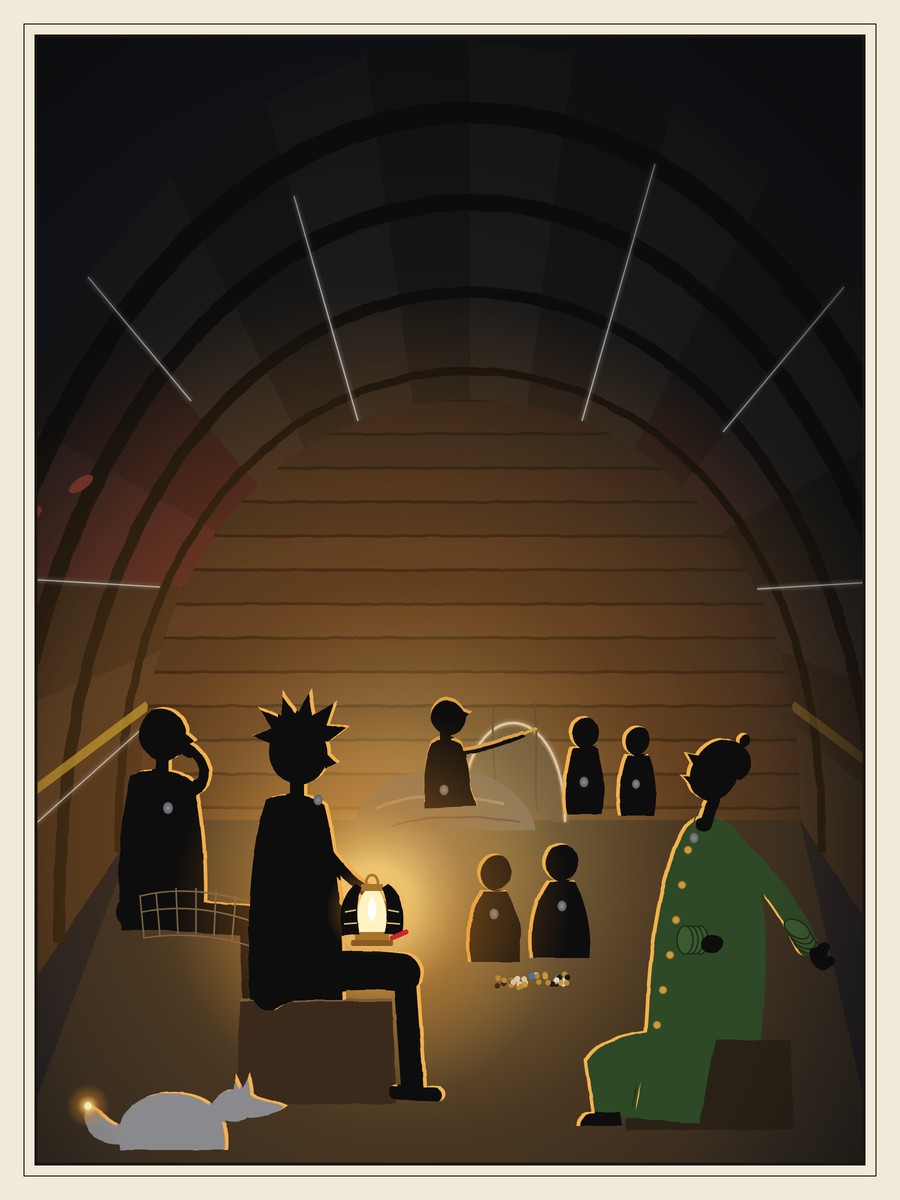
The den was under the fish-market, at the back, where the tarry legs stood thickest and the tide hardly reached. Somebody, a long time ago, had dragged an old rowing-boat up the shingle and turned it upside down over a hollow in the stones, and the street-children of Vaelport had made it their house. You crawled in under the stern, on your hands and knees, through a gap hung with an old sack. Inside it was low and close and smelt of fish and wet wool, and the light came in through a hundred cracks between the planks in thin white lines.
There were nine of them. Wren counted, out of habit. The biggest was a boy of about twelve with a broken nose, and the smallest was a girl who could not have been more than four, sitting on a heap of old sail-cloth with her knees drawn up. They were thin and ragged and dirty, and every one of them had a little stone on a string. Wren knew them at once. She had grown up with a dozen children exactly like them in Mott’s yard.
Only — she did not know them. Not quite. It took her a long time to work out what was wrong.
In Mott’s yard, if nine sweeps were stuck in one small space for more than a minute, somebody would be shoving somebody, and somebody — usually Nettle — would be laughing so hard she got the hiccups.
Here nobody shoved anybody. The big boy with the broken nose was mending a net. Two others were sorting a heap of stolen buttons into piles. And the littlest ones — four or five of them, along the back of the boat — were not doing anything at all. They were sitting quite still, each holding the stone on its string up in front of its face, and looking into it. The way the little boy by the fountain had looked into his. Their faces were pale and quiet and smooth, and the white light of their stones lay on them like frost on a windowpane.
Wren sat down on an upturned crate. Pim sat down opposite, and began to bargain.
She was good at it. She wanted to know what Wren had, and what Wren wanted, and whether the fox was for sale (it was not), and whether the white carriage would come back and might there be anything in it worth having. She talked fast and flat, and she watched Wren’s hands the whole time. If you had told Wren that she was looking into a mirror, she would have said, “Rot.” But she was.
“You don’t trust nobs,” said Wren.
“Nobody does, that’s got any sense.”
“What about Venn? He’s a nob. The biggest one.”
Pim shrugged inside her coat. “Venn gives you stones,” she said. “Stones are free. Everybody’s got one. You can’t sell ‘em, ‘cause everybody’s got one, so they’re no use to steal. But they’re free.” She said it the way you say the tide comes in. “Nobody pays Venn nothing. That’s how you know it’s all right.”
Wren did not say anything for a moment. She was watching the littlest girl on the sail-cloth, who had not moved once since they came in. She was holding her stone in both small hands, and looking into it, and her face was perfectly empty — not sad, not sleepy, just empty, like a room where somebody has taken all the furniture out.
“What’s the matter with her?” said Wren.
Pim glanced round. “Nothing. She’s all right. She’s just gone a bit quiet.”
“Quiet?”
“The young ones have gone quiet,” said Pim. She said it flatly, like everything else, as if she were telling Wren what time the tide turned. “They do, after a bit. They used to be a right nuisance. Running about. Screaming the place down. Now they mostly just sit.” She shrugged again. “Everyone goes quiet in the end. Grown-ups say it’s growing up.”
“Do you?” said Wren. “Go quiet?”
“Not yet,” said Pim. Then, after a moment, as if she were checking: “Not much.”
Wren looked at her. She looked at the sharp, clever, unsmiling face under the knitted cap, and the eight fat rolls of sleeve, and the stone at her throat. And she thought: I have been sitting here a quarter of an hour, and she has not laughed once. Not at me, not at anyone. None of them have. And then she thought — and it went through her cold, like a draught under a door — I don’t think she knows how.
I should tell you that what Wren did next was not at all sensible. Ash had told her to keep the lamp hidden. She knew perfectly well that he was right. And she was not, in the ordinary way of things, a girl who did foolish things for strangers.
But she had looked at the littlest girl on the sail-cloth for a long time. And she had remembered Nettle — Nettle sitting grey on a doorstep in Soot Lane, with her freckles gone, not knowing Wren’s name.
“Pim,” she said. “Pull that sack across. Over the door.”
Pim looked at her sharply. But she reached over and dragged the sack across the gap in the stern, so that the only light in the boat came in through the cracks in the planks. Then she sat back and folded her arms in her great sleeves, and waited, with her face giving nothing away.
Wren undid her coat, and took the lamp out.
She did not hold it up. She kept it low, in her lap, and cupped her two hands round the chimney the way you shelter a match in the wind, so that only a little of its light could get out between her fingers. Just a glow. Just a small gold glow, no bigger than a cupful, there in the dim close dark under the upturned boat.
It was enough.
Warmth came first. It spread out from Wren’s hands across the boat like warmth from an opened oven — and the big boy with the broken nose looked up from his net with a start, and the button-sorters stopped sorting. Then the colour came.
The planks of the old boat over their heads were brown. Not white, not grey — brown, and some of them had been painted once, long ago, and the paint showed through in flakes: a dark faded red, and a stripe of yellow along the gunwale. The sail-cloth was the colour of oatmeal. The buttons in their piles were brass and bone and black and one, astonishingly, blue. And Pim’s great long coat, which had been as white as frost all morning, was green. It was a deep, dark, mossy green, like the bottom of a pond, with brass buttons all down the front.
“It’s green,” said Wren softly. “Your coat. Did you know it was green?”
Pim did not answer. She was staring down at her own sleeve.
And in the little gold light, the children’s glowstones had gone dull. Wren noticed it without really thinking about it — that the white stones at their throats had dimmed to a sort of dirty grey, like old ice — because she was watching the littlest girl on the sail-cloth.
The little girl had lifted her head. For the first time since Wren came in, she had stopped looking into her stone. She was looking at the gold glow in Wren’s hands instead, with her mouth a little open; and there was pink coming into her cheeks, slowly, the way the sky goes pink in the morning — or the way Wren had always been told the sky once used to. Then her eyes went to Pim’s coat. And she put out one small finger, and pointed at the green, and she giggled.
It was a very small giggle, a little cracked and rusty, as if it had not been used for a long time. But it was a real one.
Somebody else giggled. One of the button-sorters. Then the big boy with the broken nose made a strange snorting noise and put his hand over his mouth, looking astonished at himself.
And Pim laughed.
It burst out of her. It was loud — so loud in that low boat that it made Wren jump — a great, startled, honking laugh, and Pim’s sharp face cracked right across with it, and her eyes screwed up, and for one moment she looked exactly as old as she was, which was eleven.
Then she stopped.
She stopped as suddenly as if somebody had put a hand over her mouth. And the look that came into her face then was a look Wren never forgot. It was fear — not the sensible fear of a street-child who hears the watch coming, but a stranger one: the fear of somebody who has just heard a noise in an empty house, and realised it came from inside themselves.
“Put it away,” said Pim.
“Pim—“
“Put it away!” Pim was on her feet, crouched under the low planks. Her voice had gone high and thin. “What is that? What’ve you done? What did you do to me?” She grabbed the sack and wrenched it back from the door, and the white light came pouring in and the green went out of her coat like water out of a sieve. “Get out. Go on. Get out of here!”
She pushed Wren — hard, with both hands — out through the gap in the stern and onto the shingle. Wren went sprawling, with the lamp clutched to her chest. When she scrambled up, Pim was standing in the doorway of the boat with her arms spread across it, white-coated, white-faced, breathing fast.
“Don’t you bring that here again,” said Pim. “You hear me? Don’t you ever bring that here again.”
And she dropped the sack across the door, and was gone.
Wren walked back along the harbour slowly, with the lamp inside her coat and her hands in her pockets and her face burning.
She had been thrown out of a good many places in her life, and she had always known why, and mostly she had deserved it. She did not know why she had been thrown out of the boat. She had given them something, and not asked for anything back. And Pim had looked at her as if she had pulled a knife.
She laughed, Wren thought. She laughed, and it frightened her.
Halfway up the white stair to the Salt Lantern, where there was a little landing with nobody on it, she stopped. She turned her back to the street, and undid her coat a little way, so that the lamp’s light could just get out between the edges; and she took hold of the fine white chain round her own neck and lifted Venn’s pendant up off her throat, and held it in the gold.
The glowstone went dull.
It did it at once — as soon as the edge of the lamp’s light touched it. The white shine went out of it like breath going off a window, and it was left lying in her palm grey and heavy and dead-looking, like a pebble off a beach, or a lump of old ice in a gutter. Wren brought it closer to the lamp. It grew greyer.
And inside it, something moved.
It was only for a heartbeat. Deep down in the grey stone, where there should have been nothing but stone, something stirred — something like a wisp of smoke, folded over on itself, and over again, and over again, very small and very tight, the way you might fold a letter you did not want anybody to read. It turned, slowly, as if it were asleep and the warmth had disturbed it. Then it was still.
Wren nearly dropped the pendant.
Her other hand had gone to her pocket of its own accord and closed round the singing-stone. She waited for it to hum — to give that long low cold note that it had given on the hillside, when the courier came riding, the note that meant Hollow.
It was silent. It lay in her hand as smooth and still and quiet as a stone in a stream.
She let the pendant drop back against her throat. It went white again at once, and shone, and was cold. Wren did up her coat, and looked at the glowstones shining on every mast and doorway and windowsill, all the way up the hill to the Glass Palace, more than she could count.
She thought about the littlest girl on the sail-cloth, looking into her stone. The young ones have gone quiet.
She went up the rest of the stair very fast.
Old Ash was alone in the top room, sitting by the window with his bad leg up on the end of a bed and a cup of cold tea going cloudy on the sill beside him. Tobin had gone out to measure lamp-posts. From somewhere far down in the house came the sound of Mira’s voice, telling the Ferryman story again to whoever would listen.
Wren shut the door behind her and leaned on it.
She told him all of it. Pim, and the boat, and the little girl, and the laugh. The pendant going grey. The thing inside it, folded small. The singing-stone, which ought to have hummed, and had not. She told it badly, in bits, and Ash did not interrupt once.
When she had finished, he was quiet for a long time.
“Ash,” said Wren. “What are they?”
“Hm,” said Ash. He did not answer at once. He looked down at the cup of tea on the windowsill, and then — slowly — he reached out and turned it, so that the glowstone set into the ledge outside shone through the brown tea and made it grey. “I don’t know, child. Not yet. I’ve a guess. I don’t like my guess.” He looked up at her, and his old eyes under their white brows were very sharp. “Keep your eyes open, child. And keep that lamp close.”
“Shall I tell the others?”
Ash was silent.
Wren thought about Tobin, out in the street with his tape and his notebook, measuring lamp-posts, with his face all lit up and a letter in his pocket. She thought about Mira downstairs, touching the white stone at her throat while she talked, the way she had touched it at the dinner, as if it were the loveliest thing she had ever owned. They had been so happy last night, in the carriage.
“Tomorrow,” she said. “I’ll tell them tomorrow. When I’m sure.”
Ash looked at her. For a moment she thought he was going to say something. Then he only said “Hm,” and turned his face back to the window.
I would like to tell you that Wren was right to wait. But I would rather tell you the truth, and so I will say only this: there are some things that ought not to be kept until tomorrow. And in the city that never dims, tomorrow had a way of coming very much faster than anybody expected.
Chapter 3 complete
The Children Who Don’t Laugh