Chapter 2 · 17 min read · 22 min listen
Oskar Venn’s Welcome
The white carriage came back for them at six o’clock, which in Vaelport looked exactly like every other o’clock.
Tobin had spent the afternoon trying to make himself fit to dine with a merchant-prince. He had washed his face twice, and polished his spectacles until they squeaked, and tried to flatten his hair with water, which only made it stand up wet instead of dry. Mira tried to comb Wren’s hair, until Wren took the comb away and said that her hair had been cut with a knife and did not expect to be combed and would only be upset. Old Ash brushed the worst of the Greywaste off his patched blue-grey coat, looked at it, and put it back on as it was.
“He knows what we are,” he said. “No sense pretending otherwise.”
Before they went down, he stopped Wren at the top of the stairs.
“Inside your coat, child,” he said quietly. “And there it stays. Whatever anybody says to you tonight. Hm?”
Wren nodded. She had not been going to do anything else.
The carriage carried them up through the city, tier after tier, stair after stair, the white horses never slowing. At every level the houses grew larger and the glowstones grew bigger, until they were driving between walls where stones as big as barrels shone from every pillar; and at the very top of the hill, where the wind came straight off the sea, they drew up before the Glass Palace.
I am going to describe it to you as well as I can, but you must imagine the rest, because Wren never could put it properly into words afterwards.
It was made of crystal. Not walls with windows in them, but walls that were windows — tall, clear, shining sheets of crystal set in slender white frames, rising up into towers and turrets and pointed roofs, so that you could look straight into the palace from outside and see room beyond room beyond room, all lit, all white, going on and on into the hill. Inside there were mirrors everywhere. Mirrors on the walls and mirrors on the ceilings and mirrors set into the floors under sheets of crystal, so that when you walked you could see yourself walking upside down beneath your own feet. There were galleries one above another, and crystal stairs that went up through the air without seeming to touch anything. And in every room, on every pillar, at the top of every stair, there were glowstones — hundreds and hundreds of them — and their light ran from mirror to mirror and from crystal to crystal and back again, until the whole great palace seemed to be made of nothing but light.
Mira stood in the entrance hall with both hands over her face and did not take them away for a long time.
“Is it beautiful?” she whispered. “It’s so loud I can’t tell.”
“It’s beautiful,” said Tobin, in a hushed voice. He was turning round and round on the spot. “It’s — the load-bearing alone — those stairs haven’t got any supports—“
Wren did not say anything. She had just let out a breath, and she was watching it.
It hung in front of her face, white and cloudy, the way your breath hangs in a frosty yard in winter. She was indoors. There were rugs on the floors and tapestries on the walls and more light in that one hall than she had seen in all her life; and her breath was smoking in it as if she were standing on a roof in January.
Then Tobin stopped turning round, and went quite still, and looked at the floor.
“Wren,” he said, in a very odd voice. “Look. Look at us.”
She looked down. There was the floor, white and gleaming, with her own face looking back up at her out of the mirror underneath it. There were her boots. There were Tobin’s, and Mira’s, and the two ends of Ash’s poles, and Cinder’s four small grey paws.
And there was nothing else. Not one of them cast a shadow. Not even the faintest grey smudge at their feet. Five people had walked into that hall out of the night, and they stood on the bright floor as if they were not quite there.
“That’s not right,” said Wren. “Everybody’s got a shadow. Everybody—“
“My dears!” said a voice. “You came! I am so glad. I am so very glad.”
Oskar Venn came down the crystal stairs towards them with both his hands held out.
He was a tall man, about fifty, very handsome, with thick silver-white hair brushed back from a high forehead and a face that looked as if it had spent most of its life smiling at people. He was dressed in white and pale grey — a long white coat, beautifully cut, over a waistcoat the colour of a dove — and on every one of his fingers there was a ring, and in every ring there was a tiny glowstone, so that when he moved his hands they left little trails of light in the air.
“You must be the travellers from the north,” he said. “And you must be tired, and hungry, and very much in need of a good dinner, and I have kept you standing in a draughty hall. Forgive me.” He took Mira’s hand and bowed over it. He shook Tobin’s warmly. Then he took Wren’s.
His hand was cold.
It was not the cold of a hand that has been out in the wind. It was cold all the way through, the way a stone is cold, or a fish on a slab; and when he let go, Wren found that her own fingers had gone stiff and white, and she put them in her pocket to warm them on the singing-stone, and the singing-stone was cold too.
“And you, sir,” said Venn, turning last to Ash. He looked at the patched blue-grey coat and the singed beard, and at the long brass-hooked pole in Ash’s right hand, and something passed over his handsome face that looked almost like tenderness. “A Lamplighter, unless I’m much mistaken. I had not thought there were any of you left. My dear old friend — you are very welcome here. Very welcome.”
“Hm,” said Ash. “We’ll see.”
But he said it politely, and he bowed, very stiffly, on his two poles; and Venn laughed as if Ash had said something charming, and led them in to dinner.
On the way he talked. He had a low, warm, easy voice, like a cello being played in the next room, and while he talked you found yourself nodding. He knew all about the Rings. He knew which ones were failing, and how fast, and he spoke of them with a kind of grief.
“Twenty Ring-towns in the hills,” he said, “and not one with its wall fully lit. They come down to me every week now, the poor souls, with what they can carry on their backs. And do you know what they tell me? That their Guilds charge them more for oil every winter, while the lamps grow dimmer. That the poor must choose between a candle and a loaf.” He shook his silver head. “One family came to me from Emberwick, of all places. They told me of a Guild Master there — Prowle, was it? — who sold little tin discs to the poor and told them they were blessed. Flame tokens. Tin, my dears. For people who could not afford bread.”
Tobin went pink. “That’s true,” he burst out. “That’s absolutely true, sir. We found the ledgers. We—“ Wren trod on his foot. “—we heard about it,” Tobin finished.
“Then you know,” said Venn gently, “why I do what I do.”
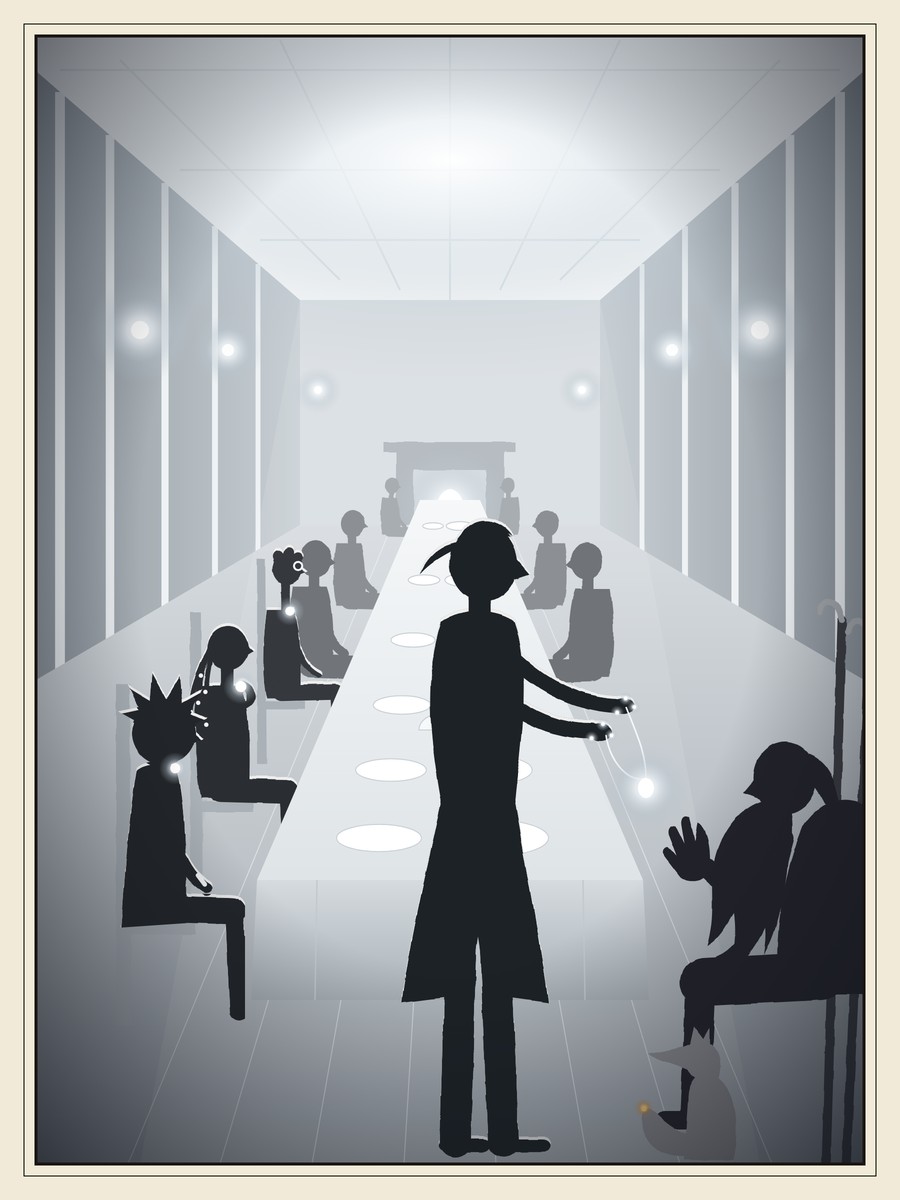
The banqueting hall was the largest room Wren had ever been in, and its ceiling was a single stone.
That is not a figure of speech. Over the whole length of the hall, high above the long white table, stretched one vast smooth glowstone, white and flawless and shining, like the underside of a frozen sea. Its light fell straight down on the table and on the white cloth and on the white dishes and on the white faces of the guests — for there were other guests, a dozen or so, pale quiet ladies and gentlemen in white, who smiled at the newcomers very politely and then went back to looking at their plates.
The food was white too. There was white fish and white soup and a great white pie, and little white cakes, and bowls of something white and wobbling that Mira poked with her spoon and said looked like a caught cloud. It was all very fine and very plentiful. And it all tasted, Wren thought, of very nearly nothing — as if somebody had cooked a dinner and then carefully taken the taste out of it before bringing it to the table.
Cinder sat beside Ash’s chair and was not given anything, because nobody had thought to set a place for a fox. She bore this for two courses. Then a footman put down a silver dish of small white biscuits near the corner of the table, and turned his back, and a grey streak went up and down again so fast that nobody but Wren saw it; and when the footman turned round there was a gap in the biscuits and Cinder was sitting by Ash’s chair exactly as before, looking at the ceiling, chewing.
She chewed thoughtfully. Then she stopped. Then she looked up at the great white stone hanging over all their heads, and her lips drew back from her teeth, and she sneezed at it — such a sneeze as Wren had never heard from her: a great, furious, crackling sneeze, full of sparks, that shot up into the air like a little rocket of gold and went out halfway to the ceiling.
Every pale face at the table turned to look.
“Dear me,” said Oskar Venn, laughing, and the pale faces turned away again. “What a remarkable little creature. Is she always so fierce?”
“Only,” said Ash, “with some things.”
Venn did not seem to hear. He had put down his spoon and leaned back in his great white chair, and he was looking down the long shining table at them all with his kind, handsome face full of light.
“I will tell you my dream,” he said. “I tell it to everyone who comes here, I’m afraid. I’m an old bore about it. But you have come so far, and seen so much of the dark, that I think you of all people will understand.” He spread his ringed hands, and the little stones glittered. “No more Rings. No more oil. No more Guilds charging the poor for a candle. Light for everyone, for ever — free. That is all I want, my dears. That is all I have ever wanted. A stone on every windowsill in Gloamhaven, from the coast to the mountains. Never dimming. Never needing to be filled. Never going out.” His voice grew softer. “No more lamps to be kept. No more lamplighters to grow old.”
He said the last part looking at Old Ash’s pole, where it leaned against the table beside him; and his face as he said it was gentle, and sad, and kind.
Ash did not say anything at all.
Tobin had been staring at Venn with his mouth a little open, and his fork forgotten in his hand. “But how?” he said. “Sir — how do they work? There’s no fuel. There’s nothing going in. Things don’t just shine. I’ve looked at the lamp-posts and there isn’t even a wire—“
Venn laughed delightedly. “A boy who wants to know how things work! My dear young man, you would have done well in my Company. They are mined, under our very feet, and finished in our works down by the harbour. As to the rest—“ he tapped the side of his nose with one cold, glittering finger, “—a merchant must have his secrets. But they work. You’ve seen that they work.”
“Could they work in Emberwick?” said Tobin. He said it very quickly, as if he had been holding it in all evening. “If — if somebody took enough of them north. To a city whose Ring was failing. Could you light a whole wall with them? So that nobody there had to be — afraid any more?”
Venn looked at him for a long moment, and his face went soft.
“That,” he said, “is the whole of my dream, my boy. Emberwick, and every city like it. And sooner than you think.”
Tobin sat back. He did not say anything else. But Wren saw his hand go to his left coat pocket, and stay there.
When the last white cakes had been taken away, Venn clapped his cold hands, and three footmen came in, each carrying a little cushion of white velvet. On each cushion, coiled up like a sleeping snake, lay a fine white chain; and on each chain hung a small, smooth, perfect glowstone, about the size of a robin’s egg.
“A welcome gift,” said Venn. “Everyone in Vaelport wears one. I could not let my guests be the only people in the city without a light of their own.”
Mira gave a little cry. Her footman bent, and she put out her hands, and Venn himself came round the table and took the chain from the cushion and fastened it round her neck. The stone lay in the hollow of her throat and shone up into her face, and in its light her face was white and smooth and still, like a face carved out of soap. She touched it with her fingertips.
“It’s so bright,” she said. “It’s mine? Truly?”
“Truly,” said Venn.
Tobin’s footman held out the cushion to him, and Tobin looked at it, and looked at Wren, and then took it, a little awkwardly, and put it on. Perhaps he did not want to be rude. Perhaps he wanted it. I do not think he knew himself.
The third footman came to Wren.
She looked at the stone on the white velvet for a long time. It was beautiful. There is no use pretending it was not. It was the most beautiful thing anyone had ever offered her, except for one; and that one was lying warm against her ribs, inside her coat, where nobody could see it. Every eye at the table was on her. The pale ladies and gentlemen had stopped looking at their plates. And Wren had been brought up in Soot Lane, where if a nob offers you something in front of other nobs, you take it, and say thank you, and run.
She took it. She said thank you. She fastened the chain round her own neck — the clasp was so cold it stung — and the stone lay against her throat, and she did not run.
Then Venn turned to Old Ash. And there was no footman beside Ash, because Venn had come round the table himself, holding a fourth chain in his own two hands — a finer one than the others, Wren thought, with a larger stone.
“For you, old friend,” he said softly. “You have kept the lights of other people long enough. Let somebody keep one for you.”
Ash looked at the stone. He looked at it for a long while, in a way Wren could not read. Then he raised his eyes to Venn’s face.
“Thank you, sir,” he said. “It’s very handsomely meant. But I’m an old man, sir. I’ve a lamp of my own, and I’m used to it.”
He said it with perfect courtesy — as kindly and as gravely as if Venn had offered him a second helping of pie. And there was nothing in the world anybody could say to it. Venn held the chain a moment longer. Then he laughed, and bowed, and gave it back to the footman.
“Of course,” he said. “Of course. Old habits.” And he went back round the table to his own chair; and on the way he walked wide of the old marble fireplace at the end of the hall, though there was only a glowstone shining in it now — quite wide, without seeming to notice — the way you might walk wide of a dog that had once bitten you.
“I never could abide a fire,” he said, seeing Wren watch him. He smiled. “Smoke, and heat, and danger. Nasty, dirty, hungry things. Do you know, my dear, I don’t believe I have sat beside one since I was a boy.” He settled himself in his chair. And then, as if it had only just come into his head: “But you have a lamp, I think. An old one. I heard something of it. I’m a great lover of old lamps — they’ll all be curiosities soon, you know. I should very much like to see it.”
Wren’s heart gave one hard knock.
She felt the lamp against her ribs, warm and steady. She felt Ash, beside her, not moving at all. And she did not decide anything. Her mouth simply opened, the way it had a thousand times in Soot Lane, and the lie came out of it smooth and easy, before she had even thought.
“It’s back at the inn,” she said. “Sir.”
Oskar Venn looked at her across the long white table. His face did not change. He went on smiling his warm, handsome, kindly smile.
“Another time, then,” he said.
It was very late when the white carriage set them down again at the bottom of the white stair. The Salt Lantern was as bright as day. They climbed the four flights in silence and went to bed without talking, and Ash tied his strip of linen over his eyes and lay down with his poles beside him, and in a little while Tobin’s breathing went slow, and so did Mira’s.
Wren lay awake.
The stone at her throat was cold. She had thought it would warm up, the way a coin warms in your hand if you hold it long enough. It had not. It lay in the hollow of her neck as cold as the moment she put it on, as cold as Venn’s hand; and the longer she lay there, the more she noticed something else, something she could not put a name to. It was a little like being hungry, only it was not in her stomach. It was a little like being sad, only there was nothing to be sad about. She felt, she thought, a little emptier. The way you feel when you have forgotten something, and cannot think what — and keep reaching for it, and it is not there.
She told herself she was tired. She told herself it was the rich food. She did not believe either.
At last she tucked the stone down inside her collar, out of the way, and pulled the blanket over her head, and undid her coat, and took out the lamp.
It was still there. Of course it was. The little gold flame stood up straight inside the cracked chimney, and her ribbon went red, and her hands went brown, the way they always did. Nothing had changed.
Only — it was heavy.
Wren frowned. She shifted it from one hand to the other. She had carried this lamp across the Greywaste and down into the Deeps and up the Black Stair, and it had never weighed more than a loaf. Now it pulled at her wrists as if it were made of lead, and her arms ached with holding it, and she could not for the life of her think why.
She put it away again inside her coat. She lay a long time in the shadowless white light, with one hand on the lamp and the other on the stone, and did not know which one she was holding on to.
Chapter 2 complete
Oskar Venn’s Welcome