Chapter 1 · 17 min read · 22 min listen
The City That Never Dims
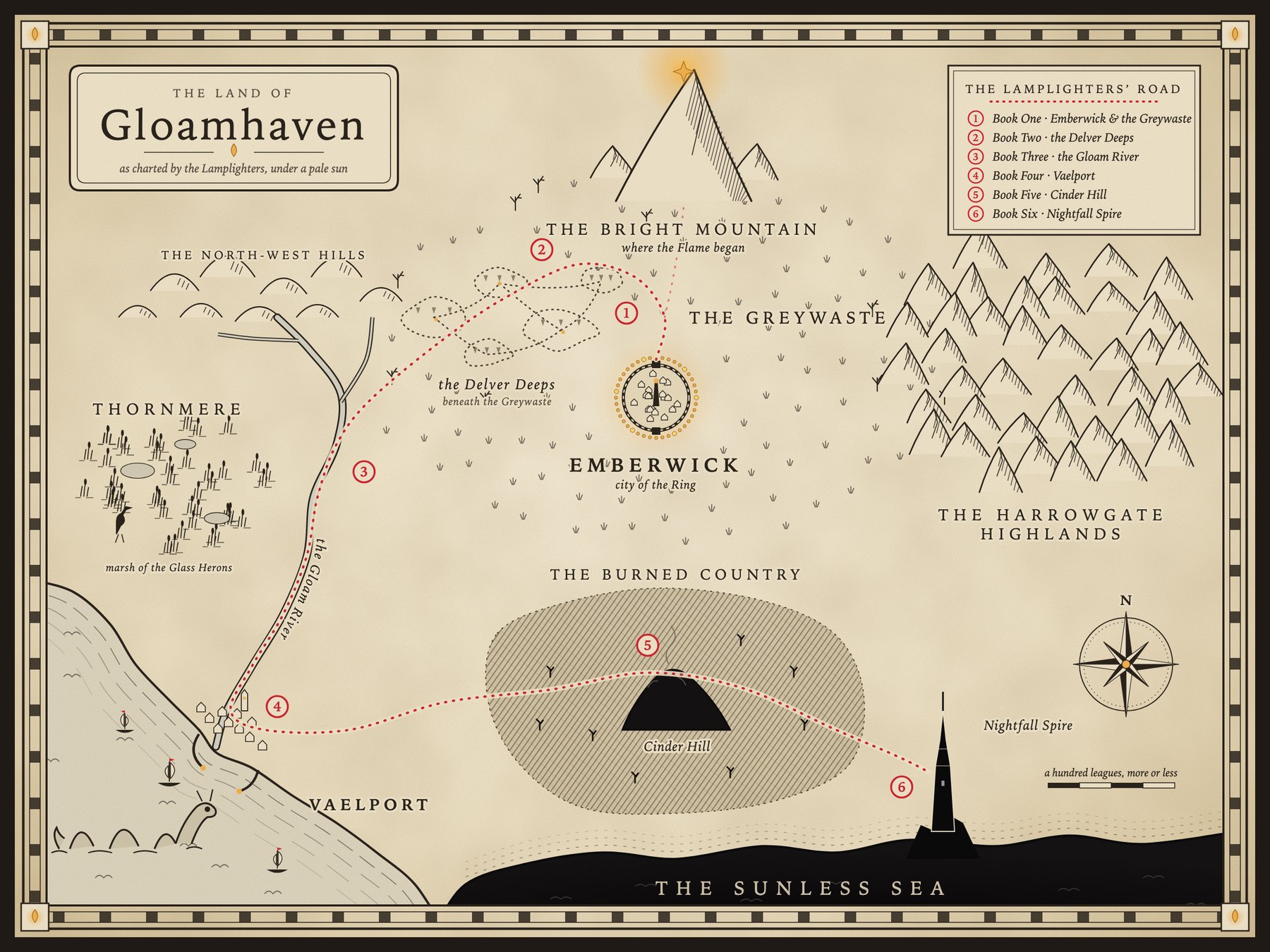
The gates of Vaelport had no guard on them. That was the first surprise.
Every gate Wren had ever known had somebody standing in it with a hand out. Even the Delvers, who did not believe in money, had made you stand and be clicked at before they let you past.
The gates of Vaelport had a man in a white coat on a white stool, and he did not hold out his hand at all. He was not old, but he looked tired. Round his neck on a fine string hung a little smooth white stone, no bigger than a thumbnail, and it shone. When the travellers came up the road, carts and bundles and babies and all, he only lifted one hand a little way off his knee and let it fall again.
“Welcome to Vaelport,” he said. “The light is free to all who come in.”
Then he looked past them at the next cart, and said it again, in exactly the same voice.
“Free,” breathed the woman with the baby, who had walked beside them all that morning. Then she gathered her two small boys by their collars and went in at a half-run, and they did not see her again.
Wren stood in the gateway with her coat done up to her chin and the lamp warm against her ribs.
“He never asked our names,” she said.
“Perhaps they don’t need to know them,” said Tobin.
“Everybody wants to know your name,” said Wren, “if they’re going to send you a bill.” But Old Ash had already set his two poles on the shining paving and gone stumping in under the arch, with Cinder pressed so close against his boot that she was nearly underneath it; so Wren shut her mouth and followed, and Tobin followed her, and Mira came last of all with one hand over her eyes and the other holding a fistful of the back of Wren’s coat.
I wish I could tell you what Vaelport looked like in proper colours, the way you would want a city in a story to look. But I cannot, because it did not have any.
It was white. The streets were paved with a white stone that glittered underfoot like frost on a step. The houses were white, and the walls, and the steep stairs that climbed from one tier of the city to the next; and above them, terrace after terrace, rose white towers and white domes and white galleries, all the way to the top of the hill, where something enormous and made of glass threw the light back so fiercely that you could not look at it for long.
And everywhere — on every lamp-post and doorstep and windowsill, set into the walls at the street-corners, hanging from the masts of the ships far below in the harbour — there were the stones. Some were small as a bead and some as big as a loaf; over the door of one tall house there was one as big as a sheep. They did not flicker. They did not smoke. They did not lean towards you, the way a flame does when you come near it. They simply shone, all of them, all at once, with a steady white light that came from everywhere and went everywhere.
“Oh,” said Mira. “Oh, it’s loud.” She peered out between her fingers at the nearest wall. “Wren. What colour is that?”
“White,” said Wren.
“And that?” A doorway.
“White.”
“And the steps? And that man’s coat? And those birds on the roof?”
The birds were gulls, standing in a row along a gutter with their feathers puffed against the wind. In Emberwick Wren would have called them grey. Here they were the colour of everything else.
“White,” she said. “It’s all white, Mira. I’m sorry. I’d tell you if it wasn’t.”
“Oh,” said Mira, and was quiet for a moment. “There seems to be a great deal of it.”
It is a strange thing, but a world made all of one colour is not a bright world, however much light it has in it. It is like a song made all of one note.
She looked down at her wrist. The ribbon there was as white as the street.
Tobin, meanwhile, had found a lamp-post, and was walking round it. He went round it twice, and crouched to look at its foot, and stood on his toes to look at its head, and pushed his spectacles up his nose and said, “But that’s impossible.”
“What is?”
“There’s nothing in it.” He rapped the post with his knuckles. It rang. “No pipe. No oil, no wick, no reservoir, no flame-wire, nothing coming up from underneath. It isn’t connected to anything. It’s a stone in a cup, and it’s shining.” He swung round, his face white in the white light. “There must be ten thousand of them, and not one needs filling, or trimming, or a Guild to keep it. It’s the most remarkable piece of engineering I’ve ever seen, and I can’t even tell what kind of engineering it is.”
“Perhaps it isn’t engineering,” said Wren.
“Everything’s engineering,” said Tobin, “if you look at it long enough.” But his hand had gone to his left coat pocket, where the letter was, and his face had the eager, faraway look it had worn on the headland the night before. Wren knew what he was thinking. She did not say anything.
There were a great many people in Vaelport, and after a while Wren could not stop noticing them.
Some, like the woman with the baby, were newcomers, with the dust of the road on their boots, staring about them with their mouths open. But most belonged here. You could tell, because every one of them wore a little shining stone at the throat; and because every one of them looked tired.
Not ill. Not unhappy, exactly. But they all moved slowly, as if they had all the time in the world and nothing much to do with it. Their faces were pale and pleasant and did not change much while they talked. Nobody hurried. Nobody shouted across the street. Nobody was singing — not a fishwife at a stall, not a man up a ladder — and if you have ever walked through a city of thousands where nobody at all is singing, you will know how strange that is, even if you cannot say at first what is wrong.
And nobody laughed. In Soot Lane you heard laughing every minute of the day, even when there was nothing to laugh about. Here there was the slow tramp of feet, and the gulls, and the sea far below breathing in and out; and that was all.
They passed a white square with a fountain in it, and a dozen children were there. That was the worst. They were walking. Two were walking slowly round the fountain, one behind the other. Nobody was running. Nobody was being it. Nobody was splashing anybody. A very small boy stood by himself at the edge of the square, holding his little glowstone up in both fists and looking into it; and he did not look away from it once, all the time that Wren was watching him.
“They’re very well behaved,” said Tobin uncertainly.
“Children aren’t well behaved,” said Wren. “Not that well. Not all at once.”
Cinder agreed with her. She went along the white streets low to the ground with her ears flat, and the spark at the tip of her tail had stayed small and dim ever since the gates. Every time they passed a glowstone close enough to sniff, she sniffed it — and sneezed, hard, a short furious sneeze full of tiny sparks that went out at once on the white stone. By the harbour she had sneezed at nineteen of them (Tobin counted).
“Hm,” said Old Ash, watching her. “Quite right, girl.”
Wren put her hand in her pocket and found the singing-stone. It lay against her fingers cool and still, and did not hum at all. In this whole bright, tired, silent city it found nothing to sing about. She did not know why that made her feel worse instead of better. But it did.
They found the Salt Lantern because Mira smelt it. “Fish,” she said, halfway down a steep white stair that zigzagged towards the water. “And tar, and — somebody has burned toast. Down there.” And she pointed, with her eyes shut, to a narrow tall house wedged in at the bottom of the stair between a sail-maker’s and a chandler’s, leaning out over the harbour as if it wanted to see what the boats were doing.
It had a sign on an iron bracket: a painted lantern, with a round hole cut in the middle and a glowstone set in it, so that the sign shone like everything else. The landlady was a large, soft woman in a grey apron. She was kind; Wren could see that at once. She pulled out a chair for Old Ash without being asked. But she did it all slowly, in a flat, faraway voice, as if she were telling you about something that had happened to somebody else a long time ago.
“You’ll want the top room,” she said. “It’s got the four beds.”
“We haven’t any money,” said Wren.
“Newcomers don’t pay, love. Not your first week. The Company sees to that — Master Venn’s orders, ever since the refugees started coming down from the hills.” She turned the big book on the counter round towards Ash. “Just put your names.”
“The Company?” said Tobin.
“The Glowstone Company. Master Oskar Venn’s.” She said it the way you might say the weather. “It’s his light. All of it.”
Ash took the pen and looked at the book for some time. Then he wrote, in his tall old-fashioned hand, Four travellers from the north, and a fox.
“Hm,” he said. “Very kind of Master Venn.”
“He’s ever so kind,” agreed the landlady, without any feeling at all.
Supper was white fish in a white sauce with white bread, and it did not taste of very much. Mira chattered all through it. She had spent the afternoon in the kitchen, finding out what burned toast looked like (“Black,” she said, “at last, a colour that isn’t white!”), and telling the landlady all about the Ferryman, and the mist, and how he had put his thumbs on her eyes.
“Mira,” said Wren, low. “You never said about—“
“The lamp? I didn’t. Well — I said the first thing I ever saw was a lamp. Not which.” Mira did not seem worried. “She didn’t believe a word of it. She said everybody in Vaelport could see perfectly well, thank you, and what was a ferry?”
When Ash asked, very courteously, for boiling water for his tea, the landlady looked at him as if he had asked for boiling custard. “The range is never lit after noon, love. Nobody needs a fire in Vaelport.”
There had been a hearth in the common room once, a great old brick fireplace big enough to roast a pig in. Somebody had bricked it up long ago and set a glowstone in the middle of the bricks, where the flames should have been. It shone out into the room, white and steady, and nobody sat near it, because it was not warm.
So Ash made his tea with water that had stood by the range since noon, out of the battered tin that had come all the way from the Leaning Tower. If you remember Old Ash’s tea, you will know that it was not improved by being made with water hardly warmer than a puddle. The leaves did not sink. They floated on top in a sullen brown raft. Ash drank it straight down with great dignity and said that it was a very interesting cup. Tobin tasted his and had to go and stand by the window.
Mira laughed out loud. The fishermen at the next table turned their pale faces slowly towards the sound, as if they had heard a strange bird; and then, slowly, turned away again.
Night came, and it did not get dark.
That is easy to write, but you will not understand it unless you have tried to sleep somewhere like Vaelport, and I hope very much that you never will. The sun went down, small and pale, into the grey sea, and the stars should have come out. They did not, because the sky over Vaelport was a dirty glowing white, lit from beneath by ten thousand stones; and the stones did not dim. At midnight the top room of the Salt Lantern was exactly as bright as it had been at noon. Set into the stone of the windowsill, on the outside, where you could not reach it, was a glowstone the size of a man’s fist; and there were no curtains, and no shutters, and it shone in through the glass like a cold moon that had come down to stand on the ledge and stare.
The landlady had left four strips of white linen on the pillows. “For your eyes. Everybody does it.” Ash tied his on and lay on his back with his poles beside him and his hands folded on his chest, like a knight on a tomb. Tobin tied his on and lay there twitching. Mira tied hers on, and took it off, and said it didn’t stop the loudness, it only made it shout more quietly.
Wren did not tie hers on at all. She lay with her back to the window, looking at her own white hand on the white cover — and noticed, for the first time, that there were no shadows. The light came in at the window and up from the street and down off the glowing sky, from so many places at once that it filled the room the way water fills a jug, and there was nowhere left for a shadow to be. She moved her fingers. Nothing moved with them.
She had spent half her life in flues and chimneys and garrets with no coal. I do not think she had ever once wanted the dark so badly.
At last she pulled the cover up over her head like a tent, drew her knees up inside it, and undid her coat. She only meant to look. She took the little brass lamp out from against her ribs and held it in her two hands, there in the white cave of the blanket.
And her heart sank. It looked so small.
In the Deeps it had been like the sun. But here the white light of Vaelport came pouring through the blanket from every side, and beside the great stone on the windowsill the lamp looked yellow and dim and ordinary — a little smudge of gold, like a candle at noon. All day she had walked through a city lit by stones that never needed filling and never went out. And she was carrying this: a battered brass thing with a dent in its side and a crack in its chimney, the sort of thing Grubb would have offered her a copper for, and then taken back.
For a moment — I am sorry to tell you this, but it is true — Wren Ashby was ashamed of it.
Then she looked down at her wrist.
The ribbon was red.
Not frosted, not bleached. Red — true berry red, warm and glad, the colour it had gone on the very first night in the flue at Thornbury House. And the red was spreading. In the little circle of the lamp’s light her hands had gone brown and pink. Her coat was brown again — sooty brown, Soot Lane brown, the most beautiful brown she had ever seen.
The blanket lifted at the edge.
“I could hear you,” whispered Mira, and crawled in beside her. “You breathe differently when you’ve got it out. Like you’ve come in from the cold.” She looked at the lamp. Then, slowly, she held up her own hand and turned it this way and that in the gold.
Her face had come back. That was the only way Wren could think of it afterwards. All day under the glowstones Mira’s face had been pale and blank as paper. Now there was pink in her cheeks, and her eyes were dark and bright, and there was a scatter of tiny brown freckles across her nose that Wren had never noticed before.
“There I am,” said Mira softly. “I was beginning to wonder.”
Then the blanket lifted on the other side, and there was a third head under it, with spectacles on; and Tobin’s hair was yellow and his ears were pink, and his face was so plainly relieved that Mira had to put her hand over her mouth.
“I wasn’t asleep,” Tobin whispered. “I kept thinking it must be morning, and then it wasn’t, and then it still wasn’t.” He looked at the lamp, and something in his shoulders let go. “Oh. That’s better.”
So there they sat, the three of them, under a white blanket in a white room in a white city, with their heads together round one small yellow flame; and Cinder came padding across the floor and shoved her way in among their knees, and the spark at the end of her tail glowed gold for the first time all day.
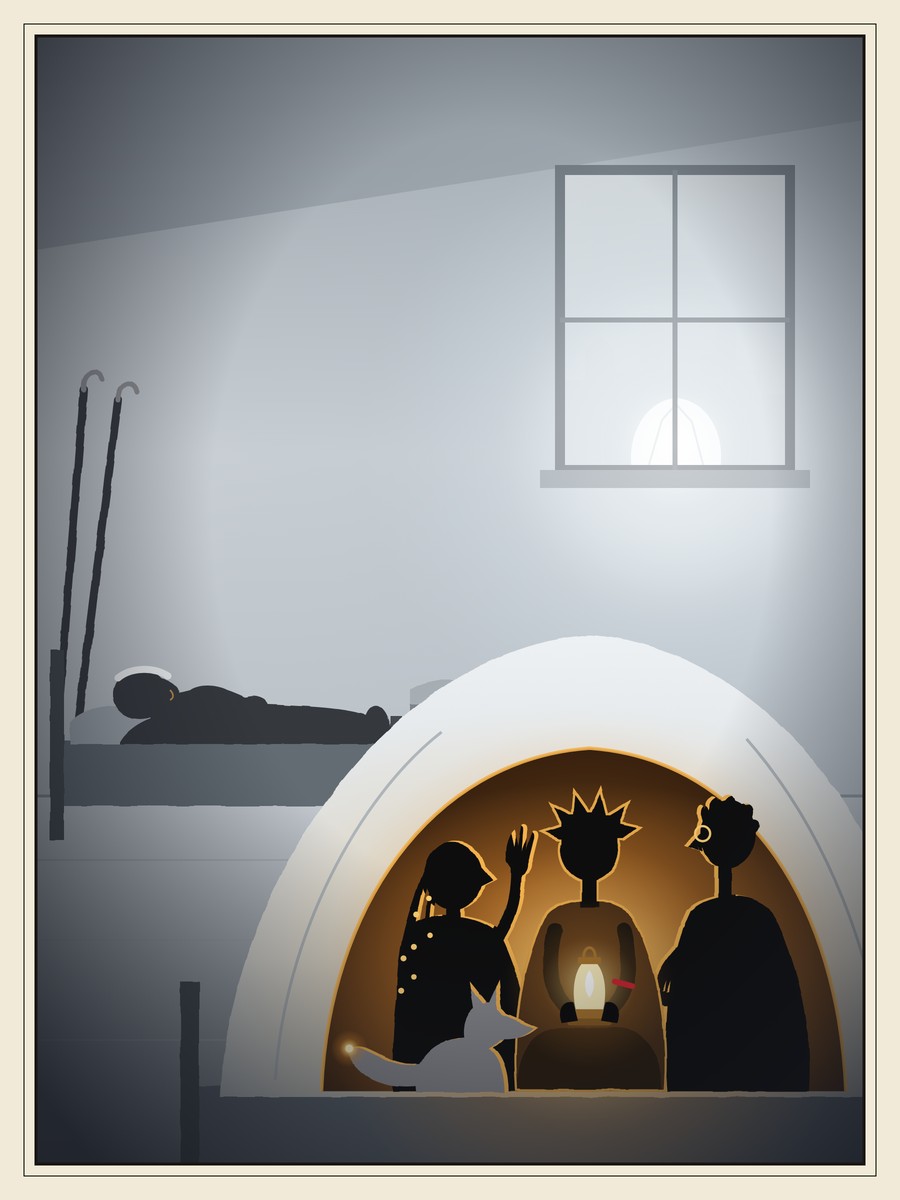
When Wren put her head out at last to breathe, Old Ash was lying exactly as before. But he had pushed the linen up off his eyes, and turned his head on the pillow, and he was looking at the faint gold glow under the blanket — the only warm light in all of Vaelport.
“Hm,” he said at last. Then he pulled the linen down again, and turned his face to the ceiling.
In the morning — if you could call it morning, when it looked exactly like the night — Wren was woken by the clatter of hooves and the grinding of wheels, and they stopped right outside the Salt Lantern.
She went to the window.
In the street below stood a carriage. It was white, of course, drawn by two white horses with white plumes, with silver on its wheels and a little glowstone shining like a star at each of its four corners.
A footman got down from the back, very tall and straight, in a white coat and white gloves, carrying a white card on a silver tray. He looked up at the front of the inn, window by window, until he found the top one. Wren did not duck back quickly enough. His eyes met hers, and he bowed.
A few minutes later the landlady came puffing up the four flights and gave the card to Old Ash. Ash read it, and handed it to Tobin; and Tobin pushed his spectacles up his nose and read it aloud, in a voice that grew more uncertain as he went.
“Master Oskar Venn has heard that travellers have come from the north with an old lamp. He would be honoured if you would dine with him.”
Nobody said anything.
Wren looked at Mira, and Mira, very pink, shook her head. A lamp, she mouthed. I only ever said a lamp. Wren looked down at her own coat, done up to the chin, and at the small warm weight inside it, which she had not taken out anywhere in all of Vaelport except under a blanket in the middle of the night.
“Old,” she said. “It says an old lamp. How did he know?”
Old Ash took the card back and turned it over in his long fingers. It was thick and white, and very cold to the touch.
“Hm,” he said. “That, child, is a very good question.”
Chapter 1 complete
The City That Never Dims