Chapter 14 · 17 min read · 22 min listen
The Docks at Low Tide
In the morning the sun came up over Vaelport, exactly as it always had.
That was the strange thing. After a night like that one, it seemed to Wren that the sun ought to have stayed down, or come up black. But it rose over the hills at the usual time, pale as a coin seen through dirty water; and Vaelport, which had not looked at its own sun for a hundred years, looked at it now, and found it was nothing much.
Wren saw it through a crack in the planks of an upturned boat.
It was the street-children’s den under the fish-market, where Pim had tried to pick her pocket a hundred years ago, last week. It was empty now: old sacks, a heap of crab shells, and a little pile of glowstones on strings, every one cracked and dull and grey, like pebbles from a cold beach. Wren had swept them into a corner with her foot and not looked at them since.
She sat with her back against the curve of the hull and her knees drawn up and the lamp in her lap.
It was still burning. It had burned all night. But it had not grown any bigger, and it gave off no more warmth than a cup of tea that somebody has forgotten to drink. Wren looked at it for a long time.
Was it ever real? she thought.
It was a terrible thought, and once she had had it she could not stop. Perhaps it was only a little old lamp, and she was only a sweep who had found it in a chimney, and all the rest — the Beacon, and the Ring, and the Black Stair, and Mrs Fenn remembering her children’s names — had been a sort of story, like the ones Ash told. Perhaps Ash had been exactly what Emberwick always said he was. A mad old man in a patched coat, walking the wall at night, talking to lamps.
A mad old man who made the worst tea in the world.
She had not meant to think of the tea. It came up all by itself, the way a bubble comes up through the Soot Canal. That first night in the Leaning Tower, with the stuffed owl glaring down from the shelf and Cinder stealing her biscuit; and Ash pouring out something black and steaming from a pot with a broken spout, and putting it into her hands as if it were a great treat. It had tasted like a boot that had been boiled in a puddle. She had told him so. And he had looked at her over his beard and said, “Hm,” and drunk his own cup to the bottom, and poured himself another.
He could say anything with hm. That was the thing about him. He had a hm for when you were being stupid, and a hm for when you were being clever and he did not want you to know he had noticed, and a hm for Varrick, and a hm for bad weather, and a very small, very quiet hm for when somebody had done something brave. Tobin had once tried to make a list of them. He had got to eleven.
Wren laughed.
It came out of her all by itself, a short cracked sound in the empty boat. And as soon as it was out, something gave way behind it, like a wall that has been holding back water for a long time; and she put her face down on her knees and cried.
She had not cried in the mine, or on the harbour wall, or all night in the boat with her eyes open. She cried now, for a long time, in great ugly gulps that hurt her chest — for the tea, and the poles, and the owl, and the singed side of his beard, and the way he always divided the last of the food and then said he was not hungry. For mind the step. For his voice, and the door, and the dark coming down between.
I will not tell you any more about that, because it was hers. But I will tell you this much: it was the right thing to do, and it was a long time coming.
When at last she stopped, she could hardly lift her head. That was when the voice came.
It came from nowhere and everywhere, soft and close, like somebody leaning down to speak into her ear. It was a beautiful voice — sweet and low and reasonable, like warm milk; only, somewhere underneath the sweetness, the milk was going cold.
There now, it said. There now. It’s over, child. You did your best. Nobody could have done more. You carried it all that way, and you were brave, and he’s gone anyway. That’s the end of the story. You can stop now.
Wren did not move.
Lie down, said the voice. Close your eyes. It is easier in the grey.
And the dreadful thing was that it was right. It would be easier. Wren was so tired. The boat was dim and quiet. She slid down a little against the hull. Her eyes were closing.
Without quite knowing why, she began to hum.
Morning comes, morning comes…
It was her mother’s song, the one she had always had, the one Ash had hummed on the wall at Emberwick the night she first heard it again. She hummed it under her breath, the way you whistle in an empty house. Morning comes, morning comes, and the dark shall not keep us…
Then she stopped. Because that was where it always ended. She did not know the rest. She had never known it, and now there was nobody to ask.
The voice was quiet for a moment. Then it laughed — softly, kindly — and was gone; and Wren lay in the bottom of the boat with her cheek against the cold planks, and did not hum any more.
Something scraped at the gap under the hull.
It was Cinder. She came wriggling in on her belly, grey with dust, her ears flat and her tail low, dragging something in her teeth. She laid it down in Wren’s lap and stood back and looked at her.
It was a long knitted scarf. Wren knew it at once. She would have known it in the dark. It smelt of ink and machine-oil and the inside of a boy’s coat pocket, and it had been wound twice round a thin neck all the way from Emberwick.
“Don’t,” said Wren. “Don’t you bring me his things.”
Cinder sneezed. It was only a very small sneeze, and only one spark came out of it, and that one was grey before it hit the planks. Then she turned round and went out again, the way she had come, without looking back.
Wren sat with the scarf in her lap for a long time. She did not throw it away.
There was one fire on Lantern Steps.
It was in the little cottage with the blue door, where Rose Pellow had gone on lighting her hearth every evening out of plain old habit, long after everyone else in Vaelport had stopped. Nobody needs a fire in Vaelport, Rose, the neighbours used to say. But on the night the lights went out it was the only fire for half a mile; and the people of Lantern Steps, stumbling in the dark, saw the red of it through the window and came knocking.
By the second morning there were thirty people in the Pellows’ cottage, and more on the steps outside.
Mira was in the middle of them.
She had brought the crying child up from the quay on the first night, and had stayed. There was always one more frightened person at the door, and one more child who had lost its mother in the dark, and Mira, it turned out, was the only person on Lantern Steps who was not frightened of the dark at all.
“Put your hand on the wall,” she was saying. “Flat. Now walk, and count your steps. Walls are really very helpful, if you let them be.” And then, to a ring of small children sitting cross-legged in front of her: “Now. Who can do it? Put your tongue behind your teeth — tk. And listen.”
“Tk,” went a dozen small tongues, all out of time.
“Very good. That was terrible. Again.”
Mr Pellow, big and slow and patient, was out in the yard teaching grown men to make fire: how to strike a spark onto a scrap of dry tow, and blow on it gently, and feed it, the way you feed something small that you want to grow. Driftwood came up from the beach in armfuls. By the second night there were fires burning all the way down Lantern Steps — small and smoky and crooked — and people sitting round them, very close together, as if they had forgotten that you could.
And in the corner by the Pellows’ hearth sat the tired children.
There were nine of them, gathered from the harbour and the alleys: the young ones who had gone quiet. They sat in a row with blankets round them, grey and silent, and looked at the fire.
Pim was at the end of the row.
She still wore her man’s coat with the sleeves rolled up eight times, and her dead glowstone on its string, which she would not let anyone take off her. Her face was the colour of the ashes in the grate, and when Mira said her name she did not turn her head.
But something was happening to the others. It was so slow that at first Mira thought she was imagining it. On the second evening the smallest of them, a little girl of four or five, held out her hands to the fire of her own accord. On the third morning a boy asked for more bread — just that, “more, please”, in a voice like a rusty hinge — and Mrs Pellow burst into tears and gave him the whole loaf.
And that afternoon Mira, going down the row with a cup of milk, stopped in front of the little girl and went tk at the end of her nose, just to see.
The little girl blinked. And then — quite suddenly, as if it had surprised her as much as anyone — she laughed.
It was not a big laugh. It was a tiny, hiccupping, rusty thing. But it was a real one; and the whole crowded room went quiet to hear it, as if a bird had begun to sing in winter.
That night, when the cottage had gone to sleep in heaps on the floor, the voice came to Mira.
She was sitting up feeding the fire, because somebody had to, and the voice came out of the shadows behind her, warm and soft and close.
It’s over now, it said. You did your best. But look at them, child. Nine grey children and a handful of crooked fires. What’s that, against all the dark there is? You can’t see in the dark. Nobody can, really. Lie down. It is easier in the grey.
Mira sat very still. Her hands had stopped on the log she was holding.
She was tired. It was a great deal of dark and a very small fire. For a moment she thought how easy it would be to lie down on the warm hearthstone and let the fire go out.
Then she put her head on one side and listened, the way the Delvers do.
“Your voice is warm,” she said at last, slowly. “But it is the wrong kind of warm. It is warm on the outside, like the Palace was bright on the outside.” She put the log on the fire. “I have heard a voice that was warm all the way through. It was in a boat. You are not that one.”
The voice did not answer. But the fire leaned up round the new log, and caught.
In the morning Mrs Pellow came and found her by the hearth, and wrapped a heel of new bread in a clean cloth and pressed it into her hands.
“For the little sweep,” said Mrs Pellow. Her eyes were red, but her voice was quite steady. “You’ll know where she is, I expect. Only don’t tell her it’s from me, pet. She’ll only think she owes me something.” She looked round at her kitchen — at the bodies asleep on the floor, the children by the fire, the boots in a heap by the door — and something in her face went soft and wondering. “Such a quiet house it’s been, Amos and me, since we lost our girl. And look at it now.” She wiped her eyes with her apron. “Go on. Take it to her.”
Mira took it to her. She took Pim too, by the hand, because Pim would not let go of her sleeve.
Wren was in the boat. She did not come out. Mira crawled in under the gunwale with the bread and the grey girl, and sat on the sacks in the dimness, and for a while nobody said anything.
“Tobin has not eaten,” said Mira at last. “I took him soup. Two times. He says thank you, and he doesn’t eat it. He sits on the end of the dock and looks at his hands.”
Wren did not answer.
“I am not going to say anything else about him,” said Mira. “I only thought you should know.” She pushed Pim gently forward. “And I thought you should see her.”
Wren looked at Pim, and Pim looked at nothing.
Wren did not say anything. But after a while she took the lamp out from under Tobin’s scarf, where it had been lying in her lap, and held it out — not high, not grandly; just held it out, the way you might hold out a cup.
“Here,” she said, and her voice was hoarse. “It’s for you. You don’t have to do anything.”
The flame did not blaze. It was much too tired for that. But it leaned. It leaned out towards Pim, slow and low and red, the way a sleepy dog lifts its head when someone it likes comes into the room; and for the first time since the mine, it grew. Not much. About the width of a fingernail. Pim’s coat, in its little circle, turned green — a dull, dark, faded green — and a faint pink came up into her cheeks and stayed there.
Pim blinked. Her lips moved.
“Pim,” she said, very faintly, as though she were reading it off a long way away. “I’m Pim.”
Then she shut her eyes and went to sleep on the sacks, with her head on Mira’s knee.
Wren put the lamp back in her lap. She did not look at Mira. “Take her back to the fire,” she said. “It’s warmer there.” And after a moment: “Tell Mrs Pellow — tell her thanks for the bread.”
“You aren’t supposed to know it was from her.”
“It’s got currants in,” said Wren. “Course I know.”
When Mira had gone, Wren sat looking at the bread. She did not eat it. She was not hungry; she had not been hungry for three days, which was the oddest thing that had ever happened to her. In the end she left it lying on the sacks beside her, and lay down, and shut her eyes.
When she opened them it was gone. There was a long, tidy fox-print in the dust where it had been.
Tobin was sitting on the end of the fish-dock with his legs over the edge, the way he had sat for three days.
He had eaten nothing. The days had gone past him grey and the nights black, and he had hardly moved except to fetch water from the pump.
He looked at his hands. That was mostly what he did. The burns had stopped hurting so much. They were healing in a shape — a round red mark across each palm, the size and shape of the bottom of a little brass lamp — and he thought that they would probably always be there, and that this was right.
He thought about the attic in the Warden’s Hall, and the Orrery ticking quietly under the eaves. He thought that if he had never followed one bright bead down into Soot Lane on a cold night, something terrible would very likely have happened in Emberwick; but Ash would have been alive. Ash would have been sitting in the Leaning Tower that very minute, with his owl and his maps and his dreadful tea, saying hm to Cinder.
I wish it had been you, Wren had said.
So did he. That was the trouble. He could not find a single thing in it to argue with.
The voice found him easily. It did not even need to come close.
There now, it said. You did your best, Tobin. You did it for your father; anyone would have. It was kinder than his father had ever been. But it’s over now. You can’t take it back. Why sit in the cold being sorry? Lie down. It is easier in the grey.
“I know,” said Tobin, aloud, to nobody.
And he lay down — on his back, on the cold wet planks of the dock, with the grey sky above him and the gulls going over — and shut his eyes.
Something heavy landed on his chest.
He opened his eyes. Cinder was standing on him, all four paws, glaring down into his face with her ears flat. In her mouth was a heel of bread with currants in it. She dropped it on his collarbone. Then she lay down, deliberately, right on top of him, the whole small warm weight of her, with her chin on the bread, so that he could not have got up if he had tried, and could not have gone to sleep either.
“Cinder,” said Tobin. “Get off.”
Cinder did not get off. She sneezed — a small, cross, very nearly ordinary sneeze — and one spark came out of it. It was orange. It landed on the planks by his ear and went out.
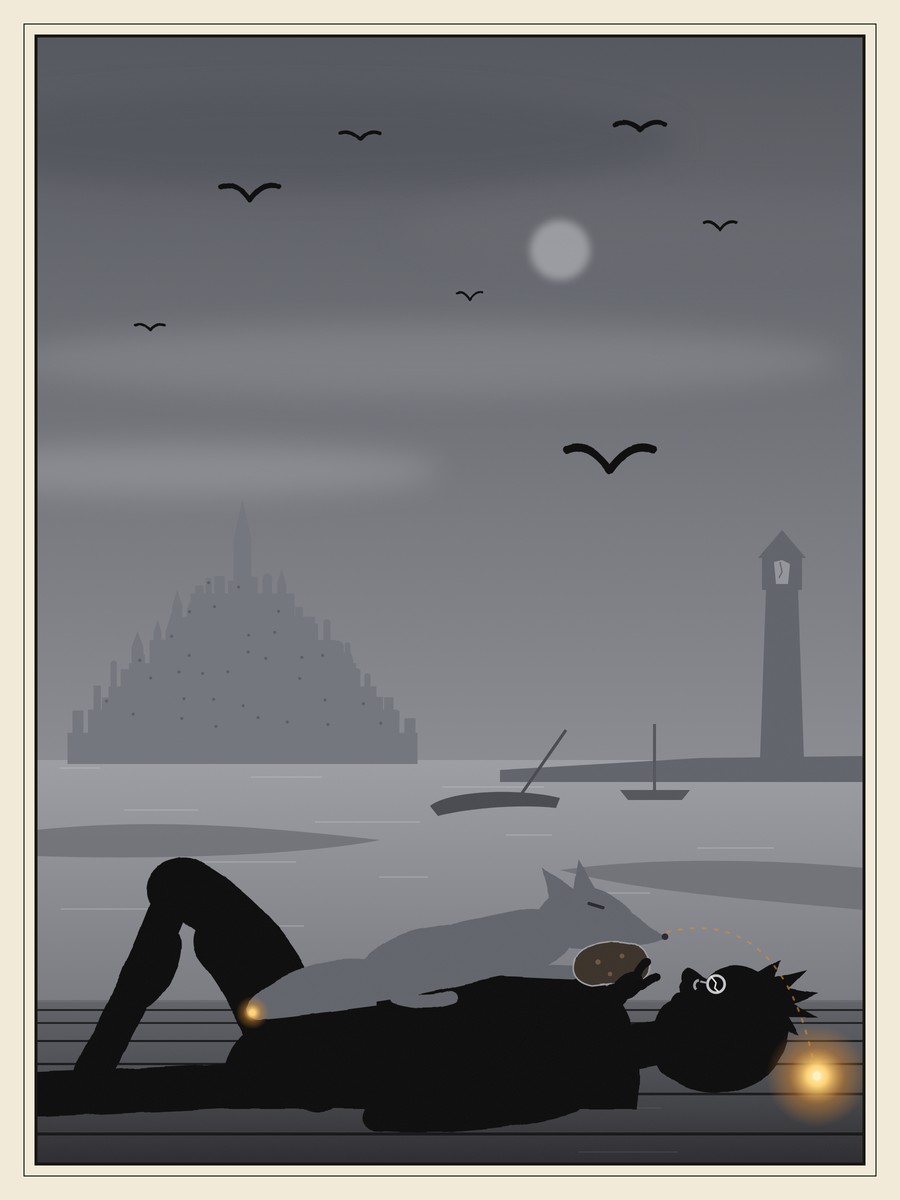
Tobin looked at the bread. He knew, without knowing how, exactly whose it was, and where it had been, and who had not eaten it.
He broke off a corner with his burned fingers, and ate it. It tasted of currants, and fox, and a little bit of fish-dock; and he lay there and ate the rest of it slowly, crumb by crumb, with Cinder’s chin on his chest, while the gulls cried overhead.
He did not cry. He still could not. But when the voice came back that night, soft and close, to tell him again that it was over, he found that he did not lie down to listen to it. He sat up, with a sleeping fox in his lap, and looked at the dark sea until the voice gave up and went away.
Very late that night, when the fires on Lantern Steps had burned down to red, a small figure came along the fish-dock without a light.
She had grown up on roofs; she did not need one. She came silently to the end of the dock and stood looking down at the long shape lying there asleep on the planks, with one arm thrown over its eyes and a grey fox curled in the crook of its knees.
Wren had something in her hand. She had carried it in her coat pocket ever since the night she found it lying on his pillow at the Salt Lantern. It was a small brass compass, dented, with words inside the lid that she could not read in the dark and did not need to.
She stood there for a long time. She opened her mouth once, as if she were going to say something. Then she shut it again.
She bent down and laid the compass on the planks beside his hand, close enough that he would find it when he woke. Then she turned round and went back along the dock the way she had come, and the dark closed behind her.
Cinder opened one eye and watched her go, and did not move.
Out beyond the end of the dock, under the harbour wall, the tide was running out. All night long it went out, quietly, further and further, as if it were going away for good.
Chapter 14 complete
The Docks at Low Tide