Chapter 13 · 17 min read · 22 min listen
Broken
The dust was the first thing. It was everywhere, thick and dry and choking, so that Wren could not tell whether her eyes were open or shut, and every breath she took went down her throat like a mouthful of flour.
The second thing was that she was digging.
She did not remember starting. She was on her knees in the rubble with the lamp clutched against her chest in one hand, and with the other hand she was tearing at the fallen stone where the tunnel had been — pulling out lumps of rock and throwing them behind her, and scrabbling at the next, and the next. Her nails were broken. She did not notice. Somewhere behind the stones, she was quite sure, there was a door, and an old man leaning against it, and in a minute she would get through to him and he would look down at her over his singed beard and say, “Hm. You took your time.”
“Wren.” Something had hold of her sleeve. “Wren. Wren, stop.”
“He’s just there.” Her voice did not sound like her voice. It sounded like somebody a long way off. “He’s only just there, he’s behind the — Mira, help me, he can’t run, he can’t get out on his own, he’s got his leg—“
“Wren, listen to it.” Mira’s hand moved from her sleeve to her wrist and held on. “Listen to the roof.”
Wren did not want to listen to anything. But she could not help it. Above them, all along the tunnel, the rock was making a sound. It was a long, low, grinding groan, like a great beast turning over in its sleep, and every so often there came a sharp crack, and a patter of grit on their heads, and somewhere further off the boom of more stone coming down.
“It is all going to fall,” said Mira, very quietly. “All of it. Not just there. Here too. I can hear it deciding.” Her fingers tightened. “He said go, Wren. He said it to you, and to Cinder, and to me. He held the door so that we could. If we stay here, then he held it for nothing.”
Wren pulled out another stone.
Then something pushed against her other side, warm and small and shaking, and it was Cinder. The fox had not made a sound since that one long howl. She pressed her whole body against Wren’s ribs, and then took Wren’s coat in her teeth, very gently, the way a mother fox takes a cub by the scruff, and pulled.
Wren looked down at her. In the dust and the dark she could just see the end of Cinder’s tail. The spark there, that had always burned so bright and quick, had gone down to almost nothing. It was the faintest pin-prick of orange, like the very last coal in a grate that everyone has gone to bed and left.
But it was there.
Wren did not know why she noticed it. She did not know why, out of all the things in that terrible tunnel, she should look at the end of a fox’s tail and think, very clearly, it hasn’t gone out. It did not seem to mean anything. It did not seem to help. But she got up off her knees.
“Which way?” she said.
If you have ever tried to walk out of a building with your eyes shut, you will know that it is not as easy as it sounds. Now imagine that the building is falling down; and that it keeps going light and dark around you, like a lamp being waved at a window; and that you would give anything in the world to be walking the other way.
The glowstones in the tunnel walls were dying. They flickered — blazing white so bright that it hurt, then going dull and grey, then blazing again — and every few yards one of them split from end to end with a noise like a cracking pond, and went dark, and stayed dark.
Mira had shut her eyes the moment the flickering began.
“Don’t look at it,” she said. “It will only tell you lies. Hold my hand, and don’t look.”
She went first, clicking — tk, tk-tk, tk — with her head on one side and her free hand out in front of her. Wren came behind, holding Mira’s hand in one of hers and the lamp in the other. Cinder ran at their heels and sometimes in front, and sometimes she stopped and looked back the way they had come, and Wren had to call her, and every time it was harder.
The lamp was no help at all.
It had not gone out. But it was burning so low that it hardly lit Wren’s own fingers round it. It was not the blaze it had been in Ash’s hands at the anvil. It was not even the steady little flame she had carried out of Thornbury House. It was a low red glow at the bottom of the chimney, like a coal under ash; and when she held it up, the dark simply came and sat round it, close, and did not move away.
“Left,” said Mira. “There’s a step down. Two. Now there’s water, but it isn’t deep. Now up. Mind your head, Wren, the roof comes low here — there.”
Wren hit her head anyway. She did not even say “blast”. She did not say anything.
They climbed, through galleries where grey miners still stood at their work with their picks raised, not moving. Wren wanted to stop for them. “We can’t carry them, Wren,” said Mira. “Not now. We will come back. I promise,” and her voice cracked on promise, and she clicked and went on.
At one turning the ground shook so hard that they both fell. Behind them something enormous came down with a roar, and a wind full of grit blew past them up the tunnel. Cinder stood over both girls with her teeth bared at the dark, as if she could keep the whole mountain off them by being cross with it.
When it was quiet again, Wren found that she had been listening — not for the roof, but for the sound of two poles on stone, thumping slowly up the tunnel after them. Tock. Tock. Tock. Ash had always been the last. He had always come along behind, slow and grumbling, and arrived when they had stopped expecting him, and said something dry about young legs and old ones.
She listened for it so hard that she almost heard it.
“Come on,” said Mira, and got up, and pulled her up too.
They came out of the Glowstone Company’s works by the harbour, through a door that hung off one hinge, into the open air; and that was when the lights of Vaelport went out.
It began down by the water. The glowstone on the nearest lamp-post gave a sharp little crack, like a nut under a boot, and went grey. Then the one beyond it. Then the ones on the masts in the harbour, crack, crack, crack, faster and faster; and then it ran away up the hill like fire along a fuse, except that it was the opposite of fire — every doorway and tower going from white to grey to nothing, tier after tier, all the way up to the Glass Palace. The Palace was the last. For a moment it hung there alone above the dark city, blazing white, like a great cold star.
Then it cracked too. And there was nothing.
In Wren’s pocket, the singing-stone began to hum again.
It hummed louder than it had ever hummed — one high, thin, rising note that set Wren’s teeth on edge. And she felt the cold. It came up out of every broken stone in the city, like the breath that goes up off a crowd on a frosty morning: thousands of little cold breaths, all let out at once. The wind off the land took it, and it streamed over their heads, pale and faint as smoke, out towards the sea.
Then the stone in Wren’s pocket gave one last shiver, and was quiet.
And it was dark.
I do not mean the kind of dark you get in your bedroom when the lamp is out, with a little grey at the edge of the curtains and the shapes of the chair and the wardrobe coming slowly out to meet you. I mean real dark. There were no stars; the sky was thick with cloud. There was no moon. There was not a candle burning in any window in all that great city, because nobody in Vaelport had owned a candle for a hundred years.
For a moment there was a silence over the whole of Vaelport, as if the city were holding its breath.
Then the screaming started.
It came from everywhere at once. People shouting names. Doors banging. Feet running, and stumbling, and falling, and running again. Somewhere a man was shouting “Where are the lights? Where are the lights?” as if somebody had stolen them and only needed to give them back.
“They don’t know how,” said Mira. She was standing very still beside Wren, with her face turned up towards the noise. “They have never had to. They don’t know how to be in the dark.” She said it with a kind of wonder. “They are all falling over.”
Wren held up the lamp.
It made a circle of light about as wide as a dinner-plate. In it she could see her own hand, and the brass, and the hairline crack in the chimney-glass. That was all.
Mira heard him first.
They had come out along the quay, feeling their way between the fish-crates and the coils of rope — Mira clicking, Wren stumbling — towards the long harbour wall that ran out into the sea. Wren did not know why she was going that way. She was not going anywhere. Her feet were just moving.
Mira stopped.
“There is someone on the wall,” she said. “Sitting. Just there, at the bottom of the steps.” She clicked again, and listened, and her face changed. “Wren. I know that breathing.”
Wren knew who it was before she held up the lamp. She knew it by the shape — the long knees, the elbows — and by the way her heart went hard and cold in her chest, like a stone dropped into a well.
Tobin was sitting on the harbour wall with his back against the steps. His spectacles were crooked. He was holding his hands in his lap, palms up, the way you hold something you are afraid of spilling, and when the low red light of the lamp fell on them, Wren saw why. They were burned. Both palms were red and raw and shining, and blistered across in a shape that she knew at once — the round shape of the bottom of a small brass lamp.
He looked up.
“Wren,” he said. “Mira. Oh — you’re out.” He was trying to stand. “The ground shook, all the way out here, and the stones went dark, and I thought — I’ve been waiting, I didn’t know where else to — where’s Ash?”
Nobody said anything.
Tobin looked from one of them to the other, and then down at the lamp, burning so low in Wren’s hand; and then at Cinder, who had come up and stood a little way off, and was looking at him with her ears flat; and then at the place behind them, in the dark, where an old man on two poles ought to have been coming along slowly and grumbling about the steps.
“Where’s Ash?” he said again, much more quietly.
“He’s in the mine,” said Mira. Her voice shook. “The roof came down. He held the door so that we could get out, and the roof came down between. Tobin, he—“ And then she could not say any more, and she put her hands over her face and began to cry. She cried properly — the way a small child cries, loudly, with her whole body, not caring who heard.
Tobin did not cry. He stood there with his burned hands held out in front of him, and his face went the colour of the grey stone of the wall, and he did not make a sound.
Wren had thought, all the long way up out of the mine, that she would not be able to say anything ever again. She found now that she was wrong. She found that there was something in her, under the place where her heart had gone hard, that was hot and bright and terrible, and that it wanted to come out.
“Why?” she said. “Why did you do it?”
Tobin’s mouth opened. “Varrick — he had a letter. From my father. In his own hand, Wren, I know his hand, he wrote it from a cell, he said he was sorry — and the ring, his ring — Varrick said if I brought the lamp, he’d let Father go, and I thought—“
“A letter.” Wren heard her own voice going up and up. “You sold him for a letter.”
“I didn’t know they’d—“
“You sold the lamp, and you sold Ash, and you sold him for a letter. A bit of paper. Off him. Off Varrick. You know what he is. You knew.” She came a step nearer, and the little red light shook in her fist. “Ash was in a cell because he stood up in the square and told the truth, and you went and crept into my room and took it out of my drawer while I wasn’t there, and you carried it all the way to Varrick with your hands burning, and you still didn’t stop. It was telling you. It was burning you to tell you, and you didn’t stop.”
“I know,” said Tobin.
“You’re just like him. Your father. He sold Emberwick for a throne, and you sold Ash for a letter, and that’s all you Harrowgates ever do, isn’t it — you sell things. You sell people. You sit up in your big cold Hall and you sell people, and you never even have to watch.”
“I know,” said Tobin again.
“Wren—“ said Mira, through her hands. She had stopped crying. She came and stood between them, half facing one way and half the other, with her hands held out a little at her sides as though she were trying to keep two doors from slamming at once. “Wren, please. Please don’t. He is—“
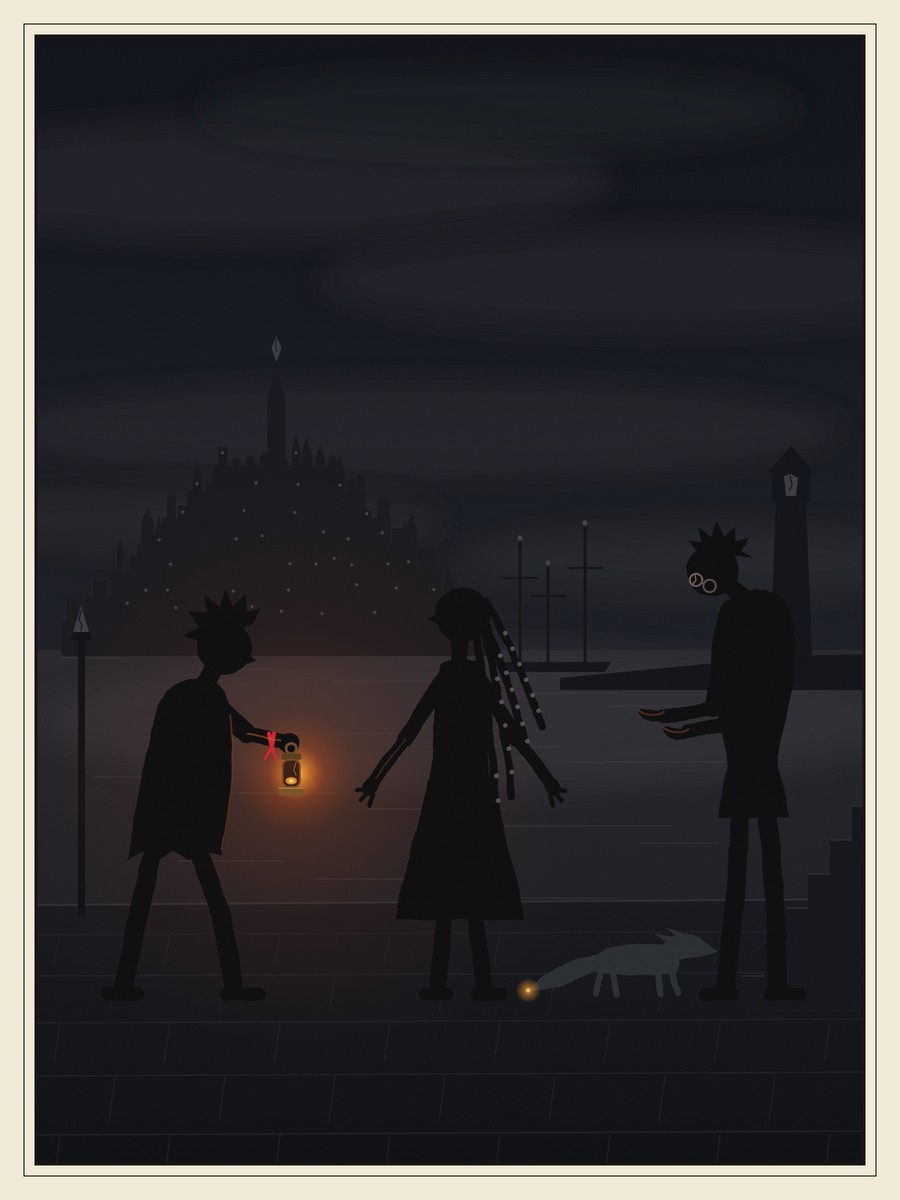
“Don’t you stick up for him!” Wren pushed past her. She did not even see Mira. All she could see was Tobin’s grey face in the low light, and his burned hands, and the spectacles she had laughed at a hundred times, and she wanted to hurt him so badly that it was like a hunger. “He went back for you, Tobin Harrowgate. Do you know that? On the Greywaste. When you froze. He got in front of you with his bad leg, and he got hurt, and he said it wasn’t your fault, and he sat up all night with you telling you you weren’t a coward. And you are. You’re a coward and a thief and a — a Harrowgate. And he’s under the mountain, and you’re here.” Her breath was coming in gulps. “I wish you’d never come out of your Hall. I wish you’d stopped at home with your night-lamp and your clocks and your rotten father. I wish it had been you.”
She stopped.
It was out. It hung there in the cold dark air between them, the way a thing does when it has been said and can never, ever be unsaid. And for one moment Wren felt the hot terrible thing inside her go quiet, as if it were looking at what it had done.
Tobin did not say anything for a long time. Down below the wall, in the dark, the sea moved against the stones.
“I know,” he said at last. “So do I.”
He did not argue. He did not say actually, or technically speaking, or push his spectacles up his nose. He just stood there and let it land on him, all of it, as if it were a thing he was owed; and somehow that was the worst of all. Wren had wanted him to shout back — to say you left the lamp in a drawer, which was true, or you were going to stay with the Pellows, which was true too. If he had shouted, she could have gone on shouting, and the shouting would have filled up the place where Ash had been.
But he only stood there. And there was nothing to fill it with.
The lamp in her hand had gone even lower while she shouted. She looked down at it. It was not out — it never went out — but it was so small now that the dark seemed to be leaning on it. Its warmth was the warmth of a stone that somebody sat on a long time ago and then got up.
Cinder had come into the space between them. She looked up at Wren, and then at Tobin, and then at Mira, and she whined — a small, high, puzzled sound — and went from one to the other, pushing her nose against their legs, as if she were counting them and kept finding that the number was wrong.
Wren turned round and walked away into the dark.
She did not decide to. Her feet simply took her, the way they had in Soot Lane when something went wrong — away, round a corner, up a pipe, anywhere nobody could follow. She went back along the quay with the little red glow in her fist, and the dark closed behind her like water.
“Wren!” Mira called after her. “Wren, you can’t see—“
But Wren had grown up in chimneys. She did not need to see.
Mira stood on the harbour wall and did not know what to do. To her left Wren’s footsteps were going away fast along the quay, the steps of somebody trying not to run. To her right Tobin’s breathing had gone very small, the way it had on the waystone the day of his father’s letter. Neither of them was the right one to follow. Both of them were.
And then, from among the fish-crates on the quay, a child began to cry — a very small child, crying the way children cry when nobody has come for a long time. “Mam? Mam? I can’t see. I can’t see anything. Mam?”
Mira turned her head towards it.
She wiped her face on her sleeve. She clicked once, and listened, and went towards the sound, with her hand out in front of her, the way the Delvers do; and her voice came back through the dark, warm and steady, the voice of somebody who has lived her whole life in the dark and is not one bit afraid of it.
“It’s all right. I’m here. I’m coming. No — stay where you are, I can find you. I can find you without looking. Shall I tell you how?”
So Tobin was left alone on the harbour wall.
He sat down again where he had been sitting, with his back against the steps, and held his burned hands in his lap.
Cinder stood on the stones for a long time, looking after Wren, and then after Mira, and then at Tobin. Her tail hung low behind her. The spark at the end of it was so faint now that you would have had to look very hard to see it at all, and nobody was looking.
But it had not gone out.
I cannot yet tell you why that matters. But I want you to remember it. On the first night that ever fell on Vaelport — with the lamp burning as low as it had ever burned, and three children who had come so far together scattered along a cold quay as if they had never met — at the end of a small grey fox’s tail there was still, very faintly, a spark.
Chapter 13 complete
Broken