Chapter 15 · 17 min read · 22 min listen
Go to the Hill
At low tide, the harbour of Vaelport smelt of mud.
It was not a bad smell, exactly. It was a deep, salty, rotten-green sort of smell, the smell of things that live at the bottom of the sea and do not care who knows it; and in the grey half-light before dawn it came up off the mud-flats in great slow waves, along with the crying of the gulls. The sea had gone right out in the night. Where there had been water there was now a wide brown plain of mud, ribbed and shining, with little channels winding through it and the fishing boats lying over on their sides like tired dogs.
Tobin woke on the end of the fish-dock with a crick in his neck and his hand on something cold.
He did not look at it at once. He lay still for a while with his eyes shut, listening to the gulls, and feeling the shape of it under his fingers: round, and smooth, and dented on one side, with a little hinge. He did not need to look. He had carried it every day since he was five years old.
When at last he sat up and opened his eyes, the compass was lying on the planks beside him exactly where somebody had set it down.
Cinder had gone from the crook of his knees. There was nobody on the dock at all. But Tobin knew who had brought it, as surely as if she had left a note; and he knew, too, that she had come all this way in the dark and stood over him and gone away again without waking him. He sat with the compass in his burned hand and thought about that for a long time.
He did not open the lid. On the night he took the lamp he had left it on his pillow because he could not bear it watching him, and he found he still could not.
Home is where the light is. He knew what it said without looking. And there was no home any more, and the light had gone so small, and it was his doing.
He was still sitting there, turning it over and over, when somebody sat down beside him.
He did not hear the man come. One moment the end of the dock was empty, and the next there was somebody sitting on it, a little way off, with his legs hanging over the mud the same as Tobin’s.
He was a beggar, by the look of him: a coat of patches, holes in his boots, and his hood up against the wind off the flats, so that Tobin could see only a short greying beard and a mouth that looked as though it had been tired a long time and was used to it. He did not ask for anything. He did not hold out a cup. He only sat there, looking out over the mud towards the sea, as if he had come to see the tide turn and had nowhere in particular to be until it did.
Tobin waited for him to go. He did not go.
“There’s nothing to steal,” said Tobin at last. His voice was hoarse from not being used. “If that’s what you — I’m sorry. I haven’t got anything. I haven’t even got a coat.”
The man turned his head. Under the edge of the hood his eyes were kind, and very tired, and they looked at Tobin as if they had known him for a long time.
“Tobin,” he said.
That was all. Just his name. He said it gently, the way you might say the name of somebody who has been lost and has just been found again, sitting on the end of a dock.
Tobin stared at him.
“How do you—“ he began. And then, all in a rush, because it seemed to him all at once that this stranger must have mistaken him for somebody better: “You don’t know what I did. You don’t know. If you knew, you wouldn’t — I took something that wasn’t mine. I sold it. I sold my friend. He was the best person I ever — he was old, and he was lame, and he’d only ever been kind to me, and I sold him for a letter, and now he’s—“ He could not finish. He held up his burned hands instead, palms out, as if they were the evidence in a trial. “That’s what I did. That’s who I am.”
The man looked at the hands.
He did not flinch from them, or tut, or look away. He looked at the two round red marks for a long, quiet moment, the way Ash used to look at a lamp that had gone dim — not as if it were finished, but as if he were working out how to mend it. And Tobin understood, without knowing how, that the man had known all of it before he spoke. Every bit. The drawer, and the lighthouse, and the stair, and Varrick’s laugh, and the door in the dark, and Wren on the harbour wall saying I wish it had been you. He knew it all, and he was still sitting there.
He did not say it doesn’t matter. He did not say you couldn’t help it, or anyone would have done the same. He did not say anything about it at all.
He only reached across, and laid his own hand for a moment over Tobin’s burned one — very lightly, so that it did not hurt. His hand was warm. It was the first warm thing Tobin had felt in days. And on the back of it, as it lay there, Tobin saw an old scar, pale and puckered, running right across it from side to side.
Tobin looked at the scar. He did not know why it made his breath catch.
“Go to the Hill,” said the man.
Then he took his hand away, and got up — stiffly, the way people get up who have walked a long way — and went back along the dock towards the fish-market, where a few early fires were burning and people were beginning to stir. Tobin watched him go. He saw the grey hood among the crowd for a moment, between the stalls, and then a woman with a basket of driftwood went past in front of him, and when she had gone by, the hood was not there.
Tobin sat very still.
Which hill? he wanted to shout after him. There are dozens of hills. Technically speaking, the whole of the country inland is hills, you can’t just say the Hill as though—
But he did not shout it. Because there was only one hill he had ever heard anybody speak of in that way, as if it were the only one. He had heard of it in the Leaning Tower in Emberwick, on a night that seemed to belong to somebody else now, sitting on the floor with Wren beside him, while an old man made shadows on a sheet with his hands and Cinder kept walking in front of the light. It was a hill in a story. The worst part of the story. The place where the dark had come down.
He opened the compass.
He had not meant to. His fingers did it on their own. And the needle, which for all the long months since Ash tuned it had pointed north and a bit east to the Bright Mountain — steady as a pointing finger, never wavering — swung.
It swung right round, slowly, as if it were thinking. It went past north. It went past north-and-a-bit-east. It trembled, and settled, and pointed due east, inland, away from the sea, at the low grey hills behind the city where the sun had just come up.
Tobin looked at it for a long time.
Then he shut the lid, and put the compass in his pocket, and stood up on the end of the dock, a little unsteadily, like a person who has been ill. He did not go back to the inn. He did not look for anyone. He walked down off the dock and up through the waking streets of Vaelport, past the cracked grey lamp-posts and the smoky little fires, with his burned hands held carefully in front of him; and at the top of the town he found a road going east, and he took it.
That same morning, at about the same time, Mira went down to the shingle below Lantern Steps to look for driftwood.
She liked the shore at low tide; it was the only place in Vaelport that had ever been quiet. She walked along the line of weed at the edge of the mud with her eyes open, which was a thing she still did on purpose, to practise; and she looked at everything. The weed was brown. The mud was brown and silver. A crab, going sideways, was a dark sort of red-brown that she did not have a name for yet. She meant to ask Wren.
Then she remembered that she could not ask Wren, and stood still on the shingle with her arms full of driftwood.
An old fisherman was sitting on an upturned crate by the slipway, mending a net. He had it spread over his knees, and his fingers went in and out of the holes with a little wooden needle, knotting and pulling, knotting and pulling, so quick and sure that Mira stopped to watch. She had never seen anybody mend a net before. It looked like a kind of reading.
He did not look up.
“Go to the Hill,” he said.
He said it quite ordinarily, as if he were telling her the time, or that the tide would be in by noon. His voice was low and warm and a little rough, and it made her think, for no reason at all, of mist lying on a slow river.
Mira’s breath stopped in her throat.
“I’m sorry?” she said. “Which hill? What did you say?”
But the old man only went on mending his net, knotting and pulling, as if she were not there; and after a moment he tipped his head — just a little — towards the east, where the grey hills rose up behind the city into the morning. And that was all.
Mira stood there a long time with her arms full of wet sticks. Then she went back up Lantern Steps very fast.
Mrs Pellow was at the stove. There was porridge, and there were children everywhere — on the floor, on the settle, on Mr Pellow, who was sitting by the fire with a small boy asleep across his knees and a look on his big slow face as though he could hardly believe his luck. And by the hearth, sitting up in her blanket, was Pim.
She was not grey any more. Not all the way. There was still a tiredness in her face, as if she had been ill a long time; but her cheeks had colour in them, and her coat was green, and she was watching the room with her own sharp eyes. When Mira came in she looked up and scowled — a real, fierce, Pim scowl.
“You let the door bang,” said Pim. “There’s babies asleep.”
Mira had never in her life been so pleased to be scolded.
She did not know how to say goodbye. She had never had to say it to a house before. In the end she simply told Mrs Pellow, in a rush, that she had to go — that she had to go now, inland, to the hills, and she did not know why, only that she must — and waited to be told that she was being silly.
Mrs Pellow did not tell her she was being silly. She looked at Mira for a long moment over the porridge-pot. Then she wiped her hands, and went to the bread-crock, and wrapped up half a loaf in a clean cloth, and put it into Mira’s hands.
“There now,” she said. “For the road. You’ll want something.” She hesitated. “If you see the little sweep—“
“I don’t know where she is,” said Mira. “I went to the boat. She wasn’t there.” She swallowed. “I don’t know where any of them are.”
“Well,” said Mrs Pellow, and put her arms round her, flour and all. “Well, pet. Perhaps you’ll find out.”
Pim had got up and come to the door. She stood in it with her arms folded, in her coat with the sleeves rolled up eight times.
“Someone’s got to mind the young ones,” she said, not looking at Mira. “While they come round. So I’m stopping.” She scowled harder. “Here. With them.” And she jerked her head at the Pellows, and Mrs Pellow made a small sound and turned back to the stove very quickly.
Mira went down Lantern Steps with the bread under her arm. At the bottom she turned, not towards the harbour, but away from it, up through the town, the way the old man’s head had pointed. She did not know the road. She did not need to. She shut her eyes for a moment at the edge of the town, and clicked once, and listened, and heard the hills ahead of her, long and quiet and very old.
Then she opened her eyes again, because she liked to, and went on.
Wren had not been asleep. She had only been lying in the bottom of the boat with her eyes shut, which is not the same thing, though it can look like it from the outside.
She had been lying there since she came back from the dock. She had lain there while the dark went grey, and the gulls began, and the smell of the mud came up through the planks. She had Tobin’s scarf round her neck. She had not decided to put it on. It had just got there, sometime in the night, the way things do when you are cold and not thinking. The lamp lay against her chest, inside her coat, small and low and steady.
She did not know what anybody did, after. You could not go back to Emberwick. You could not go on to the Mountain; you had given the compass back, and anyway, what would be the point? You could not go and sit in the Pellows’ kitchen and say sorry, I’ve changed my mind again, can I have the room with the quilt. You could only lie in the bottom of a boat with a scarf that smelt of ink, and wait for something to happen, and know that nothing would.
Something happened.
A face appeared in the gap under the gunwale.
It was a very small face — the smallest Wren had ever seen in the fish-market, and she had seen some small ones. It was round, and muddy to the eyebrows, and it was looking at her with great interest and no fear at all. A child of three, perhaps. Barefoot, by the sound of the feet. Wren had never seen it before in her life.
“Oi,” said Wren. “Hop it. This is—“
“Go to the Hill,” said the child.
It said it very clearly and importantly, the way small children say a thing they have been given to say and are proud of having remembered. Then it beamed at her. Then it went off into a fit of giggles, as if it had told the best joke in the world, and scrambled away backwards out of the gap.
“Oi!” Wren was out from under the boat in one wriggle, scarf flying. “Wait! Who told you to — come back—“
But the child was already away across the mud-flats, small and quick and bare-legged, splashing through the little channels and shrieking with laughter. It ran past the leaning boats, and round the end of the slipway, among the people coming down to look for shellfish; and Wren, standing on the shingle with her mouth open, lost it among them, and did not see it again.
She stood there a long time.
Then she took the lamp out of her coat and looked at it.
It was still very small. It was still burning low, the way it had burned ever since the mine. But — perhaps she imagined it — it was not burning straight up any more. It was leaning. Just a little. The way it had always leaned towards someone it wanted to reach. It was leaning away from the sea, towards the east, towards the low grey hills behind the town, where the pale sun had just come up.
Wren thought of a story told in a tower, with shadows on a sheet. She thought of a hill where the dark came down, and of a man who carried a little brass lamp, and of his friends, who wept.
She did not want to go there. Of all the places in the world, it was the very last she wanted to go.
She tucked the lamp back inside her coat, against her ribs, where it lay warm and small and steady, like a hand. She wound Tobin’s scarf once more round her neck. Then she turned her back on the sea, and on the boat, and on the white town with its dead grey stones; and she began to walk.
There is a place where the long harbour wall of Vaelport meets the land, and from the top of it, if you sit very still, you can see the whole of the town spread out below, and the roads leading out of it.
A small grey fox was sitting there that morning.
She had been sitting there a long time. She sat very upright, with her tail curled round her feet, and she watched. And what she watched, if you had been there to see it, was three roads.
On the first, going east along the old coast road and then turning inland, there walked a tall thin boy without a coat, with his hands held carefully in front of him and his head down. On the second, further north, climbing out of the town past the fishermen’s cottages, went a pale girl with a loaf of bread under her arm, who sometimes shut her eyes and sometimes opened them. And on the third, by the narrow back way behind the fish-market, there went a small, quick, ragged figure with cropped black hair and a long knitted scarf, walking fast, the way you walk when you are trying not to think.
None of them looked back. None of them knew that the others were on the road at all. Each of them, so far as they could tell, was walking quite alone.
But the fox could see what they could not: that the three roads, though they began so far apart, all bent the same way. They curved and climbed and wandered, as roads do; and every one of them, in the end, ran east into the same low grey hills, towards the same place.
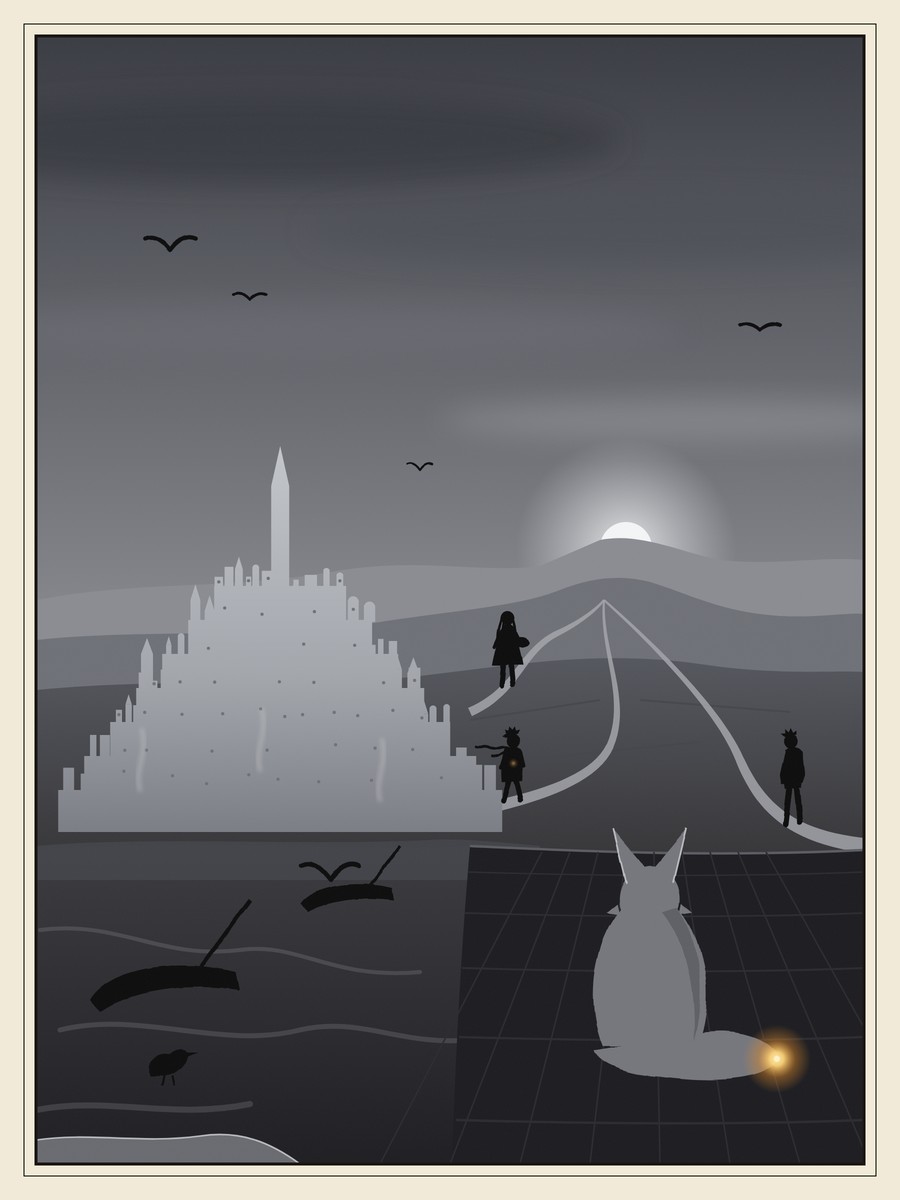
Cinder watched them until they were very small.
Then she stood up, and stretched, and shook herself all over, the way foxes do when they have made up their minds. And she trotted down off the harbour wall and away up the road after them, her nose to the ground and her tail held high behind her.
I should tell you that the spark at the end of her tail was still very small. It was still hardly anything at all; you might have walked right past it. But if you had looked closely, that morning, as she went up the road into the hills, you would have seen that it was just a little brighter than it had been the night before.
Behind her, out on the wide brown mud, where nobody was watching, the tide had turned — the way it always does, very quietly, without any fuss at all — and had begun, a little at a time, to come back in.
Chapter 15 complete
Go to the Hill