Chapter 12 · 15 min read · 20 min listen
Old Ash’s Last Lamp
This is the part of the story that Wren never liked to tell.
She told it in the end, of course, many years afterwards, to people who needed to hear it. But she always told it quickly, and plainly, looking at her hands; and when she had finished she would get up and go and see to the fire, whether it needed seeing to or not. So I shall tell it the way she did, as plainly as I can. You may see to the fire afterwards, if you like.
The great hammer hung over the anvil, and did not fall.
All round the black shaft the other hammers went on rising and falling, slow and steady, and the dark went on rolling up out of the shaft, and the grey smiths went on carrying the new white stones away. Nobody looked up. Nobody but Varrick turned to see the lame old man coming across the floor. And Ash came on, tock, step, tock, until he stood on the other side of the great anvil, and leaned on his poles, and got his breath.
“Old man,” said Varrick. His voice was as smooth as ever. “You ought to be in a cell.”
“Hm. I was,” said Ash. “The company was poor. I left.”
He looked down at the little brass lamp lying dark on the anvil between them. Then he looked up again at the tall grey man, and Wren, up on the gallery, saw his face; and there was nothing in it that she had expected. No anger. No fear. Only a great tiredness, and under the tiredness, something very like love.
“You’ve grown thin, lad,” said Old Ash. “Does nobody feed you, in her service?”
“I want for nothing.”
“No,” said Ash. “I don’t suppose you do. That’s always been the trouble with her bargains. You never want for anything again. You only stop wanting.” He shifted on his poles. “Do you still take three sugars in your tea?”
Something flickered at the corner of Varrick’s mouth, and was gone. “Not in yours. I never did. Nobody could.”
“Hm,” said Ash, and almost smiled. “That’s fair.”
Then he let go of one of his poles — it leaned against the anvil — and held out his empty hand, palm up, across the lamp.
“Show me your hand, lad.”
Varrick did not move.
“You know which one,” said Ash gently. “The right. Take off that glove and show me.”
For a long moment nothing happened. The hammers rose and fell. The dark rolled up out of the shaft. And then, slowly, as if somebody else were doing it, Captain Varrick drew the grey gauntlet off his right hand, and the glove beneath it, and turned his hand over.
The scar lay across the palm, old and white and puckered, from one side to the other.
“I put that there,” said Ash. “Do you remember? I held the oath-flame, and you put your hand over it, and you said the words — freely given, freely given. You didn’t flinch. You were sixteen, and so proud you could hardly stand still.” His voice was very quiet, but the great round chamber carried it, every word. “And the next night I took you up on the wall at Emberwick, and gave you the taper, and let you light your first Ring-lamp on your own. Do you remember that? Your hands were shaking so, I thought you’d drop it over the parapet. And the wick caught, and the lamp went up gold all at once, and you laughed. Out loud. On the wall, at midnight. Half the Watch came running to see what was the matter.” He paused. “I’ve never heard a better sound in my life. Not before or since.”
Varrick was looking at his own palm.
“That boy,” said Ash, “is not dead. I’ve told you before. I never buried him. Pick up the lamp, lad. Not for her. Give it back to the girl, and come home. It isn’t too late. It’s never too late, while you can still hear me.”
Wren held her breath. Up on the gallery, Mira’s fingers were crushing hers; Cinder was pressed against her legs, trembling.
And Varrick hesitated.
It was not a heartbeat this time. It was longer than that — much longer — so long that Wren began to believe, really to believe, that something was going to happen. His left hand had come up and closed over his scarred right palm, and was holding it, hard, the way you hold a burn. His head had bent. He stood there by the anvil, in the cold white light, and for the length of a long slow breath he looked like what he must once have been: a young man on a wall, at midnight, with a taper in his hand.
Ash did not say anything more. He only waited, leaning on his one pole, as if he had all the time in the world, and meant to spend every bit of it here.
Then his face closed.
It closed the way a door closes in a big house, far away down a corridor: quietly, without a slam, but quite finally. He let go of his palm. He did not put the glove back on.
“You talk too much, old man,” he said. “You always did.”
And he struck.
He did it fast, the way a snake does it. His bare hand swept the leaning pole away from the anvil, and the other pole out from under Ash’s arm, and the old man, who had only one good leg and nothing now to stand on, went down. He fell hard against the great anvil, and slid, and caught at the edge of it to save himself.
Wren screamed. She did not know she was going to. She was already running — along the gallery, to where an iron stair went down the wall, and down it, three steps at a time, with Mira behind her clicking and Cinder ahead of them both, a grey streak with a spark for a tail.
And Old Ash, on his knees at the anvil, reached up over the edge of it with one long hand, and his fingers closed on the lamp.
He did not hold it to his chest. He did not hold it up against Varrick, or the hammers, or the dark. He turned on his knees, and he looked for Wren, and he found her — a small dark shape pelting down the iron stair — and he held the lamp out towards her, at the full length of his arm, the way he had once held out a cup of dreadful tea to a frightened chimney-sweep at his table, without asking anything at all.
“Wren,” he said. “Here, child. Here. Take it.”
And the lamp blazed.
I do not know how to tell you how bright it was. Nobody who was there could ever tell it properly either.
It was not like the white light of the glowstones. It did not glare, or dazzle, or make your eyes water. It was gold — deep, warm, living gold — and it filled the Great Forge from wall to wall in one breath, the way the sun fills a room when somebody throws back the curtains. And where it went, colour came back. The white floor was suddenly warm grey stone with veins of rust-red in it. The chains of the hammers were black iron with brown in the links. Mira’s dress was blue. Cinder’s coat was the grey of old ashes, warm and soft, and her tail-spark flared up like a struck match. And Old Ash’s coat, his old patched coat, which even by the lamp had only ever been a tired blue-grey — Ash’s coat was blue. A deep, clear, glad blue, like the sky must have been once, before the curse: Lamplighter blue, as it had been on the day it was new. Wren had not known it could be.
The great hammer over the anvil shuddered on its chain, and stopped.
Then all the hammers stopped, all round the shaft, one after another, high in the air, and hung there.
And the shaft screamed.
You will remember, if you have read the earlier parts of this story, that the Hollows make no sound, except one. Wren had heard it in Soot Lane, and on the Beacon, and in the Deeps. It came now out of the black shaft, out of the rolling dark itself, a long thin shriek that went on and on and set every tooth in her head aching. The dark in the shaft heaved and boiled and drew back from the gold like a hand from a stove.
And all round the walls of the Great Forge, the glowstones began to crack.
They cracked the way ice cracks on a pond in spring — with a sharp, singing crack here, and another there, and then a great many all at once, running across the walls in white lines. And out of every crack came a thread of grey-black cold, curling, loose, like smoke from a snuffed wick. The singing-stone in Wren’s pocket went from a keen to a shriek of its own. The white light of the walls flickered — and dimmed — and went out in patches, so that for the first time since they had come to Vaelport there were shadows, long and black and jumping. And the whole chamber shook.
The grey smiths round the shaft had stopped too. They stood with their tongs hanging from their hands, and in the gold light Wren saw their faces change — not much; only a little; the way a sleeper’s face changes when somebody says his name. One of them, a big woman with a scarf over her hair, put up her hand and touched her own cheek, as though she had felt something there that she had forgotten about.
“Up!” Old Ash’s voice rang across the forge, the way it must once have rung along the wall at Emberwick on a bad night. “Up, all of you! Out! Go up to the air!”
And they went. They dropped their tongs and turned, slowly at first and then faster, stumbling, holding on to one another, and went streaming away into the tunnels towards the surface, a long grey line of them; and here and there among the grey, in the last of the gold, was a face that was not quite so grey as it had been.
Varrick had flung up his bare arm across his eyes. He stood in the gold blaze with his face turned away from it, and he cried out, once, as if the light hurt him. Perhaps it did. For one moment, through the dazzle, Wren saw him look at the old man kneeling by the anvil with the lamp held out — just one look, and she never forgot it.
Then he turned and ran. He ran into the mouth of a tunnel on the far side of the forge, where the glowstones had already gone dark, and the dark took him, and he was gone.
Wren reached Ash.
She did not remember crossing the floor. She only remembered falling on her knees beside him, and his arm coming round her, and the lamp warm and gold between them. Mira was there, clicking frantically, and Cinder was licking Ash’s face.
“Hm,” said Ash. He was breathing hard, but his eyes were bright. “I thought I told you to stay on the quay.”
“You did,” said Wren. “We didn’t.”
A stone fell from the roof, somewhere behind them, as big as a cart, and burst on the floor like a dropped jar.
“Up,” said Ash. “Up, child. My poles.”
They got him to his feet between them. Wren found one pole and Mira found the other, and they put them in his hands. Ash hung the lamp on the brass hook at the end of the right-hand pole, the way he had carried lamps along the wall at Emberwick all his life, and lifted it high, and swung himself forward; and they went across the forge floor as fast as he could go, which was not very fast at all.
Behind them the black shaft was pouring out its dark. It came up over the rim in a great slow wave and spread across the floor after them like a tide coming in over mud-flats, cold and grey and silent. Wherever it touched the gold of the lamp it shrank back; but there was so much of it, and it kept coming. The roof was falling now in earnest — not all at once, but in pieces, here and there, so that the whole chamber was full of the noise of it and of dust.
Wren could not see for the dust. Nobody could. “Shut your eyes,” said Mira, “and hold his coat,” and shut her own, and clicked, and led them — round a fallen hammer-chain lying across the floor like a dead snake, past a split anvil, between two stones that came down in the time it took to say so. Ash went between the girls, swinging on his poles, with the lamp swaying gold on its hook above their heads. He did not hurry, because he could not. He breathed like a bellows with a hole in it.
“I’ve walked the wall,” he said, between breaths, “in worse weather than this.”
“You have not,” said Wren.
“Hm,” said Ash. “No. Perhaps not.”
“The door,” said Mira. “There’s a door ahead. I can hear the draught under it. Iron. And glass.”
It stood in the wall at the top of three low steps: a great forge-door of iron bars with thick glass set between them, and beyond it a tunnel going steeply up. Ash had come in that way. It was the way out.
They went through it. Mira first, then Wren, then Cinder; and Ash last of all, slow, on his poles.
He turned in the doorway, and looked back once at the Great Forge, at the dark rolling towards him across the floor. He lifted the lamp off its hook. Then he let his poles fall, and took hold of the great door with his free hand, and swung it shut behind him; and leaned his back against it.
The dark struck the other side.
Wren felt it through the stone floor. The door jumped in its frame. Frost came racing across the glass in white feathers, and the iron bars groaned. Ash set his feet — his good one and his bad one — and leaned back, and held it.
“Ash,” said Wren. “Ash, come on—“
“Go with them, girl,” said Ash, to Cinder. Cinder was pressed against his legs, and would not move. “Go on.” And at something in his voice, she went — three steps up the tunnel, and turned, and stood there shivering, with her tail-spark gone small.
“Off you go, then,” said Ash, to the two girls. “Mind the step.”
“No,” said Wren. “No. Not without you. We’ll carry you. Mira — help me — we can carry him, he’s all bones, we can—“
The door jumped again. A crack ran across the glass behind his head.
Old Ash held out the lamp to her. Wren would not take it; she put her hands behind her back, as if that could make him come. So he reached out and took her hands, gently, and put the lamp into them, and folded her fingers round it, and held them there a moment with his own, which were very warm. He looked at her. His face, in the gold light, was not frightened at all.
“It was never mine,” he said. “It’s never been anyone’s. Give it.”
Then he let go of her hands, and set his back square against the forge-door, and lifted his head.
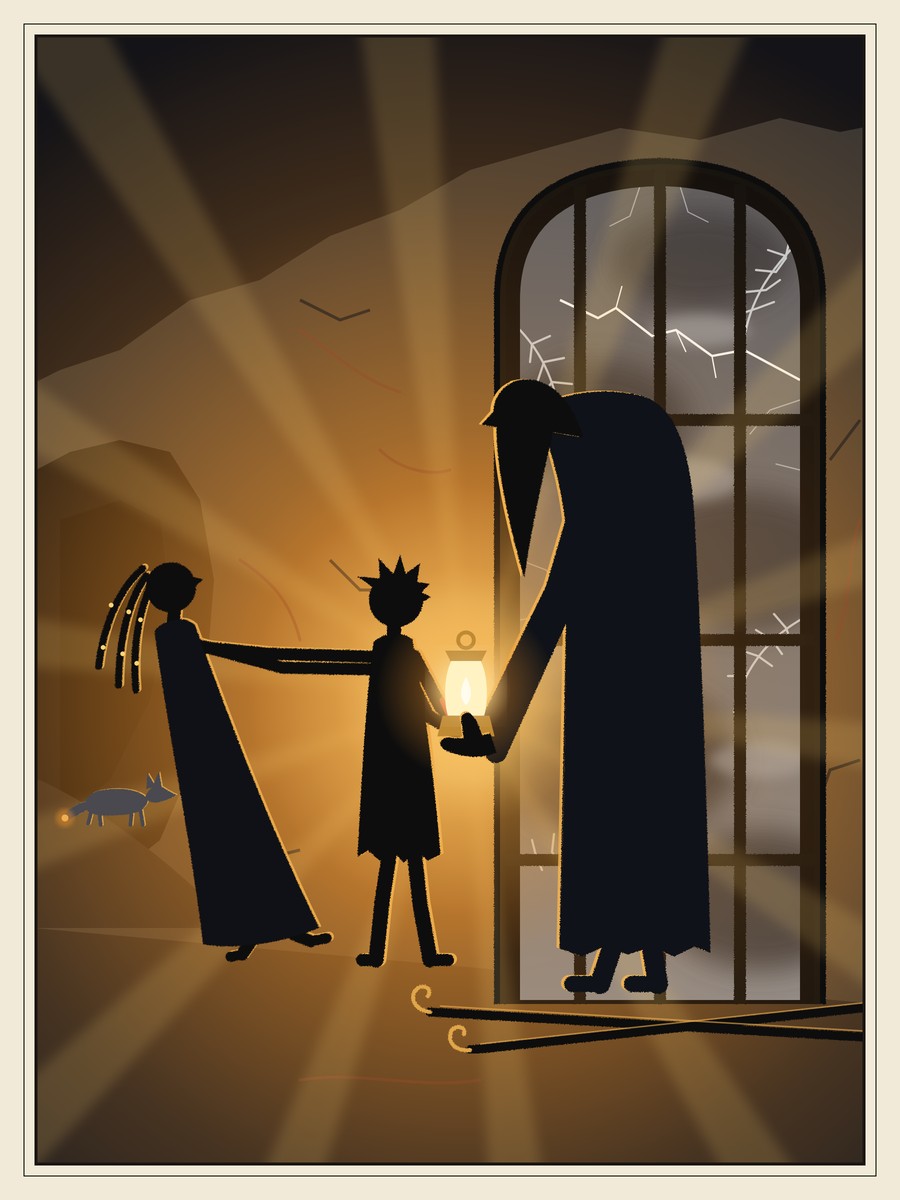
Mira took hold of Wren’s arm and pulled.
Wren did not remember running. She remembered the tunnel going up, steep and rough, and Mira’s hand on her arm like iron, and Cinder ahead, and the lamp blazing in her own two fists so that the walls jumped gold. She remembered looking back, once.
He was standing with his back to the door. The lamp was gone from him, and the light was going with it, up the tunnel; so that what she saw last was only an old man in a blue coat, very tall, at the bottom of a dark slope, with his head up. And for a moment — only a moment, and she never knew afterwards how she knew it — she was sure that he was not alone down there. As if someone had come to stand beside him.
“ASH!” screamed Wren.
The roof of the tunnel came down between them.
There was a long roar, and then a rumble, and then a rattle of small stones, going on and on and getting smaller. The dust came up the tunnel in a great soft rush and covered them, and they could not see, and could not breathe, and crouched against the wall with their arms over their heads.
Then the stones stopped.
There was dust, settling. That was all. Where the bottom of the tunnel had been, there was a wall of fallen rock, from floor to roof, and no way through it, and no sound behind it.
No sound at all.
Wren knelt on the stones in the dust with the lamp in her hands, and stared at the fallen rock, and did not move, and did not speak, and did not cry. She could not have told you what she was waiting for. Mira knelt beside her, with her eyes wide open and tears making two clean lines down the dust on her face, and her hand still holding on to Wren’s sleeve.
Cinder went down the slope, slowly, to the place where the rocks were. She sniffed along the bottom of them, all the way from one wall to the other, and back again. Then she sat down in front of them, very straight, with her small grey face turned up.
And she howled — once — a long, high, broken sound that went up and up the dark tunnel, and away through all the cracked and darkening mines of Vaelport, and did not come back.
Chapter 12 complete
Old Ash’s Last Lamp