Chapter 11 · 16 min read · 21 min listen
Into the Glowstone Mines
The town gaol of Vaelport was the cleanest prison in Gloamhaven. It had white walls and a white floor and white bars, and a glowstone in every corridor, so that the prisoners could never once, by day or night, get away from the light. Most of them had stopped trying. They sat in their cells with their hands in their laps and looked at nothing, and gave the gaoler no trouble at all.
The prisoner in the end cell was different. He sat on his bench with his bad leg stretched out in front of him, and his long hands folded on his knee, and he hummed. He hummed it out of tune, because there was nobody to mind. Now and then he said “Hm” to the wall, as if the wall had said something foolish.
The gaoler, who was young and tired and had a cold, had been told that the old man was mad. He was beginning to think it was catching.
That evening, as the tide turned, the gaoler sat at his table at the end of the corridor with his supper in front of him — a heel of bread, a slab of cheese, and one round sugared biscuit, which he was saving — and his chair tipped back against the wall, and his great iron ring of keys hanging from his belt on a leather thong. And because it was warm in the guardroom, and he had been on duty since dawn, and the white light never changed, his chin went down, and down, until it rested on his chest.
Something small and grey came in under the door.
It came in flat, like a draught. It crossed the white floor without a sound. It stopped by the table, and sat up, and looked at the gaoler’s supper with great seriousness; and the spark at the end of its tail, which had been very small and dim for days, glowed a little brighter.
Cinder, I am afraid, had her priorities. She took the biscuit first.
She ate it in three bites under the table, and licked up the crumbs, and sneezed once, very quietly, at the glowstone in the corridor, which she disliked on principle. Then she turned her attention to the keys.
The ring hung from the gaoler’s belt by its thong, just out of reach. Cinder stood on her hind legs, and put her front paws delicately on the gaoler’s knee, and began to chew.
The gaoler snored. Cinder chewed. The gaoler stirred, and muttered, “Not now, Mother, I’ve done the step,” and Cinder froze with the thong between her teeth and her ears flat, and the gaoler sank down again; and the thong parted; and the great ring of keys slid off the belt and into Cinder’s jaws with a clank that would have woken anybody who was not very tired indeed.
She dragged it down the corridor, clink, clank, clink, though it was nearly as big as she was. In the cells along the way, grey faces turned slowly to watch her go by, and turned slowly back again.
At the end cell, Old Ash was waiting at the bars.
“Hm,” he said. “You took your time.”
Cinder pushed the keys through the bars with her nose and sat down, very pleased with herself, and sneezed a small shower of sparks onto his boots.
It took Ash some while to find the right key, because there were forty of them. When he had found it, and let himself out, and fetched his two poles from the rack in the guardroom where they had been leaning, he stopped beside the sleeping gaoler. He looked at the empty plate. He looked at Cinder, who looked back at him with no shame whatever.
He took a crust out of his own coat pocket, and laid it where the biscuit had been. Then he hung the ring of keys carefully on the back of the gaoler’s chair, so that the lad would not be blamed for losing them.
“Come along, girl,” he said. “Something’s wrong. I can feel it in my leg.” He leaned on his poles and listened, with his head up, the way Cinder listened. “Something’s gone cold that oughtn’t to be.”
Wren and Mira were on the harbour front, by the fish-market, where the gulls stood about on the bollards looking for somebody to blame.
They had been everywhere looking for Tobin: the upturned boat, the end of the fish-quay, up and down Lantern Steps twice. They had left Pim sitting by the Pellows’ fire with a blanket round her, staring at it, and Mrs Pellow kneeling beside her holding a cup of milk that Pim did not drink.
And all that time the singing-stone in Wren’s pocket had been humming.
It had begun very softly, in Tobin’s empty room. It had grown louder ever since. Now it was a low, steady, trembling note that Wren could feel through the cloth of her coat, against her leg, like a cat purring — only there was nothing friendly in it at all. It was the sound it had made on the Greywaste when the Hollow courier came. It was the sound of cold, let loose.
“I don’t understand,” Wren kept saying. “I don’t understand.”
She had said it so many times that the words had worn smooth. Mira had stopped answering. She only held on to Wren’s sleeve, and listened.
Then Mira lifted her head and said, “Oh. Wren. Two sticks, and a step, and two sticks. And something small with claws.”
Wren turned round.
Old Ash was coming along the harbour front towards them, slow on his two poles, with Cinder trotting at his heel; and the white light lay on his patched coat and his singed beard and made him look very old and very thin. Wren had not seen him since the market square. She had not known how much she wanted to until that moment. She ran at him, and very nearly knocked him over, and held on to his coat with both fists.
“Steady,” said Ash. “Steady, child. One good leg, remember.” But he let go of one pole and put his hand on her hair.
“How did you get out?”
“Cinder had a word with the gaoler.” He looked down at her. “Where’s the lamp, Wren?”
Wren let go of his coat.
She told him. She told it badly, all out of order — the drawer, and the empty handkerchief, and Mrs Pellow saying so happily that Tobin had come by to see how she was getting on, and how he’d gone up to fetch a book, and gone off without his coat. The inn. The bed. She took the compass out of her pocket and held it out to him, and her hand was shaking.
“He wouldn’t,” she said. “Would he? Not Tobin. He’s — he’s Tobin. He wouldn’t.”
Ash took the compass. He opened the lid and looked at it. The needle swung, and settled: north and a bit east. He looked at it for a long time.
And Wren, watching his face, saw something happen to it that she had never seen before.
She had expected him to be angry. She had seen Ash angry; it was like weather coming over a hill. But it was not anger. It was something much quieter, and much worse. It was the face of a man who has been told of a death. Just for a moment, all the lines in it went down at once.
“Oh, lad,” said Old Ash, very low. “Oh, my poor lad.”
Then he shut the compass, and gave it back to her, and his face was his own again — stern and tired and sure.
“Varrick,” he said. “It’ll have been Varrick. He’ll have offered the boy his father.” He drew a long breath. “Hm. And he’ll not drown it, or break it. That’s not her way. She’ll want it made into one of hers.” He looked past them, along the harbour front, to where the long white sheds of the Glowstone Company stood by the water, with their chimneys that gave no smoke. “Down there. Under the city. The Forge.”
“Then we’ll go and get it,” said Wren.
“I’ll go and get it,” said Ash. “You’ll stay here.”
“Rot!”
“You’ll stay here,” said Ash, “with Mira, and you’ll look for Tobin. Somebody must. He’ll need finding tonight more than any of us.” He looked at her, and his eyes under their white brows were very steady. “Don’t hate him yet, child. You’ll want all your strength for other things.”
And before Wren could think of an answer, he had turned on his two poles and was going away along the white quay, slow and lame, towards the sheds; and Cinder went with him.
Wren stood and watched him go.
“Well?” said Mira, after a moment.
“Well what?”
“Well, are we staying here, as we were told?” said Mira. “Or are we following him at a sensible distance, as you were going to suggest?”
Wren looked at her. Then she took the singing-stone out of her pocket. It was humming so hard now that it buzzed in her palm like a trapped bee.
“I wasn’t going to suggest anything,” she said. “Come on.”
They went in at shift-change, the way Tobin and Ash had gone in before them days ago, through a side-gate in the yard of the Company’s works, among the long silent line of miners going down.
Nobody stopped them. Nobody so much as looked at them. The miners walked in a slow grey file, men and women both, with their tools on their shoulders and their eyes on the back of the person in front, and they did not speak, and they did not hurry. Wren had seen people like that before: sitting on doorsteps in Soot Lane, the night the Ring failed, with the colour gone out of them. But these people were walking. These people had jobs. That was somehow the most horrible thing of all.
The tunnel went down. And the further down it went, the brighter it grew.
At first there were glowstones set in the walls here and there, like lamps along a street. Then there were more of them. Then the walls were glowstone — raw, uncut, great white veins of it running through the rock — and the light came at Wren from every side at once, from above and below and behind, so that there were no shadows anywhere and no edges to anything. The floor was white and the walls were white and the roof was white, and they all ran together, so that she could not tell where one stopped and the next began.
Her eyes began to water. She screwed them up. It made no difference. She put her hand up to shade them, and the light came round the sides of it.
Then she walked into a wall.
She did not see it coming. One moment there was white in front of her, and the next there was white against her nose, very hard, and she sat down.
“Blast,” said Wren, holding her nose.
“There is a wall there,” said Mira helpfully.
“I know there’s a wall there, I’ve just met it.” Wren got up, and blinked, and tried to look round. It was no good. Everything was white. It was worse than the dark, where at least you know that you cannot see. Her eyes kept telling her that she could see, and then showing her nothing. Somewhere ahead she could hear Ash’s poles, tock, tock, going away from them, and the shuffling feet of the miners, and the stone humming in her pocket. She could not tell which way any of it was.
“Mira,” she said, and her voice came out small. “I can’t. I can’t see anything. It’s too bright. I can’t see a thing.”
“No,” said Mira. “I don’t suppose you can.”
She had stopped beside Wren. And Wren, squinting at her through her streaming eyes, saw that Mira was standing quite easily, with her head up and her face calm, and that her eyes were shut.
“Give me your hand,” said Mira.
“What are you doing? You’ll walk us both into—“
“I don’t need it to be dark, Wren,” said Mira. “I only need to not look.”
She clicked her tongue — tk-tk — and listened, and turned her head a little to the left, and clicked again. And Wren remembered, all in a rush, the Deeps: the Whispering Galleries, black as the inside of a boot, and Mira walking ahead of them all with her eyes open on nothing, finding the way by echoes. Mira had lived her whole life in the dark. She had only had her eyes for a few weeks. She had not forgotten how to do without them.
Wren held out her hand. Mira took it.
“Now shut yours,” said Mira. “It will be easier. You won’t keep trying to believe them.”
Wren shut her eyes. The white went red and then dim behind her lids, and it was such a relief that she nearly cried.
They went on.
It was the strangest walk of Wren’s life, and she had walked through some strange places. Mira went first, clicking softly, and Wren came behind with her eyes shut, holding Mira’s hand, the way Tobin had held Mira’s sleeve in the dark on the way to Deepholm. Every now and then Mira said, “Step down,” or “Duck,” or “There’s a miner coming; stand still,” and Wren did as she was told. Once a grey shoulder brushed past her, cold as a gravestone, and went on without a pause. Once the tunnel forked, and Mira stood clicking for a long moment, and then said, “Left. That way is longer, and it goes down. And the poles went this way.”
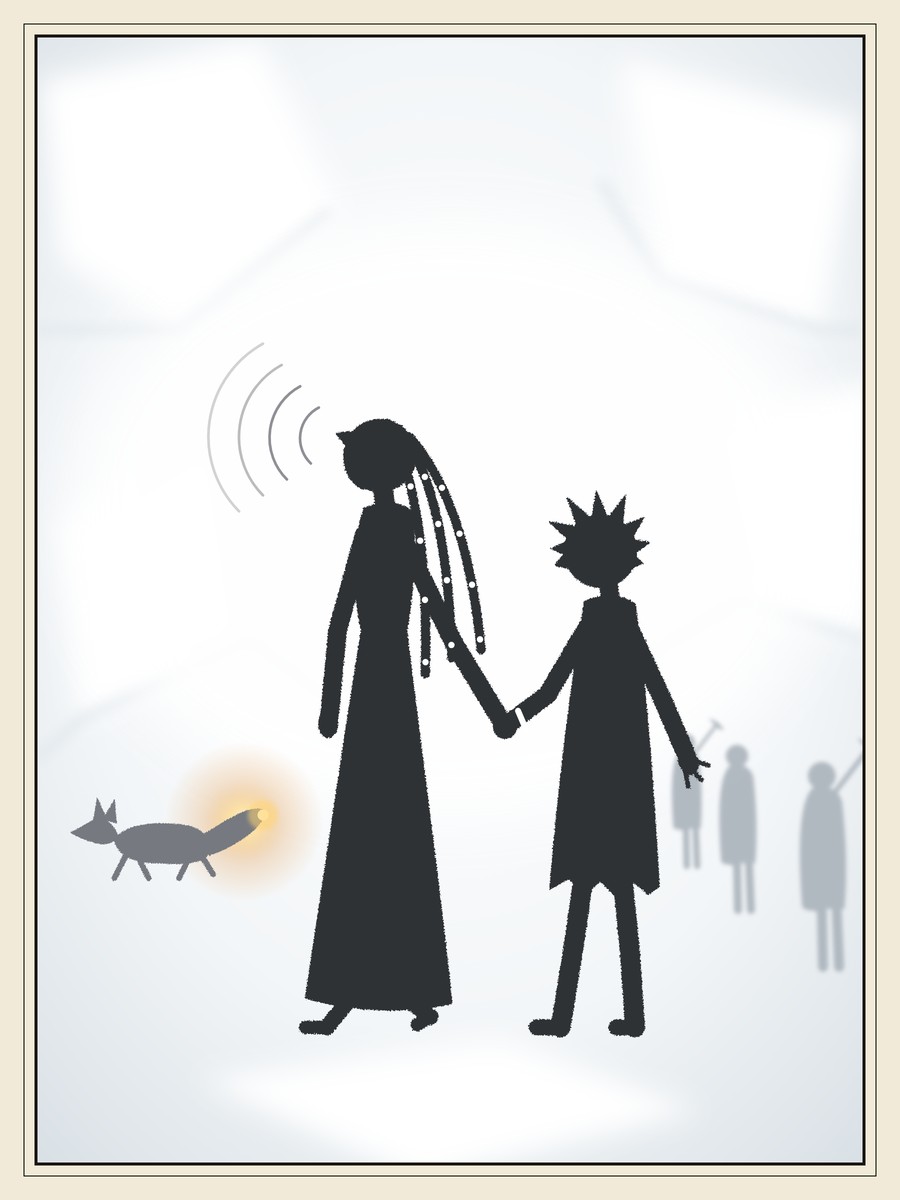
“You can hear that?”
“I can hear his poles,” said Mira, “and I can hear your stone. They’re going the same way.”
The singing-stone was humming louder now. It hummed so loud that Wren’s whole pocket shook with it. And the air was changing. It had been cold before, the flat dead cold of Vaelport’s light; but now there was another cold coming up from below to meet them, and Wren knew that one. She had met it in Soot Lane, and on the Greywaste, and in the Galleries of the Deeps. It was a cold that was not just the absence of warmth. It was a cold that wanted something.
Cinder came trotting back to them out of the white, sneezing furiously at every glowstone she passed, and pushed her nose into Wren’s hand, and trotted on again.
“She says hurry,” said Mira.
“She does not.”
“She does. Listen to her feet.”
They hurried.
“If you walk me into a wall,” said Wren, through her teeth, stumbling, “I’ll never speak to you again.”
“You walked yourself into three before I started,” said Mira. “I think I am allowed one.”
And despite everything — despite the drawer, and the empty handkerchief, and Tobin’s bed not slept in, and the cold coming up from below — Wren very nearly laughed. It stuck in her chest and never quite got out. But I tell you this because it is worth knowing: even in the worst places, a friend can make you very nearly laugh. It is not nothing. Sometimes it is a great deal.
The tunnel ended quite suddenly.
Mira stopped. Wren bumped into her. Mira clicked once, and then again, and then she let out a long, slow breath, and held Wren’s hand very tight.
“It’s very big,” she whispered. “It’s the biggest place I’ve ever heard. Bigger than the Great Echo-Hall. And there’s a — a sound in the middle. Going up. Like wind in a chimney, only cold. Wren, you can open your eyes. It’s not so bright here. Not in the middle.”
Wren opened her eyes.
They were standing on a narrow iron gallery, high up on the wall of an enormous round chamber. The walls all round were glowstone, white and blazing, as bright as the tunnels had been. But the middle of the chamber was not bright. The middle of the chamber was the darkest thing Wren had ever seen.
It was a shaft. A great round black shaft in the floor, as wide as a mill-pond; and up out of it, slowly, endlessly, came the dark. It came up like smoke from a chimney, thick and cold and grey-black, rolling and folding over on itself, and the cold of it reached Wren even up on the gallery, so that her breath smoked and her fingers went numb on the rail. It made no sound of its own. But all round the rim of the shaft stood the hammers.
They were huge — pale as bone, each as big as a cart, hung on great chains from the roof — and they rose and fell, slow and steady as a heartbeat, on the dark that rolled onto the anvils round the rim. Each time they rose, something small and white and shining lay where the dark had been, and a grey figure stepped forward and carried it away.
“That’s it,” Wren whispered. “What Tobin saw.”
The singing-stone in her pocket was not humming any more. It was keening, high and thin, like a kettle.
Out on the forge floor, between the black shaft and the gallery, stood one anvil bigger than all the rest, with one hammer hanging over it bigger than all the rest; and beside it stood a tall man in grey armour and a grey cloak.
Wren could not see his face from so high. She did not need to. She knew the set of his shoulders. She had seen it on the top of the Great Beacon in Emberwick, and at the edge of the market square, half in shadow, rubbing his palm.
Captain Varrick held something small in his grey gauntlet. He looked at it a moment. Then he set it down on the great anvil, carefully, almost gently, the way you set down a cup.
It was a little battered brass lamp with a cracked chimney. And it was dark.
Wren made a sound. She did not know she had made it. Mira’s hand closed on hers like a trap.
High over the anvil, the great pale hammer had stopped at the top of its swing, and hung there, waiting.
And then, from the far side of the forge floor, out of the mouth of a low tunnel, came a sound that Wren would have known anywhere in the world.
Tock. A step. Tock.
Old Ash came out into the light. He was alone. He was very lame. He leaned on his two poles, and set them down, and swung himself forward on them, and set them down again; and he came out across the wide white floor of the Great Forge, between the falling hammers, towards the tall grey man at the anvil, slowly, without stopping, the way he had walked the wall at Emberwick every night for thirty years to light the lamps that nobody else would light.
Varrick turned round and saw him coming.
And Old Ash, very tall and very thin and very old, lifted his head and spoke one word across the forge; and it carried, the way the Galleries had carried words in the Deeps, all the way up to the gallery where the two girls stood.
“Lad,” he said.
Chapter 11 complete
Into the Glowstone Mines